💡 Direct Answer & Executive Summary (ABO Pediatric Blood Type Inheritance Solver)
Definition: Determine possible and impossible pediatric offspring ABO blood groups, genotype probabilities, and materno-fetal neonatal incompatibility risks from maternal and paternal phenotypes.
Governing Math Formula: Mendelian Codominant Cross: Alleles I^A and I^B are codominant, while allele i (Type O) is recessive. Child genotypes are determined by the 2×2 parental allele segregation Punnett square.
Target Applications: Provides real-time quantitative solutions in Biology for students, engineers, researchers, and finance professionals.
ABO Pediatric Blood Type Inheritance Solver: Genetics, Punnett Ratios & Clinical Guide
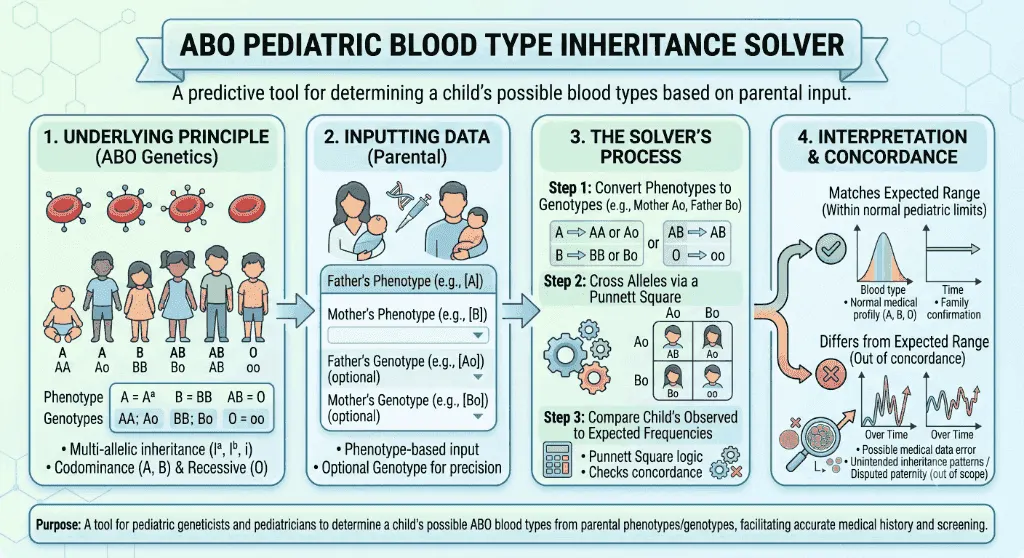
1. Introduction
When a newborn enters the world, one of the earliest laboratory tests performed on umbilical cord blood is the determination of the infant's ABO and Rh blood group. For prospective parents, discovering that two Type A parents can produce a Type O baby—or that a Type A mother and Type B father can have a child of any of the four major blood groups—often feels like a genetic paradox.
Beyond parental curiosity, pediatric blood group genetics plays a vital life-saving role in modern medicine. In labor and delivery suites, materno-fetal ABO incompatibility can trigger neonatal hemolytic jaundice within 24 hours of birth. In pediatric emergency rooms and pediatric oncology units, knowing exact blood group compatibility ensures safe emergency transfusions and bone marrow transplantation.
How are ABO blood types passed from parents to children? How do codominant and recessive alleles interact in a Punnett square?
The answer lies in the Mendelian Multi-Allelic Inheritance Model of the human gene.
flowchart LR
PARENTS["👨👩👦 Parental Input
Mother Phenotype (A, B, AB, O)
Father Phenotype (A, B, AB, O)"] --> GENO["🧬 Genotype Allele Mapping
Convert to Alleles: I^A, I^B, i"]
GENO --> PUNNETT["🔲 2×2 Punnett Square Cross
Calculate Offspring Genotype Probabilities"]
PUNNETT --> CLINIC["🏥 Clinical & Pediatric Evaluation
Possible Blood Types & Neonatal Jaundice Risk"]2. Definitions
2.1 Simple Everyday Definition
The ABO Pediatric Blood Type Inheritance Solver is a genetic calculator that predicts the possible and impossible blood types a child can inherit based on the blood types of their biological mother and father.
2.2 Formal Technical Definition
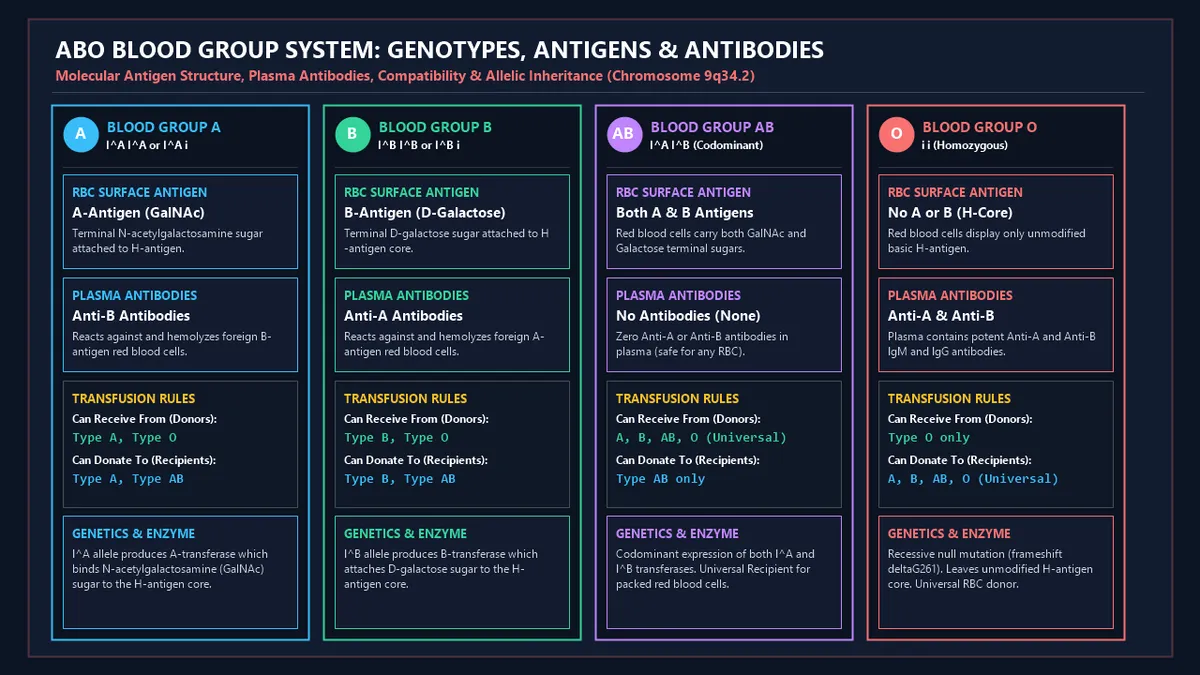
Human ABO blood groups are governed by a single polymorphic gene locus () located on the long arm of Chromosome 9 ($9q34.2$). The locus exhibits multiple allelism and Mendelian codominance featuring three primary alleles: 1. : Encodes , producing A-antigen. 2. : Encodes , producing B-antigen. 3. (or ): Contains a single-base deletion () causing a frameshift that produces a non-functional enzyme, leaving the precursor H-antigen unmodified (Type O).
The relationship between the alleles follows strict rules:
- and are codominant with respect to each other (both expressed equally in heterozygous genotype , producing Type AB).
- Both and are completely dominant over the recessive allele.
2.3 Vivid Real-World Analogies
The Cellular Nametag & Uniform:
Think of red blood cells as students wearing school badges. The gene attaches a blue badge (A-antigen), the gene attaches a yellow badge (B-antigen), and the genotype wears both badges simultaneously (Type AB). The recessive allele does not add any badge, leaving a blank shirt (Type O).
The Lock-and-Key Biochemical Factory:
Imagine a biological assembly line where workers attach specialized sugar charms to red cell membrane proteins. Team A attaches GalNAc charms, Team B attaches Galactose charms, and Type O workers have no charms to attach.
3. History & Scientific Milestones
The discovery of human blood groups earned Karl Landsteiner the Nobel Prize and laid the groundwork for modern immunology.
timeline
    title Milestones in Blood Group Genetics & Transfusion
    1900 : Karl Landsteiner : Discovers A, B, and O blood groups via agglutination assays
    1902 : DeCastello & Sturli : Discover the fourth rare blood group (Type AB)
    1910 : von Dungern & Hirszfeld : Prove ABO blood types follow Mendelian inheritance
    1924 : Felix Bernstein : Deciphers the 3-allele multiple allelism model (I^A, I^B, i)
    1952 : Y.M. Bhende : Discovers the rare Bombay Phenotype (hh epistasis)
1990 : Fumiichiro Yamamoto : Clones the ABO gene cDNA and identifies molecular mutations- Karl Landsteiner (1900): Austrian physician who mixed red blood cells and sera from his laboratory colleagues, observing distinct agglutination (clumping) patterns that revealed the A, B, and C (later renamed O) blood groups, earning the 1930 Nobel Prize in Physiology or Medicine.
- Emil von Dungern & Ludwik Hirszfeld (1910): Demonstrated through extensive family pedigrees that blood groups are inherited according to classical Mendelian laws.
- Felix Bernstein (1924): Mathematically proved that the ABO system is governed by three alleles at a single genetic locus, disproving earlier flawed two-locus hypotheses.
- Fumiichiro Yamamoto et al. (1990): Sequenced the gene, showing that the A and B transferase enzymes differ by only 4 critical amino acid substitutions (Arg176Gly, Gly235Ser, Leu266Met, Gly268Ala) across 354 residues, while allele is caused by a single critical deletion at nucleotide position .
4. Core Concepts & Theoretical Principles
graph TD
    subgraph ABO_Genotypes["6 Genetic Combinations (Genotypes)"]
        G_AA["I^A I^A (Homozygous)"] --> P_A["Type A Phenotype
A Antigens | Anti-B in Plasma"]
        G_AO["I^A i (Heterozygous)"] --> P_A
        G_BB["I^B I^B (Homozygous)"] --> P_B["Type B Phenotype
B Antigens | Anti-A in Plasma"]
        G_BO["I^B i (Heterozygous)"] --> P_B
        G_AB["I^A I^B (Codominant)"] --> P_AB["Type AB Phenotype
Both A & B Antigens | No Antibodies"]
        G_OO["i i (Homozygous Recessive)"] --> P_O["Type O Phenotype
No Antigens | Anti-A & Anti-B in Plasma"]
    end
4.1 The 4 Phenotypes vs. 6 Genotypes
Because alleles and are dominant over , an individual with Blood Type A or B may possess one of two distinct underlying genotypes:
- Blood Type A: Can be either Homozygous () or Heterozygous ().
- Blood Type B: Can be either Homozygous () or Heterozygous ().
- Blood Type AB: Exclusively Heterozygous Codominant ().
- Blood Type O: Exclusively Homozygous Recessive ($i i$).
4.2 Naturally Occurring Antibodies (Isohemagglutinins)
Unlike other immune responses that require prior pathogen exposure, humans naturally produce IgM and IgG antibodies against the ABO antigens absent from their own red blood cells by 6 months of age, stimulated by gut microbial flora:
- Type A Individuals: Produce Anti-B antibodies.
- Type B Individuals: Produce Anti-A antibodies.
- Type AB Individuals: Produce Neither anti-A nor anti-B (Universal Red Cell Recipient).
- Type O Individuals: Produce Both Anti-A and Anti-B (Universal Red Cell Donor).
5. Formulas & Mathematical Derivations
5.1 The Mendelian Punnett Cross Model
To determine the probability of each pediatric blood group, parent phenotypes are expanded into their possible gamete allele frequencies ():
Father Gametes
                   I^A (50%)      i (50%)
                 +-------------+-------------+
        I^B (50%)|   I^A I^B   |    I^B i    |
  Mother         |  (Type AB)  |  (Type B)   |
  Gametes        +-------------+-------------+
          i (50%)|    I^A i    |     i i     |
                 |  (Type A)   |  (Type O)   |
                 +-------------+-------------+
5.2 Variable Reference Table
| Parameter | Symbol | Genetic Value | Molecular Role |
|---|---|---|---|
| A-Allele | Dominant | Synthesizes GalNAc transferase; adds A-antigen to RBCs | |
| B-Allele | Dominant | Synthesizes Galactosyltransferase; adds B-antigen to RBCs | |
| O-Allele | (or ) | Recessive | Non-functional enzyme; leaves unmodified H-antigen core |
| Maternal Genotype | Determines maternal gamete pool | ||
| Paternal Genotype | Determines paternal gamete pool | ||
| Child Phenotype | Expressed blood group of the offspring |
6. Step-by-Step Computational Walkthrough
Let us evaluate the pediatric inheritance probabilities for a couple where the Mother is Blood Type A (heterozygous ) and the Father is Blood Type B (heterozygous ):
flowchart TD
    STEP1["Step 1: Identify Parental Gametes
Mother Gametes: 50% I^A, 50% i
Father Gametes: 50% I^B, 50% i"] --> STEP2["Step 2: Construct 2×2 Punnett Square
Cross: (0.5 I^A + 0.5 i) × (0.5 I^B + 0.5 i)"]
    STEP2 --> STEP3["Step 3: Calculate Genotype Probabilities
25% I^A I^B | 25% I^A i | 25% I^B i | 25% i i"]
    STEP3 --> STEP4["Step 4: Map to Child Phenotypes
Type AB: 25% | Type A: 25% | Type B: 25% | Type O: 25%"]
    STEP4 --> STEP5["Step 5: Pediatric Clinical Interpretation
All 4 blood groups are possible (Zero exclusions)"]- Step 1: Determine Parental Gametes:- Mother (): Produces and ova.- Father (): Produces and sperm.
- Step 2: Calculate 4 Offspring Genotypic Combinations:----
- Step 3: Convert Genotypes to Clinical Phenotypes:- Type AB: 25%- Type A: 25%- Type B: 25%- Type O: 25%
- Step 4: Outcome:- This cross provides equal $1:1:1:1$ odds for every major human blood group!
7. Visual Explanations & Molecular Antigens
graph TD
    PRECURSOR["Lipid / Protein Membrane Core"] -->|"FUT1 Gene (Fucosyltransferase)"| H_ANTIGEN["Substance H (L-Fucose core)
(Present in all normal RBCs)"]
    H_ANTIGEN -->|"I^A Allele (GalNAc Transferase)"| A_ANTIGEN["A-Antigen (N-Acetylgalactosamine)
Blood Group A"]
    H_ANTIGEN -->|"I^B Allele (Galactosyltransferase)"| B_ANTIGEN["B-Antigen (D-Galactose)
Blood Group B"]
    H_ANTIGEN -->|"i Allele (Non-functional)"| O_ANTIGEN["Unmodified H-Antigen
Blood Group O"]
8. Complete Parental Blood Type Inheritance Matrix
The following comprehensive cross matrix summarizes all possible and impossible blood types for offspring based on parental phenotypes (assuming standard heterozygous carriers where applicable):
| Mother's Blood Type | Father's Blood Type | Possible Child Blood Types | Genetically Excluded Child Blood Types |
|---|---|---|---|
| O | O | O (100%) | A, B, AB |
| O | A | A, O | B, AB |
| O | B | B, O | A, AB |
| O | AB | A, B | O, AB |
| A | A | A, O | B, AB |
| A | B | A, B, AB, O (All 4 possible) | None |
| A | AB | A, B, AB | O |
| B | B | B, O | A, AB |
| B | AB | A, B, AB | O |
| AB | AB | A, B, AB | O |
9. Practical Real-World Applications
Example 1: Materno-Fetal ABO Incompatibility in Obstetrics
A Type O mother gives birth to a Type A infant.
- The Immunology: Type O individuals naturally possess IgG-class Anti-A,B antibodies in their plasma. Unlike large IgM pentamers, monomeric IgG crosses the placenta during the third trimester.
- Clinical Presentation: The newborn develops neonatal jaundice at 36 hours of life due to mild erythrocyte hemolysis.
- Management: Phototherapy using blue-green light () isomerizes unconjugated bilirubin into water-soluble lumirubin for biliary excretion.
Example 2: Forensic Paternity Exclusion
In a legal custody dispute, a Type AB mother and a Type AB alleged father have a child with Type O blood.
- Mendelian Rule: Parents with Type AB blood cannot pass an allele ().
- Conclusion: The alleged father is genetically excluded from biological paternity (or non-maternity/sample mix-up has occurred).
Example 3: Emergency Pediatric Transfusion (Universal Donor Selection)
A 4-year-old trauma victim with massive blood loss arrives at the emergency department before cross-matching is complete.
- Selection: The pediatric trauma team transfuses O-Negative uncrossed Packed Red Blood Cells (PRBCs) because Type O RBCs lack A, B, and RhD surface antigens, preventing acute intravascular hemolytic transfusion reactions.
10. In-Depth Case Studies
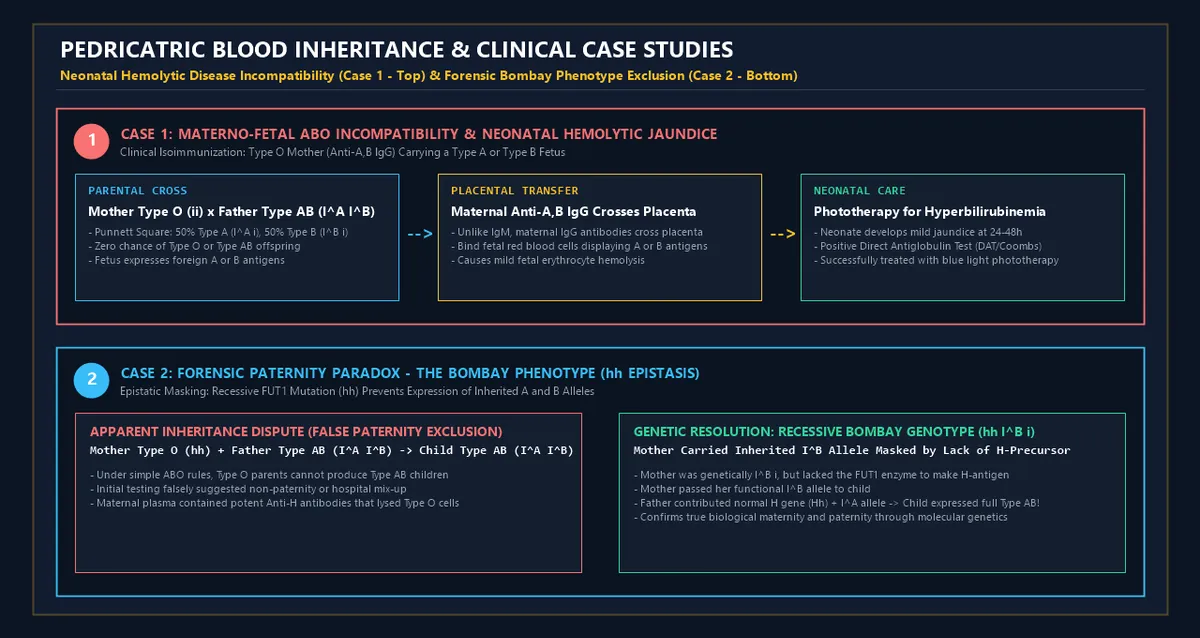
Case Study 1: Materno-Fetal ABO Incompatibility & Neonatal Hemolytic Jaundice
- Clinical History: A 28-year-old primigravida mother with Blood Type O positive () delivers a full-term boy. The biological father is Blood Type AB positive ().
- Inheritance Mapping:- Punnett Cross: .- The infant tests as Blood Type A positive.
- Pathophysiology: Maternal IgG Anti-A antibodies crossed the placenta during late pregnancy, binding fetal A-antigens on red blood cells.
- Outcome: The infant's total serum bilirubin peaks at at 40 hours. Under continuous intensive blue-light phototherapy, bilirubin levels decline to safe physiological ranges within 48 hours without requiring exchange transfusion.
Case Study 2: Forensic Paternity Paradox — The Rare Bombay Phenotype ( Epistasis)
- Clinical Scenario: A child is born with Blood Type AB (). The biological mother has confirmed Blood Type O, and the father is Blood Type AB.
- The Paradox: Standard ABO genetics dictates that a Type O mother () cannot produce a Type AB child, prompting allegations of hospital baby-switching.
- Molecular Investigation: Further serological and genetic testing revealed that the mother possessed the rare Bombay Phenotype ( genotype):- She possessed a normal inherited allele, but carried homozygous null mutations in the gene (), failing to synthesize the essential H-antigen precursor.- Without H-antigen, her A/B transferase enzymes had no substrate to modify, making her red blood cells appear serologically as Type O.- When she passed her active allele to her child, the child inherited a functional gene () from the father, fully expressing the inherited Type AB blood group!
- Conclusion: Molecular genetic testing resolved the paradox, confirming authentic biological maternity and paternity.
11. Advantages of Pediatric Blood Type Prediction
- Prenatal Risk Stratification: Preemptively alerts obstetricians to high-risk materno-fetal ABO and RhD incompatibilities before delivery.
- Pediatric Medical History Documentation: Provides immediate validation during newborn screening and pediatric wellness examinations.
- Safe Emergency Preparedness: Helps families know compatible donor profiles for rare blood groups and elective surgical procedures.
- Educational Clarification: Eliminates common misconceptions regarding non-identical parental and child blood types.
12. Genetic Complexities & Clinical Nuances
- The Rhesus () Factor System: Controlled by a separate gene locus ( on Chromosome 1). is dominant over . Rh-negative mothers carrying Rh-positive fetuses require Rho(D) Immune Globulin (RhoGAM) prophylaxis at 28 weeks gestation to prevent life-threatening Rh isoimmunization (erythroblastosis fetalis).
- Cis-AB Inheritance: An exceedingly rare mutation where both and glycosyltransferase activities reside on a single structural chromosome (). A Cis-AB individual paired with a Type O partner can produce Type AB or Type O offspring.
- Subgroups of A ( vs. ): transferase is highly efficient (80% of Type A individuals), while produces fewer antigen sites (20%), occasionally developing weak anti- cold antibodies.
13. Common Mistakes to Avoid
1. Assuming a Child Must Have the Exact Same Blood Type as a Parent:
A Type A parent and Type B parent can produce a Type O or Type AB child. Offspring inherit one allele from each parent, creating novel genotype combinations.
2. Confusing Phenotype with Genotype:
A parent with Blood Type A is not necessarily homozygous (). Heterozygous carriers () carry the recessive O allele, allowing Type O children to be born to Type A and Type B couples.
3. Using ABO Blood Grouping Alone for Legal Paternity Testing:
While ABO blood grouping can definitively exclude paternity in certain crosses, it cannot prove paternity. Modern forensic paternity verification requires high-resolution Short Tandem Repeat (STR) DNA multiplexing ( discriminatory power).
12. Frequently Asked Questions (FAQ)
Can two Type A parents have a Type O child?
Yes! If both parents are heterozygous carriers of the recessive O allele (), there is a 25% probability ( chance) of having a Type O () child.
Can two Type O parents have a Type A, B, or AB child?
No. Standard Type O parents possess only recessive alleles (). They can only pass alleles, resulting exclusively in 100% Type O children (except in extremely rare Bombay phenotype cases).
Can a Type AB parent have a Type O child?
Under standard Mendelian inheritance, no. A Type AB parent will always contribute either an or an allele to their offspring, ensuring the child is at least Type A, Type B, or Type AB.
What is the most common blood type in the world?
Globally, Blood Type O positive () is the most common blood group (found in of the world population), followed by Type A positive () (). Type AB negative () is the rarest ().
What causes neonatal jaundice from ABO incompatibility?
When a Type O mother carries a Type A or Type B fetus, maternal IgG anti-A or anti-B antibodies cross the placenta and destroy fetal red blood cells. The resulting heme breakdown produces elevated bilirubin levels that cause temporary jaundice.
What is the difference between ABO and Rh factor?
The ABO system refers to the presence of A and B carbohydrate antigens on red blood cells (Chromosome 9). The Rh factor refers to the presence or absence of the separate RhD protein antigen (Chromosome 1).
What is the Universal Red Blood Cell Donor blood type?
Type O-Negative () is the universal red blood cell donor because its red cells lack A, B, and RhD antigens, making them safe for emergency transfusion into any recipient.
15. Expert Tips for Geneticists, Pediatricians & Parents
- Evaluate Cord Blood Direct Antiglobulin Test (DAT): For Type O mothers delivering Type A or B infants, perform a cord blood DAT (Coombs test) to monitor for subclinical maternal antibody coating.
- Differentiate IgM vs. IgG Antibodies: Remember that naturally occurring isohemagglutinins are predominantly IgM (cannot cross placenta), but Type O individuals uniquely produce high-titer IgG Anti-A,B that freely crosses the placenta.
- Account for Heterozygosity in Pedigree Analysis: Never assume homozygous genotypes when calculating clinical risk unless validated by molecular DNA sequencing.
16. Summary Checklist
- ✔ Identify Mother's Blood Type: Record ABO phenotype and RhD status.
- ✔ Identify Father's Blood Type: Record ABO phenotype and RhD status.
- ✔ Map Parental Alleles: Identify potential homozygous and heterozygous gamete pools.
- ✔ Execute Punnett Cross: Calculate percentage probabilities for Types A, B, AB, and O.
- ✔ Check Exclusions: List genetically impossible blood groups for clinical verification.
- ✔ Assess Incompatibility Risk: Check for Type O maternal / Type A or B fetal configurations.
Additional Technical Guidelines & Measurement Standards
When conducting calculations for ABO Pediatric Blood Type Inheritance Solver, maintaining quantitative precision and verifying input parameter boundaries is essential for reliable scenario evaluation. Always verify that raw numerical inputs are measured using standardized instrumentation, and double-check unit conversions prior to applying outputs in commercial, industrial, or academic projects.
For quantitative unit conversions and scientific calculations, always maintain at least four decimal places of precision during intermediate arithmetic stages before rounding final results. When preparing technical reports, laboratory documentation, or financial forecasts, cross-verify all output variables against established international measurement standards (such as SI, NIST, and ISO metric benchmarks) to guarantee consistent analytical rigor across all computational workflows.
MathsLover.com delivers this interactive solver 100% free of charge to foster global mathematical literacy, educational accessibility, and data-driven problem solving across scientific, technical, and academic communities worldwide.