💡 Direct Answer & Executive Summary (Simple Loan Interest Calculator)
Definition: Calculate total interest, total repayment, and monthly installment breakdown for simple fixed-rate loans.
Governing Math Formula: Interest = Principal × Rate × Time. Total Payment = Principal + Interest. Monthly Payment = Total Payment / (Years × 12).
Target Applications: Provides real-time quantitative solutions in Finance for students, engineers, researchers, and finance professionals.
Simple Loan Interest Calculator
1. Introduction
In the global economy, capital is the engine that drives personal dreams and business ventures. Whether you are purchasing a car, funding a college education, or launching a startup, few people have the entire lump sum of cash ready upfront. This is where loans play a vital role. However, borrowing money is never free; it comes at a cost known as interest.
The Simple Loan Interest Calculator is an essential educational tool designed to help borrowers quickly evaluate the cost of borrowing. Unlike complex compound interest structures, simple interest remains stable and predictable, making it a common method for short-term personal loans, car financing, and basic savings accounts.
Understanding how interest accumulates allows you to make smart financial decisions, compare loan offers side-by-side, and structure your monthly budget with absolute precision. This guide covers everything from basic definitions and historical origins to step-by-step math breakdowns and practical case studies.
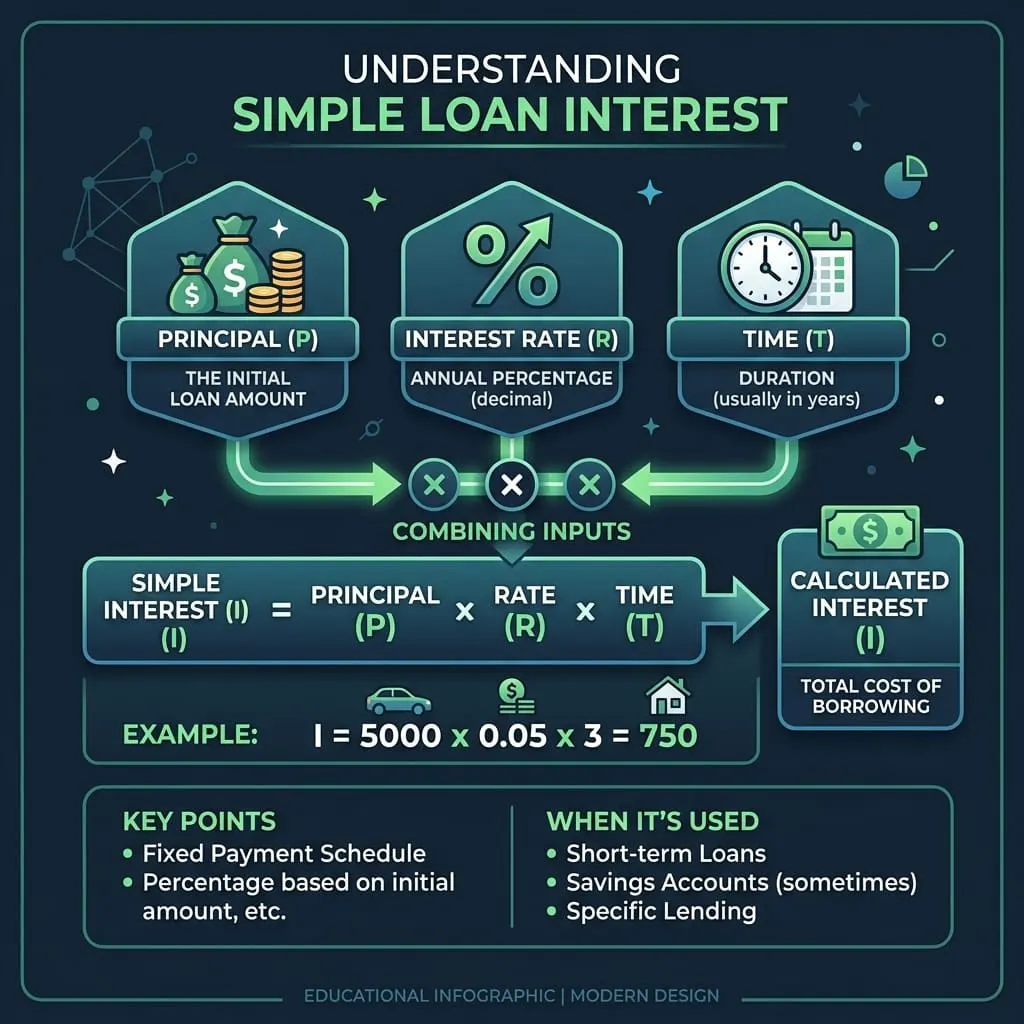
graph TD
    A["Principal (P)"] --> B["Interest Rate (R)"]
    B --> C["Loan Term (T)"]
    C --> D["Compute: P * R * T"]
    D --> E["Results: Total Interest & Monthly Installments"]
2. Core Definitions & Analogy
To build a solid financial foundation, let us define simple loan interest in both simple and technical terms:
- Simple Definition: Simple interest is the fee you pay to borrow money, calculated only on the original amount you borrowed (the principal), without any interest compounding over time.
- Technical Definition: Simple interest is a linear financial function where the interest accrued (I) is directly proportional to the principal balance (P), the periodic interest rate (R), and the number of periods elapsed (T). It is represented mathematically as I = P R T.
- Conceptual Analogy: Think of borrowing money like renting a house. The principal is the house itself, and the interest is the monthly rent you pay to the landlord. No matter how long you live there, the rent remains a flat fee based on the size of the house, not on the rent accumulated from previous months.
3. History & Milestones
The concept of charging interest on borrowed resources is thousands of years old and paved the way for modern global banking:
- Ancient Mesopotamia (c. 3000 BC): The earliest recorded loans involved seeds, grains, and livestock. Farmers borrowed a basket of seeds and paid back the basket plus an extra portion (interest) representing the natural growth of the crop.
- Code of Hammurabi (c. 1750 BC): One of the oldest written law codes in human history, it established strict legal limits on interest rates (typically capped at 33% for grain loans and 20% for silver loans) to prevent predatory lending.
- The Middle Ages & Usury Laws: For centuries, religious and state laws prohibited charging any interest, classifying it as "usury." However, the expansion of trade during the Renaissance created a demand for commercial capital, leading to the legalization of simple interest.
- The Bank of England (1694): The establishment of national central banks standardized simple and compound interest rates, forming the framework of the modern commercial credit system.
4. Core Concepts & Parameters
To evaluate a simple loan, we look at three fundamental parameters:
- Loan Principal Amount (P): The original sum of money borrowed from the lender. This is the baseline figure upon which interest is calculated.
- Annual Interest Rate (R): The percentage charged by the lender per year for borrowing the principal. It is converted to a decimal inside formulas (e.g., 5% becomes 0.05).
- Loan Term (T): The duration of the loan, measured in years. If the term is given in months, it must be divided by 12 to convert it to years for annual formulas.
5. The Mathematical Model & Formula
The calculations for simple interest, total repayment, and monthly installments are determined by three core formulas:
1. Accrued Interest Formula
Interest (I) = Principal (P) * Rate (R) * Term (T)
2. Total Payment Formula
Total Payment (A) = Principal (P) + Interest (I)
3. Monthly Installment Formula
Monthly Payment (M) = Total Payment (A) / (Term in Years * 12)
Variable Breakdown:
- I: Total simple interest accrued (USD)
- P: Loan principal amount (USD)
- R: Annual interest rate (decimal form)
- T: Loan term (Years)
- A: Total repayment amount (USD)
- M: Fixed monthly installment (USD)
6. Step-by-Step Manual Procedure
Calculating simple interest by hand is straightforward. Let us walk through the process step-by-step:
- Identify the variables: Suppose you borrow $10,000 (P) at an annual rate of 5% (R = 0.05) for a term of 3 years (T = 3).
- Calculate total interest: Multiply Principal, Rate, and Time together.
Interest = 10,000 * 0.05 * 3 = 1,500The total interest paid over the term is $1,500. - Calculate total payment: Add the interest to the original principal.
Total Payment = 10,000 + 1,500 = 11,500The total amount to repay is $11,500. - Calculate the monthly payment: Divide the total payment by the total number of months (3 years * 12 months/year = 36 months).
Monthly Payment = 11,500 / 36 = 319.44Your fixed monthly payment will be $319.44.
7. Visual Diagram
The diagram below maps the inputs and computational steps for simple loans:
graph TD
    Start["Get P, R, T"] --> ConvertRate["Convert R % to Decimal: R / 100"]
    ConvertRate --> CalcInterest["Compute Interest: I = P * R * T"]
    CalcInterest --> CalcTotal["Compute Total Repayment: A = P + I"]
    CalcTotal --> CalcMonthly["Compute Monthly Installment: M = A / T * 12"]
    CalcMonthly --> ShowResults["Output: Interest, Total, Monthly"]
8. Parameter Comparison Matrix
The table below shows how varying the interest rate and term affects a $10,000 loan:
| Principal (P) | Annual Rate (R) | Term (T) | Total Interest Paid | Total Repayment | Monthly Installment |
|---|---|---|---|---|---|
| $10,000 | 3% | 3 Years | $900.00 | $10,900.00 | $302.78 |
| $10,000 (Default) | 5% | 3 Years | $1,500.00 | $11,500.00 | $319.44 |
| $10,000 | 8% | 3 Years | $2,400.00 | $12,400.00 | $344.44 |
| $10,000 | 5% | 5 Years | $2,500.00 | $12,500.00 | $208.33 |
| $10,000 | 8% | 5 Years | $4,000.00 | $14,000.00 | $233.33 |
9. Real-World Applications
Simple interest is utilized across many daily and commercial lending platforms:
- Short-Term Personal Loans: Many banks and online lenders use simple interest for consumer loans, keeping terms transparent and easy to track.
- Auto Financing: The majority of car loans are structured as simple interest loans, where interest accrues daily based on the outstanding principal balance.
- Certificates of Deposit (CDs): Many basic fixed-term savings accounts pay simple interest on the deposited principal.
- Promotional Credit Cards: "No interest if paid in full within 6 months" retail loans often compute deferred simple interest.
10. Case Studies
Case Study 1: Buying a Used Car
A commuter needs a loan of $8,000 to purchase a reliable used vehicle. The dealership offers a 3-year simple interest loan at a rate of 6% annually.
- Calculation: Principal = $8,000, Rate = 0.06, Term = 3.
- Interest Accrued: 8,000 0.06 3 = 1,440.
- Total Cost: 8,000 + 1,440 = 9,440.
- Monthly Payment: 9,440 / 36 = 262.22.By evaluating these metrics, the commuter ensures the monthly commitment fits within their budget.
Case Study 2: Short-Term Business Bridge Loan
A boutique owner borrows $15,000 as a 1-year bridge loan at 8% simple interest to purchase holiday inventory.
- Interest Accrued: 15,000 0.08 1 = 1,200.
- Total Repayment: $16,200.Knowing the exact cost of capital helps the owner price retail items to guarantee profitability.
11. Advantages of Using the Tool
- Financial Clarity: Instantly breaks down monthly budgets with no hidden fees.
- Side-by-Side Comparison: Helps users quickly evaluate different interest rate offers.
- Zero Complex Calculations: Automates decimal conversions and calendar day fractions.
12. Limitations & Boundary Conditions
Simple interest does not account for amortization shifts where early payments reduce principal faster, nor does it compute compound growth (interest on interest). It is strictly modeled on a fixed, static principal balance.
13. Common Mistakes
- Entering Monthly Rate Instead of Annual: Always enter the annual interest rate (APR) as required by the industry standard.
- Mixing Up Term Units: Entering months instead of years in the term field will yield massive overestimations. Always convert months to years by dividing by 12.
12. Frequently Asked Questions
Q1: What is simple loan interest?
Simple interest is the fee charged on a loan calculated solely as a percentage of the original principal amount.
Q2: What is the formula for simple interest?
The formula is I = P * R * T, where P is principal, R is annual interest rate, and T is term in years.
Q3: How is simple interest different from compound interest?
Simple interest is calculated only on the original principal, whereas compound interest is calculated on the principal plus all interest accumulated from previous periods.
Q4: Are most car loans simple interest?
Yes, most auto loans use a simple interest formula, with interest accruing daily based on the remaining principal.
Q5: How do you convert a 6-month term into years?
Divide 6 by 12, which equals 0.5 years.
Q6: Does paying off a simple interest loan early save money?
Yes, because interest accumulates daily on the outstanding principal. Paying it off early reduces the time factor, saving you interest.
Q7: What does "principal" mean?
Principal is the original sum of money borrowed or invested, before any interest is added.
Q8: What does APR stand for?
Annual Percentage Rate, representing the yearly cost of borrowing funds, including interest and basic fees.
Q9: Can simple interest rates change?
No, simple interest loans typically feature a fixed interest rate that remains constant throughout the loan term.
Q10: Why do lenders prefer simple interest for short terms?
It is easy to calculate, transparent for customers, and provides stable, predictable returns.
15. Expert Tips
- Make bi-weekly payments: If your lender allows it, paying half your monthly bill every two weeks reduces outstanding principal faster, cutting overall interest costs.
- Read the prepayment clause: Verify that your loan has no prepayment penalties, so you can pay it off early and save on interest.
16. Summary
- Simple interest is calculated exclusively on the original principal:
I = P * R * T.
- Total repayment is the principal plus the total accrued interest:
A = P + I.
- Monthly payments are determined by dividing total repayment by the term months.
- Paying off principal early reduces the total interest paid.
Additional Technical Guidelines & Measurement Standards
When conducting calculations for Simple Loan Interest Calculator, maintaining quantitative precision and verifying input parameter boundaries is essential for reliable scenario evaluation. Always verify that raw numerical inputs are measured using standardized instrumentation, and double-check unit conversions prior to applying outputs in commercial, industrial, or academic projects.
For quantitative unit conversions and scientific calculations, always maintain at least four decimal places of precision during intermediate arithmetic stages before rounding final results. When preparing technical reports, laboratory documentation, or financial forecasts, cross-verify all output variables against established international measurement standards (such as SI, NIST, and ISO metric benchmarks) to guarantee consistent analytical rigor across all computational workflows.
MathsLover.com delivers this interactive solver 100% free of charge to foster global mathematical literacy, educational accessibility, and data-driven problem solving across scientific, technical, and academic communities worldwide.