💡 Direct Answer & Executive Summary (Body Mass Index (BMI) & Category Calculator)
Definition: Calculate body mass index (BMI), BMI prime, and healthy body weight ranges based on WHO clinical standards.
Governing Math Formula: BMI = Weight (kg) / [ Height (m) ]².
Target Applications: Provides real-time quantitative solutions in Health & Fitness for students, engineers, researchers, and finance professionals.
Body Mass Index (BMI) & Category Calculator
1. Introduction
Maintaining a healthy body weight is one of the most critical aspects of long-term wellness and disease prevention. To assess whether an individual's weight is in a healthy proportion to their height, healthcare professionals, fitness coaches, and researchers worldwide use a standardized metric called the Body Mass Index (BMI).
BMI is a simple, non-invasive calculation that classifies individuals into different weight categories, such as underweight, normal weight, overweight, and obese.
The Body Mass Index (BMI) & Category Calculator is an educational tool designed to compute this score and estimate where your weight falls according to the World Health Organization (WHO) clinical classifications.
2. Core Definitions & Analogy
To understand how body mass metrics work, let us define the key concepts:
- Simple Definition: BMI is a score that compares your weight to your height, giving you a general idea of whether you are carrying too much or too little body mass for your frame size.
- Technical Definition: Body Mass Index (BMI) is a biometric value defined as an individual's body mass (weight) divided by the square of their height. It is expressed in units of kilograms per square meter (kg/m²). It acts as a surrogate measure of body fatness because it correlates well with direct measures of body fat.
- Conceptual Analogy: Imagine you are building a tower of blocks. If the tower is very tall (high height) but you only use a few blocks (low weight), the tower is thin and unstable (underweight). If the tower is very short but you pile up a massive stack of blocks, the tower is excessively wide and heavy for its height (obese). BMI is simply a measurement of this balance—how much structural weight is distributed along the height of the tower.
3. The Formulas & Calculations
BMI can be calculated using either metric units (kilograms and meters) or imperial units (pounds and inches).
The Metric Formula
The metric formula is the global standard: BMI = Weight (kg) / Height (m)^2
The Imperial Formula
For countries using the imperial system, a conversion scaling factor of 703 is introduced: BMI = Weight (lbs) / Height (in)^2 * 703
Step-by-Step Example Calculation (Metric)
Let us calculate the BMI of an individual who weighs 70 kilograms and is 1.75 meters (175 cm) tall:
- Step 1: Square the height
- 1.75 * 1.75 = 3.0625 m^2
- Step 2: Divide weight by squared height
- BMI = 70 / 3.0625 = 22.857
- Result: The individual's BMI is approximately 22.86 kg/m^2, which falls into the "Normal Weight" category.
Step-by-Step Example Calculation (Imperial)
Let us calculate the BMI of an individual who weighs 154 pounds and is 5 feet 9 inches (69 inches) tall:
- Step 1: Square the height in inches
- 69 * 69 = 4,761 in^2
- Step 2: Divide weight by squared height and multiply by 703
- BMI = (154 / 4,761) 703 ≈ 0.032346 703 ≈ 22.74
- Result: The individual's BMI is approximately 22.74 kg/m^2, which is also within the healthy range.
4. WHO Weight Classifications
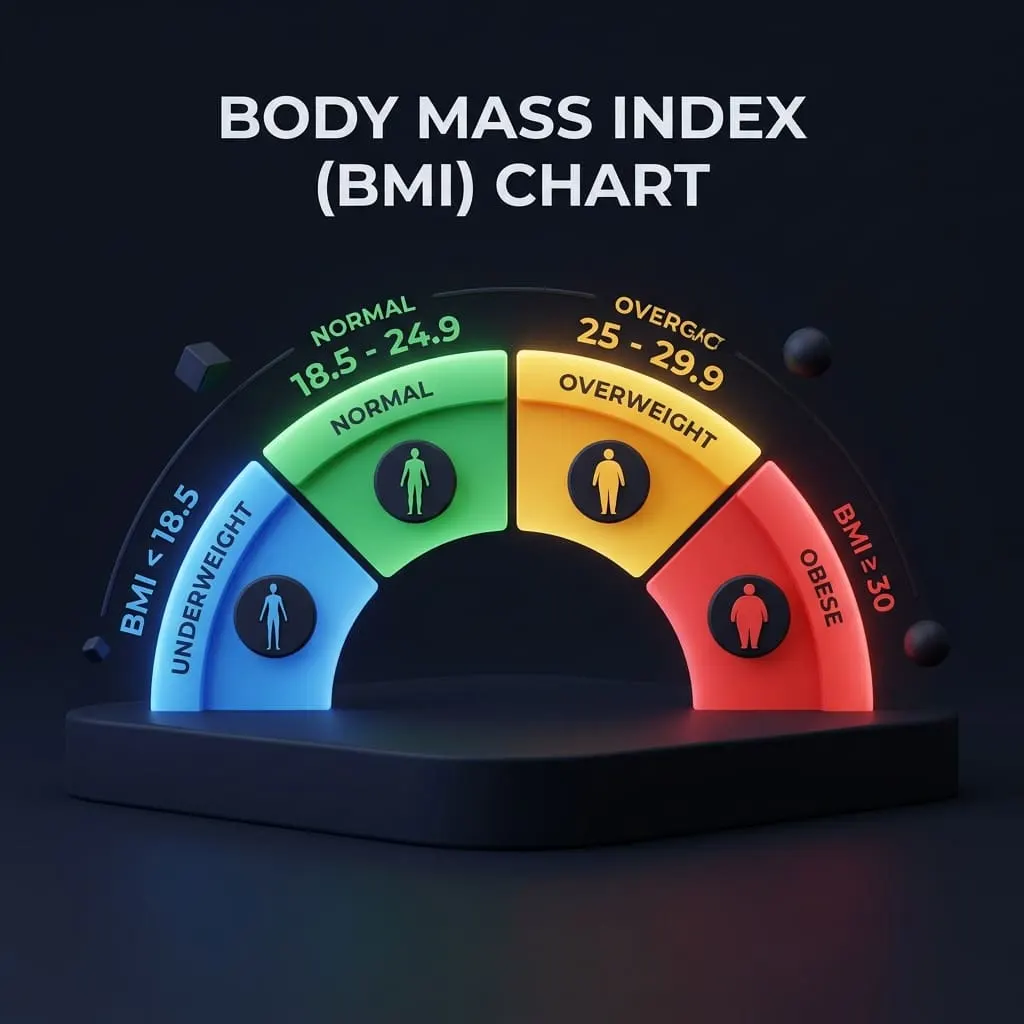
The World Health Organization (WHO) divides BMI scores into standard categories to assess health risk levels:
- BMI under 18.5: Underweight. This indicates potential nutritional deficiencies, immune system vulnerability, or underlying health issues.
- BMI 18.5 to 24.9: Normal Weight. This range is associated with the lowest risk of cardiovascular disease, type 2 diabetes, and other chronic weight-related conditions.
- BMI 25.0 to 29.9: Overweight. This indicates an increased accumulation of body mass, which can place extra strain on joints and the cardiovascular system.
- BMI 30.0 and above: Obese. This category is further divided into classes (Class I: 30-34.9, Class II: 35-39.9, and Class III: 40+) indicating progressive levels of metabolic and cardiovascular risk.
5. Clinical Limits & Better Health Indicators
While BMI is a useful screening tool, it has significant limitations because it does not distinguish between muscle mass, bone density, water weight, and fat tissue:
- The Athlete Paradox: A highly muscular athlete or bodybuilder may have very low body fat but rank as "overweight" or "obese" under the BMI formula because muscle tissue is much denser than fat.
- The Elderly: Older adults may lose muscle mass and bone density over time. A senior with a "normal" BMI might still carry excess visceral fat around organs, which is a condition known as "normal-weight obesity" or "skinny fat."
- Waist Circumference: To complement BMI, clinicians often measure waist circumference. A waist size over 40 inches (102 cm) for men and 35 inches (88 cm) for women indicates abdominal adiposity, which is a strong risk factor for metabolic syndrome.
6. Reference Table of Healthy Weights for Heights
Here is a list of healthy weight ranges (based on a healthy BMI range of 18.5 to 24.9) for various heights:
- Height 150 cm (4'11") rightarrow Healthy weight: 41.6 kg to 56.0 kg
- Height 155 cm (5'1") rightarrow Healthy weight: 44.4 kg to 59.8 kg
- Height 160 cm (5'3") rightarrow Healthy weight: 47.4 kg to 63.7 kg
- Height 165 cm (5'5") rightarrow Healthy weight: 50.4 kg to 67.8 kg
- Height 170 cm (5'7") rightarrow Healthy weight: 53.5 kg to 72.0 kg
- Height 175 cm (5'9") rightarrow Healthy weight: 56.7 kg to 76.3 kg
- Height 180 cm (5'11") rightarrow Healthy weight: 59.9 kg to 80.7 kg
- Height 185 cm (6'1") rightarrow Healthy weight: 63.3 kg to 85.2 kg
- Height 190 cm (6'3") rightarrow Healthy weight: 66.8 kg to 89.9 kg
7. Frequently Asked Questions (FAQ)
- Is BMI accurate for children?Standard adult BMI categories do not apply to children. For children and teens, doctors use BMI-for-age percentiles to account for rapid growth and gender-specific developmental variations.
- What is BMI Prime?BMI Prime is a ratio of your actual BMI to the upper limit of the healthy range (25.0). A BMI Prime of 1.0 indicates you are exactly at the top of the normal weight range.
- Can you have a normal BMI but be unhealthy?Yes. Factors like cardiovascular fitness, cholesterol levels, blood pressure, and blood sugar are critical markers of overall health that BMI cannot measure.
- How can I lower my BMI score?To lower your BMI score, you should focus on a combination of regular physical activity (both strength training and cardiovascular exercise) and a balanced, calorie-controlled diet.
Additional Technical Guidelines & Measurement Standards
When conducting calculations for Body Mass Index (BMI) & Category Calculator, maintaining quantitative precision and verifying input parameter boundaries is essential for reliable scenario evaluation. Always verify that raw numerical inputs are measured using standardized instrumentation, and double-check unit conversions prior to applying outputs in commercial, industrial, or academic projects.
For quantitative unit conversions and scientific calculations, always maintain at least four decimal places of precision during intermediate arithmetic stages before rounding final results. When preparing technical reports, laboratory documentation, or financial forecasts, cross-verify all output variables against established international measurement standards (such as SI, NIST, and ISO metric benchmarks) to guarantee consistent analytical rigor across all computational workflows.
MathsLover.com delivers this interactive solver 100% free of charge to foster global mathematical literacy, educational accessibility, and data-driven problem solving across scientific, technical, and academic communities worldwide.