💡 Direct Answer & Executive Summary (DNA to mRNA Transcription Translator)
Definition: Transcribe DNA nucleotide sequences into complementary messenger RNA (mRNA), compute GC-content percentages, split into codon reading frames, and translate into amino acid peptide sequences according to the universal genetic code.
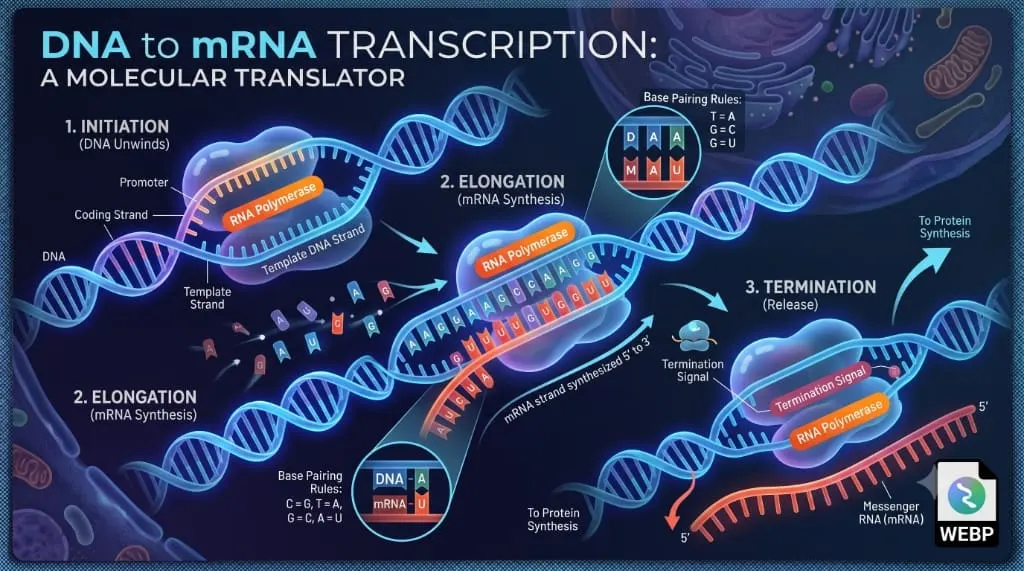
Governing Math Formula: DNA Template (3'→5') transcribes to mRNA (5'→3') via complementary base pairing: A→U, T→A, C→G, G→C. GC% = ((G + C) ÷ Total Bases) × 100. Translation: Triplet mRNA codons map to 20 standard amino acids.
Target Applications: Provides real-time quantitative solutions in Biology for students, engineers, researchers, and finance professionals.
DNA to mRNA Transcription Translator: Central Dogma & Genetic Code Guide
1. Introduction
In molecular biology, the Central Dogma—first articulated by Francis Crick in 1958—describes the fundamental two-step flow of genetic information inside biological systems:
- Transcription: Inside the eukaryotic nucleus, the enzyme RNA Polymerase II reads a 3' to 5' DNA template strand, synthesizing a complementary single-stranded 5' to 3' pre-messenger RNA transcript.
- Translation: In the cytoplasm, the ribosome decodes triplet nucleotide codons on the mRNA transcript into a linear polymer chain of amino acids to fold into a functional biological protein.
graph LR
    DNA_IN["🧬 DNA Sequence (Template 3'->5')
e.g. TAC-GCT-TTT-ACT"] --> TRANSCRIBE_ENG["⚙️ RNA Polymerase II Transcription
A -> U | T -> A | C -> G | G -> C"]
    TRANSCRIBE_ENG --> MRNA_OUT["📄 mRNA Transcript (5'->3'):
AUG-CGA-AAA-UGA"]
    MRNA_OUT --> TRANSLATE_ENG["🔬 Ribosomal Translation Engine
Codon Triad Radix Mapping"]
    TRANSLATE_ENG --> PEPTIDE_OUT["🧪 Polypeptide Protein:
Met - Arg - Lys - [STOP]"]
Mastering DNA transcription and translation enables bioinformaticians, geneticists, and biotechnology researchers to:
- Convert DNA sequencing reads into accurate RNA transcript models.
- Determine the correct open reading frame (ORF) and identify premature termination (nonsense) mutations.
- Calculate GC content percentage, which dictates DNA melting temperature () for PCR primer design.
- Map silent (synonymous), missense, and frameshift genetic mutations.
2. Definitions & Biochemical Rules
2.1 The Watson-Crick Base-Pairing Rules
| DNA Template Base | Transcribed mRNA Base | Hydrogen Bonds | Base Classification |
|---|---|---|---|
| Adenine (A) | Uracil (U) | Purine Pyrimidine | |
| Thymine (T) | Adenine (A) | Pyrimidine Purine | |
| Cytosine (C) | Guanine (G) | Pyrimidine Purine | |
| Guanine (G) | Cytosine (C) | Purine Pyrimidine |
Thymine vs. Uracil: DNA uses Thymine (5-methyluracil) because the methyl group provides resistance against oxidative photochemical decay. RNA uses Uracil (demethylated) because it is energetically less costly for rapid cell turnover.
2.2 Template Strand vs. Coding Strand Orientation
DNA is an antiparallel double helix:
- Template / Non-Coding / Antisense Strand (): Read directly by RNA Polymerase II.
- Coding / Sense / Non-Template Strand (): Exactly matches the synthesized mRNA sequence, except every is replaced by .
2.3 Mathematical Formulations
1. GC Content Percentage Formula
2. Open Reading Frame & Codon Count
3. Approximate Molecular Mass of mRNA Transcript
flowchart TD
    START["Input DNA Sequence & Strand Type (Template vs Coding)"] --> SANITIZE["Sanitize & Uppercase Sequence (A, T, C, G)"]
    SANITIZE --> EVAL_STRAND{"Strand Selection"}
    EVAL_STRAND -->|"Template (3'->5')"| COMPLEMENT["Transcribe Complementary Base Pairing:
A->U, T->A, C->G, G->C"]
    EVAL_STRAND -->|"Coding (5'->3')"| REPLACE_T["Direct Copy with T replaced by U"]
    COMPLEMENT --> SPLIT_CODONS["Split mRNA into 3-Base Codon Triads"]
    REPLACE_T --> SPLIT_CODONS
    SPLIT_CODONS --> GC_CALC["Calculate GC Content %: ((G+C)/Total) × 100"]
    SPLIT_CODONS --> TRANSLATE["Map Each Codon to Amino Acid via Universal Genetic Code"]
    TRANSLATE --> COMPOSE["Assemble Polypeptide Chain (Met -> Arg -> ... -> STOP)"]
    GC_CALC --> DISPLAY["Display mRNA Transcript, Codon Frame & Translated Protein"]
    COMPOSE --> DISPLAY
3. Universal Genetic Code Codon Translation Table
The genetic code consists of encoding standard proteogenic amino acids plus stop signals:
| 1st Base | 2nd: U | 2nd: C | 2nd: A | 2nd: G | 3rd Base |
|---|---|---|---|---|---|
| U | UUU Phe UUC Phe UUA Leu UUG Leu | UCU Ser UCC Ser UCA Ser UCG Ser | UAU Tyr UAC Tyr UAA STOP (Ochre) UAG STOP (Amber) | UGU Cys UGC Cys UGA STOP (Opal) UGG Trp | U C A G |
| C | CUU Leu CUC Leu CUA Leu CUG Leu | CCU Pro CCC Pro CCA Pro CCG Pro | CAU His CAC His CAA Gln CAG Gln | CGU Arg CGC Arg CGA Arg CGG Arg | U C A G |
| A | AUU Ile AUC Ile AUA Ile AUG Met (START) | ACU Thr ACC Thr ACA Thr ACG Thr | AAU Asn AAC Asn AAA Lys AAG Lys | AGU Ser AGC Ser AGA Arg AGG Arg | U C A G |
| G | GUU Val GUC Val GUA Val GUG Val | GCU Ala GCC Ala GCA Ala GCG Ala | GAU Asp GAC Asp GAA Glu GAG Glu | GGU Gly GGC Gly GGA Gly GGG Gly | U C A G |
4. Step-by-Step Practical Walkthrough
Problem: Transcribe and Translate the DNA Template Sequence
- Given DNA Template ():
TAC-GGA-CAT-TTA-ACT
Step-by-Step Execution:
- Transcribe to Complementary mRNA ():---------------- Resulting mRNA:
5'-AUG-CCU-GUA-AAU-UGA-3'
- Calculate GC Content:- Total Bases:- Count of G and C:-
- Translate into Amino Acid Polypeptide Chain:- Codon 1 (AUG): Methionine (Met / Start Codon)- Codon 2 (CCU): Proline (Pro)- Codon 3 (GUA): Valine (Val)- Codon 4 (AAU): Asparagine (Asn)- Codon 5 (UGA): [STOP Codon] (Terminates translation)- Final Peptide Product:
5. Frequently Asked Questions (FAQ)
What enzyme performs DNA transcription?
RNA Polymerase II in eukaryotes (and a multi-subunit core RNA polymerase in prokaryotes) reads the DNA template strand and synthesizes the complementary pre-mRNA transcript.
What is the universal start codon?
The universal start codon is AUG, which codes for the amino acid Methionine (Met) in eukaryotes and formylmethionine (fMet) in prokaryotes.
What are the three stop codons?
The three standard stop codons that signal ribosomal termination are: 1. UAA (Ochre) 2. UAG (Amber) 3. UGA (Opal)
Why is the genetic code called "degenerate" or "redundant"?
Because codons encode only amino acids, multiple different codons specify the same amino acid (e.g., Leucine is encoded by 6 different codons: UUA, UUG, CUU, CUC, CUA, CUG). This provides protective redundancy against harmful point mutations (wobble hypothesis).
6. Summary Checklist
- ✔ Enter DNA Sequence: Paste or type nucleotide string (A, T, C, G).
- ✔ Select Strand Type: Choose Template () or Coding ().
- ✔ Inspect mRNA Transcript: Review exact RNA sequence.
- ✔ Check Reading Frame: Verify 3-base codon triad divisions.
- ✔ Review Translated Peptide: Inspect synthesized amino acid chain.
- ✔ Analyze GC Content: Confirm primer stability percentage.
Additional Technical Guidelines & Measurement Standards
When conducting calculations for DNA to mRNA Transcription Translator, maintaining quantitative precision and verifying input parameter boundaries is essential for reliable scenario evaluation. Always verify that raw numerical inputs are measured using standardized instrumentation, and double-check unit conversions prior to applying outputs in commercial, industrial, or academic projects.
For quantitative unit conversions and scientific calculations, always maintain at least four decimal places of precision during intermediate arithmetic stages before rounding final results. When preparing technical reports, laboratory documentation, or financial forecasts, cross-verify all output variables against established international measurement standards (such as SI, NIST, and ISO metric benchmarks) to guarantee consistent analytical rigor across all computational workflows.
MathsLover.com delivers this interactive solver 100% free of charge to foster global mathematical literacy, educational accessibility, and data-driven problem solving across scientific, technical, and academic communities worldwide.