💡 Direct Answer & Executive Summary (Respiratory Quotient CO2 Metabolism Solver)
Definition: Calculate human Respiratory Quotient (RQ) and Respiratory Exchange Ratio (RER), determine carbohydrate vs. lipid oxidation percentages, and compute Resting Energy Expenditure (REE) via indirect calorimetry.
Governing Math Formula: Respiratory Quotient: RQ = VCO2 / VO2. Substrate Partitioning: % Carbohydrate = ((RQ - 0.707) / 0.293) × 100%; % Fat = ((1.00 - RQ) / 0.293) × 100%. Weir Energy Equation: REE (kcal/day) = (3.941 × VO2_L + 1.106 × VCO2_L) × 1440.
Target Applications: Provides real-time quantitative solutions in Biology for students, engineers, researchers, and finance professionals.
Respiratory Quotient CO2 Metabolism Solver: Gas Exchange, Indirect Calorimetry & Substrate Guide
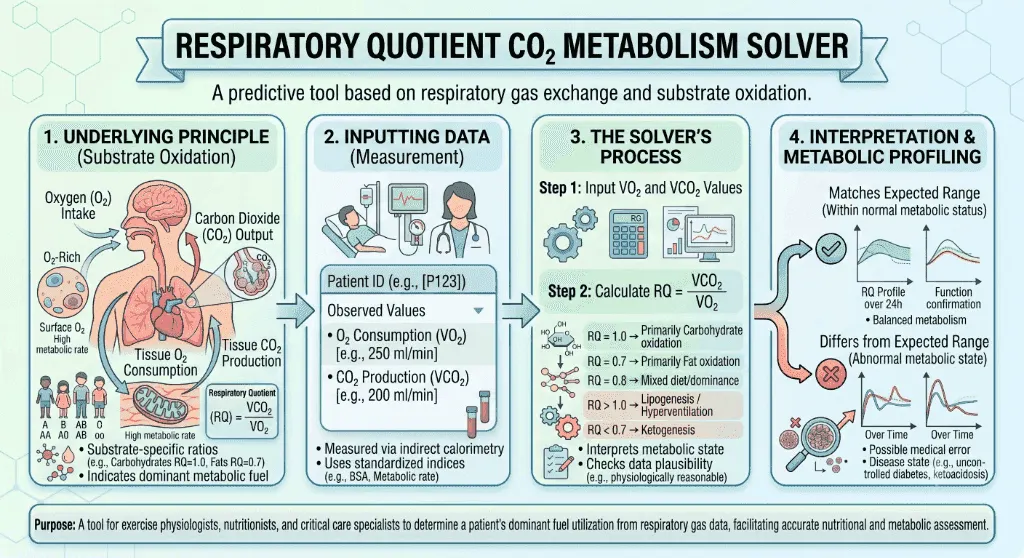
1. Introduction
Inside the mitochondria of trillions of living cells, biochemical combustion transforms food into mechanical, electrical, and chemical energy. Every molecule of glucose, fatty acid, and amino acid broken down consumes oxygen () and produces carbon dioxide () and water ().
In clinical nutrition, sports physiology, and intensive care medicine, the Respiratory Quotient () provides a non-invasive metabolic window into the body's cellular fuel tank. By measuring the precise volumes of consumed and exhaled via indirect calorimetry, clinicians can determine whether a patient is burning carbohydrates, oxidizing stored body fat, catabolizing muscle protein, or overfed into lipogenesis.
In Intensive Care Units, an elevated caused by excess carbohydrate feeding produces a massive ventilatory burden, causing diaphragmatic fatigue and recurrent failure to wean from mechanical ventilation. In endurance sports, tracking the Respiratory Exchange Ratio () identifies an athlete's FatMax zone—the precise running or cycling intensity that maximizes lipid oxidation while conserving scarce intramuscular glycogen.
How is the Respiratory Quotient calculated? What biochemical equations govern substrate oxidation? How does indirect calorimetry compute daily caloric expenditure?
This comprehensive guide details the stoichiometric chemistry, mathematical formulas, clinical applications, and metabolic interpretations of the human respiratory quotient.
flowchart LR
    LUNGS["🫁 Pulmonary Gas Exchange
Inhaled O₂ Intake & Exhaled CO₂ Output"] --> METAB["🔬 Indirect Calorimetry
Measure VO₂ (mL/min) & VCO₂ (mL/min)"]
    METAB --> SOLVER["🧮 Respiratory Quotient (RQ)
RQ = VCO₂ / VO₂"]
    SOLVER --> SUBSTRATE["⚡ Substrate Partitioning
1.00: Glucose | 0.70: Fatty Acids | 0.82: Protein"]
2. Definitions
2.1 Simple Everyday Definition
The Respiratory Quotient () is the ratio of carbon dioxide produced by the body to oxygen consumed over the same time period. It acts like an exhaust gas analyzer for the human body, revealing what percentage of your energy comes from burning carbohydrates versus fats.
2.2 Formal Technical Definition
At the cellular level, the Respiratory Quotient () is the dimensionless molar ratio of carbon dioxide production () to oxygen consumption () during steady-state aerobic metabolism:
At the whole-body level measured at the mouth or endotracheal tube via metabolic cart, this gas exchange ratio is termed the Respiratory Exchange Ratio ():
- Under steady-state resting conditions with normal acid-base balance, .
- Under non-steady-state conditions (e.g., intense anaerobic exercise, severe hyperventilation, or acute metabolic acidosis), diverges from cellular due to the respiratory buffering of lactic acid via bicarbonate:
2.3 Vivid Real-World Analogies
The Automotive Exhaust Gas Analyzer:
When an auto mechanic tunes a high-performance engine, an exhaust sensor measures the ratio of air consumed to carbon emissions produced. If the fuel mixture is rich in octane vs. diesel, the emission signature shifts. In the human engine, carbohydrates produce per , whereas energy-dense fats produce only per .
The Caloric Currency Exchange:
Think of oxygen as investment capital and carbon dioxide as the tax receipt. Burning pure glucose costs tokens and yields receipts (Ratio ). Burning palmitic fat costs tokens but yields only receipts (Ratio ), because much of the oxygen is invested in binding hydrogen atoms to form water ().
3. History & Scientific Milestones
The discovery of human gas exchange laid the groundwork for modern thermodynamics, biochemistry, and clinical nutrition.
timeline
    title Milestones in Respiratory Metabolism & Calorimetry
    1780 : Antoine Lavoisier : Discovers that respiration is a slow combustion consuming O2 and producing CO2
    1901 : Nathan Zuntz : Publishes foundational gas exchange tables for substrate oxidation
    1924 : A.V. Hill : Measures exercise oxygen debt and respiratory exchange kinetics (Nobel Prize)
    1928 : Graham Lusk : Establishes the science of nutrition and non-protein respiratory quotient
1949 : J.B. de V. Weir : Derives the classic Weir Equation for indirect calorimetry energy expenditure- Antoine Lavoisier & Pierre-Simon Laplace (1780): Proved using an ice calorimeter that respiration is a form of chemical combustion, demonstrating that animals consume oxygen and release carbon dioxide in proportion to heat generated.
- Nathan Zuntz (1901): Constructed the first portable respiratory gas meter, publishing precise stoichiometric coefficients linking oxygen consumption and carbon dioxide excretion to carbohydrate, fat, and protein breakdown.
- Graham Lusk (1928): Published The Elements of the Science of Nutrition, establishing the mathematical framework for calculating non-protein by measuring 24-hour urinary urea nitrogen ().
- J.B. de V. Weir (1949): Formulated the universally accepted Weir Equation, allowing clinicians to calculate exact Resting Energy Expenditure () from and without requiring continuous nitrogen excretion measurements.
4. Core Concepts & Biochemical Mechanisms
graph TD
    FOOD["🍽️ Ingested Macronutrients"] --> CARBS["🍞 Carbohydrates (Glucose)
C₆H₁₂O₆ + 6 O₂ → 6 CO₂ + 6 H₂O
RQ = 6/6 = 1.00"]
    FOOD --> FATS["🥑 Lipids (Palmitic Acid)
C₁₆H₃₂O₂ + 23 O₂ → 16 CO₂ + 16 H₂O
RQ = 16/23 = 0.70"]
    FOOD --> PROT["🥩 Proteins (Amino Acids)
Deamination & Urea Synthesis
RQ ≈ 0.82"]

    CARBS --> REST["🥗 Mixed Diet (Resting Steady State)
Standard Omnivorous RQ = 0.80 - 0.85"]
    FATS --> REST
    PROT --> REST
4.1 Stoichiometry of Carbohydrate Oxidation ()
Carbohydrates possess an internal chemical formula of , already containing sufficient oxygen atoms to balance their hydrogen atoms ($2:1$ ratio). Complete combustion of one mole of glucose requires exactly six moles of oxygen and generates six moles of carbon dioxide:
4.2 Stoichiometry of Lipid Oxidation ()
Fatty acids are highly reduced hydrocarbon chains with very few oxygen atoms (e.g., palmitic acid, ). Substantial external oxygen must be consumed to oxidize the hydrogen atoms into water, lowering the ratio:
4.3 Stoichiometry of Protein Oxidation ()
Amino acids contain carbon, hydrogen, oxygen, nitrogen, and sulfur. In the liver, amino groups () are deaminated and converted to urea (), while the remaining carbon skeletons enter the citric acid cycle. The average protein is approximately .
4.4 Non-Steady-State & Extreme Metabolic Ranges
- (De Novo Lipogenesis / Overfeeding): When carbohydrate intake exceeds immediate energy expenditure, the liver converts excess glucose into fatty acids (). This reductive pathway synthesizes fat molecules, releasing surplus without consuming external , driving up to .
- (Ketogenesis / DKA / Severe Starvation): In untreated Diabetic Ketoacidosis or prolonged fasting, incomplete -oxidation yields ketone bodies (acetoacetate and -hydroxybutyrate), consuming oxygen while sequestering unoxidized carbon fragments, driving down to .
5. Formulas & Mathematical Derivations
5.1 Respiratory Quotient Formula
5.2 Substrate Partitioning Equations (Lusk / Frayn Model)
Assuming non-protein substrate oxidation between pure fat () and pure carbohydrate ():
5.3 The Modified Weir Equation for Daily Energy Expenditure
Total Resting Energy Expenditure () in kilocalories per 24 hours is calculated from continuous oxygen consumption and carbon dioxide production:
Where:
- is in grams (, default ).
- When is omitted (abbreviated Weir formula), the error is typically :
5.4 Variable Reference Table
| Parameter | Symbol | Units | Normal Resting Value | Clinical Role |
|---|---|---|---|---|
| Respiratory Quotient | Dimensionless | Identifies predominant cellular metabolic fuel | ||
| Respiratory Exchange Ratio | Dimensionless | (Rest) | Pulmonary gas ratio measured at the mouth/airway | |
| Oxygen Consumption | Rate of whole-body cellular oxygen uptake | |||
| Carbon Dioxide Production | Rate of metabolic carbon dioxide excretion | |||
| Resting Energy Expenditure | Total daily resting basal metabolic requirement | |||
| Urinary Urea Nitrogen | Measures 24-hour protein catabolism rate |
6. Step-by-Step Computational Walkthrough
Let us evaluate a critically ill patient in the intensive care unit undergoing indirect calorimetry. The metabolic cart records an Oxygen Uptake () of and a Carbon Dioxide Output () of , with .
flowchart TD
    STEP1["Step 1: Calculate Respiratory Quotient (RQ)
RQ = 200 mL/min / 250 mL/min = 0.800"] --> STEP2["Step 2: Substrate Oxidation Partitioning
% Carb = (0.800 - 0.707) / 0.293 = 31.7%
% Fat = (1.000 - 0.800) / 0.293 = 68.3%"]
    STEP2 --> STEP3["Step 3: Convert Gas Volumes to Liters/min
VO2 = 0.250 L/min | VCO2 = 0.200 L/min"]
    STEP3 --> STEP4["Step 4: Apply the Weir Equation
REE = [(3.941 × 0.250) + (1.106 × 0.200)] × 1440 - (2.17 × 12)"]
    STEP4 --> STEP5["Step 5: Compute Final Energy Expenditure
REE = [0.98525 + 0.2212] × 1440 - 26.04 = 1,711 kcal/day (24.4 kcal/kg/day)"]- Step 1: Compute Respiratory Quotient ():
- Step 2: Calculate Macronutrient Oxidation Proportions:
- Step 3: Convert Gas Flow Rates to Liters per Minute:--
- Step 4: Calculate Daily Energy Expenditure via Weir Formula:
- Step 5: Clinical Interpretation:The patient exhibits a balanced resting metabolic state (), reflecting normal overnight fasting physiology with no evidence of harmful overfeeding or ketoacidosis.
7. Visual Explanations & Stoichiometric Substrates
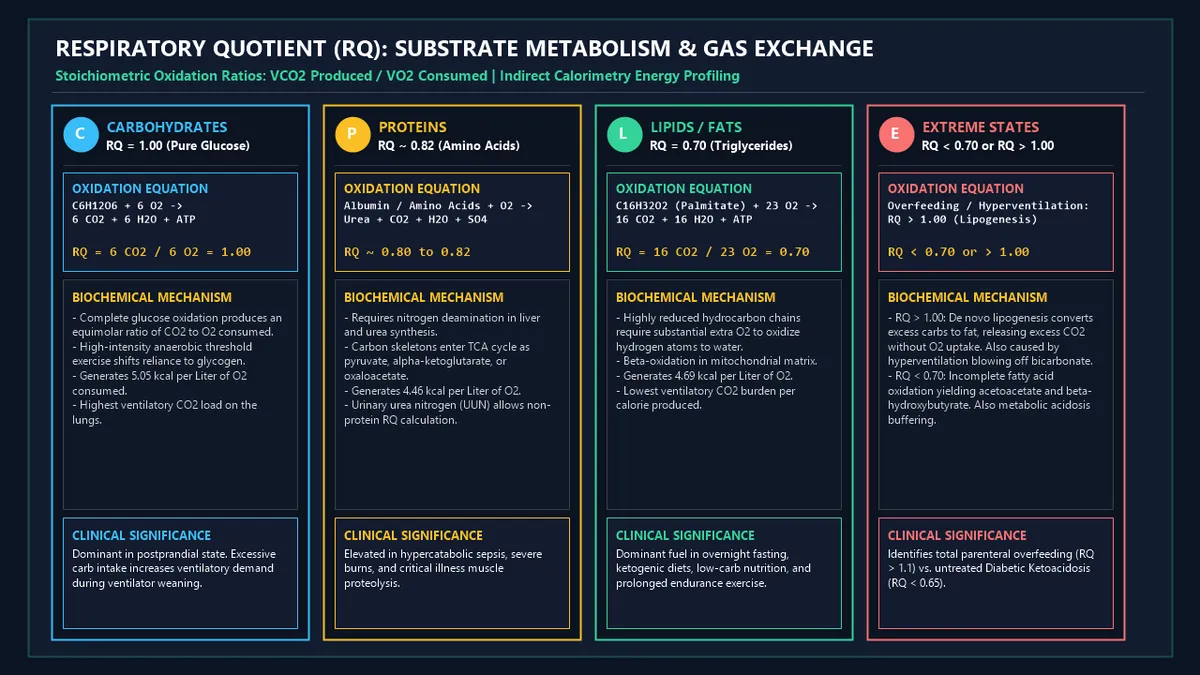
flowchart TD
    RQ_SPECTRUM["Respiratory Quotient (RQ) Spectrum"]

    RQ_SPECTRUM --> LOW["🔥 RQ < 0.70 (Ketogenesis & Starvation)
• Diabetic Ketoacidosis (DKA)
• Prolonged Fasting & Ketone Body Accumulation"]
    RQ_SPECTRUM --> FAT["🥑 RQ ≈ 0.70 (Pure Lipid Oxidation)
• High-Fat / Ketogenic Diet
• Overnight Fasting & Endurance Aerobic Base"]
    RQ_SPECTRUM --> MIX["🥗 RQ = 0.80 - 0.85 (Mixed Omnivorous Diet)
• Balanced Carbohydrate, Fat & Protein Oxidation
• Normal Resting ICU Target"]
    RQ_SPECTRUM --> CARB["🍞 RQ = 1.00 (Pure Carbohydrate Oxidation)
• Postprandial High-Carb Meal
• High-Intensity Exercise near Anaerobic Threshold"]
    RQ_SPECTRUM --> HIGH["⚡ RQ > 1.00 (Lipogenesis & Hyperventilation)
• Total Parenteral Nutrition (TPN) Overfeeding
• De Novo Lipogenesis (Surplus CO₂ Generated)"]
8. Complete Macronutrient Oxidation & Caloric Equivalence Matrix
| Fuel Substrate | Respiratory Quotient () | Energy per Liter () | Energy per Gram () | Carbon Dioxide Burden per Calorie | Clinical Setting |
|---|---|---|---|---|---|
| Glucose / Starch (Carbohydrate) | $1.00$ | Highest () | Postprandial state; sprint exercise | ||
| Mixed Amino Acids (Protein) | $0.82$ | Moderate () | Hypercatabolism; severe trauma/burns | ||
| Mixed Triglycerides (Lipids) | $0.70$ | Lowest () | Fasting; low-carb diets; endurance exercise | ||
| Mixed Omnivorous Diet | Mixed | Standard Baseline | Healthy resting adult | ||
| Alcohol (Ethanol) | $0.67$ | Low | Hepatic ethanol oxidation | ||
| Ketone Bodies (Acetoacetate) | $0.60$ | Very Low | Severe ketosis / Starvation | ||
| De Novo Lipogenesis (Overfeeding) | Varies | Surplus Storage | Extreme Excess | Excessive TPN/Enteral carbohydrate infusion |
9. Practical Real-World Applications
Example 1: Preventing Hypercapnic Failure in COPD Mechanical Ventilation
A patient with severe Chronic Obstructive Pulmonary Disease () is intubated in the ICU.
- The Problem: The patient receives a standard high-carbohydrate tube feed delivering . Indirect calorimetry reveals an and .
- Pathophysiology: Converting excess glucose into fat produces excess . Because the patient's obstructed airways cannot increase minute ventilation to clear the , arterial spikes to , causing respiratory acidosis and weaning failure.
- Intervention: Switching to a low-carbohydrate, high-fat enteral formula reduces to $0.78$ and to ( in ventilatory load), enabling successful extubation.
Example 2: Endurance Sports "FatMax" Testing in Marathon Runners
An exercise physiologist performs a graded exercise test on an elite triathlete:
- At heart rate (Zone 2), the athlete's (), preserving precious glycogen.
- As intensity rises to (Threshold), climbs to $1.02$ due to lactic acid buffering.
- Application: Identifies the exact race pace that maximizes energy output without triggering premature carbohydrate depletion ("hitting the marathon wall").
Example 3: Detecting Unrecognized Insulin Resistance & DKA
A hospitalized patient with diabetes displays an indirect calorimetry . Despite intravenous dextrose infusions, the low signals that glucose cannot enter cells, uncovering severe insulinopenia and active ketogenesis before lab blood gas results return.
10. In-Depth Case Studies
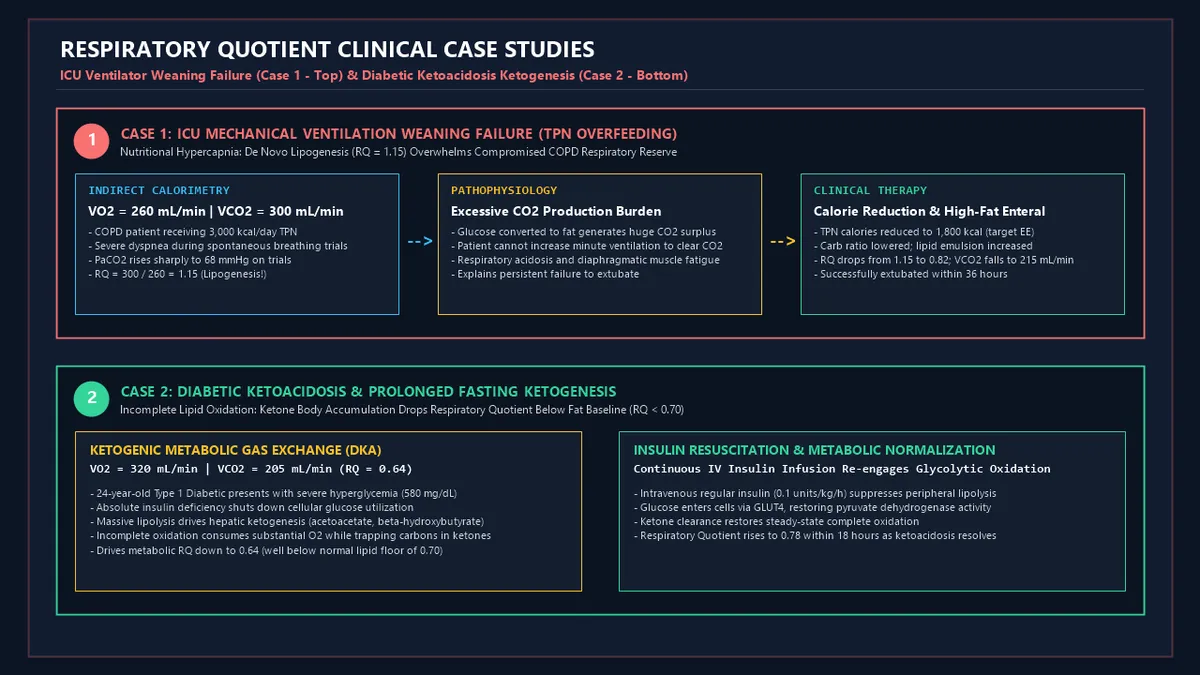
Case Study 1: ICU Mechanical Ventilation Weaning Failure from TPN Overfeeding
- Patient Presentation: A male with severe emphysema is recovering from abdominal sepsis. He has failed spontaneous breathing trials for 5 consecutive days due to severe tachypnea and respiratory acidosis ().
- Nutritional Audit: Receiving total parenteral nutrition containing of dextrose.
- Indirect Calorimetry Assessment:- ,- (Confirmed De Novo Lipogenesis)- Measured (The patient was receiving 180% of his actual caloric requirement!)
- Clinical Intervention:- TPN total calories reduced to , with carbohydrate contribution reduced to 40% and lipid emulsion increased.
- Outcome: Within 36 hours, fell to $0.82$, dropped to , normalized to , and the patient was successfully extubated.
Case Study 2: Diabetic Ketoacidosis & Prolonged Fasting Ketogenesis
- Patient Presentation: A female with Type 1 Diabetes presents to the Emergency Department with nausea, deep Kussmaul respirations, and altered mental status. Blood glucose is , , , and serum -hydroxybutyrate is elevated at .
- Indirect Calorimetry:- ,-
- Metabolic Interpretation:- Complete cellular glucose starvation driven by absolute insulin deficiency.- Unopposed lipolysis and hepatic ketogenesis generate ketone bodies. Incomplete oxidation traps carbons in acetoacetate while consuming oxygen, pushing the well below the normal lipid floor of $0.70$.
- Therapeutic Normalization:- Intravenous regular insulin infusion () and aggressive fluid resuscitation.- Re-engages cellular glucose transport via GLUT4 and restores pyruvate dehydrogenase activity.- As ketosis resolves over 18 hours, rises to $0.78$, reflecting restored mixed fuel oxidation.
11. Advantages of Respiratory Gas Exchange Analysis
- Eliminates Caloric Guesswork in Critical Care: Replaces inaccurate predictive equations (Harris-Benedict, Mifflin-St Jeor) with real-time measured energy expenditure ().
- Prevents Complications of Overfeeding and Underfeeding: Avoids hepatic steatosis, hypercapnia, and refeeding syndrome.
- Optimizes Athletic Performance & Fuel Utilization: Determines the exact metabolic crossover point from fat to carbohydrate oxidation.
- Validates Substrate Utilization in Metabolic Research: Provides non-invasive quantification of whole-body insulin sensitivity and lipid turnover.
12. Methodological Complexities & Artifacts
- Hyperventilation and Hypoventilation Artifacts: Acute hyperventilation blows off large amounts of stored in the body's bicarbonate buffer pool, creating an artificially elevated that does not reflect true mitochondrial .
- Metabolic Acidosis Compensation: Generation of lactic acid during anaerobic exercise or shock releases additional non-metabolic through carbonic acid buffering.
- Airway Leaks in Indirect Calorimetry: Leaks around an endotracheal tube cuff or loose face mask allow exhaled to escape, falsely depressing the measured .
13. Common Mistakes to Avoid
1. Assuming RER Always Equals Cellular RQ:
While during steady-state resting conditions, any non-steady state (intense exercise, anxiety, shivering, or acute acid-base shifts) will cause pulmonary to diverge from cellular .
2. Prescribing High-Carbohydrate Diets to Ventilator-Dependent Patients:
Overfeeding carbohydrates to ICU patients with respiratory insufficiency creates massive carbon dioxide production (), directly precipitating ventilatory fatigue and weaning failure.
3. Overlooking Non-Protein Nitrogen Losses:
Calculating exact non-protein requires subtracting protein oxidation via urinary urea nitrogen (), especially in hypercatabolic burn and trauma patients.
12. Frequently Asked Questions (FAQ)
What is the normal Respiratory Quotient for a healthy person?
On a standard mixed diet during resting steady-state conditions, the normal Respiratory Quotient is (representing fat oxidation and carbohydrate oxidation).
What does an RQ of 1.0 indicate?
An of $1.00$ indicates 100% carbohydrate (glucose) oxidation. It occurs naturally after a high-carbohydrate meal or during high-intensity exercise approaching the anaerobic lactate threshold.
What does an RQ of 0.7 indicate?
An of $0.70$ indicates 100% lipid (fatty acid) oxidation. It is observed during overnight fasting, on strict ketogenic diets, or during prolonged low-intensity endurance exercise.
Can the Respiratory Quotient exceed 1.0?
Yes. An occurs during de novo lipogenesis (when excess carbohydrate calories are converted to stored fat) or during acute hyperventilation where stored bicarbonate is blown off as excess .
What causes an RQ below 0.70?
An occurs during ketogenesis (such as in Diabetic Ketoacidosis or prolonged starvation), where fats are incompletely oxidized into ketone bodies, or during ethanol metabolism ().
What is the Weir Equation?
The Weir Equation is the standard mathematical formula used in indirect calorimetry to calculate Resting Energy Expenditure () from oxygen consumption () and carbon dioxide output ():
Why is RQ important for mechanical ventilator weaning?
Excessive production () forces the lungs to increase minute ventilation to clear the gas. In patients with weakened respiratory muscles or COPD, this extra workload causes diaphragmatic exhaustion and extubation failure.
15. Expert Tips for Exercise Physiologists, Dietitians & Intensivists
- Target an RQ of 0.80–0.85 in Critical Care Nutrition: When tailoring enteral or parenteral nutrition, adjust carbohydrate-to-fat caloric ratios to maintain an between $0.80$ and $0.85$, minimizing the ventilatory burden while providing adequate energy.
- Verify Steady-State Criteria Before Interpreting Gas Data: Ensure that and vary by less than 5% over a measurement window to ensure that pulmonary accurately reflects cellular .
- Use the Crossover Concept for Athletic Carb Loading: In marathon and triathlon coaching, utilize graded CPET gas analysis to identify the heart rate where to structure Zone 2 aerobic base training.
16. Summary Checklist
- ✔ Measure Gas Exchange Volumes: Record and in using a calibrated indirect calorimeter.
- ✔ Calculate Respiratory Quotient: Solve .
- ✔ Evaluate Substrate Partitioning: Compute percentage carbohydrate vs. lipid oxidation.
- ✔ Calculate Daily Energy Expenditure: Apply the Weir Equation to determine exact in .
- ✔ Screen for Lipogenesis or Ketosis: Verify whether (overfeeding) or (ketosis/starvation).
- ✔ Adjust Clinical Nutrition / Training Plans: Optimize dietary macronutrient ratios and ventilatory management.
Additional Technical Guidelines & Measurement Standards
When conducting calculations for Respiratory Quotient CO2 Metabolism Solver, maintaining quantitative precision and verifying input parameter boundaries is essential for reliable scenario evaluation. Always verify that raw numerical inputs are measured using standardized instrumentation, and double-check unit conversions prior to applying outputs in commercial, industrial, or academic projects.
For quantitative unit conversions and scientific calculations, always maintain at least four decimal places of precision during intermediate arithmetic stages before rounding final results. When preparing technical reports, laboratory documentation, or financial forecasts, cross-verify all output variables against established international measurement standards (such as SI, NIST, and ISO metric benchmarks) to guarantee consistent analytical rigor across all computational workflows.
MathsLover.com delivers this interactive solver 100% free of charge to foster global mathematical literacy, educational accessibility, and data-driven problem solving across scientific, technical, and academic communities worldwide.