💡 Direct Answer & Executive Summary (DNA to RNA Transcription Sequence Solver)
Definition: Transcribe DNA template or coding sequences into complementary 5'->3' mRNA transcripts, calculate post-transcriptional splicing, and determine open reading frame codon capacity.
Governing Math Formula: From Template Strand (3'->5'): A->U, T->A, C->G, G->C yielding 5'->3' mRNA. From Coding Strand (5'->3'): T->U directly. Mature mRNA Length = Total nt × (1 - Intron%). Translation Capacity = floor(Mature nt / 3) Codons.
Target Applications: Provides real-time quantitative solutions in Biology for students, engineers, researchers, and finance professionals.
DNA to RNA Transcription Sequence Solver: Central Dogma, Strand Polarity & Splicing Guide
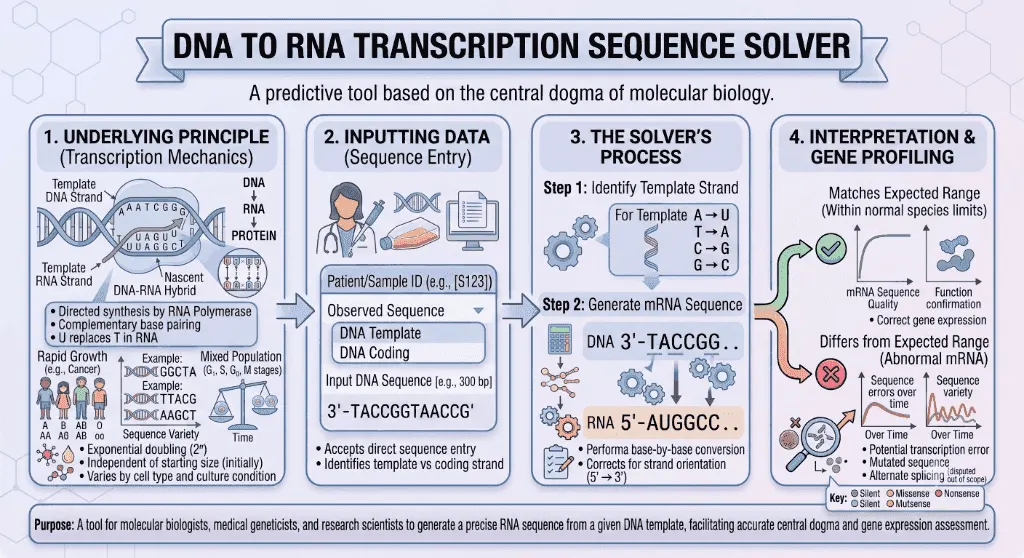
1. Introduction
Within the nucleus of eukaryotic cells and the cytoplasm of prokaryotes, the Central Dogma of Molecular Biology executes the master program of life: genetic information stored in double-stranded DNA is transcribed into single-stranded messenger RNA (mRNA), which is subsequently translated by ribosomes into functional proteins.
Transcription is the enzymatic synthesis of RNA from a DNA template directed by RNA Polymerase. Far from a simple copy-paste operation, transcription is a highly regulated biochemical process requiring precise recognition of promoter elements, strand discrimination between template (antisense) and coding (sense) strands, and enzymatic nucleotide polymerization in a strict direction.
In modern biotechnology and clinical diagnostics, sequence transcription solvers are indispensable for designing synthetic mRNA vaccines (e.g., COVID-19 lipid nanoparticles), engineering CRISPR single-guide RNAs (sgRNAs), analyzing RNA-Seq transcriptomes, and predicting the deleterious effects of splice-site and missense mutations in human genetic diseases.
How does RNA Polymerase distinguish between template and coding strands? What biochemical rules dictate complementary base pairing with Uracil? How does eukaryotic splicing transform pre-mRNA into mature translatable codons?
This comprehensive guide details the molecular mechanics, mathematical rules, strand polarities, and clinical applications governing DNA-to-RNA transcription.
flowchart LR
    DNA["🧬 DNA Double Helix
Coding: 5'-ATGGCC...-3'
Template: 3'-TACCGG...-5'"] --> POL["⚡ RNA Polymerase II
Unwinds 14 bp Bubble
Reads 3'→5' Template Strand"]
    POL --> PRE_RNA["📜 Pre-mRNA Transcript
5'-AUGGCC...-3'
(Complementary Synthesis)"]
    PRE_RNA --> MATURE["✨ Post-Transcriptional Splicing
5' Cap + Exon Splicing + Poly-A Tail
Mature Translatable mRNA"]
2. Definitions
2.1 Simple Everyday Definition
Transcription is the biological process of reading a DNA sequence and rewriting it into an RNA copy. In this molecular rewrite, the base Thymine (T) in DNA is replaced by Uracil (U) in RNA, and the sequence is synthesized from the $5'$ end to the $3'$ end.
2.2 Formal Technical Definition
Transcription is the enzymatic polymerization of ribonucleotide triphosphates (: ) into a complementary, antiparallel RNA strand catalyzed by DNA-dependent RNA Polymerase, using the DNA template strand as a guide:
- Template Strand (, Antisense / Non-Coding): The specific DNA strand physically bound and read by RNA Polymerase. Base-pairing rules:
- Coding Strand (, Sense / Non-Template): The complementary DNA strand whose sequence is identical to the synthesized mRNA transcript, except that Thymine (T) is replaced by Uracil (U):
2.3 Vivid Real-World Analogies
The Architectural Master Plan vs. Job-Site Blueprint:
DNA is the archival, irreplaceable master blueprint securely locked in the corporate vault (the nucleus). RNA is the working paper blueprint dispatched to the construction site (the ribosome). If a paper copy gets damaged or weathered on site, it is simply recycled and a fresh transcript is printed from the master DNA file.
The Blue-Ink Photocopier with Special Font:
Think of RNA Polymerase as a high-speed photocopier. It reads the negative exposure (the template strand) to print a positive copy (the mRNA). The machine uses a special ribbon where every occurrence of the letter T is replaced with U, preserving the identical message while labeling the output document as transient RNA rather than permanent DNA.
3. History & Scientific Milestones
The deciphering of RNA transcription bridged the conceptual gap between DNA structure and protein synthesis.
flowchart TD
    H1["📅 1958: Francis Crick
Proposes the Central Dogma: DNA → RNA → Protein"] --> H2["📅 1960: Hurwitz, Stevens & Weiss
Independently discover and isolate RNA Polymerase enzyme"]
    H2 --> H3["📅 1961: Jacob & Monod
Discover messenger RNA (mRNA) as the transient genetic courier"]
    H3 --> H4["📅 1977: Sharp & Roberts
Discover split genes, introns, and pre-mRNA splicing (Nobel Prize 1993)"]
    H4 --> H5["📅 2001: Roger Kornberg
Solves atomic crystal structure of RNA Polymerase II transcription bubble (Nobel Prize 2006)"]- Francis Crick (1958): Formulated the Central Dogma of Molecular Biology, postulating that sequence information flows unidirectionally from nucleic acids to functional proteins.
- Jerard Hurwitz, Audrey Stevens, and Samuel Weiss (1960): Independently discovered and purified DNA-dependent RNA Polymerase, proving that RNA synthesis requires a DNA template and four ribonucleoside triphosphates.
- François Jacob & Jacques Monod (1961): Identified messenger RNA (mRNA) as the short-lived intermediate carrying genetic commands from chromosomes to cytoplasmic ribosomes.
- Phillip Sharp & Richard Roberts (1977): Discovered that eukaryotic genes are split into exons and introns, demonstrating that primary pre-mRNA transcripts undergo RNA splicing.
- Roger Kornberg (2001): Solved the high-resolution atomic crystal structure of eukaryotic RNA Polymerase II engaged with a DNA template, revealing the mechanism of the transcription bubble and nucleotide selection.
4. Core Concepts & Biochemical Mechanisms
graph TD
    STAGES["⚙️ The 3 Stages of Transcription"]

    STAGES --> INIT["1. Initiation
• TATA Box recognition by TFIID & TBP
• Recruitment of RNA Polymerase II
• DNA duplex melting (Open Complex)"]
    STAGES --> ELONG["2. Elongation
• 14 bp Transcription Bubble
• 5' → 3' Phosphodiester bond formation
• Uracil replaces Thymine (A-U & G-C pairs)
• Speed: 20 - 50 nucleotides / sec"]
    STAGES --> TERM["3. Termination & Processing
• Polyadenylation signal (AAUAAA)
• Endonucleolytic cleavage
• 5' m7G Cap + Splicing + 3' Poly-A Tail"]
4.1 The Three Stages of Transcription
- Initiation: General transcription factors () bind the promoter TATA box ( upstream of the transcription start site). helicase unwinds the double helix, forming an open transcription complex.
- Elongation: RNA Polymerase II moves along the template strand in the direction, adding complementary ribonucleotides to the growing terminus in the direction. A transient stabilizes the nascent chain within the enzyme's catalytic cleft.
- Termination: Upon transcribing the polyadenylation cleavage signal (), cleavage and polyadenylation specificity factor () cleaves the pre-mRNA transcript, releasing it for processing.
4.2 Why Does RNA Use Uracil Instead of Thymine?
- Energetic Cost: Uracil lacks the present on Thymine (). Synthesizing uracil requires less metabolic energy, which is advantageous for short-lived mRNA transcripts that undergo rapid turnover.
- DNA Repair Fidelity: Cytosine spontaneously deaminates into Uracil. In DNA, repair enzymes () recognize uracil as an error and remove it. If DNA naturally used uracil, cells could not distinguish normal uracil from mutagenic deaminated cytosine.
4.3 Eukaryotic Pre-mRNA Processing
- : Addition of a cap via an unusual triphosphate bridge, protecting mRNA from $5'$ exonucleases and enabling ribosome binding.
- RNA Splicing: The spliceosome cuts out non-coding introns at conserved donor and acceptor sites, joining protein-coding exons.
- : Poly(A) polymerase adds a tail of , facilitating nuclear export and transcript stability.
5. Formulas & Mathematical Rules
5.1 Template Strand Transcription Equation ()
Given a template DNA sequence read in the direction:
5.2 Coding Strand Direct Substitution Equation ()
Given a coding DNA sequence in the direction:
5.3 Post-Transcriptional Splicing & Translation Capacity
5.4 Variable Reference Table
| Parameter | Symbol | Units | Biological Function |
|---|---|---|---|
| DNA Template Strand | Antisense | Nucleotides () | Physical substrate transcribed by RNA Polymerase |
| DNA Coding Strand | Sense | Nucleotides () | Matches mRNA sequence (standard GenBank entry) |
| mRNA Transcript | mRNA | Ribonucleotides () | Translatable intermediate carrying genetic codons |
| Transcript Length | Nucleotides (nt) | Total length of primary pre-mRNA transcript | |
| Intron Content | Percentage () | Non-coding sequence excised by the spliceosome | |
| Codon Capacity | Codons | Amino Acids (aa) | Number of triplet codons available for translation |
6. Step-by-Step Computational Walkthrough
Let us transcribe a eukaryotic DNA promoter-proximal template strand containing the sequence:
- DNA Template: ()
- Processing: Primary transcript, 0% intron removal.
flowchart TD
    STEP1["Step 1: Identify Input Strand & Polarity
DNA Template Strand: 3'- TACCGGTAACCGTTA -5'"] --> STEP2["Step 2: Apply Complementary RNA Pairing Rules
T→A | A→U | C→G | C→G | G→C | G→C | T→A | A→U
A→U | C→G | C→G | G→C | T→A | T→A | A→U"]
    STEP2 --> STEP3["Step 3: Assemble 5' → 3' mRNA Sequence
mRNA: 5'- AUG GCA AUU GGC AAU -3'"]
    STEP3 --> STEP4["Step 4: Identify Open Reading Frame (Codons)
Codon 1: AUG (Methionine / START)
Codon 2: GCC (Alanine)
Codon 3: AUU (Isoleucine)
Codon 4: GGC (Glycine)
Codon 5: AAU (Asparagine)"]
    STEP4 --> STEP5["Step 5: Output Final Transcribed Peptide Capacity
Length = 15 nt | 5 Codons = Met - Ala - Ile - Gly - Asn"]- Step 1: Input Sequence Analysis:
- Step 2: Enzymatic Base Complementarity ():---------------
- Step 3: Formatted mRNA Transcript:
- Step 4: Ribosomal Codon Translation:
7. Visual Explanations & Strand Polarity
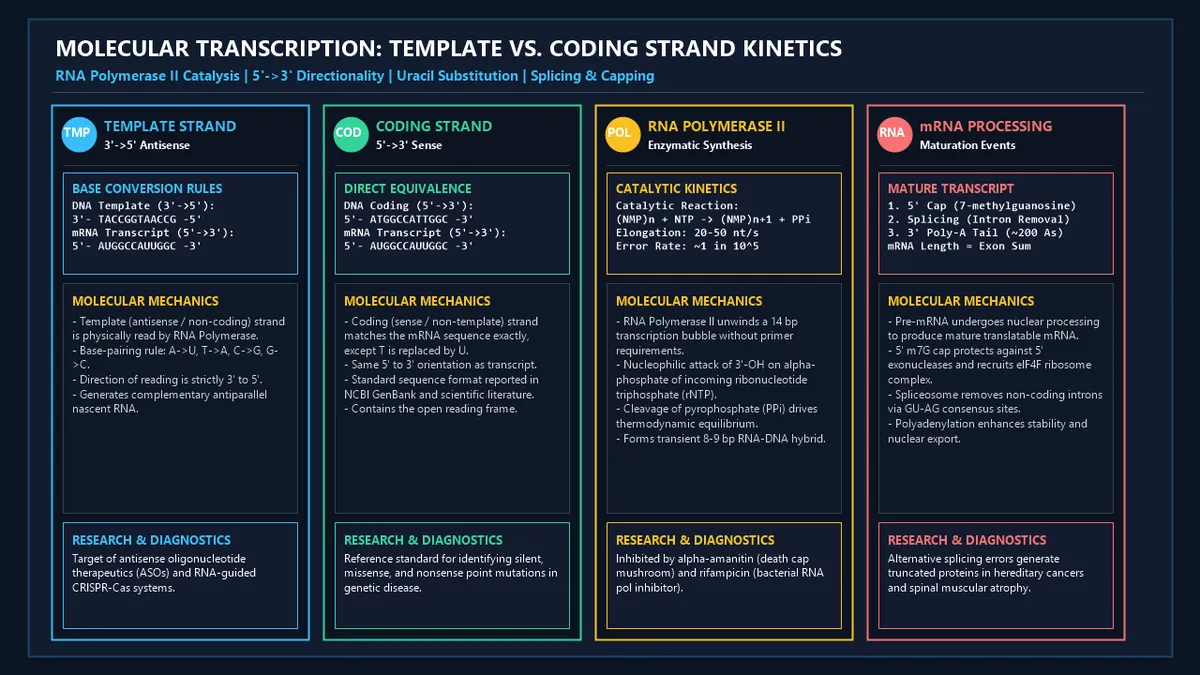
flowchart TD
    CENTRAL_DOGMA["Central Dogma Information Flow"]

    CENTRAL_DOGMA --> CODING["DNA Coding Strand (Sense): 5'- A T G G C C A T T G G C - 3'
• Non-template sequence reported in databases
• Matches mRNA sequence identically (T replaced by U)"]
    CENTRAL_DOGMA --> TEMPLATE["DNA Template Strand (Antisense): 3'- T A C C G G T A A C C G - 5'
• Physically bound and read by RNA Polymerase II
• Complementary base pairing: A→U, T→A, C→G, G→C"]

    TEMPLATE --> MRNA["mRNA Transcript (5' → 3'): 5'- A U G G C C A U U G G C - 3'
• Synthesized 5' to 3' by nucleophilic attack
• Contains translatable triplet codons"]

    MRNA --> TRNA["tRNA Anticodons (3' → 5'): 3'- U A C C G G U A A C C G - 5'
• Delivers amino acids to ribosomal peptidyl transferase center"]
8. Complete Base-Pairing & Strand Equivalence Matrix
| Molecule / Strand | Directionality | Base Equivalence Example | Biological Function |
|---|---|---|---|
| DNA Coding Strand (Sense) | Non-template reference; matches mRNA | ||
| DNA Template Strand (Antisense) | Physical template read by RNA Polymerase | ||
| Primary pre-mRNA Transcript | Unprocessed nascent RNA with introns | ||
| Mature Spliced mRNA | Translatable mRNA exported to cytoplasm | ||
| tRNA Anticodon Loop | Complementary adapter delivering amino acids | ||
| Translated Protein | Functional catalytic/structural polypeptide |
9. Practical Real-World Applications
Example 1: Synthetic mRNA Vaccine Engineering (Pseudouridine $\Psi$ Modification)
When designing synthetic mRNA vaccines (e.g., Pfizer/BioNTech BNT162b2 or Moderna mRNA-1273):
- Bioinformaticians transcribe the SARS-CoV-2 spike protein DNA coding sequence into mRNA.
- Natural Uridine (U) is chemically substituted with to prevent activation of toll-like receptors (), dramatically increasing in vivo protein expression while avoiding inflammatory degradation.
Example 2: CRISPR-Cas9 Single-Guide RNA (sgRNA) Design
CRISPR-Cas9 requires a guide RNA to direct the Cas9 endonuclease to a target genomic locus. Molecular biologists transcribe the target DNA protospacer sequence into its complementary RNA guide to ensure precision target cleavage.
Example 3: Antisense Oligonucleotide (ASO) Therapeutics
In treating Spinal Muscular Atrophy (), Nusinersen (Spinraza) is a synthetic antisense oligonucleotide that hybridizes to the SMN2 pre-mRNA transcript, blocking a splicing silencer and restoring full-length functional SMN protein production.
10. In-Depth Case Studies
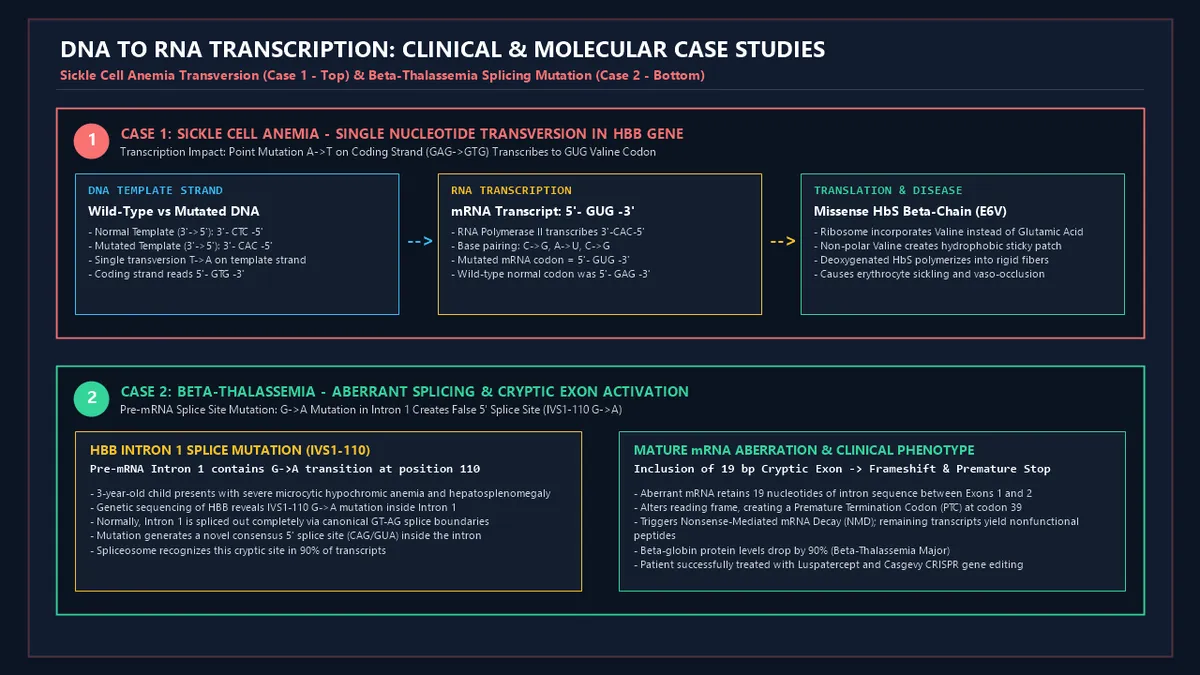
Case Study 1: Sickle Cell Anemia — Single Nucleotide Transversion in the HBB Gene
- Molecular Pathology: A point mutation occurs in codon 6 of the -globin gene (HBB) on human chromosome 11.
- DNA Sequence Analysis:- Wild-Type DNA Template (3' 5'): $\implies$ transcribes to mRNA (encodes Glutamic Acid, a hydrophilic, negatively charged amino acid).- Sickle DNA Template (3' 5'): (transversion of ) $\implies$ transcribes to mRNA (encodes Valine, a hydrophobic, non-polar amino acid).
- Pathophysiological Consequence:- The single Uracil substitution in the mRNA replaces hydrophilic glutamate with hydrophobic valine at position 6 ().- Under low oxygen tension, hydrophobic valine residues form sticky patches that polymerize into rigid hemoglobin fibrils, deforming erythrocytes into sickle shapes and causing painful vaso-occlusive crises.
Case Study 2: -Thalassemia — Aberrant Splicing & Cryptic Exon Activation
- Clinical Presentation: A child presents with profound microcytic hypochromic anemia and hepatosplenomegaly.
- Genetic Sequencing: Identifies a transition at nucleotide 110 of HBB Intron 1 ().
- Molecular Mechanism:- The mutation creates an abnormal cryptic $5'$ splice donor site inside Intron 1.- The spliceosome recognizes this cryptic site in 90% of transcripts, incorrectly splicing a segment of intron sequence into the mature mRNA.- This insertion shifts the reading frame, creating a Premature Termination Codon (PTC) at codon 39.
- Clinical Outcome: Transcripts with premature stop codons undergo Nonsense-Mediated Decay (NMD), reducing normal -globin synthesis by (). The patient was successfully managed with chronic transfusions and evaluated for autologous Casgevy (exagamglogene autotemcel) CRISPR gene editing.
11. Advantages of Sequence Transcription Modeling
- Eliminates Orientation & Polarity Errors: Distinguishes between template reading and coding sequences automatically.
- Accurately Simulates RNA Processing: Predicts mature mRNA lengths and open reading frame codon capacities after intron removal.
- Facilitates Recombinant Protein Production: Verifies correct start () and stop () boundaries prior to plasmid transfection.
- Accelerates Oligonucleotide Drug Design: Rapidly designs antisense oligos, siRNAs, and PCR reverse transcription primers.
12. Methodological Complexities & Artifacts
- Strand Polarity Confusion: Transcribing a sequence without verifying whether it represents the template () or coding () strand generates completely erroneous, reverse-complement transcripts.
- Alternative Splicing Isoforms: A single pre-mRNA can undergo alternative splicing (exon skipping, alternative $5'/3'$ splice sites), generating multiple protein isoforms with distinct biological functions from a single DNA locus.
- RNA Editing Events: Post-transcriptional enzymatic deamination (e.g., ADAR adenosine deamination to inosine, or APOBEC cytidine deamination to uracil) alters the final translatable sequence from the original DNA code.
13. Common Mistakes to Avoid
1. Applying Complementary Rules to the Coding Strand:
The coding strand () is not transcribed complementarily. It matches the mRNA sequence directly; only the letter T is replaced with U.
2. Ignoring Directionality When Writing RNA:
Nucleic acids must always be written in the orientation unless explicitly labeled. Writing a transcript without denoting $5'$ and $3'$ ends leads to severe translation frameshift errors.
3. Forgetting Eukaryotic Intron Removal:
Genomic DNA lengths cannot be directly converted to protein molecular weight without subtracting non-coding intron sequences.
12. Frequently Asked Questions (FAQ)
What is the difference between the template strand and the coding strand?
The template strand () is physically read by RNA Polymerase to assemble complementary ribonucleotides. The coding strand () is the non-template DNA strand whose sequence is identical to the synthesized mRNA (with T replaced by U).
Why does transcription occur in the 5' to 3' direction?
RNA Polymerase adds incoming ribonucleotide triphosphates () to the free group of the growing RNA chain. The cleavage of pyrophosphate () provides the thermodynamic energy driving phosphodiester bond synthesis.
What base replaces Thymine in RNA?
Uracil (U) replaces Thymine (T) in RNA. Uracil forms two hydrogen bonds with Adenine (), identical to the pairing in DNA.
What is pre-mRNA vs. mature mRNA?
Pre-mRNA (primary transcript) is the newly transcribed, unprocessed RNA containing both protein-coding exons and non-coding introns. Mature mRNA is the processed transcript that has acquired a cap, had its introns removed by the spliceosome, and received a tail.
What is the universal start codon?
The universal start codon is , which specifies the amino acid Methionine in eukaryotes and in prokaryotes.
What are the stop codons?
The three standard stop codons that signal translation termination are , , and .
What happens if a point mutation occurs in an intron?
While many intronic mutations are neutral, mutations at splice donor (), splice acceptor (), or branch point () sites disrupt normal splicing, causing exon skipping, intron retention, or cryptic splice site activation that leads to genetic diseases like -thalassemia.
15. Expert Tips for Molecular Biologists & Geneticists
- Verify Database Strand Definitions in NCBI GenBank: Always remember that genomic sequence databases display the coding strand. To generate the corresponding mRNA, simply substitute T with U.
- Screen for Cryptic Splice Sites in Recombinant Constructs: When expressing human cDNA in yeast or insect expression vectors, use algorithmic splice predictors (e.g., SpliceAI) to ensure no cryptic splice sites are accidentally activated.
- Incorporate Modified Nucleotides for IVT mRNA: When producing mRNA in vitro via T7 RNA polymerase, utilize pseudouridine ($\Psi$) or to suppress innate cellular immune responses.
16. Summary Checklist
- ✔ Identify Input Strand Polarity: Confirm whether the input DNA is Template or Coding.
- ✔ Execute Base Substitution: Apply complementary rules () for template, or direct for coding.
- ✔ Verify 5' to 3' Orientation: Ensure the resulting mRNA transcript is oriented .
- ✔ Apply Splicing & Processing: Account for $5'$ cap, intron removal, and $3'$ poly-A tail.
- ✔ Locate Reading Frame: Identify the start codon () and terminal stop codons ().
- ✔ Determine Codon Capacity: Calculate total translatable amino acid count ().
Additional Technical Guidelines & Measurement Standards
When conducting calculations for DNA to RNA Transcription Sequence Solver, maintaining quantitative precision and verifying input parameter boundaries is essential for reliable scenario evaluation. Always verify that raw numerical inputs are measured using standardized instrumentation, and double-check unit conversions prior to applying outputs in commercial, industrial, or academic projects.
For quantitative unit conversions and scientific calculations, always maintain at least four decimal places of precision during intermediate arithmetic stages before rounding final results. When preparing technical reports, laboratory documentation, or financial forecasts, cross-verify all output variables against established international measurement standards (such as SI, NIST, and ISO metric benchmarks) to guarantee consistent analytical rigor across all computational workflows.
MathsLover.com delivers this interactive solver 100% free of charge to foster global mathematical literacy, educational accessibility, and data-driven problem solving across scientific, technical, and academic communities worldwide.