💡 Direct Answer & Executive Summary (Boyle's Gas Law P1V1 = P2V2 Solver)
Definition: Chemical stoichiometry calculation: Boyle's Gas Law P1V1 = P2V2 Solver.
Governing Math Formula: P1 × V1 = P2 × V2 (at Constant Temperature T and Fixed Gas Mass n). Unknown variable solver: V2 = (P1 × V1) / P2, or P2 = (P1 × V1) / V2.
Target Applications: Provides real-time quantitative solutions in Chemistry for students, engineers, researchers, and finance professionals.
Boyle's Gas Law (): Comprehensive Chemistry & Physics Guide
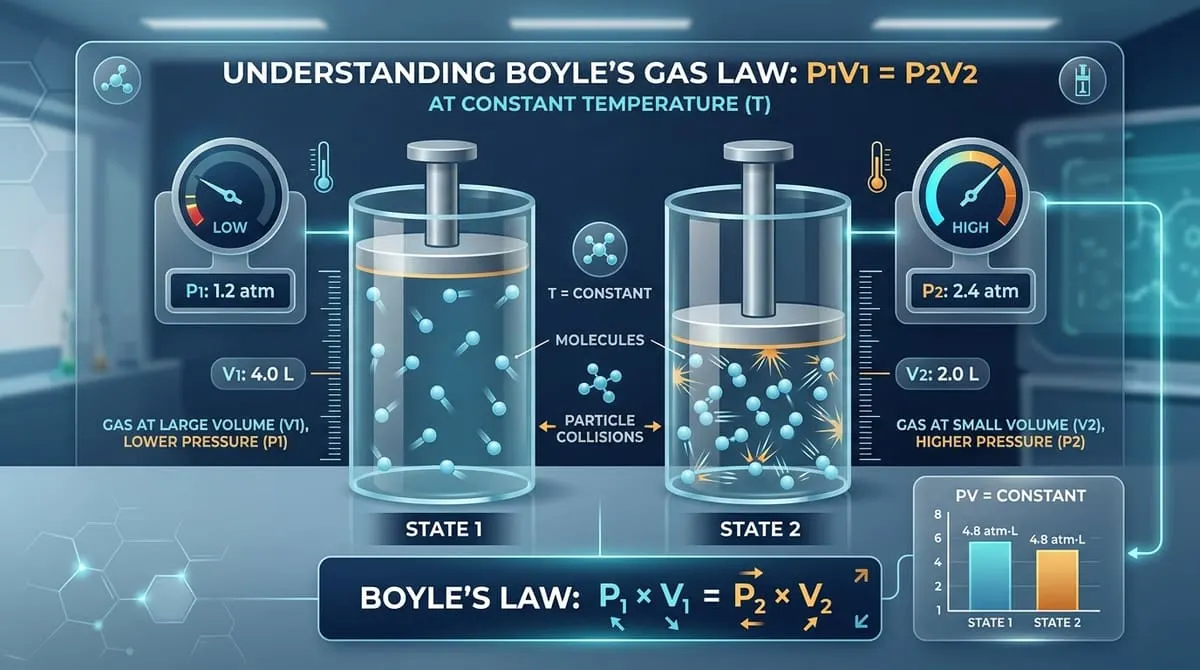
1. Introduction & Conceptual Overview
Imagine slowly pushing down the plunger of a bicycle tire pump while covering the nozzle firmly with your thumb. As you force the piston downward, the volume of air trapped inside shrinks. Simultaneously, the resistance against your hand escalates exponentially until pushing any further becomes nearly impossible.
What physical phenomenon explains this dramatic surge in opposing force? Why do the bubbles released by deep-sea scuba divers expand in size as they float toward the surface? Why do bags of potato chips puff up like small pillows when carried onto high-altitude commercial airline flights?
Every single one of these physical, mechanical, and biological behaviors is governed by Boyle's Gas Law (often referred to simply as Boyle's Law).
Formulated in 1662 by Anglo-Irish natural philosopher Robert Boyle, this foundational principle establishes the quantitative inverse relationship between the absolute pressure () and the volume () of a fixed mass of gas maintained at a constant thermodynamic temperature ().
graph TD
    A["🔒 Closed System
(Constant Temperature T & Fixed Gas Moles n)"] --> B{"Thermodynamic Action"}
    B -->|"Compress Volume (V ↓)"| C["Dense Molecular Packing
Frequency of Wall Collisions ↑"]
    C --> D["📈 Gas Pressure Increases (P ↑)"]
    B -->|"Expand Volume (V ↑)"| E["Dispersed Molecular Packing
Frequency of Wall Collisions ↓"]
    E --> F["📉 Gas Pressure Decreases (P ↓)"]
    D --> G["P₁V₁ = P₂V₂ = Constant (k)"]
    F --> G
flowchart LR
subgraph S1["📦 Large Initial Volume"]
P1["Pressure: P₁ = 1.0 atm"]
V1["Volume: V₁ = 4.0 L"]
end
subgraph S2["⚖️ Halved Volume"]
P2["Pressure: P₂ = 2.0 atm"]
V2["Volume: V₂ = 2.0 L"]
end
subgraph S3["⚡ Quarter Volume"]
P3["Pressure: P₃ = 4.0 atm"]
V3["Volume: V₃ = 1.0 L"]
end
S1 -->|"Compress to 1/2 V"| S2
S2 -->|"Compress to 1/4 V"| S3Boyle's Law Isothermal Invariance:
In all three states, the product .
As volume shrinks by 50%, absolute pressure strictly doubles.
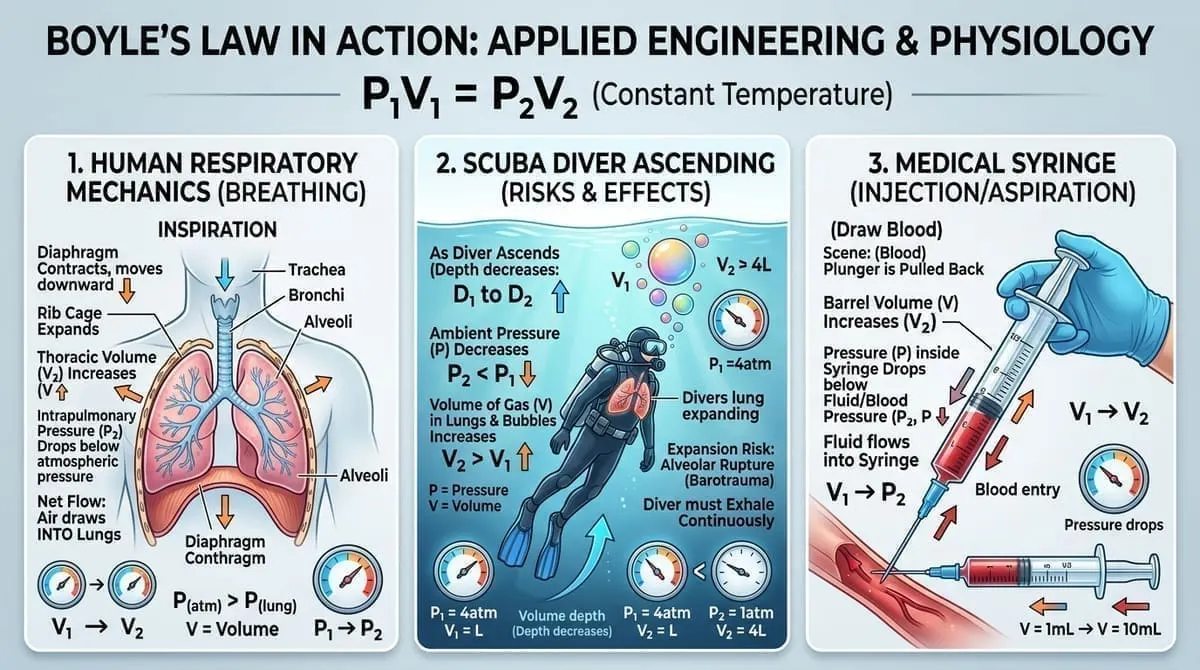
Why Boyle's Law Matters Today
- Human Respiratory Physiology: The entire mechanism of human breathing (inspiration and expiration) operates strictly on Boyle's Law as our diaphragm alters thoracic volume to generate negative intrapulmonary pressure gradients.
- Hyperbaric Medicine & Scuba Diving Safety: Safe diving ascent profiles, decompression stops, and the prevention of fatal arterial gas embolisms (pulmonary barotrauma) rely directly on Boyle's Law calculations.
- Aerospace & High-Altitude Pressurization: Aircraft cabin pressure regulation, spacesuit life-support seals, and weather balloon payload buoyancy systems require exact volumetric forecasting.
- Internal Combustion Engines & Pneumatics: Diesel engine ignition stroke compression, industrial pneumatic actuators, air brake reservoirs, and cryogenic gas bottling rely on pressure-volume equations.
- Chemical Synthesis & High-Pressure Reactors: Regulating gas-phase reactant concentrations and reaction kinetics in closed autoclaves at isothermal baselines.
2. Chemical Definition & Theory
2.1 Simple Definition (Everyday Language)
In everyday terms, Boyle's Law states: > "If you squeeze a gas into a smaller container without changing its temperature, its pressure goes up. If you let a gas expand into a bigger container, its pressure goes down."
Pressure and volume are inversely proportional. When one doubles, the other is cut in half.
2.2 Technical Definition (Thermodynamics & Physical Chemistry)
Formally, Boyle's Law states that for a fixed quantity ( moles) of an ideal gas held at a constant absolute temperature ( in Kelvin), the absolute pressure () exerted by the gas is inversely proportional to the volume () occupied:
Where is a constant characteristic of the thermodynamic state of the gas system:
Because the product of pressure and volume remains strictly invariant throughout any isothermal process between state 1 and state 2:
Where:
- = Initial absolute pressure (, , , , or )
- = Initial gas volume (, , , , or )
- = Final absolute pressure (same unit as )
- = Final gas volume (same unit as )
2.3 The Kinetic Molecular Theory (KMT) Analogy
To intuitively grasp why pressure increases when volume decreases, picture a basketball gymnasium containing 50 energetic children who are running in straight lines at constant speeds and bouncing elastically off the gym walls.
flowchart LR
    subgraph BigV["📦 Large Volume (Low P)"]
        B1["Dispersed Gas Molecules
Long Mean Free Path
Fewer Collisions / sec on Walls"]
    end

    subgraph SmallV["⚡ Small Volume (High P)"]
        S1["Packed Gas Molecules
Halved Distance to Walls
2× Collision Frequency = Double Pressure"]
    end

    BigV -->|"Compress Piston (V → V/2)"| SmallV
3. History & Discovery Timeline
The discovery of Boyle's Law marked a historic turning point in the history of science: the transition from qualitative alchemy to quantitative, empirical physics and chemistry.
timeline
    title Historical Evolution of Gas Mechanics & Boyle's Law
    1643 : Evangelista Torricelli invents the Mercury Barometer & discovers Atmospheric Pressure
    1650 : Otto von Guericke invents the Vacuum Pump (Magdeburg Hemispheres Demonstration)
    1660 : Robert Boyle & Robert Hooke construct the Advanced Pneumatic Air Pump
    1662 : Robert Boyle publishes "New Experiments Physico-Mechanicall" establishing P1V1 = P2V2
    1676 : Edme Mariotte independently discovers and formalizes temperature constancy ("Mariotte's Law")
    1738 : Daniel Bernoulli derives Boyle's Law mathematically using Kinetic Atomic Collision Theory
    1834 : Émile Clapeyron integrates Boyle, Charles & Avogadro laws into the Ideal Gas Law (PV = nRT)
    1873 : Johannes Diderik van der Waals publishes real gas equation accounting for molecular volume
Major Milestones & Figures
- The J-Tube Experiment (1660–1662): Robert Boyle, assisted by the brilliant experimental architect Robert Hooke, poured mercury into a giant 12-foot tall glass J-shaped tube, trapping a small pocket of air in the sealed shorter limb. By measuring the height of the mercury column (which added hydrostatic pressure) and the shrinking length of the trapped air column, Boyle demonstrated mathematically that volume diminished in exact inverse proportion to the total applied pressure.
- Edme Mariotte's Clarification (1676): French physicist Edme Mariotte independently observed the same mathematical relationship. Crucially, Mariotte explicitly stated that the temperature of the air must remain strictly constant throughout the experiment. For this reason, in France and parts of continental Europe, the equation is known as Boyle-Mariotte's Law.
- Bernoulli's Kinetic Formulation (1738): Swiss mathematician Daniel Bernoulli published Hydrodynamica, demonstrating that gas pressure is simply the cumulative mechanical impulse of billions of microscopic submicroscopic atoms colliding with solid surfaces.
4. Core Concepts & Variables
To apply Boyle's Law accurately in chemical calculations and engineering scenarios, several fundamental thermodynamic parameters must be defined:
| Parameter | Symbol | Standard SI Unit | Common Lab Units | Description & Role |
|---|---|---|---|---|
| Absolute Pressure | , , , , | Force per unit area exerted by gas molecules colliding against container walls. Must be absolute, never gauge! | ||
| Gas Volume | , , , | The 3D spatial capacity occupied by the gas. Gases expand to uniformly fill any accessible container volume. | ||
| Absolute Temperature | (never !) | Proportional to the mean translational kinetic energy () of gas particles. Must remain strictly constant. | ||
| Amount of Substance | , , | The total number of gas particles (). The container must be sealed with no leaks. | ||
| Boyle's Constant | or | , , | The product , equivalent to . Represents total isothermal internal energy scaling. |
The Critical Distinction: Absolute Pressure vs. Gauge Pressure
One of the most frequent errors in gas law calculations involves confusing Gauge Pressure () with Absolute Pressure ():
- Gauge Pressure (): The pressure measured relative to ambient local atmospheric pressure (e.g., tire pressure gauges read when detached, despite being surrounded by of atmospheric air).
- Absolute Pressure (): The true thermodynamic pressure relative to a complete, absolute vacuum ().
Gas Laws Require Absolute Pressure!
If a problem states that a cylinder has a gauge pressure of at sea level ( ambient), you must use in Boyle's Law. Using will produce a completely incorrect volume!
5. Mathematical Derivations & Formulas
5.1 The Four Algebraic Variations of
Depending on which variable is unknown in a given laboratory or engineering scenario, the core Boyle's Law equation can be algebraically isolated into four distinct single-step solvers:
flowchart TD
    ROOT["🎯 Core Equation: P₁ · V₁ = P₂ · V₂
Isothermal Invariant Product: k = nRT"]

    ROOT --> B1["🔵 Solve for Initial Pressure (P₁)"]
    ROOT --> B2["🟢 Solve for Initial Volume (V₁)"]
    ROOT --> B3["🟠 Solve for Final Pressure (P₂)"]
    ROOT --> B4["🟣 Solve for Final Volume (V₂)"]

    B1 --> F1["P₁ = (P₂ · V₂) / V₁"]
    B2 --> F2["V₁ = (P₂ · V₂) / P₁"]
    B3 --> F3["P₂ = (P₁ · V₁) / V₂"]
    B4 --> F4["V₂ = (P₁ · V₁) / P₂"]
5.2 Derivation from the Ideal Gas Law ()
To prove why Boyle's Law is valid from foundational thermodynamics: 1. Start with the general equation of state for an ideal gas: 2. In an isothermal process (constant temperature, ) within a closed system (no gas leakage, ): 3. Therefore, at State 1: 4. At State 2 (after compression or expansion at the same temperature): 5. Because both products equal the identical thermodynamic quantity :
5.3 Isothermal Boundary Work Equation (Thermodynamics)
When a gas expands or contracts isothermally according to Boyle's Law (), the boundary work performed on or by the surroundings is calculated by integrating the pressure over volume:
- If (Isothermal Expansion): (The gas performs positive mechanical work on surroundings).
- If (Isothermal Compression): (Surroundings perform work on the gas to compress it).
6. Graphical Representations of Boyle's Law
In experimental physical chemistry, data from Boyle's Law can be plotted in three distinct graphical formats:
flowchart LR
    subgraph G1["📈 1. P vs. V (Isotherm)"]
        A1["Rectangular Hyperbola
As V → 0, P → ∞
As V → ∞, P → 0"]
    end
    subgraph G2["📏 2. P vs. 1/V (Linearized)"]
        A2["Straight Line through Origin (0,0)
Slope m = k = nRT
Proves Ideal Behavior"]
    end
    subgraph G3["➖ 3. PV vs. P (Invariance)"]
        A3["Horizontal Flat Line (Slope = 0)
PV Product Constant at all P
Deviations reveal Real Gas forces"]
end- versus (The Isotherm): Produces a smooth rectangular hyperbola. As volume approaches zero, pressure asymptotically approaches infinity (). As volume approaches infinity, pressure approaches zero ().
- versus $1/V$ (The Linearized Plot): Plotting pressure against the reciprocal of volume yields a straight line passing through the origin $(0,0)$ with slope equal to . This plot is widely used in undergraduate laboratory courses to empirically verify that a gas follows ideal behavior.
- versus : A perfectly horizontal line with zero slope. Any upward or downward deflection at extreme pressures indicates non-ideal real gas deviations (intermolecular forces or particle volume effects).
7. Step-by-Step Problem Solving Workflow
Follow this 5-step foolproof algorithm to solve any Boyle's Law calculation without making algebraic or unit errors:
flowchart TD
    S1["1️⃣ Identify & Tabulate Inputs
Extract P₁, V₁, P₂, V₂ from question"] --> S2{"Check Temperature
& Closed System"}
    S2 -->|"Temperature Changes"| S2E["⚠️ Stop! Use Combined Gas Law (P₁V₁/T₁ = P₂V₂/T₂)"]
    S2 -->|"Constant Temperature"| S3["2️⃣ Convert to Absolute Units
Convert Gauge P to Absolute P
Match V units (L with L, mL with mL)"]
    S3 --> S4["3️⃣ Select Rearranged Formula
V₂ = (P₁ · V₁) / P₂   or   P₂ = (P₁ · V₁) / V₂"]
    S4 --> S5["4️⃣ Execute Arithmetic & Calculate
Compute product k = P₁ · V₁, then divide"]
    S5 --> S6["5️⃣ Sanity Check Intuition
Did Volume shrink? Then Pressure MUST be higher!
Did Pressure drop? Then Volume MUST be larger!"]
8. Real-World Practical Examples & Calculations
Example 1: Syringe Air Pocket Compression
- Scenario: A medical research syringe contains of air at standard atmospheric pressure (). A laboratory technician seals the tip airtight and compresses the plunger down to a volume of while keeping the temperature constant.
- Given: , , , .
- Unknown: Final pressure inside syringe ().
- Calculation:
- Interpretation: Decreasing the air volume by a factor of 4 increases the internal air pressure fourfold (to or ).
Example 2: Weather Balloon Stratospheric Expansion
- Scenario: A high-altitude meteorological weather balloon is inflated with helium to a volume of at sea level where the barometric pressure is . The balloon ascends into the upper troposphere where the ambient atmospheric pressure drops to . Assuming isothermal conditions in this atmospheric layer:
- Given: , , .
- Unknown: Final balloon volume ().
- Calculation:
- Interpretation: Because external atmospheric pressure drops to one-fifth (20%) of its surface value, the helium expands to 5 times its initial volume (). This is why weather balloons appear underinflated and flaccid at launch—they must leave room for dramatic volumetric expansion!
Example 3: Scuba Diver Ascent & Lung Volume
- Scenario: A scuba diver takes a full breath of air holding in their lungs at a depth of underwater (where hydrostatic water pressure equals absolute). If the diver were to panic and rapidly ascend to the surface () while mistakenly holding their breath:
- Given: , , .
- Unknown: Potential expanded lung volume ().
- Calculation:
- Medical Consequence: Human adult lungs can only safely stretch to approximately before alveoli rupture, causing tension pneumothorax or fatal arterial gas embolisms. Rule #1 of Scuba Diving: NEVER hold your breath while ascending!
Example 4: Compressed Gas Storage Cylinder Decanting
- Scenario: A industrial steel tank stores argon gas at a high pressure of . How many liters of argon gas can this tank deliver to an inert-atmosphere welding chamber at atmospheric pressure () at constant temperature?
- Given: , , .
- Calculation:
- Net Usable Gas Volume: Because remains trapped in the cylinder at when pressure equalizes with ambient air, the net deliverable volume is .
9. Comprehensive Comparison Table: The Classical Gas Laws
Boyle's Law is one of four historic empirical gas laws that unite to form the Ideal Gas Law. Understanding how each law holds different variables constant is key to mastering physical chemistry:
| Gas Law | Governing Formula | Constant Variables | Variable Relationship | Discovered By | Primary Application |
|---|---|---|---|---|---|
| Boyle's Law | Temperature (), Moles () | Inverse () | Robert Boyle (1662) | Scuba diving, syringes, respiration, pneumatic brakes | |
| Charles's Law | Pressure (), Moles () | Direct ($V \propto T$) | Jacques Charles (1787) | Hot air balloons, thermal expansion of balloons in winter | |
| Gay-Lussac's Law | Volume (), Moles () | Direct ($P \propto T$) | J.L. Gay-Lussac (1809) | Pressure cookers, automobile tire pressure spikes in summer | |
| Avogadro's Law | Pressure (), Temperature () | Direct ($V \propto n$) | Amedeo Avogadro (1811) | Inflating tires/balls with air pump, chemical molar volumes | |
| Combined Gas Law | Moles () | Multi-variable () | Clapeyron (1834) | Atmospheric meteorology, internal combustion engines | |
| Ideal Gas Law | Universal Constant () | Universal Equation of State | Clapeyron / Clausius | Industrial reactors, stoichiometry, rocket thrust chambers |
10. Deep-Dive Case Studies
Case Study 1: Human Respiratory Biomechanics (The Thoracic Pump)
graph TD
    A["Inhalation Triggered
Diaphragm contracts downwards & External Intercostals expand ribs"] --> B["Thoracic Cavity Volume Expands (V₁ → V₂ ↑)"]
    B --> C["Intrapulmonary Pressure Drops Below Atmospheric
(P₂ = 757 mmHg vs. Patm = 760 mmHg)"]
    C --> D["Pressure Gradient Forces Ambient Air into Lungs (ΔP = -3 mmHg)"]
    D --> E["Exhalation Triggered
Diaphragm relaxes upwards & Chest wall recoils"]
    E --> F["Thoracic Volume Shrinks (V₂ → V₁ ↓)"]
    F --> G["Intrapulmonary Pressure Rises Above Atmospheric
(P₂ = 763 mmHg vs. Patm = 760 mmHg)"]
G --> H["Air Forced Outward into Environment (ΔP = +3 mmHg)"]- Physiological Analysis: The human body does not possess an active vacuum motor. Instead, we breathe by manipulating thoracic volume. In accordance with Boyle's Law, when our diaphragm expands the thoracic volume by just (the normal resting Tidal Volume, ), intrapulmonary pressure drops from down to approximately ( gauge). This minute pressure differential draws of ambient oxygen-rich air through our trachea and into the alveoli.
Case Study 2: Deep-Sea Marine Exploration & Fish Swim Bladder Ruptures
- Background: Bony teleost fishes regulate their neutral buoyancy in the ocean using an internal organ called a swim bladder (a gas-filled sac).
- The Problem: Deep-sea rockfish caught at a depth of ( hydrostatic pressure) and rapidly reeled to the ocean surface () experience a 10-fold volumetric expansion () of the gas inside their swim bladder within minutes.
- Result: Because the fish cannot resorb nitrogen gas into its bloodstream fast enough, the expanding swim bladder pushes the stomach out through the fish's mouth and can cause fatal organ trauma (barotrauma). Modern marine conservationists use specialized descender rigs to return fish to their original depths, reversing the expansion via Boyle's Law and saving their lives.
11. Deviations from Ideality: When Does Boyle's Law Fail?
Boyle's Law is formulated for an Ideal Gas, which assumes: 1. Gas particles have zero volume (point masses). 2. No attractive or repulsive intermolecular forces exist between gas molecules.
In real-world physical chemistry, Real Gases deviate from Boyle's Law under specific extreme conditions:
flowchart TD
    COND["⚠️ Extreme Real Gas Conditions"]

    COND --> P_HIGH["🔴 Ultra-High Pressure (P > 50 atm)"]
    COND --> T_LOW["🔵 Cryogenic Low Temperature (T near condensation)"]

    P_HIGH --> D1["Molecules compressed into close contact
Particle volume is no longer negligible
👉 Actual Volume > Ideal Volume"]
    T_LOW --> D2["Kinetic velocities slow down significantly
Intermolecular attractions (Van der Waals) dominate
👉 Actual Pressure < Ideal Pressure"]

    D1 --> SOL["🛠️ Must Use Van der Waals Equation:
(P + a·n²/V²)(V - n·b) = nRT"]
D2 --> SOLRule of Thumb for Ideality:
Boyle's Law is exceptionally accurate () for common atmospheric gases () at standard temperatures ( to ) and moderate pressures ( to ). Deviations become significant only under cryogenic refrigeration conditions or in ultra-high-pressure hydraulic/pneumatic accumulators ().
12. Common Student Mistakes & How to Avoid Them
| Common Error | Why It Occurs | Correct Approach |
|---|---|---|
| Using Gauge Pressure instead of Absolute Pressure | Reading tire gauges or manometer dials without adding local atmospheric pressure. | Always add atmospheric pressure ( or ) to gauge pressure: . |
| Mismatched Units ( in , in ) | Directly multiplying numbers without checking dimension compatibility. | Convert both pressures to the same unit (e.g., ) before computing. |
| Applying Boyle's Law during Temperature Changes | Overlooking that the system was heated or cooled during compression. | Verify that temperature () is constant. If temperature varies, you must switch to the Combined Gas Law (). |
| Direct Multiplication instead of Inverse Division | Confusing direct proportions () with inverse products (). | Double-check: , never ! |
| Assuming Moles () can change | Applying the formula to open or leaking containers. | Boyle's Law strictly requires a sealed, closed container with zero mass transfer. |
13. Frequently Asked Questions (FAQ)
Q1: What is the fundamental formula of Boyle's Law?
A: The fundamental equation is , which states that the product of initial pressure () and initial volume () is equal to the product of final pressure () and final volume () for a fixed amount of gas at constant temperature.
Q2: Why is temperature kept constant in Boyle's Law?
A: Temperature is proportional to the average kinetic speed of gas molecules. If temperature changes, particle velocities change, altering impact force independently of volume changes. To isolate the pure mathematical relationship between pressure and volume, temperature must remain strictly invariant (isothermal).
Q3: What units should I use for pressure and volume?
A: You can use any valid pressure unit (, , , , , ) and any volume unit (, , , , ), as long as and share the same unit and and share the same unit.
Q4: How does Boyle's Law explain human breathing?
A: When your diaphragm contracts downward, it enlarges the volume of your chest cavity. According to Boyle's Law, this volume expansion causes air pressure inside your lungs to drop below outdoor atmospheric pressure, causing ambient air to naturally rush inward to equalize the gradient.
Q5: What is the difference between Boyle's Law and Charles's Law?
A: Boyle's Law examines the inverse relationship between pressure and volume at constant temperature (). Charles's Law examines the direct relationship between volume and temperature at constant pressure ().
Q6: What happens to gas density when volume is halved according to Boyle's Law?
A: Because mass () is constant and density is , halving the volume () doubles the density () while simultaneously doubling the pressure (). Gas density is directly proportional to pressure under isothermal conditions.
Q7: Why do deep-sea fish eyes pop when brought to the surface?
A: At deep ocean depths, gases in bodily fluids and closed tissues are equilibrated to high ambient hydrostatic pressure. Rapid ascent to low surface pressure causes trapped gases to expand rapidly (Boyle's Law), causing tissue distention, orbital pop-eye barotrauma, and swim bladder eversion.
Q8: What does a vs. graph look like for Boyle's Law?
A: A plot of pressure on the y-axis versus volume on the x-axis forms a smooth, downward-sloping rectangular hyperbola (an isotherm). Plotting versus $1/V$ produces a straight line through the origin.
Q9: Can Boyle's Law be used for liquids and solids?
A: No. Liquids and solids are condensed states of matter and are virtually incompressible under typical pressures (). Boyle's Law applies exclusively to compressible fluids (gases and vapors).
Q10: What is Boyle's constant ()?
A: Boyle's constant is the numerical product . In foundational thermodynamics, , representing the fixed thermal energy scale of the gas sample.
Q11: What is an isothermal process?
A: An isothermal process is a thermodynamic transformation of a system during which the temperature remains strictly constant (). Boyle's Law is the equation of state for ideal isothermal gas processes.
Q12: Why do potato chip bags swell in an airplane?
A: Commercial airplane passenger cabins are pressurized to an equivalent altitude of approximately (), which is lower than sea level (). As ambient external pressure drops, the air sealed inside the bag at sea level expands in volume.
Q13: Does Boyle's Law apply to gas mixtures like air?
A: Yes. Because Dalton's Law of Partial Pressures states that ideal gas mixtures behave collectively as a single unified gas, air (a mixture of , , ) obeys Boyle's Law precisely at ambient conditions.
Q14: How does a bicycle pump demonstrate Boyle's Law?
A: When you press the piston, the cylinder volume decreases. This compresses the air molecules into a smaller space, elevating the pressure until it exceeds the tire's internal valve pressure, forcing air into the tire.
Q15: What equation replaces Boyle's Law when temperature also changes?
A: When temperature varies alongside pressure and volume, use the Combined Gas Law:
14. Key Takeaways & Summary
- Inverse Proportionality: Absolute pressure and volume are inversely proportional for a fixed mass of gas at constant temperature ().
- Invariant Constant: The product of pressure and volume remains strictly invariant throughout any isothermal step: .
- Absolute Units Required: Calculations must always be performed using absolute pressures ().
- Kinetic Collision Mechanism: Compressing a gas into smaller volume brings container walls closer together, increasing particle collision frequency per unit area and raising outward physical force.
- Broad Modern Applications: Boyle's Law underpins pulmonary medicine, SCUBA diving safety tables, syringe operation, atmospheric ballooning, pneumatic robotics, and industrial gas decanting.
Additional Technical Guidelines & Measurement Standards
When conducting calculations for Boyle's Gas Law P1V1 = P2V2 Solver, maintaining quantitative precision and verifying input parameter boundaries is essential for reliable scenario evaluation. Always verify that raw numerical inputs are measured using standardized instrumentation, and double-check unit conversions prior to applying outputs in commercial, industrial, or academic projects.
For quantitative unit conversions and scientific calculations, always maintain at least four decimal places of precision during intermediate arithmetic stages before rounding final results. When preparing technical reports, laboratory documentation, or financial forecasts, cross-verify all output variables against established international measurement standards (such as SI, NIST, and ISO metric benchmarks) to guarantee consistent analytical rigor across all computational workflows.
MathsLover.com delivers this interactive solver 100% free of charge to foster global mathematical literacy, educational accessibility, and data-driven problem solving across scientific, technical, and academic communities worldwide.