💡 Direct Answer & Executive Summary (Charles's Gas Law V1/T1 = V2/T2 Solver)
Definition: Chemical stoichiometry calculation: Charles's Gas Law V1/T1 = V2/T2 Solver.
Governing Math Formula: V1 / T1 = V2 / T2 (at Constant Pressure P and Fixed Gas Mass n). Temperatures must be in absolute Kelvin (K = °C + 273.15). Solving V2 = (V1 × T2) / T1, or T2 = (V2 × T1) / V1.
Target Applications: Provides real-time quantitative solutions in Chemistry for students, engineers, researchers, and finance professionals.
Charles's Gas Law (): Comprehensive Chemistry & Thermodynamics Guide
1. Introduction & Conceptual Overview
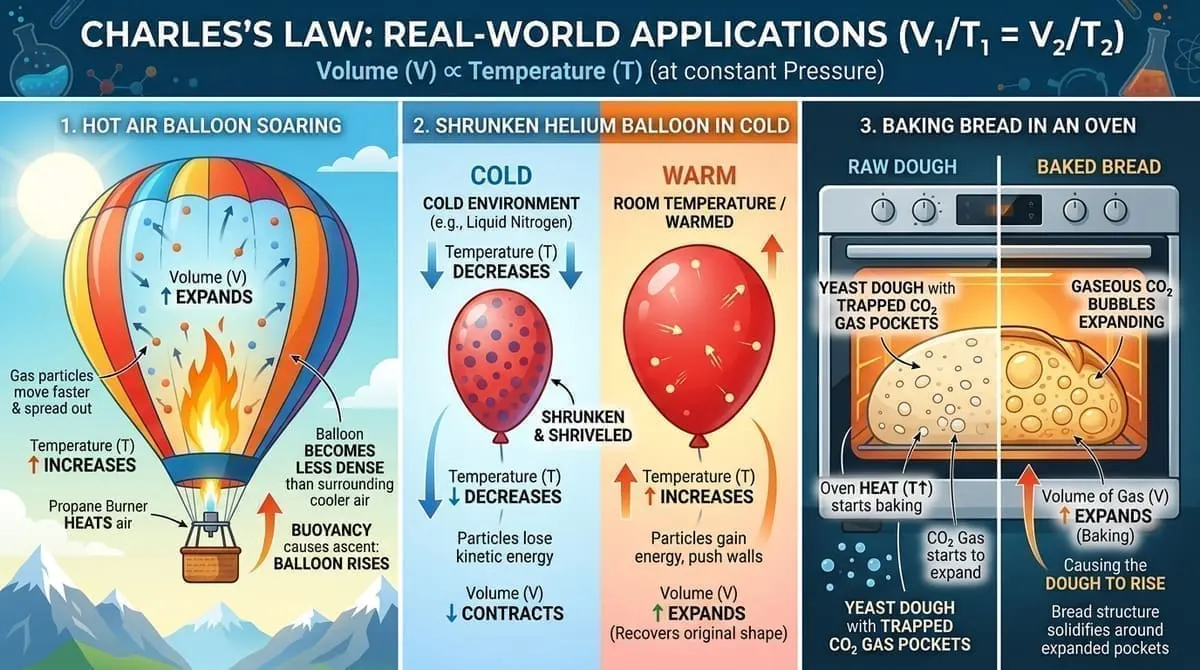
Why does a vibrant helium balloon left in a freezing cold car overnight shrink and look completely deflated by morning, only to plump back up into a full, taut sphere when brought into a warm living room? How do monumental hot air balloons weighing several tons achieve majestic atmospheric buoyancy and float gracefully across the sky? Why does freshly baked bread dough rise so dramatically inside a hot oven?
All of these everyday, industrial, and meteorological phenomena are governed by one of the most fundamental principles in physical chemistry: Charles's Gas Law (frequently referred to simply as Charles's Law, or the Law of Charles and Gay-Lussac).
Discovered experimentally in 1787 by French inventor and scientist Jacques Alexandre César Charles and formalized mathematically in 1802 by Joseph Louis Gay-Lussac, this classical gas law establishes the direct, linear relationship between the volume () of a gas and its absolute thermodynamic temperature (), provided that pressure () and the mass of the gas () remain strictly constant.
graph TD
    A["🔒 Isobaric System
(Constant Pressure P & Fixed Moles n)"] --> B{"Thermodynamic Heating / Cooling"}
    B -->|"Thermal Heating (T ↑)"| C["Molecules Gain Kinetic Speed (v_rms ↑)
Harder, More Frequent Collisions"]
    C --> D["Container Expands to Equalize P
📈 Gas Volume Expands (V ↑)"]
    B -->|"Thermal Cooling (T ↓)"| E["Molecules Lose Kinetic Speed (v_rms ↓)
Gentler, Less Frequent Collisions"]
    E --> F["Container Contracts under External P
📉 Gas Volume Contracts (V ↓)"]
    D --> G["V₁ / T₁ = V₂ / T₂ = Constant (k)"]
    F --> G
flowchart LR
subgraph S1["❄️ Cryogenic State"]
T1["Temperature: 100 K (-173°C)"]
V1["Volume: 1.00 L"]
end
subgraph S2["🌡️ Room Temp State"]
T2["Temperature: 300 K (+27°C)"]
V2["Volume: 3.00 L"]
end
subgraph S3["🔥 Boiling Heat State"]
T3["Temperature: 600 K (+327°C)"]
V3["Volume: 6.00 L"]
end
S1 -->|"Heating (+200 K)"| S2
S2 -->|"Heating (+300 K)"| S3Charles's Law Isobaric Invariance:
Throughout all states under constant pressure, the ratio remains constant.
Key Rule: Temperatures must always be converted to absolute Kelvin ().
Why Charles's Law Matters Today
- Hot Air Balloon Flight & Aerostatics: By heating the internal air envelope to over (), the air expands, reducing its density () relative to ambient cold air and producing buoyancy lift governed by Archimedes' principle.
- Cryogenic Fluid Storage & Boil-Off Safety: Liquid nitrogen (), liquid oxygen, and liquefied natural gas () expand over in volume when warmed to room temperature, requiring precision pressure relief valves to prevent catastrophic BLEVE (Boiling Liquid Expanding Vapor Explosion) ruptures.
- Atmospheric Meteorology & Thermal Convection: Solar heating warms ground air, which expands, lowers density, and rises to form thermal updrafts, cumulus clouds, thunderstorm supercells, and global Hadley circulation cells.
- Culinary Arts & Food Science: When bread, soufflés, and cakes bake, trapped micro-pockets of steam and carbon dioxide gas () undergo rapid thermal expansion, puffing the dough into a light, airy crumb structure before proteins solidify.
- Automotive Tire Dynamics: In cold winter months, ambient freezing drops the internal temperature of tire air, causing volumetric contraction and triggering the dashboard TPMS (Tire Pressure Monitoring System) low-pressure warning.
2. Chemical Definition & Physical Theory
2.1 Simple Definition (Everyday Language)
In plain English: > "When you heat a gas up, it expands and takes up more space. When you cool a gas down, it shrinks and takes up less space—as long as the surrounding pressure stays the same."
Volume and absolute temperature are directly proportional. If you double the absolute temperature (e.g., heating from to ), the volume of the gas doubles.
2.2 Technical Definition (Thermodynamics & Physical Chemistry)
Formally, Charles's Law states that for a given mass ( moles) of an ideal gas held at a constant pressure (), the volume () occupied by the gas is directly proportional to its absolute thermodynamic temperature (, expressed in Kelvin):
Where is an isobaric proportionality constant:
Because the quotient of volume and absolute temperature remains invariant across any isobaric state transformation:
Where:
- = Initial gas volume ()
- = Initial absolute temperature (Kelvin, )
- = Final gas volume (same volume unit as )
- = Final absolute temperature (Kelvin, )
2.3 The Kinetic Molecular Theory (KMT) Analogy
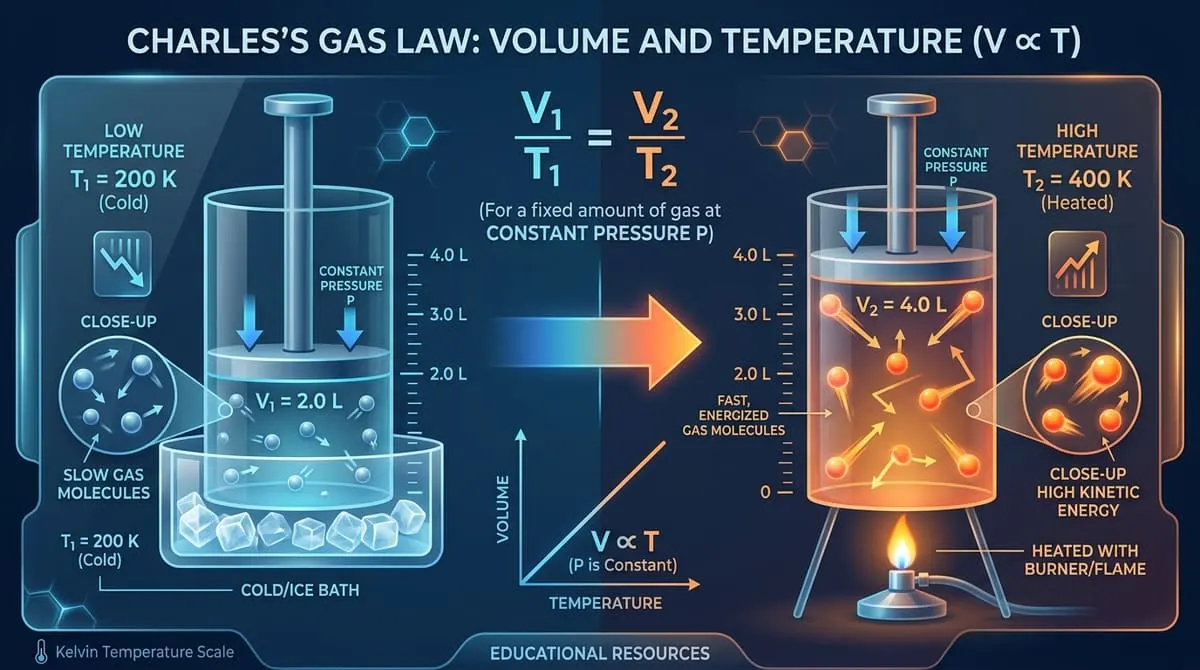
To understand the microscopic physics occurring at the atomic level, consider a movable cylinder ceiling with gas molecules trapped below:
- At Cold Temperature (): Gas particles have lower thermal kinetic energy (). They move relatively slowly, colliding against the container walls and movable piston with low force and low frequency. The external atmospheric weight pushes the piston downward to a smaller volume ().
- When Heat is Added (): Adding heat causes molecules to absorb kinetic energy. Their root-mean-square speed increases dramatically ().
- Piston Displacement to Equalize Pressure: Because the molecules are now moving much faster, they strike the piston with far greater momentum. This momentary increase in internal outward force pushes the movable piston upward, expanding the volume until the internal collision frequency per unit area drops back down to exactly match the external atmospheric pressure.
- Conclusion: Under constant pressure, the gas must expand its volume to compensate for the higher speed of its particles!
flowchart LR
    subgraph Cold["❄️ Cold Gas (T₁ = 200 K)"]
        C1["Low Kinetic Energy (E_k ↓)
Molecules move slowly
Smaller Volume: V₁ = 2.0 L"]
    end

    subgraph Hot["🔥 Heated Gas (T₂ = 400 K)"]
        H1["High Kinetic Energy (E_k ↑)
Molecules move rapidly
Expanded Volume: V₂ = 4.0 L"]
    end

    Cold -->|"Heat Energy Added (ΔT = +200 K)
Molecules push piston outward"| Hot
3. History & The Discovery of Absolute Zero
The discovery of Charles's Law is directly responsible for the discovery of Absolute Zero ( or )—one of the most profound physical constants in modern science.
timeline
    title Historical Milestones: Charles's Law & Absolute Zero
    1702 : Guillaume Amontons discovers that air pressure decreases linearly towards a zero temperature point
    1787 : Jacques Charles constructs first hydrogen balloon & discovers volume-temperature proportionality
    1802 : Joseph Louis Gay-Lussac publishes precise quantitative measurements: V increases by 1/267 per °C
    1848 : Lord Kelvin (William Thomson) extrapolates Charles's Law lines to intersect zero volume at -273.15°C
    1859 : Rudolf Clausius establishes modern Kinetic Theory connecting absolute temperature to molecular energy
The Discovery of Absolute Zero via Extrapolation
When 19th-century scientists plotted the volume of various real gases () at different experimental temperatures, they discovered a striking geometric pattern:
flowchart LR
    AZ["❄️ Absolute Zero
-273.15°C (0 Kelvin)
(Volume Extrapolates to Zero)"]

    AZ -->|"Isobaric Heating"| G1["🎈 Light Gas (He / H₂)
V = k₁ · T"]
    AZ -->|"Isobaric Heating"| G2["💨 Air / Nitrogen (N₂)
V = k₂ · T"]
    AZ -->|"Isobaric Heating"| G3["🧪 Heavy Gas (CO₂)
V = k₃ · T"]
No matter what gas was tested or what initial volume it possessed, every single linear isobaric line extrapolated backward converged at the exact same temperature on the horizontal axis: .
In 1848, British physicist Lord Kelvin (William Thomson) realized that at , the theoretical volume of an ideal gas would contract to zero, because all translational molecular kinetic motion ceases completely. Kelvin established this temperature as the absolute zero baseline of nature: .
4. The Absolute Temperature Requirement: Why Celsius Fails
The Most Common Error in All of Chemistry:
Never, ever insert Celsius () or Fahrenheit () values directly into Charles's Law! You MUST convert all temperatures to Kelvin () before calculating!
Why Celsius Leads to Mathematical Absurdity
Consider a gas with an initial volume of at . Suppose you warm the gas to .
- The Incorrect Celsius Calculation:(Incorrect: assumes energy doubled, producing a 100% computational error!)Did the thermal kinetic energy of the molecules actually double? No! Going from to is merely warming from to —a modest 3.5% increase in kinetic energy, not 100%!
- The Correct Kelvin Calculation:(Correct: true thermodynamic volumetric expansion is only )
Furthermore, if the initial temperature were , a Celsius formula would divide by zero (); if the temperature were , it would predict an impossible "negative volume"!
Temperature Conversion Formulas
5. Mathematical Formulas & Algebraic Solvers
5.1 The Four Algebraic Variations of
By cross-multiplying (), any single unknown variable can be isolated in one step:
flowchart TD
    ROOT["🎯 Core Equation: V₁ / T₁ = V₂ / T₂
Cross-Multiplication: V₁ · T₂ = V₂ · T₁"]

    ROOT --> B1["🔵 Solve for Initial Volume (V₁)"]
    ROOT --> B2["🟢 Solve for Initial Temp (T₁)"]
    ROOT --> B3["🟠 Solve for Final Volume (V₂)"]
    ROOT --> B4["🟣 Solve for Final Temp (T₂)"]

    B1 --> F1["V₁ = (V₂ · T₁) / T₂"]
    B2 --> F2["T₁ = (V₁ · T₂) / V₂"]
    B3 --> F3["V₂ = (V₁ · T₂) / T₁"]
    B4 --> F4["T₂ = (V₂ · T₁) / V₁"]
5.2 Derivation from the Ideal Gas Law ()
To rigorously prove Charles's Law from first principles: 1. Begin with the universal equation of state: 2. Rearrange the equation to isolate the temperature on the left-hand denominator: 3. In an isobaric process (constant pressure, ) within a closed container (constant moles, ): 4. Therefore, at State 1 and State 2: 5. Setting them equal gives Charles's Law:
5.3 Isobaric Boundary Work & Thermal Expansion
In an isobaric expansion, as the gas expands against constant external pressure , the boundary mechanical work done by the expanding gas is:
- Isobaric Volumetric Thermal Expansion Coefficient ():For an ideal gas, the thermal expansivity coefficient is:At (), . This precisely matches Gay-Lussac's historic 1802 experimental measurement!
6. Step-by-Step Problem Solving Workflow
flowchart TD
    S1["1️⃣ Extract Given Variables
Identify V₁, T₁, V₂, T₂ from prompt"] --> S2["2️⃣ Mandatory Conversion to Kelvin
T(K) = T(°C) + 273.15"]
    S2 --> S3{"Check Constant Pressure
& Fixed Gas Mass"}
    S3 -->|"Pressure Changes"| S3E["⚠️ Switch to Combined Gas Law (P₁V₁/T₁ = P₂V₂/T₂)"]
    S3 -->|"Pressure Constant"| S4["3️⃣ Choose Algebraic Rearrangement
e.g., V₂ = (V₁ · T₂) / T₁"]
    S4 --> S5["4️⃣ Execute Calculation
Compute new volume or temperature"]
    S5 --> S6["5️⃣ Sanity Check Directionality
Heated gas (T₂ > T₁)? Volume MUST increase (V₂ > V₁)!
Cooled gas (T₂ < T₁)? Volume MUST decrease (V₂ < V₁)!"]
7. Real-World Practical Examples & Calculations
Example 1: Liquid Nitrogen Cryogenic Balloon Contraction
- Scenario: A party balloon filled with helium has a volume of at room temperature (). The balloon is carefully submerged into a cryogenic bath of liquid nitrogen at at constant atmospheric pressure.
- Step 1: Convert Temperatures to Kelvin:
- Step 2: Solve for Final Volume :
- Interpretation: The balloon shrinks dramatically from down to less than (73.86% volume reduction) because helium atoms lose over 73% of their thermal kinetic speed.
Example 2: Hot Air Balloon Envelope Sizing
- Scenario: A hot air balloon is initially inflated on a cool morning at with of air. The pilot ignites the propane burner, heating the air inside the nylon envelope to an average temperature of at constant ambient atmospheric pressure.
- Step 1: Convert Temperatures to Kelvin:
- Step 2: Solve for Theoretical Expanded Volume :
- Physical Consequence: Because the balloon's physical envelope volume is fixed at , the expanding air forces of hot air out through the open bottom skirt. The remaining gas inside is significantly less dense, creating the positive buoyancy that lifts the basket.
Example 3: Finding the Heating Temperature for Desired Expansion
- Scenario: An engineering piston cylinder contains of compressed argon gas at . The design requires the gas to expand isobarically to exactly to actuate a mechanical switch. What final temperature (in ) must be reached?
- Step 1: Convert Initial Temperature to Kelvin:
- Step 2: Solve for Final Temperature :
- Step 3: Convert Final Temperature back to Celsius:
8. Comprehensive Gas Laws Comparison Table
| Gas Law | Equation | Constant Variables | Proportionality | Real-World Application |
|---|---|---|---|---|
| Charles's Law | Pressure (), Moles () | Direct ($V \propto T$) | Hot air balloons, cryogenic shrinking, oven baking | |
| Boyle's Law | Temperature (), Moles () | Inverse () | Scuba diving, syringes, lung inspiration | |
| Gay-Lussac's Law | Volume (), Moles () | Direct ($P \propto T$) | Autoclaves, pressure cookers, tire heating on highways | |
| Avogadro's Law | Pressure (), Temperature () | Direct ($V \propto n$) | Inflating sporting balls, chemical molar volumes | |
| Combined Gas Law | Moles () | Multi-variable | Rocket engines, atmospheric weather sounding | |
| Ideal Gas Law | Universal Constant () | Universal Equation of State | Chemical synthesis reactors, planetary atmospheres |
9. Deep-Dive Case Studies
Case Study 1: Hot Air Balloon Aerostatic Buoyancy & Density Shift
graph TD
    A["Burner Ignites: Heating Air inside Balloon (T₁ = 20°C → T₂ = 110°C)"] --> B["Charles's Law Expansion: Air molecules speed up and expand"]
    B --> C["Surplus Volume Expelled through Open Bottom Vent (ΔV = +30.7%)"]
    C --> D["Internal Mass Decreases (Fewer moles inside same envelope volume)"]
    D --> E["Internal Density Drops: ρ_hot = 0.92 kg/m³ vs. ρ_ambient = 1.20 kg/m³"]
    E --> F["Net Buoyancy Force Exceeds Total System Weight (F_B > W_total)"]
F --> G["🚀 Balloon Climbs into the Sky (Archimedes' Principle)"]- Engineering Breakdown: The density of an ideal gas at constant pressure is inversely related to temperature:
At sea level () with ambient air () at (), . When heated to (), density drops to . For a envelope, this density difference produces:
(This provides approximately of net aerostatic payload lift capacity).
Case Study 2: Oven Baking & The Physics of Yeast Dough "Oven Spring"
- The Culinary Scenario: When bread dough enters a commercial baking deck oven preheated to (), it experiences a sudden rapid surge in loaf volume within the first 10 minutes known as oven spring.
- Physicochemical Mechanism: During fermentation, baker's yeast () creates millions of microscopic pockets containing carbon dioxide gas (), water vapor, and air at room temperature ( or ).
- Applying Charles's Law: As heat rapidly diffuses into the dough, the trapped gas bubbles expand by a factor of:
(This produces a massive volumetric expansion). This thermal gas expansion stretches the gluten protein web and starch matrix into a light, honeycomb structure just moments before the gluten coagulates and crust sets permanently.
10. Deviations from Ideality: High Pressure and Low Temperature
Charles's Law assumes that a gas behaves ideally down to absolute zero. However, in physical reality:
flowchart TD
    A["🌡️ 1. Real Gas Cooled Towards 0 K"]
    B["🧲 2. Kinetic Velocity Drops & Van der Waals Attractions Dominate"]
    C["💧 3. Phase Change: Gas Condenses into Liquid"]
    D["🧊 4. Cryogenic Freezing: Liquid Solidifies into Solid Crystal"]
    E["⛔ 5. Real Volume Floor: Incompressible Molecular Hard Spheres (V > 0)"]

    A --> B
    B --> C
    C --> D
D --> ECondensation Limits:
Real gases only obey Charles's Law at temperatures well above their boiling (condensation) points. For example, water vapor ceases to follow Charles's Law at (condensing to liquid water), nitrogen deviates near , and helium deviates near ().
11. Common Mistakes & How to Avoid Them
| Common Mistake | Why It Happens | Solution |
|---|---|---|
| Using Celsius () in Formula | Habitually plugging in laboratory thermometer readings. | Always add $273.15$ to convert to Kelvin: . |
| Inverting Ratios () | Cross-multiplication errors when rearranging algebraically. | Remember the cross-multiplication identity: . |
| Ignoring Pressure Changes | Overlooking that the container was rigid (fixed volume) rather than flexible. | If volume is locked and pressure rises with temperature, switch to Gay-Lussac's Law (). |
| Mismatched Volume Units | Using in Liters and in Milliliters. | Convert all volumes to the same unit before solving. |
12. Frequently Asked Questions (FAQ)
Q1: What is the main formula for Charles's Law?
A: The governing mathematical formula is , stating that the ratio of volume to absolute Kelvin temperature remains constant for a fixed mass of gas at constant pressure.
Q2: Why MUST temperature be measured in Kelvin?
A: Temperature in Kelvin is directly proportional to the actual kinetic energy of gas molecules. The Celsius and Fahrenheit scales have arbitrary zero points (the freezing point of water and brine), meaning is not "twice as hot" as . Zero Kelvin () is true absolute physical zero.
Q3: What is held constant in Charles's Law?
A: Gas pressure () and the amount of gas ( moles) must remain strictly constant throughout the process.
Q4: What is an isobaric process?
A: An isobaric process is any thermodynamic transformation that occurs under constant external pressure (). Charles's Law models isobaric expansion and contraction.
Q5: What happens to gas volume if absolute temperature is halved?
A: If the absolute Kelvin temperature of a gas is halved (e.g., cooled from to ) at constant pressure, its volume is cut in half ().
Q6: Can Charles's Law produce negative volume?
A: No. Because absolute temperature in Kelvin can never drop below (Absolute Zero), the mathematical formula will never produce a negative volume.
Q7: Why do car tires look flatter on cold winter mornings?
A: Lower ambient temperatures cause the air molecules inside the tire to lose kinetic energy, causing the gas to contract and reducing internal pressure.
Q8: What does a graph of Charles's Law look like?
A: A plot of volume () on the y-axis against Kelvin temperature () on the x-axis yields a straight line with a positive slope that passes directly through the origin $(0,0)$.
Q9: Who discovered Charles's Law?
A: French scientist Jacques Charles discovered the relationship around 1787 during hydrogen balloon experiments, and Joseph Louis Gay-Lussac published the first formal quantitative measurements in 1802.
Q10: How does Charles's Law explain hot air balloons?
A: Heating the air inside the balloon envelope causes it to expand. Because the envelope has a fixed capacity, excess expanded air escapes out the bottom, leaving fewer air molecules inside and lowering the balloon's overall density below that of surrounding cold air.
Q11: Does Charles's Law apply to liquids?
A: No. Liquids are condensed states of matter with very small thermal expansion coefficients compared to gases. Charles's Law applies exclusively to compressible gases and vapors.
Q12: What happens when an inflated balloon is placed in liquid nitrogen?
A: Liquid nitrogen is at (). When submerged, the gas molecules inside the balloon lose almost all kinetic energy, causing the balloon to shrink and shrivel into a flat, crinkled sheet. When warmed back to room temperature, it reinflates to its original size.
Q13: What is the constant in Charles's Law?
A: The constant is equal to . It represents the specific volumetric rate of expansion per Kelvin for that gas sample.
Q14: How does Charles's Law relate to the Ideal Gas Law?
A: Charles's Law is a specific subset of the Ideal Gas Law () under conditions where pressure () and substance amount () are held constant.
Q15: What equation should I use if BOTH temperature and pressure change?
A: When both temperature and pressure vary simultaneously, use the Combined Gas Law:
13. Key Takeaways & Summary
- Direct Linear Proportionality: Volume and absolute temperature are directly proportional for a gas at constant pressure ($V \propto T$).
- Invariant Isobaric Ratio: The quotient of volume and Kelvin temperature remains invariant: .
- Kelvin Scale is Mandatory: Calculations must always use absolute Kelvin temperature ().
- Foundation of Absolute Zero: Extrapolating Charles's Law isobars down to zero volume reveals the ultimate low temperature limit of nature: ().
- Real-World Applications: Powers hot air balloon flight, cryogenic boil-off engineering, culinary dough expansion, atmospheric thermal convection, and seasonal pneumatic adjustments.
Additional Technical Guidelines & Measurement Standards
When conducting calculations for Charles's Gas Law V1/T1 = V2/T2 Solver, maintaining quantitative precision and verifying input parameter boundaries is essential for reliable scenario evaluation. Always verify that raw numerical inputs are measured using standardized instrumentation, and double-check unit conversions prior to applying outputs in commercial, industrial, or academic projects.
For quantitative unit conversions and scientific calculations, always maintain at least four decimal places of precision during intermediate arithmetic stages before rounding final results. When preparing technical reports, laboratory documentation, or financial forecasts, cross-verify all output variables against established international measurement standards (such as SI, NIST, and ISO metric benchmarks) to guarantee consistent analytical rigor across all computational workflows.
MathsLover.com delivers this interactive solver 100% free of charge to foster global mathematical literacy, educational accessibility, and data-driven problem solving across scientific, technical, and academic communities worldwide.