💡 Direct Answer & Executive Summary (Gay-Lussac Gas Law P1/T1 = P2/T2 Solver)
Definition: Chemical stoichiometry calculation: Gay-Lussac Gas Law P1/T1 = P2/T2 Solver.
Governing Math Formula: P1 / T1 = P2 / T2 (at Constant Volume V and Fixed Gas Mass n). Pressures must be absolute, and temperatures must be in absolute Kelvin (K = °C + 273.15). Solving P2 = (P1 × T2) / T1, or T2 = (P2 × T1) / P1.
Target Applications: Provides real-time quantitative solutions in Chemistry for students, engineers, researchers, and finance professionals.
Gay-Lussac's Gas Law (): Comprehensive Chemistry & Engineering Guide
1. Introduction & Conceptual Overview
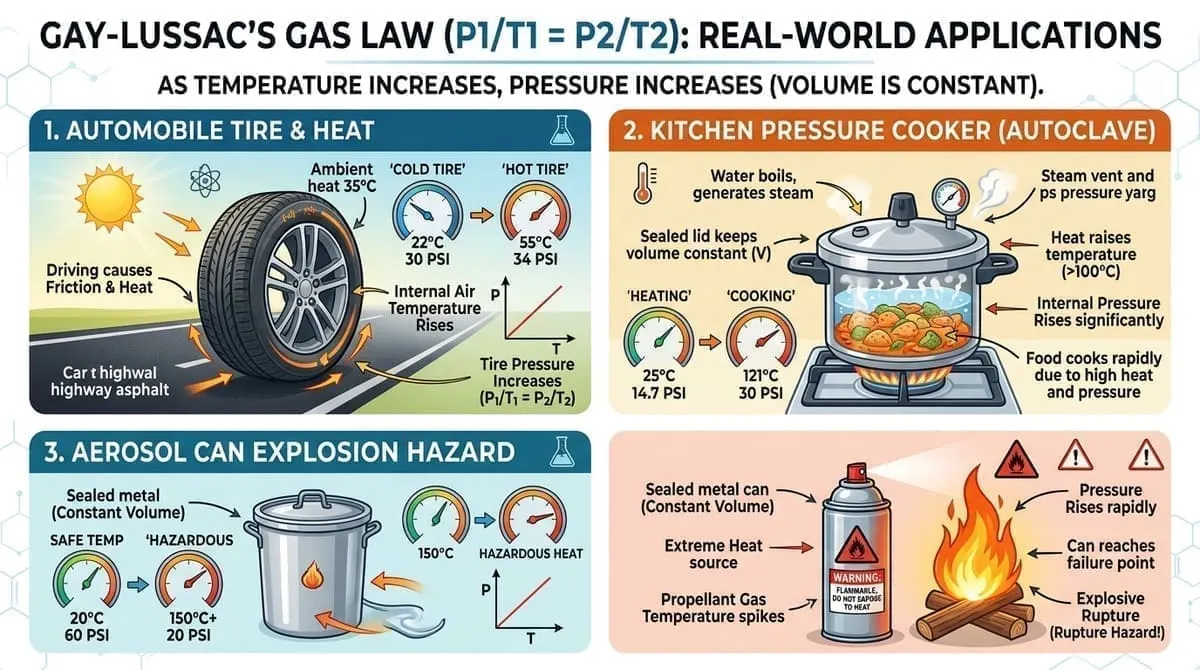
Why do automobile tires gain pressure after driving at high speeds on highway asphalt during hot summer afternoons? Why do kitchen pressure cookers and medical autoclaves reach temperatures well above () to cook food in a fraction of the time or achieve complete surgical sterilization? Why is there an urgent, prominent hazard warning stamped on every aerosol spray can: "CAUTION: Container may explode if heated or incinerated"?
All of these critical physical, mechanical, and safety phenomena are governed by Gay-Lussac's Gas Law (also historically referred to as Amontons's Law of Pressure-Temperature or the Pressure Law).
Formulated in 1808 by French chemist and physicist Joseph Louis Gay-Lussac (building upon the early 1702 pneumatic investigations of Guillaume Amontons), this fundamental classical gas law establishes the direct linear relationship between the absolute pressure () exerted by a gas and its absolute thermodynamic temperature (), provided that the volume () and mass of gas () remain strictly constant inside a rigid container.
flowchart TD
    subgraph ISO["🔒 Isochoric System (Constant Volume V & Fixed Moles n)"]
        direction TB
        HEAT["🔥 Thermal Heating (T ↑)"] --> SPEED["Molecules Gain Kinetic Speed (v_rms ↑)"]
        SPEED --> IMPACT["Molecules Strike Rigid Walls with Greater Force & Frequency"]
        IMPACT --> PRESS["📈 Gas Pressure Spikes (P ↑)"]
    end

    subgraph LAW["⚖️ Governing Invariant"]
        P1T1["P₁ / T₁ = P₂ / T₂ = Constant (k)"]
    end

    ISO --> LAW
flowchart LR
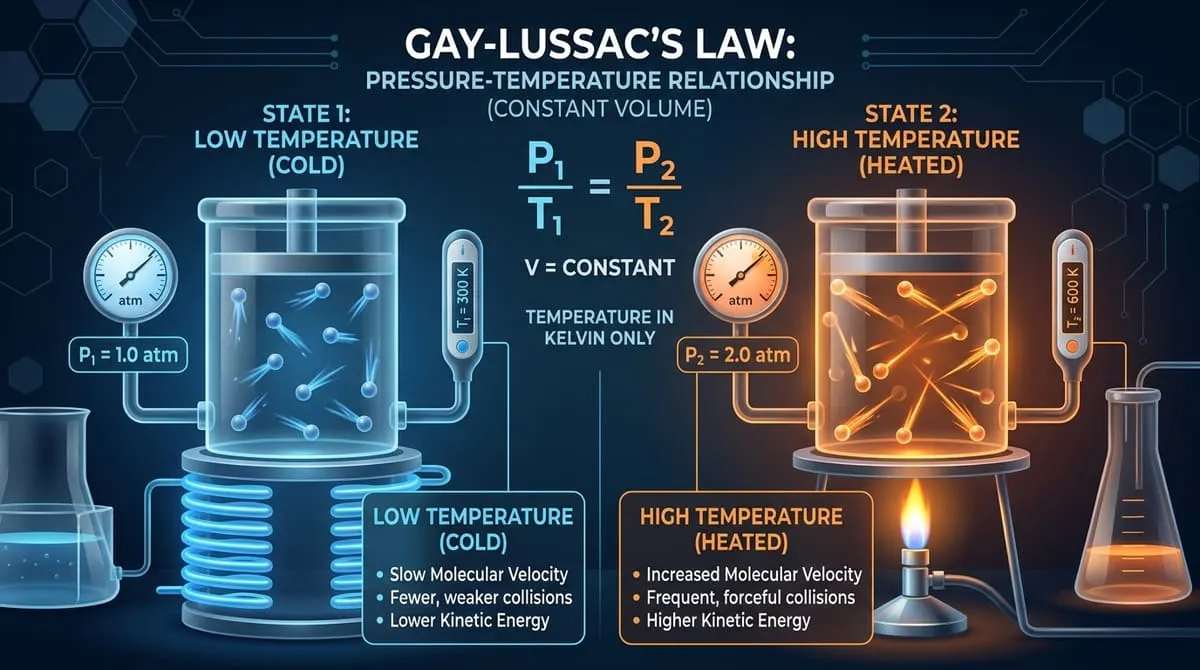
subgraph S1["❄️ State 1: Cold Baseline"]
P1["Pressure: P₁ = 1.0 atm"]
T1["Temperature: T₁ = 300 K (27°C)"]
end
subgraph S2["🔥 State 2: Doubled Temperature"]
P2["Pressure: P₂ = 2.0 atm"]
T2["Temperature: T₂ = 600 K (327°C)"]
end
S1 -->|"Heating in Rigid Tank (ΔT = +300 K)
Pressure Exactly Doubles!"| S2Gay-Lussac's Isochoric Invariance:
For any rigid sealed container, the quotient .
As absolute temperature in Kelvin doubles, internal pressure strictly doubles.
Why Gay-Lussac's Law Matters Today
- Automotive Tire Dynamics & Road Safety: Friction with asphalt during long drives heats the trapped air in car tires from to , increasing gauge pressure by and altering braking distances and hydroplaning risks.
- Autoclaves & Hospital Sterilization: Hospital sterilizers heat water in a sealed chamber up to at () of steam pressure, killing all bacterial spores and viruses within minutes.
- Aerosol Can Safety & Hazmat Transportation: Even empty aerosol cans contain pressurized propellant vapors. Incinerating or exposing cans to fires () spikes internal pressure until metal walls reach structural burst limits, creating hazardous shrapnel.
- Internal Combustion Engine Ignition Cycles: During the compression stroke of a diesel engine cylinder, rapid compression and combustion spike temperature, generating peak cylinder pressures that drive pistons down with thousands of pounds of mechanical force.
- Cryogenic Pressure Vessels & Boil-Off Mitigation: Liquid gas storage tanks (LNG, liquid oxygen, liquid helium) must be equipped with burst discs and pressure relief valves to prevent catastrophic overpressurization if cooling jackets fail.
2. Chemical Definition & Theory
2.1 Simple Definition (Everyday Language)
In everyday terms: > "If you heat a gas trapped inside a rigid, unbending container, its pressure goes up. If you cool it down, its pressure drops."
Pressure and absolute temperature are directly proportional. If you double the absolute Kelvin temperature, you double the force with which the gas pushes against the walls.
2.2 Technical Definition (Thermodynamics & Physical Chemistry)
Formally, Gay-Lussac's Law states that for a fixed quantity ( moles) of an ideal gas held at a constant volume (), the absolute pressure () is directly proportional to its absolute thermodynamic temperature ( in Kelvin):
Where is an isochoric proportionality constant:
Because the quotient of absolute pressure and absolute temperature remains invariant across any isochoric state transformation from State 1 to State 2:
Where:
- = Initial absolute pressure (, , , , or )
- = Initial absolute temperature (Kelvin, )
- = Final absolute pressure (same pressure unit as )
- = Final absolute temperature (Kelvin, )
2.3 The Kinetic Molecular Theory (KMT) Analogy
To visualize the microscopic mechanics driving Gay-Lussac's Law, consider gas molecules trapped inside a rigid steel vault:
- At Cold Baseline (): Gas molecules move with a moderate mean kinetic speed (). They collide with the fixed vault walls at regular intervals with moderate momentum, creating standard baseline pressure ().
- When Heat is Added (): Thermal energy transfers into the molecules, doubling their average translational kinetic energy ().
- Rigid Boundary Constraint (): Because the rigid steel walls cannot expand or move outward (unlike a balloon or movable piston), the faster molecules travel between opposite walls in half the time.
- Result: Molecules strike the walls twice as frequently and with significantly higher individual impact impulse (), causing the measured outward pressure to double ().
flowchart LR
    subgraph Cold["❄️ Cold Gas (T₁ = 300 K)"]
        C1["Moderate Molecular Velocity
Gentler Wall Impacts
Lower Pressure: P₁ = 1.0 atm"]
    end

    subgraph Hot["🔥 Heated Gas (T₂ = 600 K)"]
        H1["High Molecular Velocity
Forceful, Frequent Wall Collisions
Higher Pressure: P₂ = 2.0 atm"]
    end

    Cold -->|"Heat Energy Added in Rigid Tank (ΔT = +300 K)
Molecules hammer walls harder"| Hot
3. History & Discovery Timeline
timeline
    title Historical Milestones: Amontons & Gay-Lussac's Law
    1702 : Guillaume Amontons invents the Constant-Volume Air Thermometer & discovers P ∝ T
    1787 : Jacques Charles explores thermal relationships across various gases
    1802 : Joseph Louis Gay-Lussac formalizes the quantitative expansion coefficient for gases
    1808 : Gay-Lussac publishes the Law of Combining Volumes and formalizes P₁/T₁ = P₂/T₂
    1834 : Benoît Paul Émile Clapeyron integrates Gay-Lussac's Law into the Ideal Gas Law (PV = nRT)
    1860 : James Clerk Maxwell & Ludwig Boltzmann derive P/T invariance from statistical mechanics
Amontons vs. Gay-Lussac: Historical Attribution
While modern chemistry textbooks widely designate as Gay-Lussac's Law, French inventor Guillaume Amontons first built a constant-volume mercury air thermometer in 1702, observing that the pressure of air increased in direct proportion to heat.
A century later, Joseph Louis Gay-Lussac performed rigorous, highly precise quantitative measurements across multiple pure gases (), proving that all gases share the exact same thermal pressure coefficient (). For this reason, physics literature often credits the discovery jointly as Amontons's Law or The Pressure-Temperature Law of Gay-Lussac.
4. Absolute Temperature & Pressure Requirements
Two Essential Conversion Rules:
1. Temperature must ALWAYS be in Kelvin (). Inserting Celsius will cause severe computational errors!
2. Pressure must ALWAYS be Absolute Pressure (). Dial gauges read zero at atmospheric pressure!
Why Gauge Pressure Fails
If a car tire gauge reads (gauge) at , the true absolute pressure of the air inside is:
If the tire warms to on the road:
- Correct Absolute Calculation:
(This reflects an actual gauge pressure rise).
- Incorrect Gauge Calculation (Omitting ):
(Incorrect: underestimates the tire pressure spike by 33%).
5. Mathematical Formulas & Algebraic Solvers
5.1 The Four Algebraic Variations of
Cross-multiplying () allows immediate isolation of any single unknown parameter:
flowchart TD
    ROOT["🎯 Core Equation: P₁ / T₁ = P₂ / T₂
Cross-Multiplication: P₁ · T₂ = P₂ · T₁"]

    ROOT --> B1["🔵 Solve for Initial Pressure (P₁)"]
    ROOT --> B2["🟢 Solve for Initial Temp (T₁)"]
    ROOT --> B3["🟠 Solve for Final Pressure (P₂)"]
    ROOT --> B4["🟣 Solve for Final Temp (T₂)"]

    B1 --> F1["P₁ = (P₂ · T₁) / T₂"]
    B2 --> F2["T₁ = (P₁ · T₂) / P₂"]
    B3 --> F3["P₂ = (P₁ · T₂) / T₁"]
    B4 --> F4["T₂ = (P₂ · T₁) / P₁"]
5.2 Derivation from the Ideal Gas Law ()
- Start with the ideal gas equation of state:
- Isolate pressure over temperature:
- Under isochoric conditions () for a closed system ():
- Equating State 1 and State 2 gives Gay-Lussac's Law:
5.3 Isochoric Work and Heat Capacity ()
In an isochoric process, because volume does not change (), the gas performs zero boundary work on the surroundings:
According to the First Law of Thermodynamics ():
Where is the molar heat capacity at constant volume ( for monatomic gases, for diatomic gases). All added heat directly increases the internal thermal kinetic energy and pressure of the gas.
6. Step-by-Step Problem Solving Workflow
flowchart TD
    S1["1️⃣ Extract Inputs from Problem
Identify P₁, T₁, P₂, T₂"] --> S2["2️⃣ Mandatory Conversions
T(K) = T(°C) + 273.15
P_abs = P_gauge + P_atm"]
    S2 --> S3{"Verify Isochoric Conditions
(Rigid Container / Constant Volume)"}
    S3 -->|"Volume Changes"| S3E["⚠️ Switch to Combined Gas Law (P₁V₁/T₁ = P₂V₂/T₂)"]
    S3 -->|"Volume Constant"| S4["3️⃣ Select Algebraic Formula
e.g., P₂ = (P₁ · T₂) / T₁"]
    S4 --> S5["4️⃣ Execute Calculation
Compute new pressure or temperature"]
    S5 --> S6["5️⃣ Convert Back if Required
Convert Kelvin back to °C or Absolute back to Gauge"]
7. Real-World Practical Examples & Calculations
Example 1: Kitchen Pressure Cooker Autoclave
- Scenario: A sealed domestic pressure cooker containing steam at atmospheric pressure () and room temperature () is placed on an active gas burner until internal temperature reaches . Assuming the rigid stainless steel pot does not expand:
- Step 1: Convert Temperatures to Kelvin:
- Step 2: Solve for Final Absolute Pressure :
- Culinary Consequence: Higher ambient pressure elevates the boiling point of water from to , cutting cooking times for beans, stews, and tough meats by over 70%.
Example 2: Aerosol Spray Can in a Campfire (Hazard Analysis)
- Scenario: A discarded aerosol deodorant can contains propellant gas at absolute pressure at . A camper accidentally drops the can into a campfire, heating the internal gas to . If the can's crimped seam ruptures at , will it explode?
- Step 1: Convert Temperatures to Kelvin:
- Step 2: Calculate Internal Pressure :
- Safety Conclusion: Because (failure threshold), the can will violently explode, creating dangerous metal shrapnel and a fireball.
Example 3: Fire Extinguisher Temperature Rating
- Scenario: A carbon dioxide () fire extinguisher is charged to an absolute pressure of in an air-conditioned facility at . The safety release valve is rated for a maximum pressure of . What maximum ambient storage temperature (in ) can this extinguisher tolerate before venting?
- Step 1: Convert Initial Temperature to Kelvin:
- Step 2: Solve for Maximum Temperature :
- Step 3: Convert to Celsius:
8. Comprehensive Classical Gas Laws Matrix
| Gas Law | Equation | Constant Parameters | Proportionality | Key Real-World Application |
|---|---|---|---|---|
| Gay-Lussac's Law | Volume (), Moles () | Direct ($P \propto T$) | Autoclaves, pressure cookers, tire heat spikes, aerosol safety | |
| Charles's Law | Pressure (), Moles () | Direct ($V \propto T$) | Hot air balloons, cryogenic shrinking, oven bread rising | |
| Boyle's Law | Temperature (), Moles () | Inverse () | Scuba diving, syringes, pulmonary respiration | |
| Avogadro's Law | Pressure (), Temperature () | Direct ($V \propto n$) | Molar gas volume ( at STP), tire inflation | |
| Combined Gas Law | Moles () | Multi-variable | Rocket engines, atmospheric weather balloon soundings | |
| Ideal Gas Law | Universal Constant () | Universal State Model | Chemical reactors, stoichiometry, planetary science |
9. Deep-Dive Case Studies
Case Study 1: Medical Autoclave Sterilization Mechanics
flowchart TD
    A["Surgical Instruments Sealed in Rigid Autoclave Chamber (V = constant)"] --> B["Electrical Elements Boil Water to Saturated Steam"]
    B --> C["Heating Steam from 100°C (373 K) to 134°C (407 K)"]
    C --> D["Gay-Lussac Pressure Rise: Internal Pressure Surges to 3.0 bar (300 kPa)"]
    D --> E["High-Pressure Superheated Steam Penetrates Microscopic Crevices"]
E --> F["⚡ Complete Denaturation of Bacterial Endospores (Geobacillus stearothermophilus) in 3 Minutes"]- Clinical Significance: Dry air at requires several hours to kill heat-resistant bacterial endospores. By exploiting Gay-Lussac's Law inside a sealed rigid autoclave, raising steam temperature to elevates the pressure to , forcing high-enthalpy steam into complex surgical instruments and destroying all pathogens in under 5 minutes.
Case Study 2: Summer Highway Tire Blowout Prevention
- The Engineering Problem: Commercial tractor-trailer trucks carrying of cargo travel across desert highways in Arizona where road surface temperatures exceed ().
- Applying Gay-Lussac's Law: Tires inflated to (gauge) at a cool () morning baseline warm up to () due to severe rolling friction and asphalt radiation:
(This results in an alarming increase in operational gauge pressure). * Fleet Safety Action: Trucking logistics companies mandate cold tire pressure calibration and install active wireless valve-stem TPMS sensors to prevent catastrophic tread delamination blowouts.
10. Deviations from Ideality: When Does Gay-Lussac's Law Fail?
Under extreme conditions, real gases deviate from Gay-Lussac's linear proportionality:
flowchart TD
    COND["⚠️ Extreme Physical Conditions"]

    COND --> P_HIGH["🔴 Ultra-High Pressure (P > 100 atm)"]
    COND --> T_LOW["🔵 Cryogenic Temperatures (Approaching Liquefaction)"]

    P_HIGH --> D1["Finite Molecular Volume: Gas molecules occupy measurable physical space
👉 Actual Pressure > Ideal Pressure"]
    T_LOW --> D2["Intermolecular Attractions: Van der Waals dipole forces pull molecules inward
👉 Actual Pressure < Ideal Pressure"]

    D1 --> SOL["🛠️ Use Van der Waals Equation of State:
(P + a·n²/V²)(V - n·b) = nRT"]
    D2 --> SOL
11. Common Student Mistakes & How to Avoid Them
| Common Mistake | Why It Happens | How to Avoid It |
|---|---|---|
| Using Celsius () in Formula | Directly plugging thermometer readings into the equation. | Always add $273.15$ to convert to Kelvin: . |
| Using Gauge Pressure instead of Absolute | Overlooking the () atmospheric baseline. | Always add atmospheric pressure: . |
| Applying to Flexible Containers | Using Gay-Lussac's Law on balloons or expandable pistons. | If volume changes at constant pressure, switch to Charles's Law (). |
| Mismatched Pressure Units | Mixing in with in . | Convert both pressures to the same unit before solving. |
12. Frequently Asked Questions (FAQ)
Q1: What is the main formula for Gay-Lussac's Law?
A: The governing mathematical formula is , which states that the ratio of absolute pressure to absolute Kelvin temperature is constant for a fixed mass of gas at constant volume.
Q2: What is held constant in Gay-Lussac's Law?
A: Gas volume () and the amount of gas ( moles) must remain strictly constant throughout the process (an isochoric system).
Q3: Why MUST temperature be measured in Kelvin?
A: Kelvin is an absolute thermodynamic temperature scale where represents zero molecular kinetic energy. The Celsius scale has an arbitrary zero point, meaning does not have twice the thermal kinetic energy of .
Q4: What is an isochoric (isovolumetric) process?
A: An isochoric (or isometric) process is a thermodynamic process in which the volume of the closed system remains constant ().
Q5: How does a pressure cooker demonstrate Gay-Lussac's Law?
A: A pressure cooker is a sealed, rigid pot. As water inside is heated, the steam cannot expand, causing internal pressure to rise. This elevated pressure raises the boiling point of water, cooking food significantly faster.
Q6: Why do aerosol cans carry a warning against incineration?
A: Aerosol cans are sealed rigid containers. Heating an aerosol can in a fire causes the propellant gas temperature and pressure to spike dramatically (Gay-Lussac's Law) until the metal seams rupture violently, causing explosions.
Q7: What happens to gas pressure if Kelvin temperature is tripled?
A: Because pressure is directly proportional to absolute temperature, tripling the Kelvin temperature inside a rigid container will exactly triple the absolute pressure ().
Q8: What does a graph of Gay-Lussac's Law look like?
A: A plot of absolute pressure () on the y-axis against Kelvin temperature () on the x-axis produces a straight line passing directly through the origin $(0,0)$ with slope .
Q9: Who discovered Gay-Lussac's Law?
A: Guillaume Amontons discovered the qualitative relationship in 1702, and French chemist Joseph Louis Gay-Lussac published the first precise quantitative mathematical measurements in 1808.
Q10: Does Gay-Lussac's Law apply to liquids?
A: No. Liquids and solids are condensed, nearly incompressible phases. Gay-Lussac's Law applies strictly to compressible gases and vapors.
Q11: How much boundary work () is done in Gay-Lussac's Law?
A: Exactly . Because the rigid container walls do not move (), . All added heat energy converts directly into internal thermal energy ().
Q12: Why do car tire pressure warnings trigger on cold mornings?
A: Overnight cold drops the temperature of the air sealed inside your tires. According to Gay-Lussac's Law, lower Kelvin temperature reduces the kinetic velocity of air molecules, dropping the tire pressure by for every drop.
Q13: What is the constant in Gay-Lussac's Law?
A: The constant is equal to . It represents the specific pressure buildup rate per Kelvin for that gas volume.
Q14: How does Gay-Lussac's Law relate to the Ideal Gas Law?
A: Gay-Lussac's Law is the isochoric subset of the Ideal Gas Law () when volume () and moles () are held constant.
Q15: What formula should I use if BOTH volume and temperature change?
A: If all three state variables ($P, V, T$) change simultaneously, use the Combined Gas Law:
13. Key Takeaways & Summary
- Direct Proportionality: Absolute pressure and Kelvin temperature are directly proportional for a fixed mass of gas in a rigid container ($P \propto T$).
- Invariant Isochoric Ratio: The quotient of pressure and absolute temperature remains constant: .
- Kelvin & Absolute Pressure Mandatory: Formulas require absolute Kelvin temperature () and absolute pressure ().
- Zero Boundary Work: In isochoric processes, and , meaning all added heat energy translates directly into internal pressure and temperature spikes.
- Essential Modern Applications: Underpins medical autoclave sterilization, pressure cooking, tire safety management, internal combustion diesel cycles, and hazardous pressurized container transport.
Additional Technical Guidelines & Measurement Standards
When conducting calculations for Gay-Lussac Gas Law P1/T1 = P2/T2 Solver, maintaining quantitative precision and verifying input parameter boundaries is essential for reliable scenario evaluation. Always verify that raw numerical inputs are measured using standardized instrumentation, and double-check unit conversions prior to applying outputs in commercial, industrial, or academic projects.
For quantitative unit conversions and scientific calculations, always maintain at least four decimal places of precision during intermediate arithmetic stages before rounding final results. When preparing technical reports, laboratory documentation, or financial forecasts, cross-verify all output variables against established international measurement standards (such as SI, NIST, and ISO metric benchmarks) to guarantee consistent analytical rigor across all computational workflows.
MathsLover.com delivers this interactive solver 100% free of charge to foster global mathematical literacy, educational accessibility, and data-driven problem solving across scientific, technical, and academic communities worldwide.