💡 Direct Answer & Executive Summary (Gibbs Free Energy Spontaneity Calculator)
Definition: Chemical stoichiometry calculation: Gibbs Free Energy Spontaneity Calculator.
Governing Math Formula: ΔG = ΔH - (T × ΔS), Equilibrium Constant K_eq = exp(-ΔG° / RT). Predicts thermodynamic reaction spontaneity, exergonic/endergonic character, and temperature thresholds.
Target Applications: Provides real-time quantitative solutions in Chemistry for students, engineers, researchers, and finance professionals.
Gibbs Free Energy & Reaction Spontaneity ()
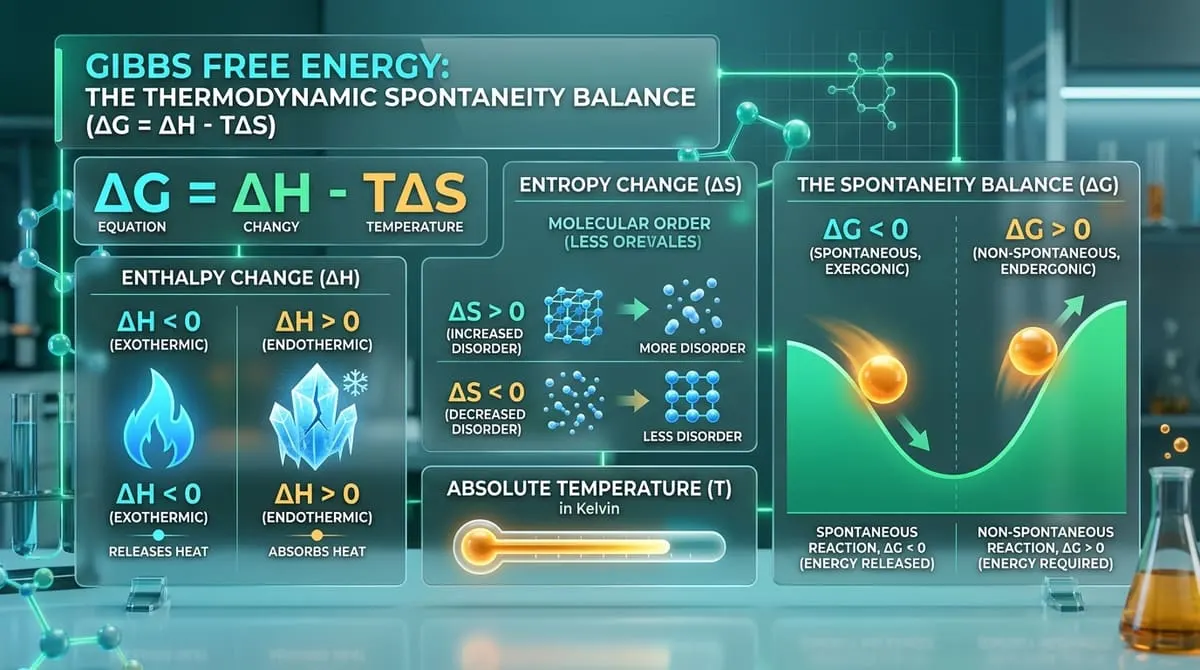
1. Introduction & Conceptual Overview
Why does liquid water freeze spontaneously into ice crystals at , but melt spontaneously into liquid water at ? Why does iron rust in moist air over time without any external energy input, while rust never spontaneously reassembles itself back into shiny metallic iron? How do living biological cells synthesize complex proteins and replicate DNA against the universal tendency toward chaos and entropy?
All of these natural, chemical, and biological phenomena are governed by the master thermodynamic potential of chemistry: Gibbs Free Energy ($\Delta G$).
Formulated in 1873 by American mathematical physicist Josiah Willard Gibbs, the Gibbs Free Energy equation combines the First Law of Thermodynamics (Enthalpy, $\Delta H$) and the Second Law of Thermodynamics (Entropy, $\Delta S$) into a single criterion that predicts whether any chemical or physical transformation will occur spontaneously at constant temperature and pressure.
flowchart TD
    subgraph SPONT["⚖️ Gibbs Spontaneity Criteria (at constant T and P)"]
        direction TB
        DG_NEG["🟢 ΔG < 0 (Exergonic / Spontaneous)
Reaction proceeds forward naturally without added work"]
        DG_ZERO["⚖️ ΔG = 0 (Dynamic Equilibrium)
Forward and reverse reaction rates are exactly equal"]
        DG_POS["🔴 ΔG > 0 (Endergonic / Non-Spontaneous)
Reaction requires external work input to proceed forward"]
endThe Thermodynamic Definition of Free Energy:
Gibbs Free Energy () represents the maximum amount of non-expansion reversible mechanical or chemical work that can be extracted from a closed thermodynamic system at constant temperature and pressure.
2. Chemical Definition & Fundamental Theory
2.1 Simple Definition (Everyday Language)
In plain English: > "Nature favors two things: releasing heat (exothermic, ) and increasing messiness/randomness (higher entropy, ). Gibbs Free Energy balances these two competing forces to determine if a reaction happens on its own."
- If $\Delta G$ is negative ($-$), the process is spontaneous (like a ball rolling downhill).
- If $\Delta G$ is positive ($+$), the process is non-spontaneous (like trying to roll a ball uphill without pushing it).
2.2 Technical Definition (Thermodynamics & Physical Chemistry)
Formally, Gibbs Free Energy () is defined by the Legendre transformation:
For a chemical reaction taking place at a constant absolute temperature ( in Kelvin):
Where:
- $\Delta G$ = Change in Gibbs Free Energy ( or )
- $\Delta H$ = Change in Enthalpy () — Heat absorbed or released
- = Absolute Thermodynamic Temperature (**Kelvin, )
- $\Delta S$ = Change in Entropy ( or ) — Change in molecular disorder
3. The Four Thermodynamic Spontaneity Quadrants
The sign of $\Delta H$ and $\Delta S$ dictates how temperature influences reaction spontaneity:
flowchart TD
    subgraph Q1["Case 1: Enthalpy & Entropy Both Favorable"]
        C1["ΔH < 0 (Exothermic) & ΔS > 0 (Disordering)
👉 ΔG is ALWAYS NEGATIVE (Spontaneous at ALL Temperatures)"]
    end

    subgraph Q2["Case 2: Enthalpy & Entropy Both Unfavorable"]
        C2["ΔH > 0 (Endothermic) & ΔS < 0 (Ordering)
👉 ΔG is ALWAYS POSITIVE (Non-Spontaneous at ALL Temperatures)"]
    end

    subgraph Q3["Case 3: Enthalpy-Driven (Low Temperature)"]
        C3["ΔH < 0 (Exothermic) & ΔS < 0 (Ordering)
👉 Spontaneous only at LOW Temperatures (T < ΔH / ΔS)"]
    end

    subgraph Q4["Case 4: Entropy-Driven (High Temperature)"]
        C4["ΔH > 0 (Endothermic) & ΔS > 0 (Disordering)
👉 Spontaneous only at HIGH Temperatures (T > ΔH / ΔS)"]
    end
Summary Matrix of Reaction Spontaneity
| Enthalpy ($\Delta H$) | Entropy ($\Delta S$) | $-T\Delta S$ Term | Gibbs Free Energy ($\Delta G$) | Reaction Spontaneity & Examples |
|---|---|---|---|---|
| Negative ($-$) | Positive ($+$) | Negative ($-$) | Always Negative () | Spontaneous at all temperatures (e.g., combustion of wood, hydrogen peroxide decomposition). |
| Positive ($+$) | Negative ($-$) | Positive ($+$) | Always Positive () | Non-spontaneous at all temperatures (e.g., photosynthesis without sunlight, ozone formation from ). |
| Negative ($-$) | Negative ($-$) | Positive ($+$) | Negative at Low , Positive at High | Spontaneous only at low temperatures (e.g., water freezing to ice, ammonia Haber-Bosch synthesis). |
| Positive ($+$) | Positive ($+$) | Negative ($-$) | Negative at High , Positive at Low | Spontaneous only at high temperatures (e.g., ice melting to water, limestone calcination ). |
4. Gibbs Free Energy and Chemical Equilibrium ()
The standard Gibbs Free Energy change () is mathematically linked to the chemical equilibrium constant ():
Solving for the Equilibrium Constant :
Where:
- = Universal Gas Constant ()
- = Absolute Temperature in Kelvin
- = Standard Gibbs Free Energy change in Joules/mol ()
flowchart LR
    K_LARGE["ΔG° << 0 (Large Negative) 👉 K_eq >> 1 (Equilibrium favors PRODUCTS overwhelmingly)"]
    K_ONE["ΔG° = 0 👉 K_eq = 1 (Reactants and Products equal at equilibrium)"]
    K_SMALL["ΔG° >> 0 (Large Positive) 👉 K_eq << 1 (Equilibrium favors REACTANTS overwhelmingly)"]

    K_LARGE --> K_ONE
    K_ONE --> K_SMALL
5. Step-by-Step Problem Solving Workflow
flowchart TD
    S1["1️⃣ Extract Thermodynamic Values
Identify ΔH (in kJ/mol), ΔS (in J/mol·K), and T (in °C)"] --> S2["2️⃣ Mandatory Unit Alignments
T(K) = T(°C) + 273.15
Convert ΔS to kJ: ΔS(kJ/mol·K) = ΔS(J) / 1000"]
    S2 --> S3["3️⃣ Execute Gibbs Formula
ΔG = ΔH - (T · ΔS)"]
    S3 --> S4{"Evaluate Sign of ΔG"}
    S4 -->|"ΔG < 0"| SP["🟢 Spontaneous (Exergonic)"]
    S4 -->|"ΔG > 0"| NSP["🔴 Non-Spontaneous (Endergonic)"]
    S4 -->|"ΔG = 0"| EQ["⚖️ At Dynamic Equilibrium"]
    S3 --> S5["4️⃣ Compute Transition Threshold
T* = ΔH / ΔS (Kelvin)"]
6. Real-World Practical Examples & Calculations
Example 1: Industrial Ammonia Synthesis (The Haber-Bosch Process)
- Reaction:
- Given Data:- (Exothermic)- (Entropy decreases due to )- Operating Temperature:
- Step 1: Calculate $\Delta G$ at :
- **Step 2: Find the Equilibrium Crossover Temperature ():**
- Engineering Insight: Below , $\Delta G$ is negative (spontaneous), but the reaction kinetics are sluggish. Industrial plants operate at with iron catalysts and high pressure () to overcome the unfavorable high-temperature free energy balance.
Example 2: Water Freezing Spontaneity
- Process:
- Given Data: , .
- At ():
- At ():
(Positive $\Delta G$: non-spontaneous, ice will not freeze).
7. Deep-Dive Case Studies: ATP Coupling in Living Cells
flowchart TD
    A["Glucose Phosphorylation: Glucose + P_i → Glucose-6-P
(ΔG₁ = +13.8 kJ/mol 🔴 Highly Endergonic / Non-Spontaneous)"]
    B["ATP Hydrolysis: ATP + H₂O → ADP + P_i
(ΔG₂ = -30.5 kJ/mol 🟢 Highly Exergonic / Spontaneous)"]

    A --> COUPLE["⚡ Enzyme Coupling (Hexokinase)"]
    B --> COUPLE

    COUPLE --> NET["Net Coupled Reaction: Glucose + ATP → Glucose-6-P + ADP
ΔG_net = +13.8 - 30.5 = -16.7 kJ/mol 🟢 SPONTANEOUS!"]- Biochemical Mechanism: Cells drive thermodynamically unfavorable synthesis reactions () by biochemically coupling them to the spontaneous hydrolysis of Adenosine Triphosphate (ATP), ensuring the net free energy change is negative ().
8. Frequently Asked Questions (FAQ)
Q1: What is the fundamental formula of Gibbs Free Energy?
A: The fundamental equation is , where $\Delta H$ is enthalpy change, is absolute temperature in Kelvin, and $\Delta S$ is entropy change.
Q2: What does a negative $\Delta G$ mean?
A: A negative $\Delta G$ () indicates that a reaction is exergonic and thermodynamically spontaneous, meaning it releases free energy and can proceed on its own without external work.
Q3: Why must temperature be in Kelvin?
A: Because thermal kinetic energy is proportional to absolute temperature. Using Celsius or Fahrenheit would produce mathematically invalid signs for the $-T\Delta S$ term.
Q4: What is the difference between $\Delta G$ and ?
A: is the standard free energy change under standard state conditions (). $\Delta G$ is the actual free energy change under non-standard, real-time reactant and product concentrations ().
Q5: Does a spontaneous reaction () always happen fast?
A: No! Gibbs Free Energy determines thermodynamic feasibility, not reaction rate. Diamond converting to graphite has a negative $\Delta G$, but its activation energy () is so high that the reaction rate is essentially zero at room temperature.
9. Key Takeaways & Summary
- Spontaneity Criterion: denotes spontaneous (exergonic) processes; denotes non-spontaneous (endergonic) processes; denotes equilibrium.
- The Energy Balance: quantifies the trade-off between heat release (enthalpy) and molecular disorder (entropy).
- Equilibrium Constant Relation: , linking free energy directly to product/reactant ratios.
- Biological ATP Coupling: Living systems power vital endergonic processes by coupling them to exergonic ATP hydrolysis ().
Additional Technical Guidelines & Measurement Standards
When conducting calculations for Gibbs Free Energy Spontaneity Calculator, maintaining quantitative precision and verifying input parameter boundaries is essential for reliable scenario evaluation. Always verify that raw numerical inputs are measured using standardized instrumentation, and double-check unit conversions prior to applying outputs in commercial, industrial, or academic projects.
For quantitative unit conversions and scientific calculations, always maintain at least four decimal places of precision during intermediate arithmetic stages before rounding final results. When preparing technical reports, laboratory documentation, or financial forecasts, cross-verify all output variables against established international measurement standards (such as SI, NIST, and ISO metric benchmarks) to guarantee consistent analytical rigor across all computational workflows.
MathsLover.com delivers this interactive solver 100% free of charge to foster global mathematical literacy, educational accessibility, and data-driven problem solving across scientific, technical, and academic communities worldwide.