💡 Direct Answer & Executive Summary (Ideal Gas PV=nRT Pressure Solver)
Definition: Chemical stoichiometry calculation: Ideal Gas PV=nRT Pressure Solver.
Governing Math Formula: P = (n × R × T) / V. Solves absolute pressure P using Universal Gas Constant R = 0.0820574 L·atm/(mol·K). Requires temperature in absolute Kelvin (K = °C + 273.15).
Target Applications: Provides real-time quantitative solutions in Chemistry for students, engineers, researchers, and finance professionals.
Ideal Gas Law (): Comprehensive Chemistry & Thermodynamics Guide
1. Introduction & Conceptual Overview
How do aeronautical engineers calculate the lift generated by high-altitude weather research balloons floating at above the Earth's surface? How do chemical plant operators determine the exact storage pressure inside industrial propane and anhydrous ammonia tanks? How do anesthesiologists calculate the exact volume of nitrous oxide () remaining inside pressurized medical cylinders?
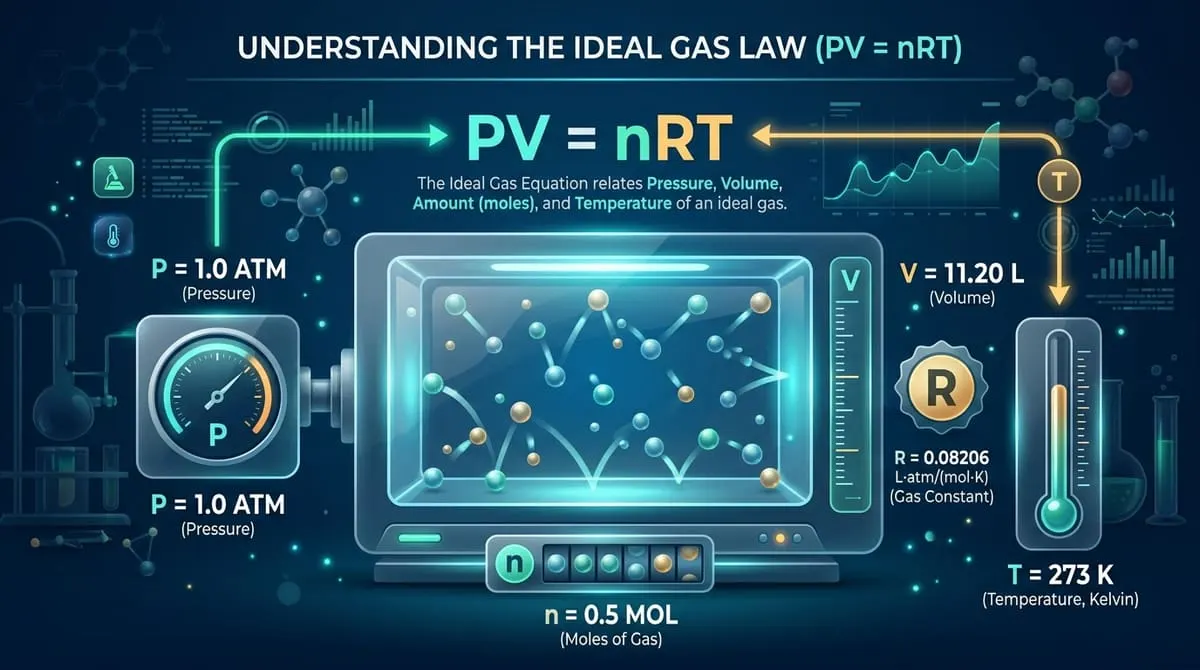
All of these foundational engineering and physical chemistry calculations rely on the master equation of classical thermodynamics: the Ideal Gas Law ().
Formulated in 1834 by French engineer and physicist Benoît Paul Émile Clapeyron, the Ideal Gas Law unites the separate historical gas discoveries of Robert Boyle (1662), Jacques Charles (1787), Joseph Louis Gay-Lussac (1808), and Amedeo Avogadro (1811) into a single universal Equation of State. It establishes the mathematical relationship between the four fundamental state variables of any gas: Absolute Pressure (), Volume (), Amount of Gas ( in moles), and Absolute Temperature ( in Kelvin).
flowchart TD
    subgraph COMB["🏛️ Historical Synthesis: The 4 Gas Laws into PV = nRT"]
        B["Boyle's Law: V ∝ 1/P (Constant T, n)"]
        C["Charles's Law: V ∝ T (Constant P, n)"]
        G["Gay-Lussac's Law: P ∝ T (Constant V, n)"]
        A["Avogadro's Law: V ∝ n (Constant P, T)"]
    end

    COMB --> MASTER["🎯 The Ideal Gas Equation of State
P · V = n · R · T"]Universal State Invariance:
The Ideal Gas Law states that the state of any gas sample is completely described by three independent variables. Knowing any three of ($P, V, n, T$) uniquely determines the fourth through the Universal Gas Constant ().
2. Chemical Definition & Theory
2.1 Simple Definition (Everyday Language)
In plain English: > "If you put more gas particles into a container ($n \uparrow$) or heat them up ($T \uparrow$), the pressure goes up. If you squeeze the container into a smaller space ($V \downarrow$), the pressure also goes up."
The Ideal Gas Law mathematically balances how much gas you have, how hot it is, and how much space it occupies to tell you exactly how hard it pushes against its container walls.
2.2 Technical Definition (Thermodynamics & Statistical Mechanics)
Formally, an Ideal Gas is a theoretical gas composed of a large number of randomly moving point particles that satisfy two foundational postulates of the Kinetic Molecular Theory (KMT): 1. Negligible Particle Volume: The physical volume occupied by the gas molecules themselves is infinitesimally small compared to the total container volume (). 2. Zero Intermolecular Forces: No attractive or repulsive electrostatic forces (Van der Waals forces) exist between particles; all molecular collisions are perfectly elastic (conserving total kinetic energy and momentum).
Under these postulates, the thermodynamic state is governed by:
Where:
- = Absolute Pressure (, , , , or )
- = Gas Volume ( or )
- = Amount of Substance ()
- = Universal Gas Constant ( or )
- = Absolute Thermodynamic Temperature (Kelvin, )
3. Values and Units of the Universal Gas Constant ()
Selecting the correct numerical value for the Universal Gas Constant () depends strictly upon the units used for pressure () and volume ():
| Gas Constant () Value | Pressure Unit () | Volume Unit () | Amount () | Temperature () | Common Application Area |
|---|---|---|---|---|---|
| General chemistry laboratories & stoichiometry | |||||
| Standard SI physics & thermodynamics () | |||||
| Chemical process engineering | |||||
| IUPAC standard state reporting () | |||||
| Barometric physiology & blood gas calculations | |||||
| US petroleum & natural gas engineering |
4. Mathematical Formulas & Algebraic Solvers
Depending on which state variable is unknown, the Ideal Gas Law equation can be algebraically isolated into four primary single-step solvers:
flowchart TD
    ROOT["🎯 Core Equation: P · V = n · R · T"]

    ROOT --> B1["🔵 Solve for Pressure (P)"]
    ROOT --> B2["🟢 Solve for Volume (V)"]
    ROOT --> B3["🟠 Solve for Moles (n)"]
    ROOT --> B4["🟣 Solve for Temperature (T)"]

    B1 --> F1["P = (n · R · T) / V"]
    B2 --> F2["V = (n · R · T) / P"]
    B3 --> F3["n = (P · V) / (R · T)"]
    B4 --> F4["T = (P · V) / (n · R)"]
Derived Variations: Gas Density ($\rho$) and Molar Mass ()
Because the amount of gas in moles is equal to mass divided by molar mass (), substituting into yields:
Rearranging for gas density ():
Rearranging for unknown molar mass ():
5. Step-by-Step Problem Solving Workflow
flowchart TD
    S1["1️⃣ Extract Inputs from Scenario
Identify P, V, n (or mass m), and T"] --> S2["2️⃣ Mandatory Unit Conversions
T(K) = T(°C) + 273.15
Ensure V is in Liters (L) and n is in Moles (mol)"]
    S2 --> S3["3️⃣ Match Gas Constant R
Use R = 0.08206 for atm, or R = 8.314 for kPa / SI"]
    S3 --> S4["4️⃣ Select Isolated Algebraic Equation
e.g., P = (n · R · T) / V"]
    S4 --> S5["5️⃣ Execute Computation & Format Units
Output pressure in atm, kPa, bar, and psi"]
6. Real-World Practical Examples & Calculations
Example 1: Pressure in an Industrial Compressed Oxygen Tank
- Scenario: A rigid medical gas cylinder is filled with of pure oxygen gas () in a hospital storage bay maintained at . What is the internal absolute pressure inside the tank?
- Step 1: Convert Temperature to Kelvin:
- Step 2: Apply the Pressure Solver ():
- Step 3: Convert to SI Units:
Example 2: Determining the Molar Mass of an Unknown Volatile Liquid (Dumas Method)
- Scenario: In an organic chemistry laboratory, of an unknown volatile liquid is vaporized inside a flask immersed in a boiling water bath at . The ambient atmospheric pressure is . What is the molar mass of the compound?
- Step 1: Convert all units to standard lab format:---
- Step 2: Solve for Molar Mass ():(This corresponds to pentane, , molar mass ).
7. Deviations from Ideality: The Van der Waals Equation
Under extreme conditions (very high pressures, , or cryogenic temperatures near liquefaction), real gases deviate significantly from ideal behavior:
flowchart TD
    COND["⚠️ Real Gas Deviations from PV = nRT"]

    COND --> HIGH_P["🔴 High Pressure: Molecules crowded together
👉 Molecular volume is non-zero (V_real > V_ideal)"]
    COND --> LOW_T["🔵 Low Temperature: Slow kinetic velocities
👉 Intermolecular attractions pull particles together (P_real < P_ideal)"]

    HIGH_P --> VDW["🛠️ Johannes van der Waals Correction (1873):
(P + a·n²/V²)(V - n·b) = nRT"]
LOW_T --> VDW- The parameter: Corrects for attractive intermolecular dipole and London dispersion forces.
- The parameter: Corrects for the finite physical excluded volume of the molecules.
8. Frequently Asked Questions (FAQ)
Q1: What is the Ideal Gas Law formula?
A: The formula is , relating pressure (), volume (), moles (), universal gas constant (), and absolute temperature ().
Q2: What is Standard Temperature and Pressure (STP)?
A: Standard STP is defined by IUPAC as () and (), where of an ideal gas occupies . In older NIST conventions (), occupies .
Q3: Why MUST temperature be entered in Kelvin?
A: Gas pressure and volume are proportional to the absolute thermal kinetic energy of molecules, which is zero only at . Using Celsius () or Fahrenheit () would result in physically impossible negative pressures or division-by-zero errors.
Q4: When is the Ideal Gas Law most accurate?
A: The law is over 99.5% accurate for low-density gases (, ambient air) at moderate temperatures () and low-to-moderate pressures ().
Q5: How do you convert grams of gas to moles ()?
A: Divide the mass in grams () by the molar mass () of the chemical substance: .
9. Key Takeaways & Summary
- Master Equation of State: mathematically connects pressure, volume, moles, and temperature for all ideal gases.
- Universal Gas Constant (): Use for lab chemistry units, or for SI physics units.
- Absolute Scales Mandatory: Always convert temperatures to Kelvin () and use absolute pressures.
- Density & Molar Mass Calculations: Readily solved via and .
- Real Gas Corrections: When dealing with extreme pressures or low temperatures, transition to the Van der Waals equation of state.
Additional Technical Guidelines & Measurement Standards
When conducting calculations for Ideal Gas PV=nRT Pressure Solver, maintaining quantitative precision and verifying input parameter boundaries is essential for reliable scenario evaluation. Always verify that raw numerical inputs are measured using standardized instrumentation, and double-check unit conversions prior to applying outputs in commercial, industrial, or academic projects.
For quantitative unit conversions and scientific calculations, always maintain at least four decimal places of precision during intermediate arithmetic stages before rounding final results. When preparing technical reports, laboratory documentation, or financial forecasts, cross-verify all output variables against established international measurement standards (such as SI, NIST, and ISO metric benchmarks) to guarantee consistent analytical rigor across all computational workflows.
MathsLover.com delivers this interactive solver 100% free of charge to foster global mathematical literacy, educational accessibility, and data-driven problem solving across scientific, technical, and academic communities worldwide.