💡 Direct Answer & Executive Summary (Molarity to Mass of Solute Solver)
Definition: Chemical stoichiometry calculation: Molarity to Mass of Solute Solver.
Governing Math Formula: Mass (m) = Molarity (M) × Volume (V in L) × Molar Mass (MW in g/mol). Moles (n) = M × V. Solves the required dry mass to prepare analytical chemical solutions.
Target Applications: Provides real-time quantitative solutions in Chemistry for students, engineers, researchers, and finance professionals.
Molarity to Mass of Solute ()
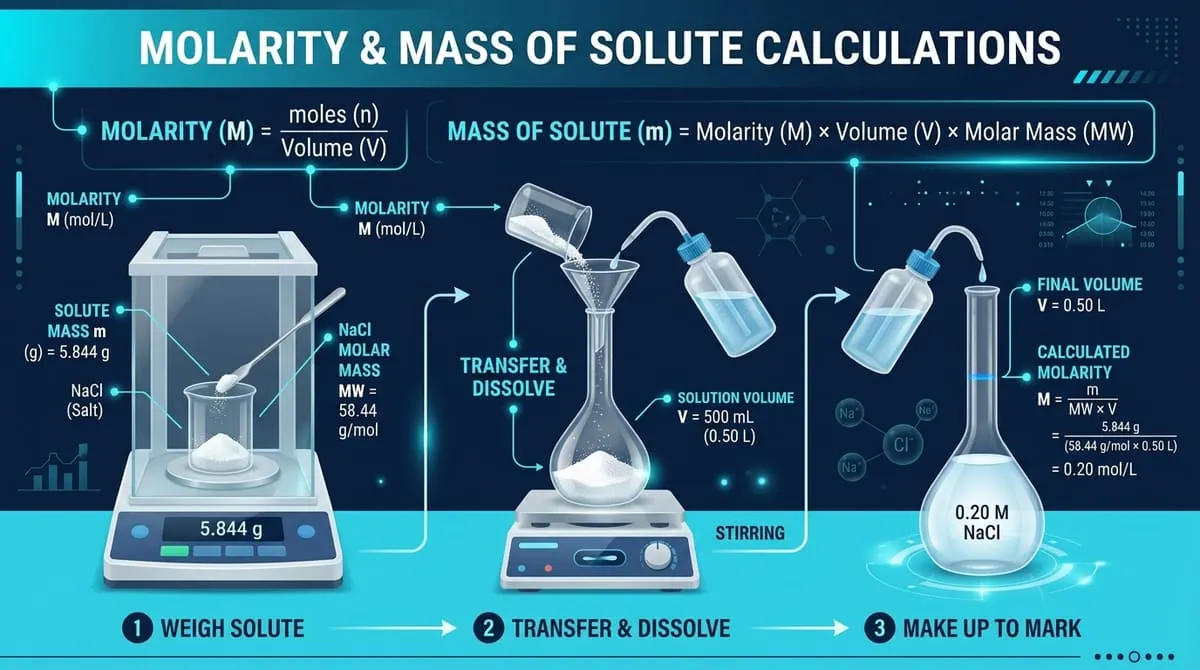
1. Introduction & Conceptual Overview
How do pharmaceutical chemists prepare exact intravenous saline () drips for hospital patients? How do molecular biology laboratories formulate precise and buffers for DNA electrophoresis? How do analytical chemists calibrate titration standards to four decimal places of precision?
All wet chemistry laboratory workflows begin with a single fundamental stoichiometric task: converting target molarity () and solution volume () into the exact dry mass of solute ( in grams) to weigh on an analytical balance.
Molarity is the universal standard for expressing solution concentration in chemistry and biology. Calculating the required solute mass bridges the theoretical world of molecules and moles with the practical, physical world of analytical balances and volumetric glassware.
flowchart TD
    subgraph INPUTS["📋 1. Target Solution Specifications"]
        M["Target Molarity: M (mol/L)"]
        V["Target Volume: V (Liters)"]
        MW["Solute Molar Mass: MW (g/mol)"]
    end

    subgraph CALC["⚙️ 2. Stoichiometric Calculations"]
        MOLES["Step A: Compute Solute Moles
n = M × V (moles)"]
        MASS["Step B: Compute Required Dry Mass
m = n × MW = M × V × MW (grams)"]
        MOLES --> MASS
    end

    subgraph LAB["⚖️ 3. Wet Laboratory Execution"]
        WEIGH["Weigh m (grams) on Analytical Balance
Pre-dissolve in solvent & dilute to V mark in Volumetric Flask"]
    end

    INPUTS --> CALC
CALC --> LABThe Master Molarity-Mass Equation:
Where mass () is in grams, molarity () is in , volume () is in Liters, and molar mass () is in .
2. Chemical Definitions & Fundamental Theory
2.1 What is Molarity ()?
Molarity (), also known as molar concentration, is defined as the number of moles of solute dissolved per liter of total solution volume:
Where:
- = Molarity ( or )
- = Amount of solute in moles ()
- = Total volume of the final solution in Liters ()
2.2 What is Molar Mass ()?
The molar mass ( or ) is the mass of one mole ( particles) of a chemical substance, expressed in grams per mole (). It is calculated by summing the standard atomic weights of all constituent atoms in the empirical chemical formula:
2.3 Deriving the Master Mass Equation
- Express moles in terms of mass and molar mass:
- Substitute into the molarity definition:
- Rearrange to isolate dry solute mass ():
3. Core Units & Conversion Tables
| Variable | Symbol | Standard SI Unit | Common Lab Units | Unit Conversion Factor |
|---|---|---|---|---|
| Solute Mass | , , | |||
| Solution Volume | , , | |||
| Molar Concentration | , , | |||
| Molar Mass |
4. Mathematical Formulas & Algebraic Solvers
Depending on which parameter is unknown in a given laboratory protocol:
flowchart TD
    ROOT["🎯 Master Relation: m = M · V · MW"]

    ROOT --> B1["🔵 Solve for Solute Mass (m)"]
    ROOT --> B2["🟢 Solve for Molarity (M)"]
    ROOT --> B3["🟠 Solve for Solution Volume (V)"]
    ROOT --> B4["🟣 Solve for Solute Molar Mass (MW)"]

    B1 --> F1["m = M · V · MW"]
    B2 --> F2["M = m / (V · MW)"]
    B3 --> F3["V = m / (M · MW)"]
    B4 --> F4["MW = m / (M · V)"]
5. Step-by-Step Standard Operating Procedure (SOP)
flowchart TD
    S1["1️⃣ Calculate Required Dry Mass
m = M · V · MW (in grams)"] --> S2["2️⃣ Weigh Solute on Analytical Balance
Use tared weigh boat or clean glass beaker"]
    S2 --> S3["3️⃣ Pre-Dissolve in Sub-Volume
Dissolve crystals in ~70% of target solvent volume with magnetic stir bar"]
    S3 --> S4["4️⃣ Transfer to Volumetric Flask
Rinse beaker 3 times into flask to ensure 100% quantitative transfer"]
    S4 --> S5["5️⃣ Make Up to Graduation Mark
Add distilled water dropwise until bottom of meniscus aligns with calibration line"]
    S5 --> S6["6️⃣ Invert & Mix Thoroughly
Stopper flask and invert 10–15 times for complete homogeneity"]
6. Real-World Practical Examples & Calculations
Example 1: Preparing Sodium Hydroxide () Standard
- Goal: Prepare of for acid-base titrations.
- Given Data:---
- Step 1: Calculate Moles Required:
- Step 2: Calculate Mass to Weigh:
- Lab Execution: Weigh of pellets, dissolve in deionized water in an ice bath (exothermic dissolution), transfer to a volumetric flask, and dilute to the calibration line.
Example 2: Preparing of Glucose Solution
- Goal: Prepare of D-glucose () cell culture medium.
- Given Data:---
- Calculation:
- Conclusion: Weigh of D-glucose powder and dilute to .
7. Common Student Mistakes & How to Avoid Them
| Common Mistake | Why It Happens | Solution |
|---|---|---|
| Using Milliliters directly in formula | Forgetting that Molarity is defined per Liter. | Always divide by to get Liters (). |
| Adding solid to final solvent volume | Adding of water to of solid results in final volume. | Dissolve solid first, then dilute up to the graduation mark. |
| Ignoring Hydration Waters (Hydrates) | Using anhydrous for a hydrated salt (e.g. vs ). | Always include the water of crystallization in the formula weight calculation. |
| Temperature Expansion Effects | Preparing volumetric solutions with hot liquids. | Allow exothermic solutions to cool to before final meniscus adjustment. |
8. Frequently Asked Questions (FAQ)
Q1: What is the main formula for calculating mass from molarity?
A: The formula is , where is solute mass in grams, is target molarity in , is total volume in Liters, and is solute molar mass in .
Q2: What is the difference between Molarity () and Molality ()?
A: Molarity () is moles of solute per Liter of solution (), which varies slightly with temperature. Molality () is moles of solute per kilogram of solvent (), which is strictly temperature-independent.
Q3: Why is a volumetric flask used instead of a beaker or graduated cylinder?
A: Volumetric flasks are calibrated Class A analytical glassware with an accuracy tolerance of , whereas standard beakers and graduated cylinders have uncertainties between 5% and 10%.
Q4: How do I account for a hydrated salt like ?
A: Add the molar mass of the water molecules () to the anhydrous formula weight (), yielding .
Q5: What is concentration?
A: Weight/Volume percent () represents grams of solute per of solution. A solution contains of solute in ().
9. Key Takeaways & Summary
- Universal Stoichiometric Formula: computes the required mass for any chemical solution.
- Units Alignment: Volume must always be in Liters (), Molarity in , and Molar Mass in .
- Meniscus Alignment: Always adjust the final solvent level so the bottom of the curved liquid meniscus touches the calibration line at eye level.
- Hydration Consideration: Incorporate waters of crystallization into the molar mass calculation when using hydrated reagents.
Additional Technical Guidelines & Measurement Standards
When conducting calculations for Molarity to Mass of Solute Solver, maintaining quantitative precision and verifying input parameter boundaries is essential for reliable scenario evaluation. Always verify that raw numerical inputs are measured using standardized instrumentation, and double-check unit conversions prior to applying outputs in commercial, industrial, or academic projects.
For quantitative unit conversions and scientific calculations, always maintain at least four decimal places of precision during intermediate arithmetic stages before rounding final results. When preparing technical reports, laboratory documentation, or financial forecasts, cross-verify all output variables against established international measurement standards (such as SI, NIST, and ISO metric benchmarks) to guarantee consistent analytical rigor across all computational workflows.
MathsLover.com delivers this interactive solver 100% free of charge to foster global mathematical literacy, educational accessibility, and data-driven problem solving across scientific, technical, and academic communities worldwide.