💡 Direct Answer & Executive Summary (Atomic Mass Molecular Weight Solver)
Definition: Chemical stoichiometry calculation: Atomic Mass Molecular Weight Solver.
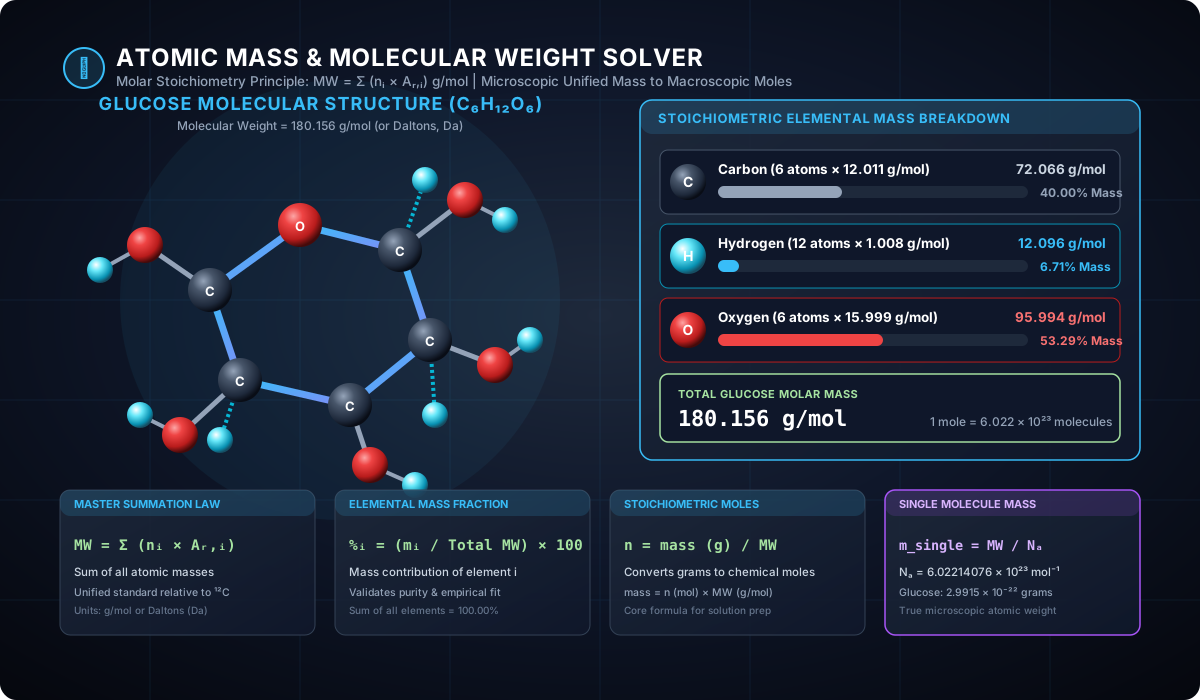
Governing Math Formula: Molecular Weight MW = Σ (n_i × A_r,i) g/mol. Mass Fraction % = (n_i × A_r,i / MW) × 100%. One mole contains 6.02214076 × 10²³ formula units (Avogadro constant).
Target Applications: Provides real-time quantitative solutions in Chemistry for students, engineers, researchers, and finance professionals.
Atomic Mass, Molecular Weight & Molar Stoichiometry
1. Introduction & Conceptual Foundation
In quantitative chemistry, molecular biology, pharmacology, and chemical engineering, Molecular Weight (Molar Mass, ) is the fundamental quantitative constant connecting the microscopic realm of individual subatomic particles to macroscopic quantities measured on laboratory analytical balances.
Atoms and molecules react strictly in integer ratios dictated by balanced stoichiometric chemical equations—not by bulk gram weight. For example, during cellular respiration:
One single molecule of glucose reacts with exactly six diatomic oxygen molecules. However, because a carbon atom () is twelve times heavier than a hydrogen atom (), weighing out of glucose contains an entirely different number of reactive particles than of oxygen.
The Molecular Weight of a substance bridges this gap by defining the exact mass in grams that contains exactly one mole () of formula units.
flowchart TD
    CHEMICAL_FORMULA["🧬 Chemical Empirical / Molecular Formula
e.g., C₆H₁₂O₆ (Glucose)"] --> LOOKUP["📖 Periodic Table Standard Atomic Weights (Aᵣ)
C = 12.011, H = 1.008, O = 15.999 g/mol"]
    LOOKUP --> SUMMATION["➕ Stoichiometric Molar Summation
MW = (6 × 12.011) + (12 × 1.008) + (6 × 15.999) = 180.156 g/mol"]
    SUMMATION --> STOICH["⚖️ Laboratory Weighing & Solution Preparation
Moles n = mass / MW | Solution Molarity M = n / V"]
2. Core Chemical Definitions: Atomic Mass vs. Molecular Weight vs. Molar Mass
To master chemical stoichiometry, one must distinguish between three closely related terms:
2.1 Relative Atomic Mass (, Standard Atomic Weight)
The dimensionless ratio of the average mass per atom of an element (accounting for the natural isotopic abundance on Earth) to of the mass of an unbound neutral Carbon-12 () atom at rest.
- is assigned an exact reference mass of .
- Naturally occurring Carbon contains and , yielding standard .
2.2 Molecular Weight ( / Formula Weight, or )
The sum of the atomic weights of all atoms comprising a single molecule or empirical formula unit. Expressed in Unified Atomic Mass Units ( / ) or Daltons ().
- .
2.3 Molar Mass (, )
The physical mass of one mole () of a chemical substance. - By definition of the Avogadro Constant (), the numerical value of the Molecular Weight in Daltons () is identically equal to the Molar Mass in grams per mole ().
- For example, one single molecule of has a molecular weight of , while one mole ( molecules) of has a molar mass of .
3. Mathematical Derivations & Governing Equations
3.1 The Master Molecular Weight Summation Formula
For any chemical formula containing distinct chemical elements:
Where:
- : Total molecular weight / molar mass of the compound ( or ).
- : Stoichiometric subscript / number of atoms of element per formula unit.
- : Standard relative atomic mass of element ().
graph LR
    E1["Element 1: n₁ × A₁"] --> SUM["➕ Total MW = Σ (nᵢ × Aᵢ)"]
    E2["Element 2: n₂ × A₂"] --> SUM
    E3["Element 3: n₃ × A₃"] --> SUM
    SUM --> MASS_PCT["📊 Elemental % Composition = (nᵢ × Aᵢ / MW) × 100%"]
3.2 Elemental Percent Composition by Mass
To determine the percentage contribution of each element to the total mass of the compound:
Validation Condition: The sum of all elemental mass percentages in a pure compound must equal exactly 100.00%:
3.3 Mass $\longleftrightarrow$ Mole $\longleftrightarrow$ Particle Conversions
Using the molecular weight as a dimensional conversion factor:
- Calculating Moles from Measured Grams:
- Calculating Required Mass in Grams for Given Moles:
- Calculating Absolute Number of Molecules ():
- Mass of an Individual Single Molecule ():
4. Master Periodic Table Reference for Common Elements
| Element Symbol | Element Name | Atomic Number () | Standard Atomic Weight (, ) | Common Valence / Oxidation States |
|---|---|---|---|---|
| H | Hydrogen | $1.008$ | $+1, -1$ | |
| C | Carbon | $12.011$ | $+4, -4, +2$ | |
| N | Nitrogen | $14.007$ | $-3, +5, +3$ | |
| O | Oxygen | $15.999$ | $-2$ | |
| Na | Sodium | $22.990$ | $+1$ | |
| Mg | Magnesium | $24.305$ | $+2$ | |
| P | Phosphorus | $30.974$ | $+5, +3, -3$ | |
| S | Sulfur | $32.065$ | $+6, +4, -2$ | |
| Cl | Chlorine | $35.453$ | $-1, +1, +5, +7$ | |
| K | Potassium | $39.098$ | $+1$ | |
| Ca | Calcium | $40.078$ | $+2$ | |
| Fe | Iron | $55.845$ | $+2, +3$ | |
| Cu | Copper | $63.546$ | $+1, +2$ | |
| Zn | Zinc | $65.380$ | $+2$ | |
| Br | Bromine | $79.904$ | $-1$ | |
| Ag | Silver | $107.868$ | $+1$ | |
| I | Iodine | $126.904$ | $-1$ |
5. Step-by-Step Practical Calculation Examples
Example 1: Molecular Weight & Elemental % Composition of Caffeine ()
- Step 1: Itemize Atomic Quantities:- Carbon ():- Hydrogen ():- Nitrogen ():- Oxygen ():
- Step 2: Sum Total Molecular Weight:
- Step 3: Calculate Elemental Mass Percentages:----- Sum check: ($\checkmark$ Validated).
Example 2: Hydrated Ionic Salts ()
- Scenario: A lab technician prepares a copper plating bath using copper(II) sulfate pentahydrate.
- Step 1: Calculate Anhydrous Part:- :- :- :-
- Step 2: Calculate Water of Hydration Part ():-
- Step 3: Total Hydrated Molar Mass:Water represents of the crystal's total weight.
6. Real-World Applications & Scientific Case Studies
Case Study 1: Active Pharmaceutical Ingredient (API) Dosing in Medicine
- Clinical Reality: In cardiovascular medicine, anticoagulants like Warfarin (, ) are dispensed in milligram tablets.
- Stoichiometric Derivation: A patient takes a () tablet. How many active drug molecules are absorbed into the bloodstream?
Case Study 2: Determining Empirical Formulas from Elemental Combustion Analysis
- Chemical Analysis: Combustion of of an unknown hydrocarbon yields and .
- Step 1: Find Grams and Moles of and :- ()- ()
- Step 2: Find Molar Ratio:
- Step 3: Mass Spectrometry Matching: If mass spectrometry finds , the molecular formula is .
7. Common Calculation Pitfalls & Experimental Mistakes
Mistake 1: Forgetting Multipliers in Subscript Parentheses
In polyatomic compounds like Calcium Nitrate or Aluminum Sulfate , subscripts outside the parentheses multiply every atom inside:
- In : Oxygen count is , Nitrogen count is .
Mistake 2: Ignoring Waters of Hydration in Reagent Bottles
Weighing anhydrous () when the bottle is actually the pentahydrate () introduces a massive 36.1% under-concentration error in molar solutions.
Mistake 3: Confusing Atomic Weight with Isotope Mass
The atomic weight on the periodic table is a weighted terrestrial average. For precise isotopic labeling experiments (e.g. Deuterium or NMR), use specific isotopic nuclide masses () rather than natural abundance averages.
8. Frequently Asked Questions (FAQ)
Q1: What is the difference between an Empirical Formula and a Molecular Formula?
A: An Empirical Formula represents the simplest whole-number ratio of elements in a compound (e.g., for glucose). A Molecular Formula represents the actual total number of atoms in a single molecule (). The molecular weight is always an exact integer multiple of the empirical formula weight: .
Q2: Why is the atomic weight of Chlorine 35.453 instead of a whole number?
A: Natural Chlorine on Earth consists of approximately 75.76% Chlorine-35 (, mass ) and 24.24% Chlorine-37 (, mass ). The weighted average is .
Q3: How does mass spectrometry measure molecular weight?
A: A mass spectrometer ionizes chemical molecules (e.g. via Electrospray Ionization or ), accelerates them through an electric/magnetic field, and measures their mass-to-charge ratio ($m/z$). This allows measurement of macromolecular weights (such as antibodies and proteins) with sub-Dalton precision.
9. Summary & Key Takeaways
- Fundamental Law: .
- Mass Percentage: .
- Mole Conversion: .
- Avogadro Bridge: per Avogadro's number () of formula units.
Additional Technical Guidelines & Measurement Standards
When conducting calculations for Atomic Mass Molecular Weight Solver, maintaining quantitative precision and verifying input parameter boundaries is essential for reliable scenario evaluation. Always verify that raw numerical inputs are measured using standardized instrumentation, and double-check unit conversions prior to applying outputs in commercial, industrial, or academic projects.
For quantitative unit conversions and scientific calculations, always maintain at least four decimal places of precision during intermediate arithmetic stages before rounding final results. When preparing technical reports, laboratory documentation, or financial forecasts, cross-verify all output variables against established international measurement standards (such as SI, NIST, and ISO metric benchmarks) to guarantee consistent analytical rigor across all computational workflows.
MathsLover.com delivers this interactive solver 100% free of charge to foster global mathematical literacy, educational accessibility, and data-driven problem solving across scientific, technical, and academic communities worldwide.