💡 Direct Answer & Executive Summary (pOH Hydroxide Ion Index Solver)
Definition: Compute values for pOH Hydroxide Ion Index Solver in thermodynamic chemical equations.
Governing Math Formula: Stoichiometric law formulations for pOH Hydroxide Ion Index Solver.
Target Applications: Provides real-time quantitative solutions in Chemistry for students, engineers, researchers, and finance professionals.
pOH & Hydroxide Ion Index ()
1. Introduction & Conceptual Overview
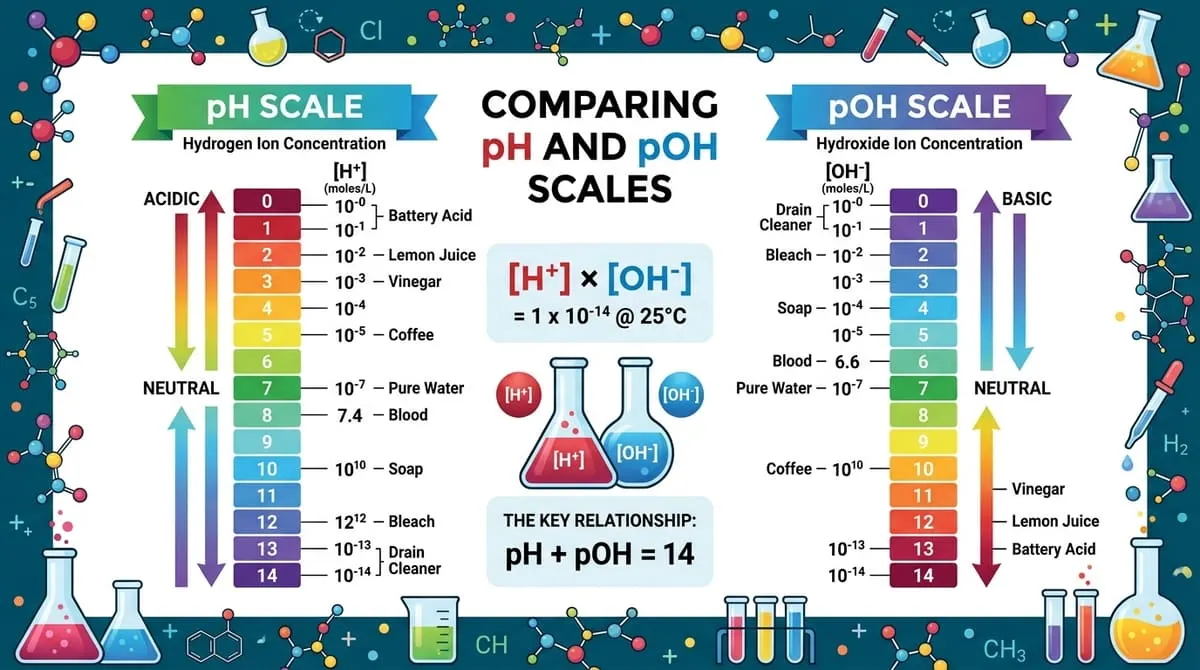
In chemical kinetics, environmental monitoring, municipal water purification, and biological homeostasis, quantifying basicity and alkalinity is just as vital as measuring acidity. While the widely recognized pH scale measures the activity of hydronium ions (), the pOH scale (Hydroxide Ion Index) directly quantifies the concentration and chemical potential of hydroxide ions () in aqueous solutions.
Whenever an Arrhenius base dissolves in water, an amine accepts a proton, or an alkaline salt undergoes hydrolysis, hydroxide ions populate the solution. Because active concentrations span across 14 orders of magnitude—from over () in concentrated sodium hydroxide down to less than in battery acid—working with standard decimal notations () is unwieldy.
The logarithmic pOH scale compresses this exponential range into an intuitive, standardized scale running from 0 (strongly basic/alkaline) to 14 (strongly acidic), with 7.00 marking exact neutral equilibrium at standard room temperature ().
┌─────────────────────────────────────────────────────────────────────────────┐
│                             AQUEOUS EQUILIBRIUM                             │
│                                                                             │
│   [H⁺]  (Hydronium / Acidic)  ◄─────────►  [OH⁻] (Hydroxide / Basic)        │
│               │                                       │                     │
│               ▼                                       ▼                     │
│          pH = -log₁₀[H⁺]                         pOH = -log₁₀[OH⁻]          │
│               │                                       │                     │
│               └─────────────► pH + pOH = 14 ◄─────────┘                     │
│                             (at 25°C / 298.15 K)                            │
└─────────────────────────────────────────────────────────────────────────────┘
Why pOH Matters Today
- Municipal Water Treatment & Infrastructure: Water engineers adjust pOH levels to maintain a protective calcium carbonate passivation layer on water mains, preventing toxic lead and copper corrosion.
- Biopharmaceutical Formulations: Many drugs are basic amine compounds; their ionization fraction, cellular membrane permeability, shelf-stability, and target bioavailability depend strictly on solution pOH.
- Industrial Chemical Manufacturing: Saponification (soap and surfactant production), lithium-ion battery electrolyte balancing, paper pulp digestion, and electroplating require real-time hydroxide control.
- Agronomy & Soil Science: Soil alkalinity controls root bioavailability of essential micronutrients (Fe, Mn, B, Zn, P). High soil alkalinity () causes severe chlorosis in sensitive crops.
2. Chemical Definition & Theory
2.1 The Hydroxide Ion () in Simple Terms
In everyday language, think of pOH as a "basicity ruler." While pH counts the amount of acid particles, pOH counts the amount of alkaline particles (hydroxide ions, ). * When water has a large excess of , the pOH number is very low (between 0 and 6).
- When water is neutral, the pOH is 7.0.
- When water has very few ions (meaning it is packed with acid), the pOH number is high (between 8 and 14).
2.2 Technical Definition
Technically, pOH is defined as the negative base-10 logarithm of the hydroxide ion molar activity (), which in dilute solutions is well-approximated by molar concentration ( in or ):
Where:
- denotes the mathematical operator .
- represents the molar concentration of hydroxide ions ().
To convert from a known pOH value back to hydroxide molarity, take the inverse logarithm (base 10):
2.3 The Teeter-Totter Analogy
Imagine a balanced seesaw (teeter-totter). One seat holds hydronium ions (), and the opposite seat holds hydroxide ions (). Because the ion product in water is fixed ( at ), pushing one side up forces the other side down. When you add a strong base like sodium hydroxide, hydroxide ions shoot upward, which forces hydronium ions downward. On the logarithmic scale, as rises, pOH drops, while pH climbs.
graph LR
    subgraph Acidic_Regime
        A1["High [H⁺] / Low pH"] --- A2["Low [OH⁻] / High pOH"]
    end
    subgraph Neutral_Baseline
        N1["[H⁺] = 10⁻⁷ M (pH 7)"] === N2["[OH⁻] = 10⁻⁷ M (pOH 7)"]
    end
    subgraph Basic_Regime
        B1["Low [H⁺] / High pH"] --- B2["High [OH⁻] / Low pOH"]
    end
3. History & Milestone Discoveries
timeline
    title Historical Milestones in Acid-Base and pOH Theory
    1887 : Svante Arrhenius publishes ion dissociation theory (H+ and OH-).
    1909 : Søren Peder Lauritz Sørensen invents the logarithmic pH scale at Carlsberg Laboratory.
    1920s : Physical chemists establish the pOH and pKw notation across thermodynamics.
    1923 : Brønsted-Lowry & G.N. Lewis generalize proton-transfer and electron-pair reactions.
Present : Automated ion-selective electrodes and IoT spectrophotometric probes provide digital pOH monitoring.- 1887 — Svante Arrhenius: Formulated the ionic theory of dissociation, establishing that bases are substances that dissociate in aqueous solution to yield hydroxide ions ().
- 1909 — Søren P.L. Sørensen: While studying enzyme kinetics during beer fermentation at the Carlsberg Laboratory in Copenhagen, Sørensen created the logarithmic "p" operator ( / power) to replace complex decimals.
- 1920s — Formalization of pOH: Physical chemists generalized Sørensen's framework to basic solutions, introducing and establishing the autoionization relationship .
4. Core Concepts & Chemical Principles
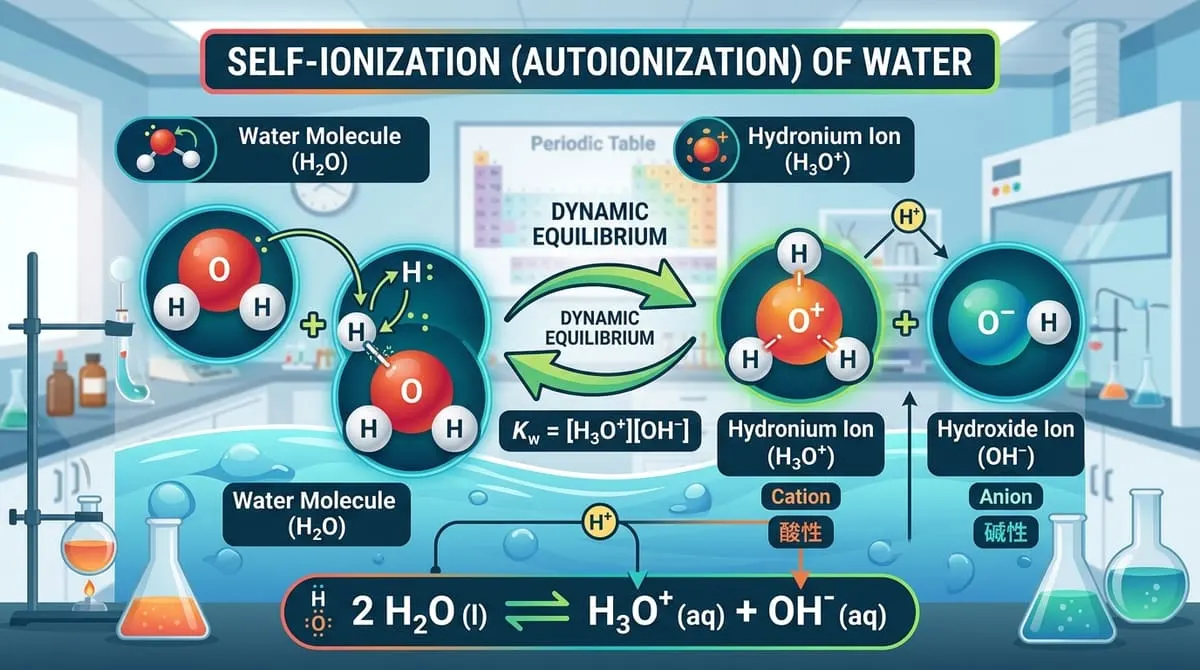
Concept 1: Amphoteric Autoionization of Water
Liquid water molecules naturally collide and undergo self-ionization, acting simultaneously as a weak acid and a weak base:
The equilibrium constant for this reaction is the ion product of water ():
In perfectly neutral pure water at :
Concept 2: Logarithmic Stepping
Because pOH is logarithmic (base-10), every whole number unit step represents a tenfold () change in hydroxide concentration:
- ( more alkaline than pOH 3)
- ( more alkaline than pOH 3)
5. Mathematical Formulas and Derivations
Summary of Governing Equations
| Formula | Equation | Use Case |
|---|---|---|
| Direct pOH | When molarity is known | |
| Hydroxide Molarity | When calculating chemical ion count from pOH | |
| pH–pOH Relation | Instant conversion at | |
| Weak Base Equilibrium | Finding pOH of un-dissociated weak bases | |
| Henderson-Hasselbalch | Calculating pOH of basic buffer solutions |
Derivation of
- Begin with the thermodynamic equilibrium expression for water:
- Apply the base-10 logarithm across both sides:
- Expand using the logarithmic multiplication rule ():
- Multiply through by $-1$:
- Substitute standard definitions (, , ):
- At , , meaning :
6. Step-by-Step Calculation Guide
graph TD
    Start["Given Input Parameter"] --> TypeCheck{"What is the input?"}
    TypeCheck -->|"Hydroxide [OH⁻]"| CalcOH["pOH = -log₁₀[OH⁻]"]
    TypeCheck -->|"pH Value"| CalcPH["pOH = 14.00 - pH"]
    TypeCheck -->|"Hydronium [H⁺]"| CalcH["pH = -log₁₀[H⁺] --> pOH = 14.00 - pH"]
    TypeCheck -->|"Weak Base (Kb, Cb)"| CalcWeak["[OH⁻] = sqrt(Kb * Cb) --> pOH = -log₁₀[OH⁻]"]
    CalcOH --> Result["Final pOH & Solution Classification"]
    CalcPH --> Result
    CalcH --> Result
    CalcWeak --> Result
Calculation Example 1: Strong Monoprotic Base
- Problem: Calculate the pOH and pH of a solution at .
- Step 1: Write the dissociation reaction: ($1:1$ stoichiometric ratio).
- Step 2: Determine : .
- Step 3: Calculate :
- Step 4: Determine :
Calculation Example 2: Strong Diprotic Base (Di-hydroxide)
- Problem: Find the pOH of a solution.
- Step 1: Write the dissociation reaction: .
- Step 2: Calculate total produced:
- Step 3: Calculate :
Calculation Example 3: Weak Base Ionization
- Problem: Calculate the pOH of a solution ().
- Step 1: Set up the equilibrium expression: .
- Step 2: Apply the small- approximation:
- Step 3: Calculate :
7. Comparative Reference Table
| Chemical Substance | Typical (M) | Typical (M) | pH | pOH | Classification |
|---|---|---|---|---|---|
| 1.0 M Sodium Hydroxide () | $1.0$ | 14.00 | 0.00 | Strongly Alkaline | |
| Household Bleach () | 12.50 | 1.50 | Strongly Alkaline | ||
| Ammonia Cleaner () | 11.50 | 2.50 | Moderately Alkaline | ||
| Milk of Magnesia () | 10.50 | 3.50 | Weakly Alkaline | ||
| Baking Soda Solution () | 8.40 | 5.60 | Mildly Alkaline | ||
| Human Blood Plasma (Arterial) | 7.40 | 6.60 | Slightly Alkaline | ||
| Pure Water () | 7.00 | 7.00 | Neutral | ||
| Black Coffee | 5.00 | 9.00 | Mildly Acidic | ||
| Tomato Juice | 4.00 | 10.00 | Moderately Acidic | ||
| Vinegar (5% Acetic Acid) | 2.50 | 11.50 | Moderately Acidic | ||
| Gastric Stomach Acid | 1.50 | 12.50 | Strongly Acidic | ||
| 1.0 M Hydrochloric Acid () | $1.0$ | 0.00 | 14.00 | Strongly Acidic |
8. Practical Real-World Applications
- 1. Municipal Wastewater & Heavy Metal Precipitation: Industrial facilities precipitate hazardous metals () out of waste streams as insoluble hydroxide solids by raising hydroxide levels to .
- 2. Swimming Pool & Spa Water Balance: Hypochlorous acid disinfectant dissociates into inactive forms when pOH is too low (, corresponding to ). Maintaining pool balances chlorine kill-rate with bather eye comfort.
- 3. Pharmaceutical Synthesis & Alkaloid Extraction: Many pain medications and antibiotics are alkaloids. Controlling pOH ensures uncharged molecular states for optimal organic solvent liquid-liquid extraction.
- 4. Commercial Clean-In-Place (CIP) Food Systems: Dairies and breweries flush processing lines with caustic solutions formulated to to saponify stubborn milk fats and hydrolyze protein films.
9. In-Depth Case Studies
Case Study 1: Neutralizing an Industrial Alkaline Tank Spill
- Incident: An industrial storage container ruptures, spilling of into a secondary neutralization basin.
- Objective: Determine the initial pOH and compute how many liters of are required to neutralize the basin to at .
- Analysis & Calculation:1. Calculate total moles of hydroxide ():2. Compute initial pOH:3. Neutralization requires stoichiometric equivalence ():
- Outcome: Adding of acid brings (), fulfilling environmental compliance discharge standards.
Case Study 2: Designing an Ammonia-Ammonium Buffer System
- Scenario: A clinical biochemist requires an enzyme storage buffer stabilized at at using ammonia (, , ) and ammonium chloride ().
- Calculation via Henderson-Hasselbalch Equation:
- Outcome: Formulating the buffer with a ratio of to locks the solution at (), protecting enzyme integrity against ambient atmospheric acidification.
10. Key Advantages of Using the pOH Scale
- Direct Calculation for Base Solutions: Eliminates tedious multi-step conversions when testing hydroxides, basic salts, and amine solutions.
- Simplified Handling of Extreme Concentrations: Replaces cumbersome exponential numbers like with simple, manageable digits.
- Direct Coupling with Values: Streamlines buffer design and equilibrium calculations for nitrogenous bases and pharmaceuticals.
- Symmetrical Intuition: Gives analytical chemists a direct mirror to the pH scale for complete equilibrium modeling.
11. Limitations & Nuances
1. Temperature Dependence of
Because water autoionization is endothermic, raising the temperature drives dissociation forward (Le Chatelier's Principle):
- At :
- At :
- At (Human Body):
- At :
Crucial Rule: The formula is strictly exact only at . For non-standard thermal systems, use .
2. Negative pOH and pOH > 14
The scale is not limited to 0–14:
- Concentrated : .
- Concentrated : .
3. Ionic Strength & Activity Coefficients
In concentrated solutions (), electrostatic ion interactions cause the effective chemical activity () to deviate from simple concentration molarity.
12. Common Mistakes to Avoid
- Mistake 1: Forgetting Stoichiometric Multipliers.Error:* Setting for .Correction:* Calcium hydroxide yields 2 hydroxide ions per unit: .
- Mistake 2: Inverting Scale Direction.Error:* Assuming indicates a strong alkaline base.Correction:* High pOH means low and high —it is strongly acidic ().
- Mistake 3: Logarithmic Significant Figures.Rule:* The number of decimal places in a logarithmic output must equal the number of significant figures in the input concentration.Example:* For (2 sig figs), write (2 decimal places).
13. Frequently Asked Questions (FAQ)
Q1: What is the primary difference between pH and pOH?
A: pH quantifies hydronium/hydrogen ion concentration (), whereas pOH quantifies hydroxide ion concentration (). They are connected in aqueous systems by .
Q2: Can a pOH value be negative?
A: Yes. When the hydroxide ion concentration exceeds (such as in ), , which is a valid negative pOH.
Q3: What is the pOH of pure neutral water at ?
A: Exactly $7.00$, because and .
Q4: Does pOH change with temperature?
A: Yes. Water autoionization is endothermic; as temperature rises, increases, decreasing the neutral pOH value (e.g., neutral pOH is $6.81$ at ).
Q5: How do you convert pOH directly to ?
A: Raise 10 to the negative power of pOH: .
Q6: What is the pOH of a solution?
A: For , . At , .
Q7: Why is pH used more often than pOH in consumer products?
A: Historical standardization led consumer and regulatory labels to rely on pH. However, industrial chemical synthesis and analytical laboratories use pOH daily.
Q8: What indicator is best for detecting pOH changes in basic ranges?
A: Phenolphthalein (color transition between / ) and thymolphthalein are standard choices.
Q9: How is pOH calculated for a weak base?
A: Use the base dissociation constant : solve for , then calculate .
Q10: How do basic buffers resist changes in pOH?
A: Basic buffers contain a weak base and its conjugate acid. Added acid is neutralized by the weak base, while added hydroxide is neutralized by the conjugate acid.
14. Expert Tips & Best Practices
- Verify Temperature Before Converting: Never assume without confirming the system is near . For human physiological assays (), always use $13.63$.
- Account for Salt Hydrolysis: Salts formed from weak acids and strong bases (e.g., sodium acetate, ) undergo hydrolysis in water to produce basic solutions with .
- Apply the 5% Rule for Weak Bases: When using , verify that . If ionization exceeds 5%, solve the quadratic equation.
- Calibrate Probes with Dual Buffer Standards: When converting physical electrode readings to pOH, perform two-point calibrations at pH 7.00 and pH 10.00 for optimal alkaline accuracy.
15. Summary & Key Takeaways
- Fundamental Definition: quantifies hydroxide ion concentration on a logarithmic scale.
- Scale Direction: Low pOH () denotes basic/alkaline solutions; high pOH () denotes acidic solutions.
- Standard Room-Temperature Law: At , .
- Thermal Response: increases with temperature, decreasing neutral pOH below 7.00 at elevated temperatures.
- Broad Utility: Essential for wastewater treatment, biopharmaceutical manufacturing, alkaline buffer design, and consumer chemical production.
16. Conclusion
The pOH scale (Hydroxide Ion Index) is an indispensable pillar of aqueous chemical thermodynamics. Mastering pOH provides deep insight into acid-base neutralizations, precipitation reactions, enzyme buffering, and large-scale industrial chemical processes. Utilize our interactive pOH Hydroxide Ion Index Solver above to compute exact pOH, pH, and ion molarity values instantly for your laboratory assays and engineering workflows.
Additional Technical Guidelines & Measurement Standards
When conducting calculations for pOH Hydroxide Ion Index Solver, maintaining quantitative precision and verifying input parameter boundaries is essential for reliable scenario evaluation. Always verify that raw numerical inputs are measured using standardized instrumentation, and double-check unit conversions prior to applying outputs in commercial, industrial, or academic projects.
For quantitative unit conversions and scientific calculations, always maintain at least four decimal places of precision during intermediate arithmetic stages before rounding final results. When preparing technical reports, laboratory documentation, or financial forecasts, cross-verify all output variables against established international measurement standards (such as SI, NIST, and ISO metric benchmarks) to guarantee consistent analytical rigor across all computational workflows.
MathsLover.com delivers this interactive solver 100% free of charge to foster global mathematical literacy, educational accessibility, and data-driven problem solving across scientific, technical, and academic communities worldwide.