💡 Direct Answer & Executive Summary (Asphalt Sealcoating Gallons Estimator)
Definition: Framing and building estimation tool: Asphalt Sealcoating Gallons Estimator.
Governing Math Formula: Sealcoat Gallons = (Driveway Area × Coats) ÷ Coverage Rate. Coverage = 80-100 sq ft/gal.
Target Applications: Provides real-time quantitative solutions in Construction for students, engineers, researchers, and finance professionals.
Asphalt Sealcoating Gallons Estimator: Complete Driveway Maintenance Guide
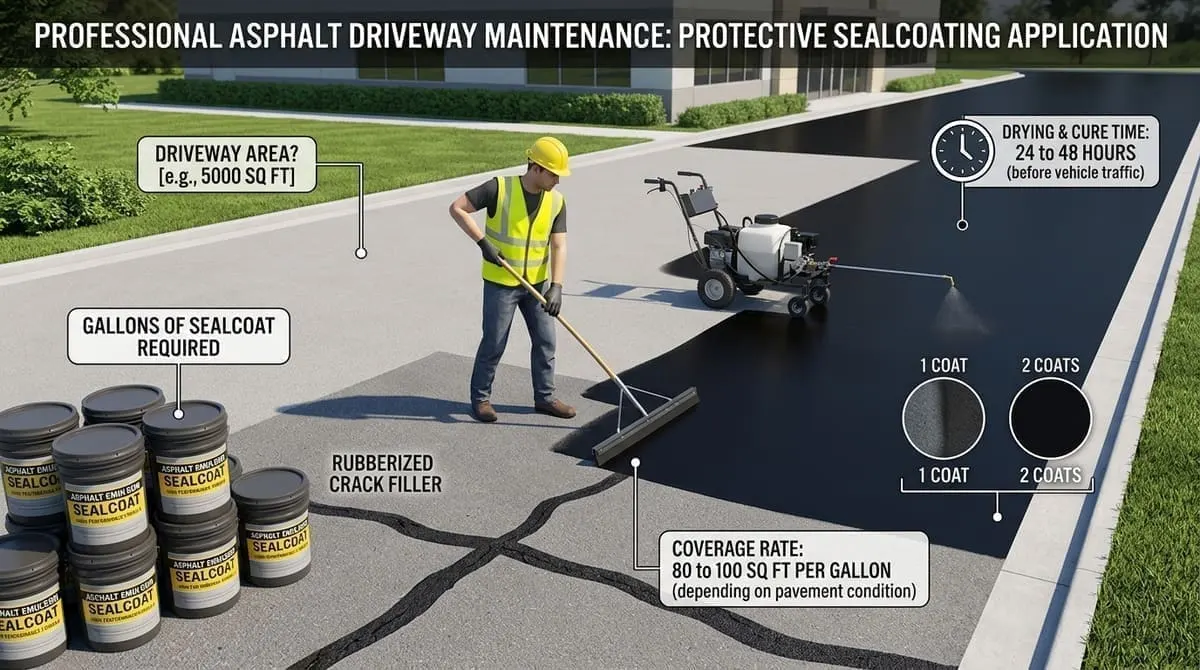
1. Introduction
Asphalt driveways and commercial parking lots are subject to severe daily environmental degradation. Sun exposure emits intense ultraviolet (UV) radiation that breaks down the flexible petroleum binders holding aggregate rocks together, turning rich black asphalt into a brittle, oxidized gray surface.
Simultaneously, winter rain and snow seep into microscopic surface pores; when temperatures drop below freezing, water expands into ice crystals, expanding surface fissures into destructive spiderweb cracks and deep potholes. Furthermore, oil drips, power steering fluid, and gasoline leaks act as organic solvents that liquefy asphalt cement, causing aggregate raveling.
Periodic asphalt sealcoating—applying a protective liquid barrier emulsion of refined coal-tar, asphalt emulsion (AE), or bio-based polymers enriched with mineral filler and silica sand—is the single most effective maintenance defense against pavement deterioration. Sealcoating every doubles the functional lifespan of an asphalt driveway, restores a rich jet-black curb appeal, and prevents water infiltration.
flowchart TD
    DIMS["📐 Driveway Square Footage
Length (ft) × Width (ft) = Total Surface Area (sq ft)"]

    DIMS --> COND["🔍 Inspect Pavement Surface Condition
Smooth / Previously Sealed: 90 to 100 sq ft/gal
Rough / Aged & Porous: 70 to 80 sq ft/gal"]

    COND --> COATS["🪣 Choose Number of Applications
1 Coat (Light Maintenance) | 2 Coats (Standard Gold-Standard Protection)"]

    COATS --> GALLONS["🧪 Calculate Total Sealcoat Gallons
Gallons = (Driveway Area × Coats) ÷ Coverage Rate"]

    GALLONS --> PAILS["🛒 Sizing 5-Gallon Commercial Pails
Buckets = Ceiling(Total Gallons ÷ 5)"]

    PAILS --> CRACKS["🛡️ Rubberized Crack Filler Estimation
Estimated Crack Filler = Area × 0.05 linear feet"]
Mastering sealcoat estimation mathematics enables property owners, commercial facility managers, and paving maintenance contractors to:
- Accurately calculate exact liquid sealcoat requirements in commercial Gallons and 5-Gallon Pails.
- Adjust application coverage rates based on pavement surface age, oxidation, and porosity ().
- Plan multi-coat systems ( are vastly superior to ).
- Estimate hot-pour or cold-pour rubberized crack filler for structural fissures.
- Execute proper surface preparation, degreasing, and cure time windows ( before vehicle traffic).
2. Definition & Core Concepts
2.1 The Simple Definition
- Sealcoating: The application of a specialized liquid bituminous emulsion to protect and beautify asphalt pavement surfaces.
- Asphalt Emulsion (AE): Water-based asphalt sealer containing microscopic asphalt globules suspended in water with clay and emulsifiers (eco-friendly, low-VOC, non-toxic).
- Coal-Tar Sealer: Traditional sealer manufactured from refined coal by-products (high chemical resistance to gas/oil spills, but restricted in several US states due to polycyclic aromatic hydrocarbons).
- Rubberized Crack Filler: Elastic polymer-modified sealant used to bridge and seal cracks wider than before sealcoating.
2.2 Technical Definition & Governing Formulas
Under ASTM D5727 / D6945 standard specifications for emulsified asphalt pavement sealers, liquid sealer coverage rates () are governed by surface texture and application methods:
Formula 1: Liquid Volume Required ()
Where:
- = Total surface area in square feet.
- = Number of applied coats ().
- = Coverage rate ( for smooth; for rough/oxidized).
Formula 2: Number of 5-Gallon Pails ()
Formula 3: Rubberized Crack Filler Estimation ()
For typical residential driveways older than 3 years, linear feet of crack repair averages approximately 5% of total square footage:
2.3 The Sunscreen Analogy
Think of asphalt sealcoating like applying waterproof sunscreen and moisturizer to skin:
- Raw asphalt is like skin exposed to direct sunlight: without protection, UV rays bake out natural oils, causing peeling, drying, and cracking.
- Sealcoat forms an impenetrable black shield that reflects UV radiation and stops rain from soaking into surface pores.
- Two thin, even coats protect far better than one thick globby layer that blisters and peels.
3. Historical Timeline of Pavement Sealcoating
timeline
    title Milestones in Asphalt Pavement Sealcoating
    c. 1930s : Industrial coking plants pioneer coal-tar pitch coatings for municipal airport runways
    1950s : Post-war suburban driveway boom popularizes retail pail sealers
    1980s : Fast-drying polymer additives & silica sand suspension technologies developed
    2000s : Environmental bans on high-PAH coal-tar drive rapid innovation in pure Asphalt Emulsions (AE)
Modern : Bio-based soybean oil rejuvenators, ceramic-infused nanotech sealers, and infrared patchers- Airport Runway Coal-Tar (1930s): Early military airfields required fuel-resistant coatings to prevent airplane aviation fuel from dissolving tarmac runways.
- Suburban Retail Pails (1950s): Hardware stores introduced 5-gallon DIY sealcoating buckets with squeegee applicators.
- Sand-Loaded Industrial Mixes (1980s): Paving associations standardized the addition of of silica sand per gallon to provide anti-skid traction for wet tires.
- Asphalt Emulsion & Eco-Sealers (2000s–Present): Environmental regulations catalyzed the shift to non-toxic water-based asphalt emulsions and bio-renewable sealants.
4. Master Sealcoating Material Comparison Matrix
| Sealer Type | Chemical Base | Typical Coverage (1 Coat) | Fuel & Oil Resistance | UV Protection | Eco & VOC Rating |
|---|---|---|---|---|---|
| Refined Coal-Tar Emulsion | Coal pitch | Outstanding | High | High VOC (restricted) | |
| Asphalt Emulsion (AE) | Petroleum bitumen | Moderate (treat spots) | High | Low VOC / Eco-friendly | |
| Acrylic Polymer Sealer | Synthetic resin | Exceptional | Maximum | Low VOC / Long lasting | |
| Soy/Bio Rejuvenator | Agricultural oil | Restores bitumen | Deep penetration | Zero VOC / Non-toxic |
5. Step-by-Step Mathematical Formulations
flowchart TD
    S1["1. Measure Driveway Area (A):
Area = Length (ft) × Width (ft)"]

    S1 --> S2["2. Select Coverage Rate Based on Surface Texture:
Smooth/Sealed: 90 sq ft/gal | Rough/Unsealed: 75 sq ft/gal"]

    S2 --> S3["3. Calculate Total Liquid Gallons:
Gallons = (Area × 2 Coats) ÷ Coverage Rate"]

    S3 --> S4["4. Sizing 5-Gallon Pails:
Buckets = Ceiling(Gallons ÷ 5)"]

    S4 --> S5["5. Estimate Crack Filler Quantity:
Linear Feet of Cracks = Area × 0.05"]

    S5 --> S6["6. Application & Curing Window:
Apply at 55°F+ and allow 24 to 48 hours cure time"]
6. Practical Real-World Calculation Walkthroughs
Example 1: Standard Suburban Two-Car Driveway ()
- Driveway Dimensions: .
- Pavement Condition: Smooth, previously sealed 3 years ago ().
- Target Application: 2 Thin Protective Coats.
- Calculations:1. Total Liquid Gallons:2. 5-Gallon Pail Purchase:3. Rubberized Crack Filler: ().
Example 2: Large Aged Country Driveway ()
- Driveway Dimensions: .
- Pavement Condition: Rough, dry, porous asphalt ().
- Calculations:1. Liquid Gallons for 2 Coats:2. Commercial Pail Count: or a contractor bulk tote.3. Estimated Crack Filler: of cracks.
7. Professional Application & Preparation Protocol
flowchart TD
    CLEAN["🧹 1. Deep Cleaning & Power Washing
Wire broom moss, power wash dirt & degrease automotive oil spots"]

    CLEAN --> CRACK["🔥 2. Fill Structural Cracks
Pack cracks >1/8'' with rubberized crack filler flush with surface"]

    CRACK --> COAT1["🪣 3. Apply First Coat of Sealer
Spread evenly with squeegee at 90 sq ft/gal and let dry 2 to 4 hours"]

    COAT1 --> COAT2["✨ 4. Apply Second Cross-Coat
Apply perpendicular second coat for complete pinhole coverage"]

    COAT2 --> CURE["⏳ 5. 24 to 48 Hour Full Cure
Block driveway with safety cones before allowing passenger vehicles"]| Step | Action Required | Critical Tool |
|---|---|---|
| 1. Oil Spot Priming | Degrease oil drips with surfactant and prime with acrylic bonding primer | Wire brush + Primer |
| 2. Crack Sealing | Melt hot rubber or squeeze cold-pour rubber into cracks | Crack scraper / Caulking gun |
| 3. Squeegee First Coat | Spread liquid sealer smoothly, cutting around garage doors with brush | |
| 4. Second Cross-Coat | Apply second thin layer across previous stroke pattern to fill voids | Squeegee or spray wand |
| 5. Curing Window | Keep all vehicle traffic off for | Warning cones & caution tape |
8. Real-World Case Studies
Case Study 1: The "Rainy Day" Washout Disaster
- Scenario: A DIY homeowner sealcoated a 1,200 sq ft driveway at 4:00 PM when the forecast called for overnight rain at 9:00 PM.
- Disaster: Water-based asphalt emulsion requires at least to evaporate its water carrier and form a solid bond. The heavy rain washed uncured liquid black sealer across the concrete sidewalk, grass lawn, and municipal storm drain, creating a $2,000 hazmat cleanup nightmare.
- Takeaway: Never apply sealcoat unless the forecast guarantees zero rain for at least 24 hours and temperatures stay above .
Case Study 2: Puddling Thick Sealer (Alligatoring)
- Scenario: A homeowner poured pure sealer thick into low spots hoping to level out an uneven driveway.
- Disaster: Sealcoat is not a leveling compound. Thick layers dry only on the top skin while remaining liquid underneath, causing the surface to wrinkle, crack, and peel off in sheets (known as "alligatoring").
- Takeaway: Always apply 2 ultra-thin coats. Fill low depressions with hot-mix asphalt patch or cold-pour patch before sealcoating.
9. Frequently Asked Questions (FAQ)
How many gallons of sealcoat do I need for a 1,000 sq ft driveway?
For two coats on standard asphalt, you need approximately ().
Is one coat of sealcoat enough?
One coat provides color restoration, but 2 coats are the industry gold standard, offering double the wear resistance and filling microscopic pinholes missed in the first pass.
How often should an asphalt driveway be sealcoated?
Sealcoat every . Applying sealer every single year leads to thick buildup that cracks and flakes.
When can I drive on a newly sealcoated driveway?
- Foot traffic: Safe after .
- Car traffic: Wait (or in humid/cloudy weather).
10. Summary Checklist
- ✔ Calculate Area: .
- ✔ Inspect Surface: Rate coverage ( rough vs. smooth).
- ✔ Plan for 2 Coats: Gallons .
- ✔ Size 5-Gallon Buckets: Divide total gallons by 5 and round up.
- ✔ Clean & Fill Cracks: Degrease oil spots and fill cracks before sealing.
- ✔ Verify Weather: and without rain.
Additional Technical Guidelines & Measurement Standards
When conducting calculations for Asphalt Sealcoating Gallons Estimator, maintaining quantitative precision and verifying input parameter boundaries is essential for reliable scenario evaluation. Always verify that raw numerical inputs are measured using standardized instrumentation, and double-check unit conversions prior to applying outputs in commercial, industrial, or academic projects.
For quantitative unit conversions and scientific calculations, always maintain at least four decimal places of precision during intermediate arithmetic stages before rounding final results. When preparing technical reports, laboratory documentation, or financial forecasts, cross-verify all output variables against established international measurement standards (such as SI, NIST, and ISO metric benchmarks) to guarantee consistent analytical rigor across all computational workflows.
MathsLover.com delivers this interactive solver 100% free of charge to foster global mathematical literacy, educational accessibility, and data-driven problem solving across scientific, technical, and academic communities worldwide.