💡 Direct Answer & Executive Summary (Concrete Slab Volume Calculator)
Definition: Framing and building estimation tool: Concrete Slab Volume Calculator.
Governing Math Formula: Volume = Length × Width × (Thickness / 12) in cubic feet. Yards = Volume / 27.
Target Applications: Provides real-time quantitative solutions in Construction for students, engineers, researchers, and finance professionals.
Concrete Slab Volume Calculator: Complete Concrete Estimating Guide
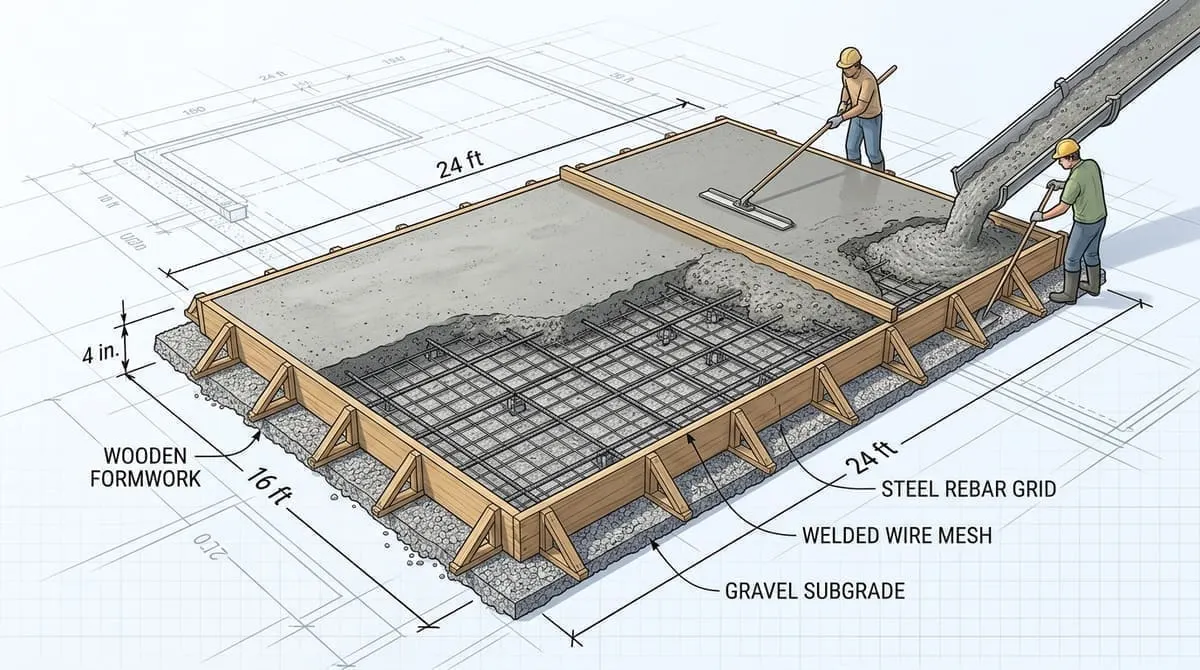
1. Introduction
Concrete is the literal and metaphorical foundation of modern infrastructure. It forms our residential patio slabs, driveways, garage floors, basement foundations, sidewalks, heavy machinery pads, and industrial warehouse floors. As the second most consumed substance on Earth after water, concrete is celebrated for its exceptional compressive strength, weather resistance, and thermal mass.
However, pouring a concrete slab is a high-stakes, time-sensitive civil engineering operation. Once water activates Portland cement, the exothermic hydration reaction begins a strict 90-minute working window. If you underestimate your volume and run out of concrete before the formwork is full, work halts while a "cold joint" develops—a permanent structural fissure where fresh concrete cannot bond with stiffening concrete, leading to water infiltration and frost heave cracks.
flowchart TD
    DIM["📐 Slab Formwork Dimensions
Length (ft) × Width (ft) × Thickness (in)"] --> VOL_CF["📦 Net Volume (cu ft)
Cu Ft = L × W × (Thickness / 12)"]
    VOL_CF --> WASTE["🚜 Subgrade & Spillage Allowance
+10% Safety Buffer"]
    WASTE --> GROSS_CF["🧱 Gross Volume (cu ft)
Gross = Net Cu Ft × 1.10"]
    GROSS_CF --> YARDS["🚚 Cubic Yards (yd³)
Cu Yds = Gross Cu Ft / 27"]
    YARDS --> DECISION{"Job Scale Decision"}
    DECISION -->|Vol > 1.5 - 2.0 yds| READYMIX["🚚 Ready-Mix Transit Truck Order"]
    DECISION -->|Vol ≤ 1.5 yds| BAGS["🛒 Bagged Pre-Mix Purchase
80-lb, 60-lb, or 50-lb Bags"]
Mastering concrete volumetric estimation enables builders, concrete contractors, landscapers, and DIY property owners to:
- Accurately calculate net cubic feet and commercial cubic yards () for any rectangular slab or irregular pad.
- Calculate exact retail pre-mix bag counts across standard 80-lb, 60-lb, and 50-lb bag sizes.
- Factor in subgrade deflection, formwork bowing, and spillage using a standard 10% waste buffer.
- Determine the economic break-even point between batch hand-mixing vs. ready-mix transit mixer truck delivery.
- Properly design reinforcement grids (rebar sizing, welded wire mesh, and control joint spacing).
2. Definition & Core Concepts
2.1 The Simple Definition
- Concrete Slab: A flat, horizontal structural element of cast concrete, typically between 4 to 6 inches thick, poured directly over a prepared gravel base to serve as a floor, patio, driveway, or walkway.
- Cubic Yard (): The primary commercial unit of measurement for bulk concrete, equal to a 3-dimensional cube measuring ().
- Pre-Mix Bag Yield: The actual volume of wet, compacted concrete produced when water is added to a factory-blended dry bag of Portland cement, sand, and gravel aggregate.
- Cold Joint: A weak plane created when freshly mixed concrete is poured against concrete that has already begun its initial set.
2.2 Technical Definition
In structural civil engineering governed by the American Concrete Institute (ACI 318 & ACI 302.1R), concrete slab volumetric estimation accounts for nominal geometric formwork volume modified by subbase compaction tolerance () and hydrostatic lateral form deflection ().
The theoretical net volumetric displacement () for a slab of length (ft), width (ft), and uniform thickness (inches) is:
Converting to commercial cubic yards:
Applying the standard subbase and spillage contingency factor (, typically 10%):
2.3 The Architectural Analogy
Think of pouring a concrete slab like baking a giant, fast-setting sheet cake inside a wooden baking pan:
- If you don't mix enough batter before pouring, you cannot bake half the cake now and add the rest two hours later—the cake will split in half along the seam.
- Because the gravel bottom of your "pan" is uneven and the wooden edges bow slightly under heavy liquid pressure, you must always prepare 10% more batter than the pan's theoretical volume.
3. Historical Milestones of Concrete Engineering
timeline
    title Milestones in Concrete Slab & Cement Technology
    6500 BCE : Nabataean bedouins develop waterproof hydraulic lime concrete for desert cisterns
    125 CE : Roman engineers complete the Pantheon dome using pozzolanic volcanic ash concrete
    1824 : Joseph Aspdin patents modern Portland cement in Leeds, England
    1867 : Joseph Monier invents steel-reinforced concrete slabs & planters
    1913 : First commercial transit-mix concrete truck with rotating drum patented in Baltimore
Modern : Fiber-reinforced, self-consolidating, and carbon-cured ultra-high performance slabs- Hydraulic Lime Concrete (6500 BCE): Nabataean builders discovered that slaked lime combined with fine silica sands formed an impermeable waterproof rock layer in underground cisterns.
- Roman Pozzolanic Concrete (125 CE): The Roman Empire constructed foundations, roads, and monumental structures using volcanic ash (pozzolana) and lime, including the span of the Pantheon.
- Portland Cement Patent (1824): English stonemason Joseph Aspdin calcined limestone and clay at extreme temperatures, producing standardized hydraulic powder that revolutionized modern civil engineering.
- Reinforced Concrete Slabs (1867): Joseph Monier patented steel wire reinforcement embedded inside concrete slabs, solving concrete’s major structural weakness: high compressive strength but poor tensile resistance.
- Ready-Mix Rotating Drum Trucks (1913–Present): Motorized agitator trucks enabled centralized computerized batch plants to deliver perfectly proportioned wet concrete directly to job site formwork.
4. Master Pre-Mix Concrete Bag Specification Matrix
When pouring smaller slabs, retail bags from home centers are the most convenient option. The table below outlines exact yields and conversion factors:
| Bag Size | Dry Weight | Compacted Wet Yield () | Compacted Wet Yield () | Bags Required per Cubic Yard () | Recommended Water per Bag | Typical Project Use |
|---|---|---|---|---|---|---|
| 80-lb Bag (Standard) | Patios, walkways, shed slabs, equipment pads | |||||
| 60-lb Bag (Medium) | Sidewalk repairs, fence posts, solo DIYers | |||||
| 50-lb Bag (Fast-Set) | Post hole anchoring, rapid steps () | |||||
| Ready-Mix Truck | Sold per | Automated batching | Pours () |
5. Step-by-Step Mathematical Formulations
flowchart TD
    S1["1. Measure Formwork Dimensions:
Length L (ft), Width W (ft), Thickness T (inches)"] --> S2["2. Convert Thickness to Feet:
Thickness (ft) = T / 12"]
    S2 --> S3["3. Calculate Net Volume (Cubic Feet):
Cu Ft = L × W × (T / 12)"]
    S3 --> S4["4. Apply 10% Waste & Settlement Allowance:
Gross Cu Ft = Net Cu Ft × 1.10"]
    S4 --> S5["5. Convert to Commercial Cubic Yards:
Cubic Yards = Gross Cu Ft / 27"]
    S5 --> S6["6. Determine Pre-Mix Bag Quantity:
80lb Bags = Gross Cu Ft / 0.60
60lb Bags = Gross Cu Ft / 0.45"]
5.1 Volume Formulas for Slabs
5.2 Factoring 10% Contingency Allowance
5.3 Bag Count Formulas
- 80-lb Bags ():
- 60-lb Bags ():
6. Practical Real-World Calculation Examples
Example 1: Backyard Patio Slab ()
- Dimensions: Length = , Width = , Thickness = .
- Net Volume:
- With 10% Waste Factor:
- Pre-Mix 80-lb Bags:
Example 2: Two-Car Garage Floor Slab ()
- Dimensions: Length = , Width = , Thickness = .
- Net Volume:
- With 10% Waste Factor:
- Delivery Recommendation: Order from a ready-mix concrete plant (equal to 360 bags of 80-lb concrete—far too large for manual mixing).
Example 3: Heavy RV Parking Pad ()
- Dimensions: Length = , Width = , Thickness = (0.50 ft).
- Net Volume:
- With 10% Waste Factor:
- Delivery Strategy: Schedule two standard 8-yard ready-mix transit mixer trucks spaced 45 minutes apart.
7. Bagged Pre-Mix vs. Ready-Mix Truck Decision Matrix
graph TD
    VOL["What is your gross volume?"]
    VOL --> VOL_SMALL["Less than 1.0 cu yd (< 45 bags)
Purchase Bagged Pre-Mix (Rent drum mixer)"]
    VOL --> VOL_MED["1.0 to 2.0 cu yds (45 - 90 bags)
Evaluate Labor vs Short-Load Fee"]
    VOL --> VOL_LARGE["Greater than 2.0 cu yds (> 90 bags)
Order Ready-Mix Transit Truck Delivery"]| Decision Variable | Pre-Mix 80-lb Bags | Ready-Mix Transit Mixer Truck |
|---|---|---|
| Material Cost (2.0 Yards) | $\sim 90\text{ bags} \times \$6.50 = \mathbf{\$585.00}$ | $2.0\text{ yds} \times \$145/\text{yd} = \mathbf{\$290.00}$ |
| Freight / Delivery Surcharge | $0 (DIY truck) or $75 flatbed delivery | $\$120\text{–}\$175$ short-load fee (orders $<4\text{ yds}$) |
| Total Out-of-Pocket | $585 – $660 | $410 – $465 |
| Physical Effort | Extremely Strenuous (7,200 lbs lifted 3x) | Low (Chute pours directly into forms) |
| Pour Duration | $3\text{ to }5\text{ hours}$ (Wheelbarrow batch mixing) | $15\text{ to }20\text{ minutes}$ |
| Risk of Cold Joints | High | Zero (Monolithic pour) |
8. Real-World Case Studies
Case Study 1: The "DIY Wheelbarrow" Cold Joint Failure
- Scenario: Mark decided to pour a shed slab () solo using a single wheelbarrow and garden hose.
- Disaster: Mixing two bags at a time took 10 minutes per batch. After 40 bags (3.5 hours), Mark was exhausted. The first half of the slab had already begun its final set before he could screed the second half. The resulting cold joint cracked open during the following winter freeze.
- Takeaway: For any pour exceeding 30 bags, always rent a powered drum mixer and recruit a minimum 3-person crew (one mixing, one hauling, one screeding).
Case Study 2: The Under-Ordered Ready-Mix Shortage
- Scenario: A contractor ordered exactly for a driveway slab measuring net geometric volume, without adding a 10% waste buffer.
- Disaster: Due to a subgrade depression across the driveway base, the truck emptied with a section unfilled. The contractor had to order an emergency "clean-up load" of , incurring a $200 short-load surcharge plus a 90-minute wait that threatened a cold joint.
- Takeaway: Always order at least 10% extra on ready-mix truck deliveries to accommodate subbase undulations and form deflection.
9. Recommended Slab Thickness & Reinforcement Guide
| Application Type | Minimum Thickness | Reinforcement Specification | Control Joint Spacing | Concrete Compressive Rating |
|---|---|---|---|---|
| Sidewalk / Garden Walkway | Welded Wire Mesh () | Every | ||
| Patio / Shed Floor Pad | \#3 Rebar ($3/8''$) grid on $18''$ centers | Every | ||
| Residential Car Driveway | \#4 Rebar ($1/2''$) grid on centers | Every | ||
| Heavy RV / Boat Storage Pad | \#4 Rebar ($1/2''$) grid on $12''$ centers, double-tied | Every |
10. Common Mistakes & Quality Control
- Adding Excess Water to Make Pouring Easier: Adding extra water weakens concrete dramatically. Every extra gallon of water added per cubic yard reduces compressive strength by up to and causes excessive shrinkage cracking.
- Pouring Over Dry, Uncompacted Dirt: Dry subgrade sucks water directly out of fresh concrete, causing rapid drying shrinkage and bottom cracking. Always compact the gravel base and dampen it with water before pouring.
- Placing Rebar on the Ground: Rebar lying flat on the gravel provides zero tensile reinforcement. Rebar must be elevated on plastic or concrete chairs to sit in the middle-to-upper third of the slab depth.
- Skipping Control Joints: Concrete will crack as it shrinks during curing. Control joints cut to a depth of of the slab thickness create intentional weak planes where clean, invisible cracks occur underneath.
11. Frequently Asked Questions (FAQ)
How many 80-lb bags of concrete make a cubic yard?
There are 45 bags of 80-lb concrete in one cubic yard ().
How many 60-lb bags of concrete are in a cubic yard?
There are 60 bags of 60-lb concrete in one cubic yard.
What is the formula for calculating concrete slab volume?
Why should I add 10% extra concrete to my order?
Excavated soil is never laser-flat. Subgrade depressions, formwork flexing under hydrostatic pressure, and spillage typically consume 5% to 10% extra volume.
How much water should I add to an 80-lb bag?
Add () of clean water per 80-lb bag. The mix should hold its shape when formed into a ball without slumping into a liquid soup.
How soon can I walk and drive on a new concrete slab?
- Foot traffic: Safe after .
- Passenger vehicles: Wait at least .
- Heavy trucks / RVs: Wait for full design cure strength.
What is the standard thickness for a concrete patio?
Standard residential patios are poured at thickness over a 4-inch compacted gravel base.
What is the difference between concrete and cement?
Cement is a dry powder ingredient (Portland cement). Concrete is the finished stone-like composite material produced by mixing cement, water, sand, and coarse stone aggregate.
12. Summary Checklist
- ✔ Measure Slab Formwork: Measure Length (ft), Width (ft), and Thickness (inches).
- ✔ Compute Net Cubic Feet: .
- ✔ Add 10% Safety Buffer: .
- ✔ Convert to Cubic Yards: Divide gross cubic feet by .
- ✔ Determine Delivery Method: Purchase 80-lb bags (gross cu ft / 0.60) for ; schedule ready-mix truck for .
- ✔ Plan Reinforcement & Joints: Elevate rebar on chairs and plan control joints every .
Additional Technical Guidelines & Measurement Standards
When conducting calculations for Concrete Slab Volume Calculator, maintaining quantitative precision and verifying input parameter boundaries is essential for reliable scenario evaluation. Always verify that raw numerical inputs are measured using standardized instrumentation, and double-check unit conversions prior to applying outputs in commercial, industrial, or academic projects.
For quantitative unit conversions and scientific calculations, always maintain at least four decimal places of precision during intermediate arithmetic stages before rounding final results. When preparing technical reports, laboratory documentation, or financial forecasts, cross-verify all output variables against established international measurement standards (such as SI, NIST, and ISO metric benchmarks) to guarantee consistent analytical rigor across all computational workflows.
MathsLover.com delivers this interactive solver 100% free of charge to foster global mathematical literacy, educational accessibility, and data-driven problem solving across scientific, technical, and academic communities worldwide.