💡 Direct Answer & Executive Summary (Interior Wall Paint Gallons Solver)
Definition: Framing and building estimation tool: Interior Wall Paint Gallons Solver.
Governing Math Formula: Wall Area = Perimeter × Height. Paint Gallons = (Net Wall Area × Coats) ÷ 350 sq ft/gal.
Target Applications: Provides real-time quantitative solutions in Construction for students, engineers, researchers, and finance professionals.
Interior Wall Paint Gallons Solver: Complete Room Paint & Primer Guide
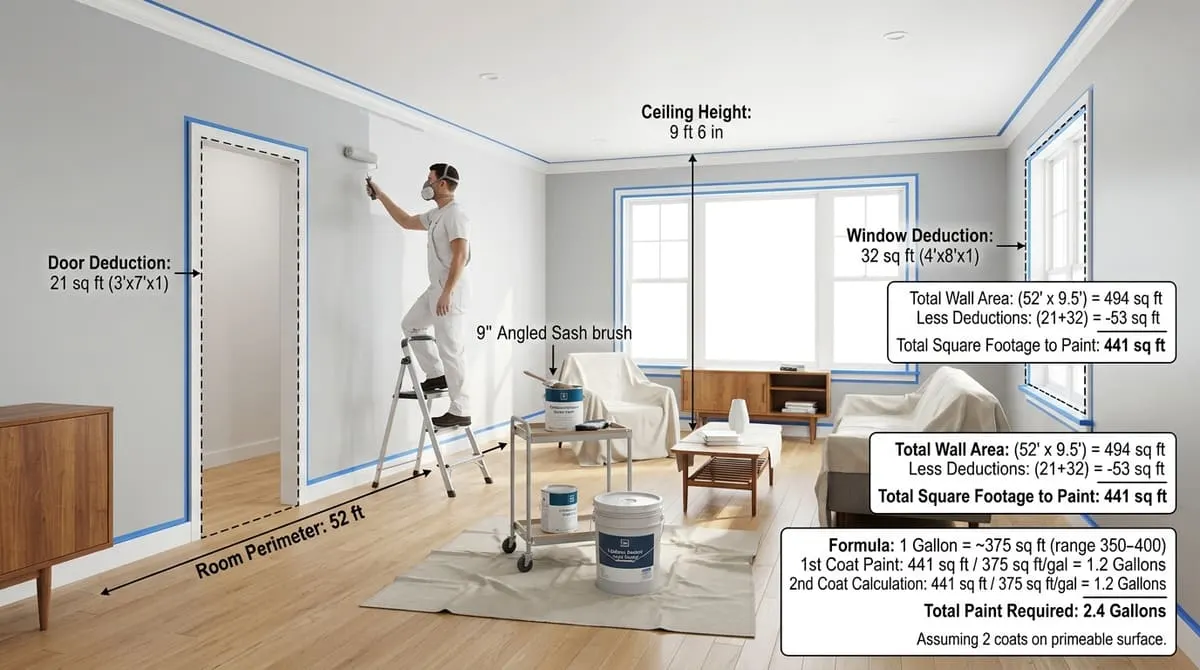
1. Introduction
Painting an interior room—whether refreshing a master bedroom, brightening a dark living room, or painting a newly drywalled basement—is the fastest, most transformative, and highest-ROI interior remodeling task in residential property care.
However, estimating paint is plagued by guesswork. Homeowners frequently run short of paint halfway through their second coat on Sunday evening, forcing an emergency trip to the paint store only to discover that the custom tinted color batch exhibits slight tint variance (dye-lot difference) against the dried wall. Alternatively, buying too much premium paint leaves $\$80\text{ cans}$ of custom color sitting unused in garages until they dry out and spoil.
Paint coverage is determined by room geometry, ceiling height, subtraction of unpainted window and door openings, surface porosity (bare drywall vs. previously painted satin walls), and the number of coats (1 coat for touch-ups; 2 coats for rich, durable opacity and true color fidelity).
flowchart TD
    DIMS["📐 Measure Room Dimensions
Room Perimeter (ft) × Ceiling Height (ft) = Gross Wall Area (sq ft)"]

    DIMS --> DEDUCT["🚪 Subtract Unpainted Openings
Deduct 21 sq ft per door & 15 sq ft per window (~12% standard)"]

    DEDUCT --> NET_AREA["📏 Calculate Net Paintable Wall Area
Net Wall Area = Gross Area − Total Window & Door Area"]

    NET_AREA --> COATS["🎨 Select Paint Coats & Primer
2 Coats Standard (350 to 400 sq ft/gal per coat)"]

    COATS --> CANS["🪣 Calculate Total Gallons & Cans
Gallons = (Net Area × Coats) ÷ 350 sq ft/gal
Cans = Ceiling(Gallons)"]

    CANS --> SUPPLIES["🖌️ Calculate Sundries & Prep Tools
Painter's Tape (60-yd rolls), Roller Covers & Drop Cloths"]
Mastering interior paint estimation mathematics enables homeowners, professional painters, interior decorators, and real estate staging teams to:
- Accurately calculate the exact volume of paint in Gallons and 1-Gallon Cans.
- Calculate wall surface area from Room Perimeter () and Ceiling Height ($8', 9', 10'$).
- Deduct realistic window and door square footage ().
- Apply the industry-standard latex paint coverage benchmark of .
- Estimate paint primer requirements for new drywall, dark-to-light color transitions, and water-stain sealing.
- Determine required rolls of blue painter's tape, microfiber roller covers, and drop cloths.
2. Definition & Core Concepts
2.1 The Simple Definition
- Room Perimeter: The total linear distance around all four walls of a room ().
- Gross Wall Area: The total unadjusted vertical surface area ().
- Net Paintable Area: Gross wall area minus the area of doors, windows, fireplaces, and archways.
- Coverage Rate: The surface area covered by one gallon of paint ( for standard interior latex paint on primed walls).
- Sheen / Finish: The microscopic light reflectivity and washability of the dried paint film (Flat/Matte, Eggshell, Satin, Semi-Gloss, and High-Gloss).
2.2 Technical Definition & Governing Formulas
Under ASTM D5150 / D1210 standard test methods for architectural coatings and wet film thickness (WFT):
Formula 1: Gross Wall Surface Area ()
Formula 2: Net Paintable Area ()
(Note: Standard residential rooms average approximately 12% unpainted openings).
Formula 3: Total Paint Volume in Gallons ()
Where:
- = Number of coats ().
- = Paint spreading rate ( standard; for porous surfaces).
Formula 4: Number of 1-Gallon Cans to Purchase ()
Formula 5: Painter's Tape Estimation ()
For masking baseboards, door casing, and window trim:
(A standard roll of blue painter's tape equals ).
2.3 The Buttering Toast Analogy
Think of painting a wall like spreading butter over warm toast:
- A single stick of butter () spreads smoothly over a predictable number of slices ().
- If the toast is rough and dry like unprimed drywall, it drinks up the butter fast, requiring more butter ().
- Spreading two thin, even layers creates a smooth, golden finish without thick, uneven butter clumps (drips and roller lap marks).
3. Historical Timeline of Interior House Paints
timeline
    title Milestones in Interior Paint Formulation & Color Science
    c. 1867 : D.R. Averill patents first ready-mixed commercial canned oil paint in Ohio
    1941 : Sherwin-Williams introduces Kem-Tone (first water-based synthetic resin emulsion paint)
    1950s : 100% Acrylic latex paint invented, eliminating harsh petroleum solvent fumes
    1978 : US Consumer Product Safety Commission bans toxic lead-based paints in housing
Modern : Zero-VOC ultra-low-odor waterborne paints, ceramic-infused washable scrubbable paints- Pre-Mixed Canned Paint (1867): Early painters had to manually grind lead pigment with raw linseed oil on site before pre-mixed cans became available.
- Kem-Tone Water-Based Paint (1941): Wartime oil shortages spurred the creation of water-thinned interior paint, allowing easy soap-and-water brush cleanup.
- Acrylic Latex Era (1950s): Synthetic acrylic resins delivered superior color retention, elasticity (preventing cracking across seasonal shifts), and scrubbability.
- Lead Ban & Zero-VOC Mandates (1978–Present): Life-safety laws eliminated neurotoxic lead, and modern zero-VOC formulations eliminated indoor air pollutants.
4. Master Paint Sheen & Finish Selection Matrix
| Paint Sheen Finish | Light Reflectivity | Durability & Washability | Best Interior Room Locations | Hides Wall Imperfections |
|---|---|---|---|---|
| Flat / Matte | 0% - 5% | Low (delicate) | Master ceilings, adult bedrooms, low-traffic areas | Best |
| Eggshell | 10% - 25% | Moderate | Living rooms, dining rooms, home offices | High |
| Satin | 25% - 35% | High (wipeable) | Hallways, family rooms, kids' bedrooms, foyers | Moderate (Most Popular) |
| Semi-Gloss | 35% - 70% | Maximum (moisture resistant) | Kitchens, bathrooms, baseboards, doors, trim | Low |
| High-Gloss | 70% - 90% | Extreme (enamel hard) | Front doors, architectural cabinets, heavy trim | Lowest (shows flaws) |
5. Step-by-Step Mathematical Formulations
flowchart TD
    S1["1. Calculate Room Perimeter (P):
Perimeter = 2 × (Length + Width)"]

    S1 --> S2["2. Compute Gross Wall Area (A_gross):
Gross Area = Perimeter × Ceiling Height"]

    S2 --> S3["3. Subtract Doors & Windows (A_net):
Net Area = Gross Area × 0.88"]

    S3 --> S4["4. Compute Paint Gallons for 2 Coats:
Gallons = (Net Area × 2) ÷ 350 sq ft/gal"]

    S4 --> S5["5. Sizing 1-Gallon Cans:
Cans = Ceiling(Gallons)"]

    S5 --> S6["6. Add Ceiling Paint (Optional):
Ceiling Gallons = (Length × Width) ÷ 350 sq ft/gal"]
6. Practical Real-World Calculation Walkthroughs
Example 1: Standard Master Bedroom (, Ceilings)
- Room Dimensions: ; Ceiling Height = .
- Openings: 2 standard doors () .
- Target Application: 2 Coats of Premium Satin Latex Paint.
- Calculations:1. Room Perimeter:2. Gross Wall Area:3. Net Paintable Area:4. Total Paint for 2 Coats:5. Paint Can Purchase: (leaves for future wall touch-ups).6. Blue Painter's Tape: .
Example 2: Large Open Living Room (, Ceilings)
- Perimeter: ; Height = .
- Calculations:1. Gross Wall Area: .2. Net Wall Area (12% opening deduction): .3. Total Paint for 2 Coats:4. Paint Purchase: (cheaper than buying 5 individual gallon cans).
Example 3: Powder Room Bathroom (, Ceilings)
- Perimeter: ; Height = .
- Calculations:1. Gross Area: .2. Net Area: .3. Paint Required: or 1 gallon $+ 1$ quart can.
7. When is Primer Absolutely Necessary?
flowchart TD
    SURF["🔍 Inspect Existing Wall Surface"]

    SURF --> DRYWALL["📄 1. New Unpainted Drywall & Joint Compound
MANDATORY: PVA Drywall Primer
Seals porous gypsum paper & mud to prevent flashing"]

    SURF --> COLOR["🔴 2. Drastic Dark-to-Light Color Change
MANDATORY: High-Hiding White Primer
Blocks red, navy, or brown bleed-through before topcoat"]

    SURF --> STAIN["💧 3. Water Stains, Smoke Damage, or Grease
MANDATORY: Oil-Based / Shellac Stain-Blocking Primer
Locks in tannins and prevents water marks bleeding through"]

    SURF --> REPAINT["✨ 4. Same-Sheen Repaint over Sound Paint
NO PRIMER NEEDED: Direct Paint-and-Primer in One
Light cleaning and 2 coats of topcoat is sufficient"]
8. Real-World Case Studies
Case Study 1: The "Flashing Drywall" Mud Seam Nightmare
- Scenario: A homeowner painted a freshly drywalled living room with two coats of satin paint without using a PVA drywall primer.
- Disaster: Drywall joint compound absorbs paint moisture much faster than the surrounding drywall paper. Under room lighting, every taped mud seam showed through as dull, chalky streaks (known in painting as "flashing"), ruining the smooth finish.
- Takeaway: Always apply a dedicated PVA (polyvinyl acetate) drywall sealer primer over fresh joint compound before painting.
Case Study 2: The Red Dining Room Color Bleed
- Scenario: A homeowner tried painting over a deep crimson red dining room with a pale linen white latex paint using "paint and primer in one".
- Disaster: After three coats of white paint, the intense red pigment still bled through as a sickly pink cast, requiring four extra cans of paint.
- Takeaway: When transitioning from dark bold colors to light pastels, apply 1 coat of gray-tinted stain-blocking primer first.
9. Frequently Asked Questions (FAQ)
How many square feet does 1 gallon of paint cover?
One gallon of quality interior latex paint covers approximately with one coat on primed walls.
How many gallons of paint do I need for a 12x12 room?
For a standard with ceilings and 2 coats of paint, you need approximately ().
Is two coats of paint really necessary?
Yes. While one coat provides color coverage, the second coat builds the full dry film thickness (DFT), ensures uniform sheen without roller streaks, and delivers maximum scrub resistance and true color depth.
How do I calculate ceiling paint?
Multiply the room length by width:
10. Summary Checklist
- ✔ Measure Room Perimeter: .
- ✔ Compute Gross Area: .
- ✔ Deduct Openings: Deduct 12% for doors and windows ().
- ✔ Calculate 2 Coats: .
- ✔ Round Up to Whole Cans: Always buy 1 extra quart/gallon for future touch-ups.
- ✔ Select Sheen: Matte for ceilings, Eggshell/Satin for walls, Semi-Gloss for trim.
Additional Technical Guidelines & Measurement Standards
When conducting calculations for Interior Wall Paint Gallons Solver, maintaining quantitative precision and verifying input parameter boundaries is essential for reliable scenario evaluation. Always verify that raw numerical inputs are measured using standardized instrumentation, and double-check unit conversions prior to applying outputs in commercial, industrial, or academic projects.
For quantitative unit conversions and scientific calculations, always maintain at least four decimal places of precision during intermediate arithmetic stages before rounding final results. When preparing technical reports, laboratory documentation, or financial forecasts, cross-verify all output variables against established international measurement standards (such as SI, NIST, and ISO metric benchmarks) to guarantee consistent analytical rigor across all computational workflows.
MathsLover.com delivers this interactive solver 100% free of charge to foster global mathematical literacy, educational accessibility, and data-driven problem solving across scientific, technical, and academic communities worldwide.