💡 Direct Answer & Executive Summary (Centimeters to Inches Converter)
Definition: Convert Centimeters (cm) to Inches (in) instantly using custom inputs or dynamic unit selectors.
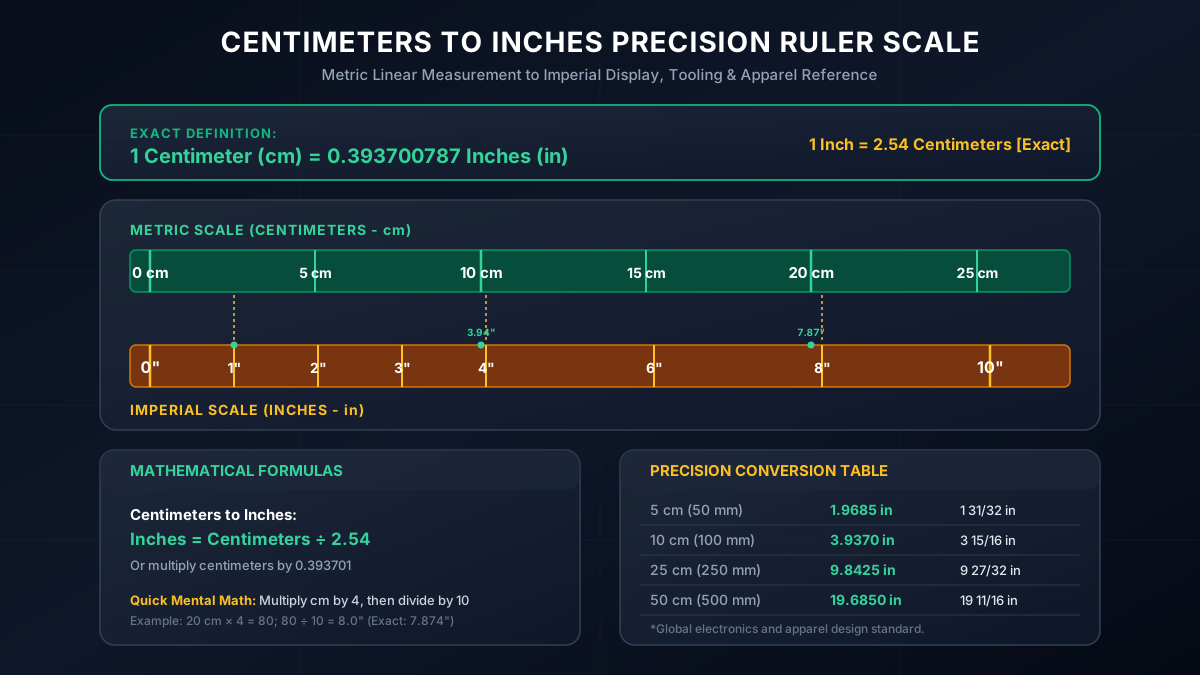
Governing Math Formula: 1 Centimeters (cm) = 0.393701 Inches (in). Formula: Value in Centimeters (cm) × 0.393701 = Value in Inches (in).
Target Applications: Provides real-time quantitative solutions in Unit Converters for students, engineers, researchers, and finance professionals.
Centimeters to Inches Converter - Precision Length Guide
1. Introduction
In global commerce, manufacturing engineering, fashion apparel sizing, electronic display design, and everyday measurements, converting from the metric Centimeter (cm) to the imperial Inch (in) is a daily necessity.
While the metric system is the dominant standard across 95% of international industry and global science, the Inch remains the primary consumer and industrial standard throughout the United States, and is universally used worldwide for specifying smartphone and television screen diagonals, wheel rim diameters, bicycle frames, and camera sensor formats.
Converting centimeters to inches requires the exact international ratio established by treaty in 1959:
The Centimeters to Inches Converter provides instant, bidirectional dimensional calculation across metric centimeters and millimeters to decimal and fractional inches. This comprehensive guide covers the historical standard, fractional tape measure subdivisions ($1/16, 1/32, 1/64$), clothing and waist size conversion charts, mental calculation shortcuts, and real-world industrial applications.
2. Core Definitions & Analogy
To understand length transformation between metric centimeters and imperial inches, let us review the core definitions:
- Simple Definition: A centimeter is a small metric unit of length (roughly the width of a fingernail or standard paperclip), while an inch is an imperial unit of length (approximately the length of the top knuckle of an adult thumb). One centimeter equals roughly 0.394 inches (just under 4 tenths of an inch).
- Technical Definition: The Centimeter ():* A sub-multiple of the International System of Units (SI) base unit meter, defined as .The International Inch ():* Formally defined under the 1959 International Yard and Pound Agreement as exactly ().
- The Paperclip and Thumb Knuckle Analogy: Look at the width of a standard metal paperclip—it measures approximately 1 centimeter. Place two and a half of those paperclips side-by-side, and they will span the exact width of 1 imperial inch ().
3. The Mathematical Formulas
Converting centimeters to inches involves division by 2.54 or multiplication by its reciprocal:
Exact Mathematical Formulas:
Converting Centimeters to Fractional Inches ( Precision):
To convert decimal inches into practical fractional carpentry inches: 1. Compute decimal inches: 2. Extract whole inches: 3. Compute fractional sixteenths: 4. Simplify the fraction (e.g. , , ).
Quick Mental Arithmetic Shortcut:
- Multiply by 4, then move the decimal one place left (0.4x estimate):Example (15 cm): (Exact: - within 1.6% accuracy)*.Example (50 cm): (Exact: )*.
4. Comprehensive Centimeters to Inches Lookup Table
The reference table below outlines standard dimensions across clothing, carpentry, and consumer products:
| Centimeters () | Millimeters () | Decimal Inches () | Fractional Inches (Tape Measure) | Common Everyday Example |
|---|---|---|---|---|
| 0.5 cm | 5 mm | 0.1969 in | 3/16 in | Standard pencil lead / notebook margin |
| 1.0 cm | 10 mm | 0.3937 in | 13/32 in | Standard paperclip width |
| 2.54 cm | 25.4 mm | 1.0000 in | 1 in (Exact) | 1-inch standard hardware bolt |
| 5.0 cm | 50 mm | 1.9685 in | 1 31/32 in | Credit card height (5.4 cm) |
| 10.0 cm | 100 mm | 3.9370 in | 3 15/16 in | Coffee mug coaster diameter |
| 15.0 cm | 150 mm | 5.9055 in | 5 29/32 in | 6-inch pocket ruler |
| 20.0 cm | 200 mm | 7.8740 in | 7 7/8 in | Standard paperback book height |
| 25.0 cm | 250 mm | 9.8425 in | 9 27/32 in | 10-inch dinner plate |
| 30.0 cm | 300 mm | 11.8110 in | 11 13/16 in | Standard 30 cm school ruler (~1 ft) |
| 30.48 cm | 304.8 mm | 12.0000 in | 1 ft 0 in (Exact) | 1 international foot |
| 50.0 cm | 500 mm | 19.6850 in | 19 11/16 in | Airline carry-on luggage width |
| 75.0 cm | 750 mm | 29.5276 in | 29 17/32 in | Standard desk height |
| 100.0 cm | 1,000 mm | 39.3701 in | 3 ft 3 3/8 in | 1 international meter |
| 150.0 cm | 1,500 mm | 59.0551 in | 4 ft 11 1/16 in | Standard fabric bolt width |
| 180.0 cm | 1,800 mm | 70.8661 in | 5 ft 10 7/8 in | Average adult human height |
| 200.0 cm | 2,000 mm | 78.7402 in | 6 ft 6 3/4 in | Standard doorway height |
5. Step-by-Step Practical Calculation Examples
Example 1: International Apparel Waist Sizing
- Scenario: A customer in the United States is ordering jeans from a European brand that lists a waist circumference of 82 cm. What is the US denim waist size in inches?
- Calculation:
- Recommendation: Order a standard Size 32 denim jean.
Example 2: Precision 3D Printing & CAD Sizing
- Scenario: A 3D model designed in Europe specifies a bolt clearance hole diameter of 1.27 cm. What imperial drill bit is required?
- Calculation:
- Result: Use a standard 1/2-inch drill bit.
6. Major Real-World Applications
flowchart LR
    CTI["Centimeters to Inches Conversion"] --> APP["Textiles & Fashion: Inseam, chest & waist sizing for international trade"]
    CTI --> MED["Medical Records: Infant birth length & pediatric growth percentiles"]
    CTI --> ELEC["Electronics: Display diagonal sizes & chassis dimensions"]
CTI --> PHOTO["Photography: Print framing (10x15 cm = 4x6 in, 20x25 cm = 8x10 in)"]- Photography & Picture Frames: Standard international photo print sizes align across systems:***
- Medical Pediatric Tracking: Newborn infant stature is measured at birth in centimeters () and converted to inches () for parental records.
- Luggage & Travel Sizing: International airlines (IATA) enforce maximum carry-on dimensions of , translating to the standard US guideline of .
7. Frequently Asked Questions (FAQ)
- How do you convert centimeters to feet and inches?1. Divide total cm by 2.54 to get total inches.2. Divide total inches by 12 to get whole feet.3. The remainder is inches.Example (): , remainder .
- Why is 1 inch exactly 2.54 cm?The 1959 International Yard and Pound Agreement codified exactly. Dividing by 36 inches yields () per inch with zero recurring decimals.
- What is the fastest way to estimate cm to inches in your head?Multiply by 4 and divide by 10 (or multiply by 0.4). For example, (actual: ).
8. Expert Summary & Best Practices
- Use 2.54 Exact: Divide by 2.54 for mathematically perfect results.
- Keep Units Clear in 3D Printing: In 3D slicer software (Cura, PrusaSlicer), always confirm whether an imported STL file was exported in millimeters, centimeters, or inches to prevent 10x scaling errors.
- Tape Measure Literacy: When reading imperial tape measures, remember each inch divides into halves (), quarters (), eighths (), and sixteenths ().
Additional Technical Guidelines & Measurement Standards
When conducting calculations for Centimeters to Inches Converter, maintaining quantitative precision and verifying input parameter boundaries is essential for reliable scenario evaluation. Always verify that raw numerical inputs are measured using standardized instrumentation, and double-check unit conversions prior to applying outputs in commercial, industrial, or academic projects.
For quantitative unit conversions and scientific calculations, always maintain at least four decimal places of precision during intermediate arithmetic stages before rounding final results. When preparing technical reports, laboratory documentation, or financial forecasts, cross-verify all output variables against established international measurement standards (such as SI, NIST, and ISO metric benchmarks) to guarantee consistent analytical rigor across all computational workflows.
MathsLover.com delivers this interactive solver 100% free of charge to foster global mathematical literacy, educational accessibility, and data-driven problem solving across scientific, technical, and academic communities worldwide.