💡 Direct Answer & Executive Summary (Centimeters to Millimeters Converter)
Definition: Convert Centimeters (cm) to Millimeters (mm) instantly using custom inputs or dynamic unit selectors.
Governing Math Formula: 1 Centimeters (cm) = 10.000000 Millimeters (mm). Formula: Value in Centimeters (cm) × 10.000000 = Value in Millimeters (mm).
Target Applications: Provides real-time quantitative solutions in Unit Converters for students, engineers, researchers, and finance professionals.
Centimeters to Millimeters Converter - Precision Metric Guide
1. Introduction
In mechanical manufacturing, architectural drafting, 3D printing engineering, apparel pattern making, biology microscopy, and carpentry, converting Centimeters (cm) to Millimeters (mm) is the most common decimal subunit multiplication in the International System of Units (SI).
Both units share the metric SI Meter as their foundational base. The Centimeter represents of a meter (), while the Millimeter represents $1/1,000$ of a meter (). Therefore, there are exactly 10 millimeters in 1 centimeter, and converting from centimeters to millimeters is as simple as multiplying by 10 (shifting the decimal point 1 place to the right).
The Centimeters to Millimeters Converter delivers instantaneous, bidirectional calculations across centimeters, millimeters, meters, and inches. This comprehensive guide covers digital caliper precision, PCB electronics trace design, hardware fastener thread pitch, and fast mental math rules.
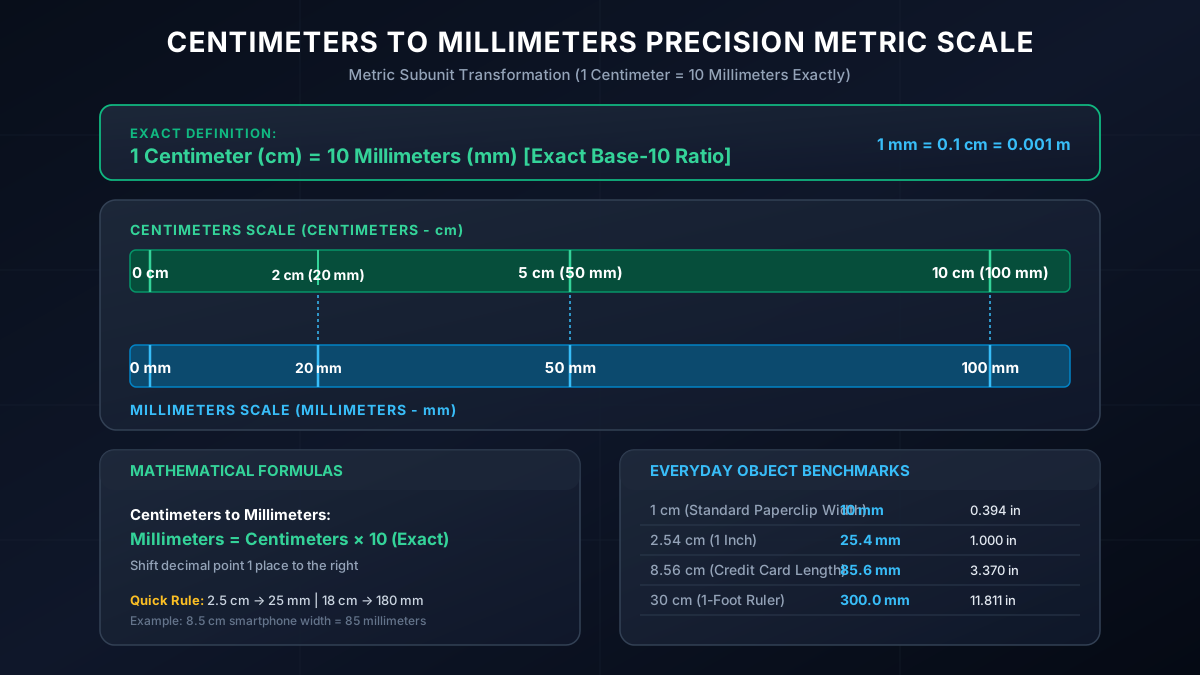
2. Core Definitions & Analogy
To understand decimal subunit scaling in the metric system, let us review their core definitions:
- Simple Definition: A centimeter is a small metric unit (about the width of a standard paperclip), while a millimeter is a tiny precision unit (about the thickness of an ID card). There are exactly 10 millimeters in 1 centimeter.
- Technical Definition: The Centimeter ():* Defined as ().The Millimeter ():* Defined as ().
- The Ruler Tick Subdivision Analogy: Take a standard metric plastic ruler. Each numbered mark represents 1 centimeter. Inside each centimeter space are 10 tiny tick marks. Each tiny tick mark is exactly 1 millimeter (10 mm = 1 cm).
3. The Base-10 Decimal System
The metric system allows scaling without fractions or complex divisions:
flowchart LR
    M["Meter (m)
1 m (SI Base Unit)"] -->|× 100| CM["Centimeter (cm)
100 cm = 1 m"]
    CM -->|× 10| MM["Millimeter (mm)
1,000 mm = 1 m"]
Because 1 centimeter equals exactly , multiplying centimeters by 10 simply moves the decimal point one place to the right with zero arithmetic rounding error.
4. The Mathematical Formulas
Converting centimeters to millimeters is direct, linear, and exact:
Exact Mathematical Formulas:
Fast Mental Arithmetic (Shift Right 1 Place):
- To convert centimeters to millimeters, shift the decimal point 1 position to the right (or append a zero):Example (2.5 cm): (1 inch is ~25.4 mm!)*.Example (8.5 cm): (Credit card length!)*.Example (30 cm): (Standard school ruler!)*.Example (100 cm): (1 meter!)*.
5. Comprehensive Centimeters to Millimeters Lookup Table
| Centimeters () | Millimeters () | Meters () | Inches () | Real-World Context |
|---|---|---|---|---|
| 0.1 cm | 1 mm | 0.001 m | 0.0394 in | Credit card thickness |
| 0.5 cm | 5 mm | 0.005 m | 0.1969 in | Standard pencil diameter (approx. 7 mm) |
| 1.0 cm | 10 mm | 0.010 m | 0.3937 in | Standard paperclip width |
| 2.0 cm | 20 mm | 0.020 m | 0.7874 in | M20 heavy metric bolt size |
| 2.54 cm | 25.4 mm | 0.0254 m | 1.0000 in | 1 International Inch (Exact) |
| 5.0 cm | 50 mm | 0.050 m | 1.9685 in | 2-inch pipe coupling |
| 8.56 cm | 85.6 mm | 0.0856 m | 3.3701 in | Standard credit card length (ISO/IEC 7810 ID-1) |
| 10.0 cm | 100 mm | 0.100 m | 3.9370 in | 1 decimeter / 4-inch PVC drain pipe |
| 15.0 cm | 150 mm | 0.150 m | 5.9055 in | 6-inch pocket scale ruler |
| 20.0 cm | 200 mm | 0.200 m | 7.8740 in | 8-inch chef's knife blade |
| 30.0 cm | 300 mm | 0.300 m | 11.8110 in | Standard 30 cm classroom ruler |
| 50.0 cm | 500 mm | 0.500 m | 19.6850 in | Half-meter bench length |
| 100.0 cm | 1,000 mm | 1.000 m | 39.3701 in | 1 SI Base Meter |
6. Step-by-Step Practical Calculation Examples
Example 1: Printed Circuit Board (PCB) Trace Layout
- Scenario: An electrical engineer measures a microcontroller chip dimension of 1.45 cm on an evaluation board. How many millimeters is this dimension for PCB CAD layout software?
- Calculation:
Example 2: Metric Fastener Selection
- Scenario: A mechanical assembly drawing requires a clearance hole of 0.80 cm. What metric drill bit size in millimeters should the technician select?
- Calculation:
7. Major Engineering & Scientific Applications
flowchart LR
    C2M["Centimeters to Millimeters Conversion"] --> PCB["Electronics: Translating schematic board dimensions (cm) to PCB component pads (mm)"]
    C2M --> CALIPER["Machining: Reading vernier & digital calipers in millimeters"]
    C2M --> BIO["Medical & Biology: Tumor sizing & surgical pathology dimensions (cm to mm)"]
C2M --> APPAREL["Textile & Fashion: Garment pattern grading from centimeters to stitch millimeters"]- Electronics PCB Layout: Circuit board footprints and surface-mount device (SMD) packaging (e.g. 0805, 0603) are dimensioned strictly in millimeters ().
- Medical Diagnostic Imaging: Radiology ultrasound, CT, and MRI scans describe anatomical lesions and cysts in centimeters (), which surgeons convert to millimeters () for operative margins.
- Digital Calipers: Precision digital calipers toggle between inches and millimeters with resolution.
8. Frequently Asked Questions (FAQ)
- How many millimeters are in 1 centimeter?There are exactly 10 millimeters in 1 centimeter.
- How do you convert cm to mm in your head?Multiply by 10 or shift the decimal point one place to the right ().
- Why is 1 cm equal to 10 mm?Because the metric system is base-10: centi- means and milli- means , making the ratio .
9. Expert Summary & Best Practices
- Multiply by 10: Multiply centimeters by (or shift the decimal 1 place right).
- Zero Rounding Loss: Base-10 metric scaling preserves 100% of precision with zero rounding error.
- Hardware Sizing: Standard metric bolts (M4, M6, M8, M10) represent nominal diameters in millimeters.
Additional Technical Guidelines & Measurement Standards
When conducting calculations for Centimeters to Millimeters Converter, maintaining quantitative precision and verifying input parameter boundaries is essential for reliable scenario evaluation. Always verify that raw numerical inputs are measured using standardized instrumentation, and double-check unit conversions prior to applying outputs in commercial, industrial, or academic projects.
For quantitative unit conversions and scientific calculations, always maintain at least four decimal places of precision during intermediate arithmetic stages before rounding final results. When preparing technical reports, laboratory documentation, or financial forecasts, cross-verify all output variables against established international measurement standards (such as SI, NIST, and ISO metric benchmarks) to guarantee consistent analytical rigor across all computational workflows.
MathsLover.com delivers this interactive solver 100% free of charge to foster global mathematical literacy, educational accessibility, and data-driven problem solving across scientific, technical, and academic communities worldwide.