💡 Direct Answer & Executive Summary (Feet to Inches Converter)
Definition: Convert Feet (ft) to Inches (in) instantly using custom inputs or dynamic unit selectors.
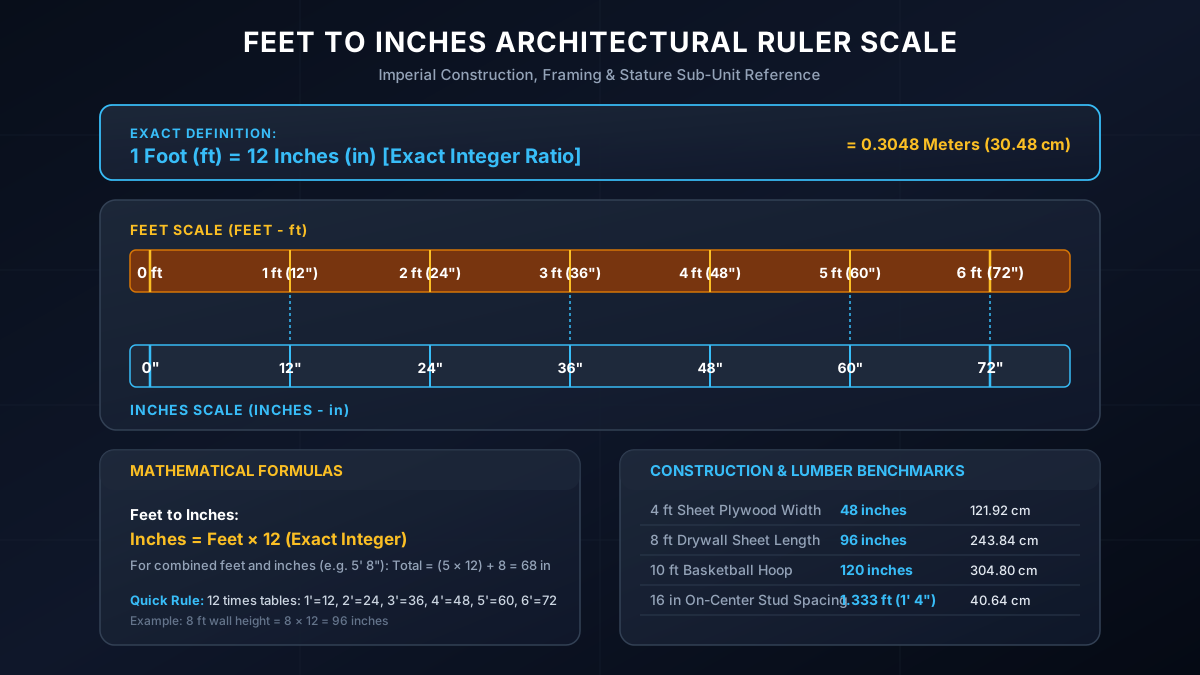
Governing Math Formula: 1 Feet (ft) = 12.000000 Inches (in). Formula: Value in Feet (ft) × 12.000000 = Value in Inches (in).
Target Applications: Provides real-time quantitative solutions in Unit Converters for students, engineers, researchers, and finance professionals.
Feet to Inches Converter - Architectural & Construction Dimension Guide
1. Introduction
In residential framing, structural carpentry, interior architecture, human height documentation, and general fabrication, converting Feet (ft) to Inches (in) is the most common within-system conversion in the US Customary and British Imperial systems.
Because 1 foot contains exactly 12 inches, transforming dimensions between whole feet, fractional feet, and decimal feet requires applying base-12 integer multiplication.
The Feet to Inches Converter delivers instantaneous calculation across decimal feet, architectural feet-and-inches callouts ($5'\ 8\frac{3}{4}''$), total cumulative inches, and metric equivalents ($cm$ and $mm$). This comprehensive guide details structural lumber callouts (2x4s, 2x6s), drywall sheet dimensions, framing stud spacing (16" and 24" on-center), tape measure fraction reading, and fast mental multiplication methods.
2. Core Definitions & Analogy
To understand length scaling between imperial feet and inches, let us review their core definitions:
- Simple Definition: A foot is an imperial unit of length equal to 12 inches (about the length of an adult foot), while an inch is a smaller subunit (roughly the length of the top joint of a thumb). One foot contains exactly 12 inches.
- Technical Definition: The International Foot ($ft$ or $'$):* Codified since 1959 as exactly $0.3048\text{ meters}$.The International Inch ($in$ or $''$):* Exactly $1/12\text{ of a foot}$, or $25.4\text{ millimeters}$.
- The 12-Inch Ruler Analogy: Look at a standard wooden school desk ruler. The entire length of the physical ruler is 1 foot. The 12 major numbered divisions along its edge are inches.
3. The Base-12 (Duodecimal) System
Why does a foot have 12 inches instead of 10?
flowchart TD
    A["Ancient Sumer & Rome: Duodecimal base-12 arithmetic based on 12 finger phalanges"] --> B["12 is highly divisible: evenly divided by 2, 3, 4, and 6 (unlike 10, divisible only by 2 and 5)"]
    B --> C["1305: English King Edward I codifies 1 Foot = 12 Inches"]
    C --> D["Present Day: Standard in US construction framing, lumber sizes & drywall sheets"]
The number 12 offers superior geometric convenience for carpenters and builders because a 12-inch board can be divided evenly into halves ($6''$), thirds ($4''$), quarters ($3''$), and sixths ($2''$) without generating awkward repeating decimals.
4. The Mathematical Formulas
Converting feet to inches is exact:
Exact Mathematical Formulas:
Converting Mixed Feet & Inches to Total Inches:
$$\text{Total Inches} = (\text{Feet} \times 12) + \text{Inches}$$ Example ($5\text{ ft } 10\text{ in}$): $(5 \times 12) + 10 = 60 + 10 = \mathbf{70\text{ inches}}$.
Quick Mental Arithmetic (12-Times Tables):
- $1\text{ ft} = 12\text{ in}$
- $2\text{ ft} = 24\text{ in}$
- $3\text{ ft} = 36\text{ in}$ (1 yard)
- $4\text{ ft} = 48\text{ in}$ (standard plywood width)
- $5\text{ ft} = 60\text{ in}$
- $6\text{ ft} = 72\text{ in}$
- $8\text{ ft} = 96\text{ in}$ (standard stud/drywall length)
- $10\text{ ft} = 120\text{ in}$ (basketball hoop height)
5. Comprehensive Feet to Inches Lookup Table
| Feet ($ft$) | Inches ($in$) | Fractional Yards ($yd$) | Centimeters ($cm$) | Common Building & Stature Benchmark |
|---|---|---|---|---|
| 0.5 ft | 6 in | 1/6 yd | 15.24 cm | Half-foot / 6-inch pocket ruler |
| 1.0 ft | 12 in | 1/3 yd | 30.48 cm | 1 standard 12-inch ruler |
| 1.5 ft | 18 in | 1/2 yd | 45.72 cm | 18-inch dishwasher width |
| 2.0 ft | 24 in | 2/3 yd | 60.96 cm | 24-inch kitchen base cabinet depth |
| 3.0 ft | 36 in | 1.0 yd | 91.44 cm | 36-inch standard kitchen counter height |
| 4.0 ft | 48 in | 1 1/3 yd | 121.92 cm | Standard 4x8 plywood sheet width |
| 5.0 ft | 60 in | 1 2/3 yd | 152.40 cm | Standard 60-inch bathtub length |
| 5.5 ft | 66 in | 1 5/6 yd | 167.64 cm | 5 ft 6 in height |
| 6.0 ft | 72 in | 2.0 yd | 182.88 cm | 6 ft 0 in height / standard patio door |
| 6.67 ft | 80 in | 2 2/9 yd | 203.20 cm | Standard interior residential door height |
| 8.0 ft | 96 in | 2 2/3 yd | 243.84 cm | Standard 8-foot ceiling framing stud |
| 9.0 ft | 108 in | 3.0 yd | 274.32 cm | 9-foot modern residential ceiling |
| 10.0 ft | 120 in | 3 1/3 yd | 304.80 cm | Regulation basketball hoop height |
| 12.0 ft | 144 in | 4.0 yd | 365.76 cm | 12-foot commercial lumber board |
| 16.0 ft | 192 in | 5 1/3 yd | 487.68 cm | 16-foot framing beam length |
6. Step-by-Step Practical Calculation Examples
Example 1: Calculating Wall Framing Lumber
- Scenario: A builder is framing an 8-foot tall wall with vertical 2x4 studs spaced 16 inches on-center. What is the height of the drywall in inches?
- Calculation:$$\text{Drywall Height (in)} = 8 \times 12 = \mathbf{96\text{ inches}}$$
- Verification: Standard $4 \times 8\text{ ft}$ gypsum drywall sheets measure exactly $48 \times 96\text{ inches}$, mounting vertically with zero cut waste.
Example 2: Human Height Conversion for Ergonomics
- Scenario: An ergonomics engineer is designing a vehicle seat for a driver who is 6.25 feet tall. What is this height in total inches and feet-and-inches?
- Total Inches: $6.25 \times 12 = \mathbf{75\text{ inches}}$.
- Feet & Inches: $6\text{ ft}$, plus $0.25 \times 12 = 3\text{ inches} \implies \mathbf{6\text{ ft } 3\text{ in}}$.
7. Major Construction & Architectural Applications
flowchart LR
    FTI["Feet to Inches Conversion"] --> FRAME["Framing: Stud spacings (16 inch OC = 1.33 ft, 24 inch OC = 2.0 ft)"]
    FTI --> SHEET["Sheet Goods: Standard 4' x 8' plywood & drywall (48 in x 96 in)"]
    FTI --> CAB["Cabinetry: Standard base cabinet heights (36 in) and depths (24 in)"]
FTI --> ROOF["Roofing: Pitch slopes (e.g. 4/12 pitch = 4 in vertical rise per 12 in horizontal run)"]- Roof Pitch Slope: In roofing architecture, pitch is specified as the vertical rise in inches per 1 foot (12 inches) of horizontal run (e.g., a "6/12 pitch" means the roof rises 6 inches for every 1 foot of horizontal distance).
- On-Center (OC) Stud Layout: American building codes mandate wall studs spaced either 16 inches OC (which aligns perfectly with 4-foot panel edges every 3 studs: $3 \times 16'' = 48'' = 4'$) or 24 inches OC ($2 \times 24'' = 48'' = 4'$).
- Plumbing Rough-In: Drain-waste-vent (DWV) slope requires a minimum slope of 1/4 inch per foot of horizontal pipe run to ensure proper gravity wastewater drainage.
8. Frequently Asked Questions (FAQ)
- How do you convert decimal feet to feet and inches?Multiply the decimal fraction by 12. For example, $5.75\text{ ft} \implies 0.75 \times 12 = 9\text{ inches} \implies \mathbf{5\text{ ft } 9\text{ in}}$.
- How many inches are in an 8-foot 2x4 stud?$8 \times 12 = \mathbf{96\text{ inches}}$ (actual pre-cut "stud length" is often $92\frac{5}{8}\text{ in}$ to account for top and bottom plates).
- Why is 16 inches on-center framing standard?Because 16 divides evenly into standard 48-inch (4-foot) and 96-inch (8-foot) plywood and drywall sheets ($48 / 16 = 3$).
9. Expert Summary & Best Practices
- Multiply by 12: Use straightforward integer multiplication ($n \times 12$).
- Remember Modular Dimensions: Keep key construction numbers in mind ($12'', 16'', 24'', 36'', 48'', 96'', 120''$).
- Nominal vs Actual Lumber Sizes: Remember that a nominal "2x4" board actually measures $1.5 \times 3.5\text{ inches}$, and a nominal "2x6" measures $1.5 \times 5.5\text{ inches}$.
Additional Technical Guidelines & Measurement Standards
When conducting calculations for Feet to Inches Converter, maintaining quantitative precision and verifying input parameter boundaries is essential for reliable scenario evaluation. Always verify that raw numerical inputs are measured using standardized instrumentation, and double-check unit conversions prior to applying outputs in commercial, industrial, or academic projects.
MathsLover.com delivers this interactive solver 100% free of charge to foster global mathematical literacy, educational accessibility, and data-driven problem solving across scientific and technical communities.