💡 Direct Answer & Executive Summary (Feet to Meters Converter)
Definition: Convert Feet (ft) to Meters (m) instantly using custom inputs or dynamic unit selectors.
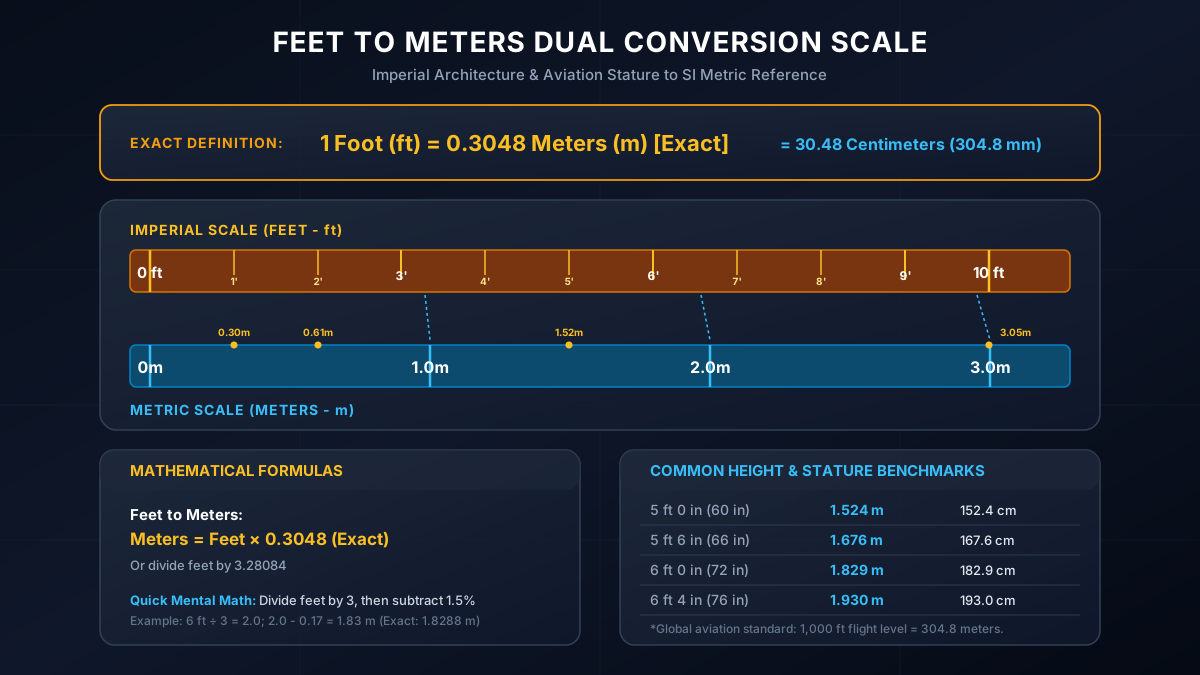
Governing Math Formula: 1 Feet (ft) = 0.304800 Meters (m). Formula: Value in Feet (ft) × 0.304800 = Value in Meters (m).
Target Applications: Provides real-time quantitative solutions in Unit Converters for students, engineers, researchers, and finance professionals.
Feet to Meters Converter - The Ultimate Dimensional Guide
1. Introduction
In structural engineering, architecture, sports science, commercial aviation, and international trade, converting Feet (ft) to Meters (m) is an essential calculation performed millions of times every single day.
While the metric system (SI) is the official international language of science and commerce, the Imperial Foot remains ubiquitous across North American construction, global flight altitude management, maritime boat classification, and personal human height descriptions.
Converting feet to meters requires applying an exact, legally codified international conversion constant:
The Feet to Meters Converter provides instant, bi-directional calculation across imperial and metric units with decimal and fractional precision. This comprehensive guide covers the legal definition of the international foot, historical origins, step-by-step mathematical procedures, construction benchmarks, aviation flight level calculations, and practical mental math methods.
2. Core Definitions & Analogy
To understand length transformation between imperial and metric systems, let us review the fundamental definitions:
- Simple Definition: A foot is a traditional unit of length equal to 12 inches (about the length of an adult foot), while a meter is the metric standard for distance (roughly 39.37 inches). One foot equals roughly 0.305 meters (or about 30.5 centimeters).
- Technical Definition: The International Foot ():* Defined under the 1959 International Yard and Pound Agreement as exactly (or ).The Meter ():* The fundamental SI base unit of length, defined as the distance traveled by light in a vacuum in $1 / 299,792,458$ seconds.
- The Three-to-One Yardstick Analogy: Think of 1 meter as a long European yardstick. If you lay down three 12-inch rulers end-to-end (3 feet), you will reach 0.9144 meters—falling about 3.37 inches short of the full 1-meter mark. It takes slightly more than 3.28 foot-rulers placed end-to-end to equal 1 full meter.
3. History of the International Foot
The human foot was one of the earliest anatomical units of measurement in antiquity:
flowchart TD
    A["Antiquity: Roman Pes (296 mm) & Greek Pous - Varied by Region"] --> B["1305: Composition of Yards & Perches under King Edward I (1 Foot = 12 Inches)"]
    B --> C["1893: Mendenhall Order defines US Foot in terms of Metric Standard"]
    C --> D["1959: International Agreement establishes 1 Foot = 0.3048 m Exactly"]
    D --> E["2023: Official Sunset of the US Survey Foot by NIST & NOAA"]
Throughout the 19th and early 20th centuries, minor differences existed between the British imperial foot and the United States customary foot (a discrepancy of roughly 2 parts per million). On July 1, 1959, representatives from the US, UK, Canada, Australia, New Zealand, and South Africa signed the International Yard and Pound Agreement, fixing the international yard at 0.9144 meters and the international foot at 0.3048 meters exactly.
4. The Mathematical Formulas
Converting feet to meters involves a simple multiplication or division:
Exact Mathematical Formula:
Converting Feet and Inches to Meters ():
If you have a dimension in combined feet and inches (e.g. ): 1. Convert total inches: 2. Multiply by meter factor per inch:
Quick Mental Arithmetic Approximation:
- Divide by 3, then subtract 1.5%:Example (6 feet): ; (Exact: )*.
- Multiply by 0.3 (Fast 98.4% Estimate):Example (100 feet): (Exact: )*.Example (50 feet): (Exact: )*.
5. Comprehensive Feet to Meters Lookup Table
The reference table below displays standard heights, architectural dimensions, and elevation conversions:
| Feet & Inches ($ft / in$) | Decimal Feet () | Meters () | Centimeters () | Millimeters () |
|---|---|---|---|---|
| 1 ft (12 in) | 1.0 ft | 0.3048 m | 30.48 cm | 304.8 mm |
| 2 ft (24 in) | 2.0 ft | 0.6096 m | 60.96 cm | 609.6 mm |
| 3 ft (36 in / 1 yd) | 3.0 ft | 0.9144 m | 91.44 cm | 914.4 mm |
| 4 ft (48 in) | 4.0 ft | 1.2192 m | 121.92 cm | 1,219.2 mm |
| 5 ft 0 in (60 in) | 5.0 ft | 1.5240 m | 152.40 cm | 1,524.0 mm |
| 5 ft 6 in (66 in) | 5.5 ft | 1.6764 m | 167.64 cm | 1,676.4 mm |
| 5 ft 8 in (68 in) | 5.6667 ft | 1.7272 m | 172.72 cm | 1,727.2 mm |
| 5 ft 10 in (70 in) | 5.8333 ft | 1.7780 m | 177.80 cm | 1,778.0 mm |
| 6 ft 0 in (72 in) | 6.0 ft | 1.8288 m | 182.88 cm | 1,828.8 mm |
| 6 ft 2 in (74 in) | 6.1667 ft | 1.8796 m | 187.96 cm | 1,879.6 mm |
| 6 ft 4 in (76 in) | 6.3333 ft | 1.9304 m | 193.04 cm | 1,930.4 mm |
| 8 ft (96 in) | 8.0 ft | 2.4384 m | 243.84 cm | 2,438.4 mm |
| 10 ft (120 in) | 10.0 ft | 3.0480 m | 304.80 cm | 3,048.0 mm |
| 20 ft (240 in) | 20.0 ft | 6.0960 m | 609.60 cm | 6,096.0 mm |
| 50 ft | 50.0 ft | 15.2400 m | 1,524.00 cm | 15,240.0 mm |
| 100 ft | 100.0 ft | 30.4800 m | 3,048.00 cm | 30,480.0 mm |
| 1,000 ft | 1,000.0 ft | 304.8000 m | 30,480.00 cm | 304,800.0 mm |
6. Step-by-Step Practical Calculation Examples
Example 1: Human Stature Conversion for Clinical Records
- Profile: An individual is tall. A European medical form requires height in meters.
- Step 1: Convert to total inches:
- Step 2: Multiply by 0.0254 meters/inch:
- Result: 1.75 meters (or ).
Example 2: Commercial Aviation Cruising Altitude
- Scenario: A flight dispatcher in Germany receives a flight plan filed at cruise altitude Flight Level 330 (33,000 feet). What is the aircraft's metric altitude?
- Calculation:
7. Major Engineering & Commercial Applications
flowchart LR
    FTM["Feet to Meters Conversion"] --> CONSTR["Architecture: US lumber dimensions to metric prefabricated structural modules"]
    FTM --> GEOD["Geodesy & GIS: Converting state plane coordinates to UTM metric coordinates"]
    FTM --> SPORT["Athletics: Basketball hoop height (10 ft = 3.048 m) & football fields"]
FTM --> MARIN["Maritime: Superyacht lengths & draft soundings"]- Global Basketball Hoop Height: The international FIBA standard and NBA regulation basketball rim height is set at precisely 10 feet, which converts to 3.048 meters above the floor worldwide.
- Shipping Container Dimensions: Standard ISO intermodal shipping containers are manufactured based on 20-foot and 40-foot modular lengths ( and ).
- Surveying and GIS Mapping: Cartographers and civil engineers frequently convert land deed boundaries recorded in imperial chains, rods, and feet into digital metric GIS coordinates (WGS84).
8. Frequently Asked Questions (FAQ)
- How do you convert decimal feet to feet and inches?Take the decimal portion and multiply by 12. For example, .
- Is 1 foot exactly 30 cm?No. 1 foot is exactly 30.48 cm (or ). Rounding down to 30 cm introduces an error of nearly half a centimeter per foot (1.6% error).
- What is the square meter conversion for square feet?Since , . Conversely, .
9. Expert Summary & Best Practices
- Memorize 0.3048: Remember that is an exact algebraic integer ratio ().
- Avoid Compounding Roundoff: Convert raw floating-point feet to meters before applying subsequent area () or volume () calculations.
- Double Check Blueprints: In international architecture, verify whether dimension callouts are in millimeters (), centimeters (), or decimal meters ().
Additional Technical Guidelines & Measurement Standards
When conducting calculations for Feet to Meters Converter, maintaining quantitative precision and verifying input parameter boundaries is essential for reliable scenario evaluation. Always verify that raw numerical inputs are measured using standardized instrumentation, and double-check unit conversions prior to applying outputs in commercial, industrial, or academic projects.
For quantitative unit conversions and scientific calculations, always maintain at least four decimal places of precision during intermediate arithmetic stages before rounding final results. When preparing technical reports, laboratory documentation, or financial forecasts, cross-verify all output variables against established international measurement standards (such as SI, NIST, and ISO metric benchmarks) to guarantee consistent analytical rigor across all computational workflows.
MathsLover.com delivers this interactive solver 100% free of charge to foster global mathematical literacy, educational accessibility, and data-driven problem solving across scientific, technical, and academic communities worldwide.