💡 Direct Answer & Executive Summary (Feet to Miles Converter)
Definition: Convert Feet (ft) to Miles (mi) instantly using custom inputs or dynamic unit selectors.
Governing Math Formula: 1 Feet (ft) = 0.000189 Miles (mi). Formula: Value in Feet (ft) × 0.000189 = Value in Miles (mi).
Target Applications: Provides real-time quantitative solutions in Unit Converters for students, engineers, researchers, and finance professionals.
Feet to Miles Converter - Complete Elevation & Highway Guide
1. Introduction
In commercial aviation, mountain climbing, topographical surveying, civil highway design, and athletics, converting Feet (ft) to Statute Miles (mi) is essential when transforming high-altitude elevations, runway distances, or long running courses into geographic miles.
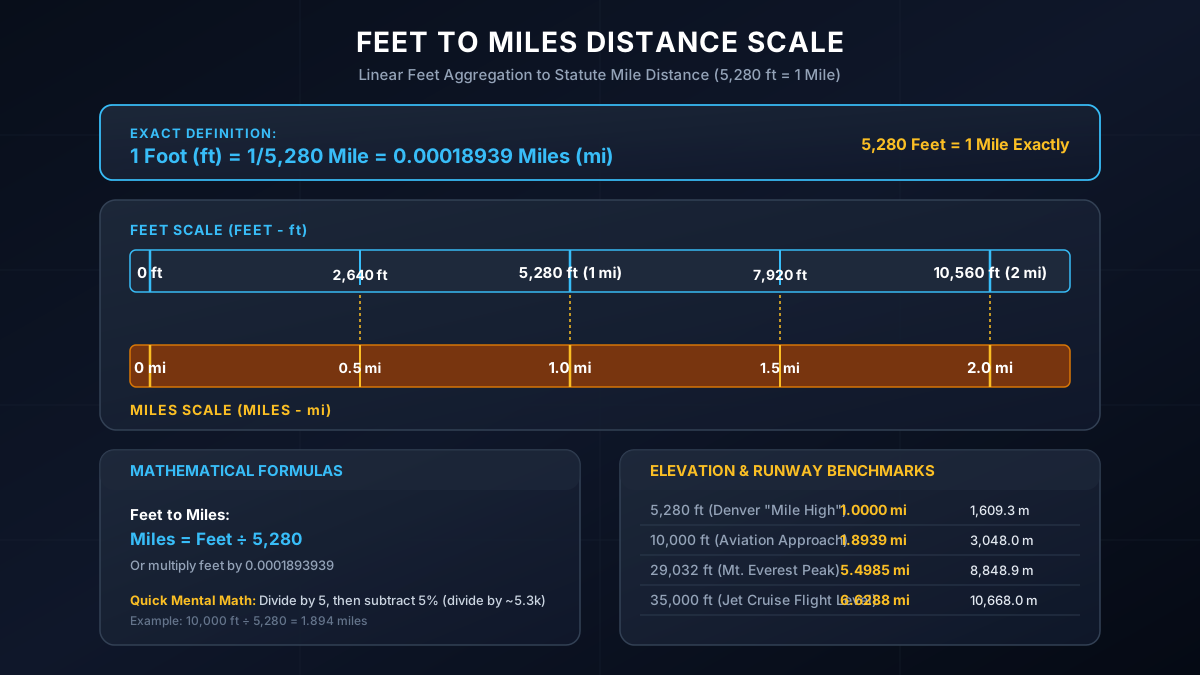
Because 1 statute mile equals exactly 5,280 feet, converting feet to miles requires division by 5,280:
The Feet to Miles Converter provides instant, bidirectional distance calculations across linear feet, decimal miles, yards, and metric equivalents ( and ). This guide explores mountain summit elevations (Mt. Everest, Denali), aviation cruising altitudes (FL350 = 35,000 ft), topographical contour maps, and fast mental division methods.
2. Core Definitions & Analogy
To understand distance transformation from linear feet into statute miles, let us review the primary definitions:
- Simple Definition: A foot is an imperial unit of length (about 12 inches), while a mile is a large unit of geographic distance (5,280 feet). To find how many miles are in a given number of feet, you divide by 5,280.
- Technical Definition: The International Foot ():* Codified since 1959 as exactly .The Statute Mile ():* Exactly ().
- The Football Field Stacking Analogy: Imagine laying 100-yard (300-foot) American football fields end-to-end. It takes 17.6 full football fields placed in a straight line to span exactly 1 mile (5,280 feet).
3. The Mathematical Formulas
Converting feet to miles involves exact linear division:
Exact Mathematical Formulas:
Quick Mental Arithmetic Shortcut (Divide by ~5.3k):
- Divide feet by 5,000, then subtract 5% from the result:Example (10,000 feet): (Exact: )*.Example (26,400 feet): (Exact!)*.Example (35,000 feet): (Cruising jet altitude!)*.
4. Comprehensive Feet to Miles Lookup Table
| Feet () | Miles () | Yards () | Meters () | Kilometers () | Real-World Context |
|---|---|---|---|---|---|
| 528 ft | 0.1000 mi | 176 yd | 160.93 m | 0.161 km | City block length |
| 1,000 ft | 0.1894 mi | 333 yd | 304.80 m | 0.305 km | Standard aviation pattern altitude above airport |
| 1,320 ft | 0.2500 mi | 440 yd | 402.34 m | 0.402 km | 1/4-Mile drag strip racing |
| 2,640 ft | 0.5000 mi | 880 yd | 804.67 m | 0.805 km | Half-mile running track |
| 5,280 ft | 1.0000 mi | 1,760 yd | 1,609.34 m | 1.609 km | Denver "Mile High City" baseline |
| 10,000 ft | 1.8939 mi | 3,333 yd | 3,048.00 m | 3.048 km | 10,000-foot aviation oxygen requirement |
| 14,411 ft | 2.7294 mi | 4,804 yd | 4,392.47 m | 4.392 km | Mount Rainier summit elevation |
| 16,404 ft | 3.1069 mi | 5,468 yd | 5,000.00 m | 5.000 km | 5K Road Race |
| 20,310 ft | 3.8466 mi | 6,770 yd | 6,190.49 m | 6.190 km | Denali (Mount McKinley) summit |
| 29,032 ft | 5.4985 mi | 9,677 yd | 8,848.86 m | 8.849 km | Mount Everest summit elevation |
| 35,000 ft | 6.6288 mi | 11,667 yd | 10,668.00 m | 10.668 km | Commercial jet cruising altitude |
| 52,800 ft | 10.0000 mi | 17,600 yd | 16,093.44 m | 16.093 km | 10-mile distance |
| 138,435 ft | 26.2188 mi | 46,145 yd | 42,195.00 m | 42.195 km | Official Full Marathon distance |
5. Step-by-Step Practical Calculation Examples
Example 1: Commercial Jet Cruising Altitude
- Scenario: A Boeing 787 cruises at Flight Level 370 (37,000 feet). What is the aircraft's vertical altitude in statute miles above sea level?
- Calculation:
- Insight: A cruising commercial jet flies more than 7 vertical miles above the Earth's surface.
Example 2: Mountain Elevation Profile
- Scenario: A mountaineer ascends Mount Everest (29,032 feet). How many vertical miles high is the summit?
- Calculation:
6. Major Real-World Applications
flowchart LR
    FTM["Feet to Miles Conversion"] --> AVIAT["Aviation: Translating flight levels (e.g. 35,000 ft) into true vertical miles"]
    FTM --> TOPO["Topography: Mountain summit elevations & relief map contours"]
    FTM --> SPORT["Athletics: Elevation gain/loss in mountain trail running & cycling"]
FTM --> MET["Meteorology: Cloud ceiling altitudes & storm tops (feet to radar miles)"]- Aviation Cloud Ceilings: Weather reports (METAR) specify cloud base ceilings in hundreds of feet (e.g., OVC025 = overcast at 2,500 ft, or ).
- Trail Running Elevation Gain: Ultramarathon races (like the Western States 100 or UTMB) quantify difficulty in cumulative vertical feet gained (e.g., ).
- Space Flight Boundaries: The United States Air Force and NASA award astronaut wings at 50 miles (264,000 feet), while the international Kármán line is set at 100 kilometers (328,084 feet = 62.14 miles).
7. Frequently Asked Questions (FAQ)
- How many miles is 10,000 feet?(or roughly 1.9 miles).
- How many feet are in a half-mile?.
- What is the formula to convert feet to miles?Divide the number of feet by 5,280 ().
8. Expert Summary & Best Practices
- Divide by 5,280: Divide by $5,280$ for exact mathematical calculations.
- Mental Estimation: For fast estimation in your head, divide by 5,000 and subtract 5%.
- Aviation Precision: Remember that standard altimeters measure pressure altitude in feet above sea level (QNH/QNE), where 1 flight level (FL) represents 100 feet.
Additional Technical Guidelines & Measurement Standards
When conducting calculations for Feet to Miles Converter, maintaining quantitative precision and verifying input parameter boundaries is essential for reliable scenario evaluation. Always verify that raw numerical inputs are measured using standardized instrumentation, and double-check unit conversions prior to applying outputs in commercial, industrial, or academic projects.
For quantitative unit conversions and scientific calculations, always maintain at least four decimal places of precision during intermediate arithmetic stages before rounding final results. When preparing technical reports, laboratory documentation, or financial forecasts, cross-verify all output variables against established international measurement standards (such as SI, NIST, and ISO metric benchmarks) to guarantee consistent analytical rigor across all computational workflows.
MathsLover.com delivers this interactive solver 100% free of charge to foster global mathematical literacy, educational accessibility, and data-driven problem solving across scientific, technical, and academic communities worldwide.