💡 Direct Answer & Executive Summary (Inches to Centimeters Converter)
Definition: Convert Inches (in) to Centimeters (cm) instantly using custom inputs or dynamic unit selectors.
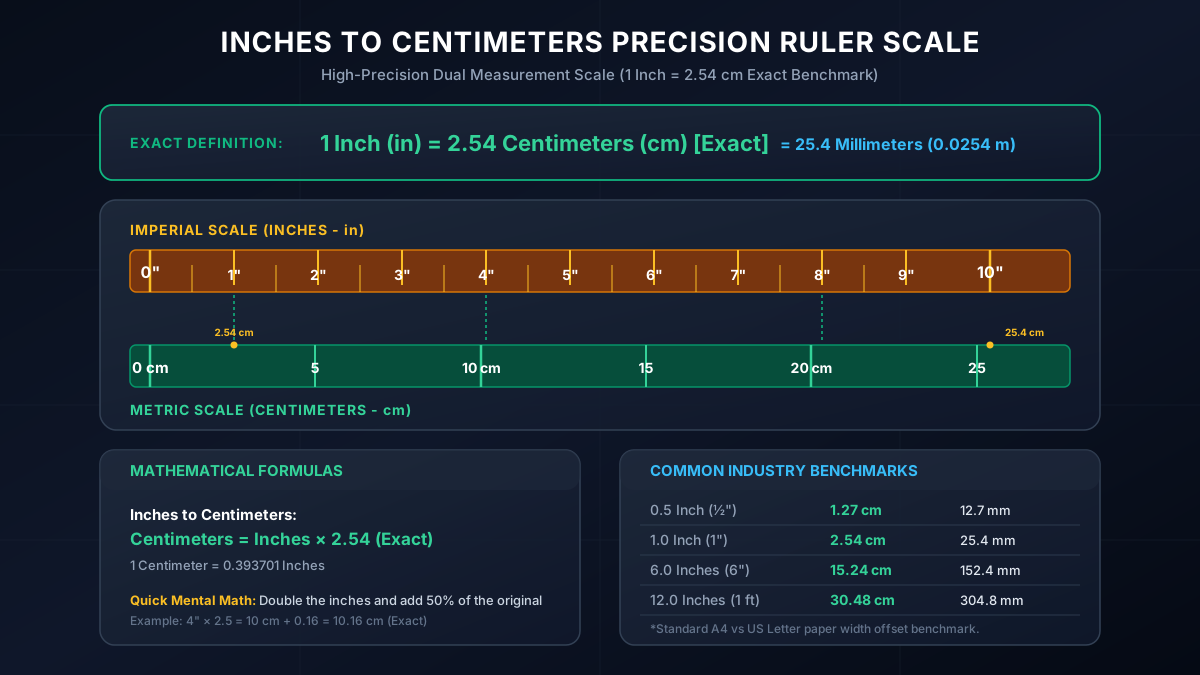
Governing Math Formula: 1 Inches (in) = 2.540000 Centimeters (cm). Formula: Value in Inches (in) × 2.540000 = Value in Centimeters (cm).
Target Applications: Provides real-time quantitative solutions in Unit Converters for students, engineers, researchers, and finance professionals.
Inches to Centimeters Converter - High-Precision Measurement Guide
1. Introduction
From manufacturing microchips and precision CNC tooling to designing clothing patterns, evaluating electronic screen displays, and drafting architectural blueprints, converting between Inches (in) and Centimeters (cm) is the most common small-scale dimensional calculation in modern technology and commerce.
The Inch is the foundational small unit of length in the US Customary and British Imperial systems, defined by division into fractions ($1/2$, $1/4$, $1/8$, $1/16$, $1/32$, $1/64$) or decimal thousandths of an inch (known as "mils" or "thou" in machining). The Centimeter is the metric (SI) decimal subunit of length, equal to one-hundredth ($1/100$) of a meter or 10 millimeters.
Under international measurement standards codified in 1959, the relationship between inches and centimeters is defined with absolute mathematical certainty: $$1\text{ Inch} = 2.54\text{ Centimeters (Exact)}$$
The Inches to Centimeters Converter provides instant, bidirectional dimensional calculation across decimal and fractional inches to centimeters and millimeters. This comprehensive guide details the history of the 2.54 cm standard, mechanical precision tolerances, paper and screen size standards, mental arithmetic tricks, and real-world industrial case studies.
2. Core Definitions & Analogy
To understand fine linear conversions between imperial and metric units, let us review the core definitions:
- Simple Definition: An inch is a traditional unit of length (approximately the width of an adult human thumb), while a centimeter is a metric unit of length (roughly the width of a standard pencil or staple). One inch contains exactly 2.54 centimeters (or 25.4 millimeters).
- Technical Definition: The International Inch ($in$ or $''$):* Formally defined since July 1, 1959, as exactly $25.4\text{ millimeters}$ ($0.0254\text{ meters}$).The Centimeter ($cm$):* A decimal fraction of the SI base unit meter ($1\text{ cm} = 10^{-2}\text{ m} = 10\text{ mm}$).
- The Thumb & Paperclip Analogy: Look at the top joint of your thumb (from the knuckle to the tip). In most adults, this distance is approximately 1 inch. If you line up small standard paperclips or matchsticks alongside your thumb, you will need approximately two and a half centimeters to span that exact same distance.
3. History of the Inch and the 2.54 cm Standard
The definition of the inch has evolved from ancient agrarian rules of thumb to atomic laser interferometry:
flowchart TD
    A["1324: King Edward II defines 1 Inch as '3 grains of barley, dry and round, placed end-to-end'"] --> B["1893: Mendenhall Order in the US defines 1 Inch = 25.40005 mm (1 m = 39.37 in)"]
    B --> C["1930s: British Standards Institution (BSI) & ASA adopt 25.4 mm for Industrial Tooling"]
    C --> D["1959: International Yard & Pound Agreement permanently standardizes 1 Inch = 2.54 cm Exactly"]
    D --> E["Present Day: Global ISO / ANSI standard in semiconductors, displays & CNC machining"]
Prior to 1959, the US inch ($25.40005\text{ mm}$) and British inch ($25.399956\text{ mm}$) differed by a microscopic fraction of a micrometer. While imperceptible in everyday carpentry, this difference caused significant calibration discrepancies during World War II when precision aircraft engine parts and munitions manufactured in American and British factories were cross-assembled. The 1959 standardization to 25.4 mm (2.54 cm) exactly established complete international manufacturing interchangeability.
4. The Mathematical Formulas
Converting between inches and centimeters is direct and linear:
Exact Mathematical Formulas:
Converting Fractional Inches to Centimeters:
To convert fractional carpentry measurements (e.g. $5\text{ 3/8 inches}$): 1. Convert the fraction to decimal: $3 / 8 = 0.375 \implies 5.375\text{ inches}$. 2. Multiply by 2.54: $$\text{Centimeters} = 5.375 \times 2.54 = 13.6525\text{ cm}$$
Fast Mental Arithmetic Shortcut:
- Double the inches, then add half the original value (2.5x estimate):Example (8 inches):* $8 \times 2 = 16$; $16 + 4 = 20\text{ cm}$.Fine-tune (+1.6%): Add a tiny sliver ($+0.32\text{ cm}$) $\implies \mathbf{20.32\text{ cm}}$ (Exact!)*.
5. Comprehensive Inches to Centimeters Reference Table
The lookup table below outlines standard industrial, hardware, and screen display benchmarks:
| Fractional Inches | Decimal Inches ($in$) | Centimeters ($cm$) | Millimeters ($mm$) | Common Real-World Example |
|---|---|---|---|---|
| 1/16 in | 0.0625 in | 0.1588 cm | 1.5875 mm | Thin sheet metal gauge |
| 1/8 in | 0.1250 in | 0.3175 cm | 3.1750 mm | 1/8" audio headphone jack |
| 1/4 in | 0.2500 in | 0.6350 cm | 6.3500 mm | 1/4" guitar cable plug |
| 1/2 in | 0.5000 in | 1.2700 cm | 12.7000 mm | 1/2" copper plumbing pipe |
| 3/4 in | 0.7500 in | 1.9050 cm | 19.0500 mm | 3/4" garden hose fitting |
| 1 in | 1.0000 in | 2.5400 cm | 25.4000 mm | 1" standard bolt / washer |
| 2 in | 2.0000 in | 5.0800 cm | 50.8000 mm | 2x4 lumber actual thickness (1.5"x3.5") |
| 3.5 in | 3.5000 in | 8.8900 cm | 88.9000 mm | Classic 3.5" floppy disk / HDD |
| 6 in | 6.0000 in | 15.2400 cm | 152.4000 mm | Standard 6" smartphone screen |
| 8.5 in | 8.5000 in | 21.5900 cm | 215.9000 mm | US Letter paper width (8.5" x 11") |
| 10 in | 10.0000 in | 25.4000 cm | 254.0000 mm | 10-inch iPad / tablet screen |
| 12 in (1 ft) | 12.0000 in | 30.4800 cm | 304.8000 mm | 1-foot standard ruler |
| 15.6 in | 15.6000 in | 39.6240 cm | 396.2400 mm | Standard laptop display diagonal |
| 24 in | 24.0000 in | 60.9600 cm | 609.6000 mm | 24-inch computer monitor |
| 36 in (1 yd) | 36.0000 in | 91.4400 cm | 914.4000 mm | 1-yard fabric bolt |
| 55 in | 55.0000 in | 139.7000 cm | 1,397.0000 mm | 55-inch 4K living room television |
6. Step-by-Step Practical Calculation Examples
Example 1: Display Screen Diagonal Conversion
- Scenario: A consumer in France is purchasing a 65-inch 4K television online. How wide is the diagonal screen measurement in centimeters?
- Calculation:$$\text{Diagonal (cm)} = 65 \times 2.54 = 165.10\text{ cm}$$
- Result: 165.1 cm diagonal viewing area.
Example 2: International Paper Size Comparison
- Scenario: US Letter paper measures $8.5 \times 11.0\text{ inches}$. How does this compare to international metric ISO A4 paper ($21.0 \times 29.7\text{ cm}$)?
- Width: $8.5 \times 2.54 = \mathbf{21.59\text{ cm}}$ (US Letter is 5.9 mm wider than A4).
- Height: $11.0 \times 2.54 = \mathbf{27.94\text{ cm}}$ (US Letter is 17.6 mm shorter than A4).
7. Major Engineering & Consumer Applications
flowchart LR
    ITC["Inches to Centimeters Conversion"] --> DISP["Consumer Electronics: TV & Smartphone Diagonal Screen Sizes"]
    ITC --> CNC["Precision Machining: Translating Imperial CAD files into metric CNC mills"]
    ITC --> TEXT["Textile & Apparel: Waist, inseam & bust sizing across US and EU markets"]
ITC --> PLUMB["Plumbing & Fasteners: Standard pipe diameters (1/2 in, 3/4 in, 1 in)"]- Global Semiconductor & Silicon Wafer Sizing: In the microelectronics industry, silicon crystal ingots and semiconductor wafers are internationally classified by inch diameters (8-inch / 200 mm and 12-inch / 300 mm wafers) while microscopic circuit transistor gates are measured in metric nanometers ($nm$).
- Fashion & Clothing Sizes: US apparel brands list denim waist sizes in inches (e.g. 32W x 34L), while European fashion sizing translates these directly to centimeters ($81.3\text{ cm} \times 86.4\text{ cm}$).
- Automotive Tire & Wheel Dimensions: Vehicle tires combine metric and imperial units in a single specification: a
225/45 R17tire has a tread width of 225 mm, an aspect ratio of 45%, and mounts on a 17-inch (43.18 cm) wheel rim.
8. Frequently Asked Questions (FAQ)
- Is 1 inch exactly 2.54 cm or rounded?It is 100% exact. By international legal and scientific treaty (the 1959 Yard and Pound Agreement), 1 inch is defined as precisely $2.5400000...$ centimeters with zero recurring decimals.
- How many centimeters is a 5-foot 8-inch person?1. Total inches: $(5 \times 12) + 8 = 68\text{ inches}$.2. Centimeters: $68 \times 2.54 = \mathbf{172.72\text{ cm}}$ (or $1.73\text{ m}$).
- What is a "mil" or "thou"?In precision engineering, a "mil" (or "thou") is one-thousandth of an inch ($0.001\text{ in}$), which equals $0.0254\text{ mm}$ or $25.4\text{ micrometers } (\mu m)$.
9. Expert Summary & Best Practices
- Apply 2.54 as a Fixed Constant: Treat 2.54 as an immutable mathematical constant in all code, calculations, and scripts.
- Convert Fractions First: Always convert fractional fractions ($1/4, 3/8, 7/16$) into decimal floating-point numbers prior to multiplying by 2.54.
- Precision CNC Rule: When working in machine shops, verify whether digital readouts (DRO) are set to G20 (inches) or G21 (millimeters) before executing machine cuts.
Additional Technical Guidelines & Measurement Standards
When conducting calculations for Inches to Centimeters Converter, maintaining quantitative precision and verifying input parameter boundaries is essential for reliable scenario evaluation. Always verify that raw numerical inputs are measured using standardized instrumentation, and double-check unit conversions prior to applying outputs in commercial, industrial, or academic projects.
MathsLover.com delivers this interactive solver 100% free of charge to foster global mathematical literacy, educational accessibility, and data-driven problem solving across scientific and technical communities.