💡 Direct Answer & Executive Summary (Inches to Feet Converter)
Definition: Convert Inches (in) to Feet (ft) instantly using custom inputs or dynamic unit selectors.
Governing Math Formula: 1 Inches (in) = 0.083333 Feet (ft). Formula: Value in Inches (in) × 0.083333 = Value in Feet (ft).
Target Applications: Provides real-time quantitative solutions in Unit Converters for students, engineers, researchers, and finance professionals.
Inches to Feet Converter - Architectural & Framing Calculation Guide
1. Introduction
From converting rough tape measure readings into building blueprint callouts to translating human stature measurements from total inches into feet and inches, converting Inches (in) to Feet (ft) is a daily task in carpentry, civil engineering, interior design, and retail.
Because there are exactly 12 inches in a foot, converting inches to feet requires division by 12, yielding either decimal feet (for CAD, surveyor coordinates, and excavation calculations) or mixed feet-and-inches format (for architectural schedules and carpentry tape measures).
The Inches to Feet Converter provides instant, bidirectional calculation across cumulative inches, decimal feet, architectural feet-and-inches ($5'\ 11\frac{1}{2}''$), yards, and metric units ($m$ and $cm$). This comprehensive guide details modulo arithmetic, architectural scale rulers, building code headroom clearances, and practical mental calculation methods.
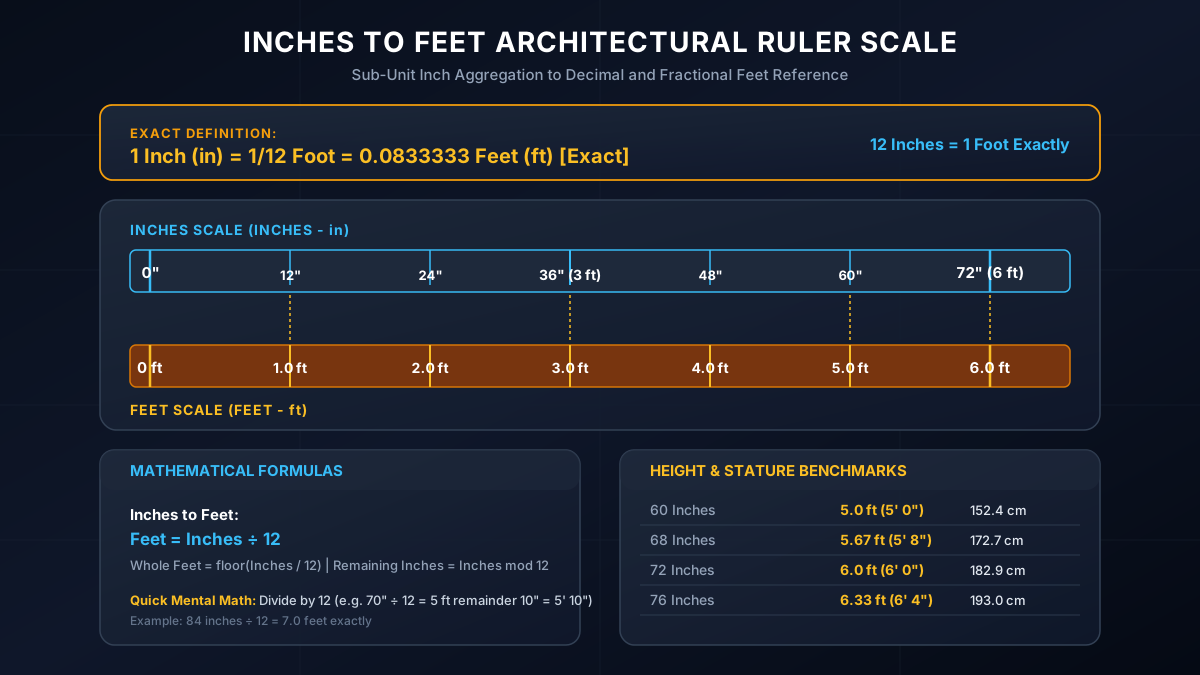
2. Core Definitions & Analogy
To understand length transformation from small inch subdivisions into feet, let us review their core definitions:
- Simple Definition: An inch is a small imperial unit of length (roughly the width of an adult thumb), while a foot is a larger unit equal to 12 inches (about the length of an adult shoe). To find how many feet are in a given number of inches, you divide by 12.
- Technical Definition: The International Inch ($in$ or $''$):* Defined since 1959 as exactly $25.4\text{ millimeters}$.The International Foot ($ft$ or $'$):* Defined as exactly $0.3048\text{ meters}$ ($12\text{ inches}$).
- The Egg Carton Analogy: Think of inches like individual eggs and feet like 12-egg cartons. If you have 36 inches, you have exactly 3 full cartons (3 feet). If you have 70 inches, you have 5 full cartons (5 feet) plus 10 loose eggs (10 inches), which equals 5 feet 10 inches.
3. The Mathematical Formulas
Converting inches to feet involves integer division (to find whole feet) and modulo arithmetic (to find the remaining inches):
Exact Mathematical Formulas:
Step-by-Step Conversion Algorithm:
- Divide total inches by 12: $\text{Result} = \text{Inches} / 12$.
- Take the integer part as the Whole Feet: $\lfloor \text{Result} \rfloor$.
- Multiply the remaining decimal by 12 to get the Remaining Inches: $(\text{Result} - \text{Whole Feet}) \times 12$.
Quick Mental Arithmetic (Divide by 12):
- 24 in → 24 / 12 = 2 ft
- 36 in → 36 / 12 = 3 ft (1 yard)
- 48 in → 48 / 12 = 4 ft
- 60 in → 60 / 12 = 5 ft
- 72 in → 72 / 12 = 6 ft
- 84 in → 84 / 12 = 7 ft
- 96 in → 96 / 12 = 8 ft
4. Comprehensive Inches to Feet Lookup Table
| Inches ($in$) | Decimal Feet ($ft$) | Feet & Inches ($ft\ in$) | Yards ($yd$) | Centimeters ($cm$) | Real-World Context |
|---|---|---|---|---|---|
| 6 in | 0.5000 ft | 0 ft 6 in | 1/6 yd | 15.24 cm | 6-inch hand ruler / half foot |
| 12 in | 1.0000 ft | 1 ft 0 in | 1/3 yd | 30.48 cm | 1 standard foot |
| 18 in | 1.5000 ft | 1 ft 6 in | 1/2 yd | 45.72 cm | Dishwasher standard width |
| 24 in | 2.0000 ft | 2 ft 0 in | 2/3 yd | 60.96 cm | 24" on-center stud spacing / cabinet depth |
| 36 in | 3.0000 ft | 3 ft 0 in | 1.0 yd | 91.44 cm | 1 yard / standard door width |
| 48 in | 4.0000 ft | 4 ft 0 in | 1 1/3 yd | 121.92 cm | Plywood sheet width (4x8 ft) |
| 60 in | 5.0000 ft | 5 ft 0 in | 1 2/3 yd | 152.40 cm | 5 ft 0 in stature |
| 66 in | 5.5000 ft | 5 ft 6 in | 1 5/6 yd | 167.64 cm | 5 ft 6 in stature |
| 68 in | 5.6667 ft | 5 ft 8 in | 1 8/9 yd | 172.72 cm | 5 ft 8 in stature |
| 70 in | 5.8333 ft | 5 ft 10 in | 1 17/18 yd | 177.80 cm | 5 ft 10 in average US adult male height |
| 72 in | 6.0000 ft | 6 ft 0 in | 2.0 yd | 182.88 cm | 6 ft 0 in stature / standard shower curtain |
| 74 in | 6.1667 ft | 6 ft 2 in | 2 1/18 yd | 187.96 cm | 6 ft 2 in stature |
| 80 in | 6.6667 ft | 6 ft 8 in | 2 2/9 yd | 203.20 cm | Standard residential interior door height |
| 84 in | 7.0000 ft | 7 ft 0 in | 2 1/3 yd | 213.36 cm | 7-foot ceiling clearance / commercial door |
| 96 in | 8.0000 ft | 8 ft 0 in | 2 2/3 yd | 243.84 cm | Standard 8-foot drywall sheet length |
| 120 in | 10.0000 ft | 10 ft 0 in | 3 1/3 yd | 304.80 cm | 10-foot basketball rim height |
5. Step-by-Step Practical Calculation Examples
Example 1: Human Stature Documentation
- Scenario: A medical questionnaire asks for height in feet and inches. The patient's driver's license lists 71 inches.
- Step 1 (Find Whole Feet): $71 / 12 = 5.9167 \implies \mathbf{5\text{ whole feet}}$ ($5 \times 12 = 60\text{ inches}$).
- Step 2 (Find Remaining Inches): $71 - 60 = \mathbf{11\text{ inches}}$.
- Result: 5 ft 11 in (or $5.92\text{ decimal feet}$).
Example 2: Civil Engineering Land Trench Depth
- Scenario: An excavator dig spec states a trench depth of 42 inches. The surveyor's level rod is marked in decimal tenths of a foot. What is the reading in decimal feet?
- Calculation:$$\text{Decimal Feet} = \frac{42}{12} = \mathbf{3.50\text{ feet}}$$
- Result: The surveyor checks for a target grade of 3.5 ft.
6. Major Real-World Applications
flowchart LR
    ITF["Inches to Feet Conversion"] --> ARCH["Architecture: Translating tape measure field dimensions to CAD floor plans"]
    ITF --> DOOR["Building Codes: Minimum hallway widths (36 in = 3.0 ft) & door heights (80 in = 6 ft 8 in)"]
    ITF --> WOOD["Lumber Mills: Board-foot lumber volume calculations (Thickness in x Width in x Length ft)"]
ITF --> MED["Healthcare: Clinical stature percentiles & infant growth charts"]- Board-Foot Lumber Calculation: In timber and forestry pricing, 1 "board foot" equals a volume of $1\text{ in} \times 12\text{ in} \times 1\text{ ft}$ ($144\text{ in}^3$). Lumber is calculated as:$$\text{Board Feet} = \frac{\text{Thickness (in)} \times \text{Width (in)} \times \text{Length (ft)}}{12}$$
- Building Code Clearances (IBC / IRC):* Minimum standard interior door height: 80 inches (6 ft 8 in).* Minimum residential stair headroom: 80 inches (6.67 ft).* Minimum residential hallway clear width: 36 inches (3.0 ft).
- Apparel Inseam Measurements: Pants and trousers list inseams in total inches (e.g. 30", 32", 34"), which translates directly to legs spanning $2.5\text{ to }2.83\text{ feet}$.
7. Frequently Asked Questions (FAQ)
- How do you convert 68 inches to feet?$68 / 12 = 5\text{ remainder } 8 \implies \mathbf{5\text{ ft } 8\text{ in}}$ (or $5.67\text{ decimal feet}$).
- What is the decimal equivalent of 6 inches in feet?$6 / 12 = \mathbf{0.5\text{ feet}}$ (exactly half a foot).
- How many feet is 100 inches?$100 / 12 = 8\text{ ft } 4\text{ in}$ (or $8.333\text{ decimal feet}$).
8. Expert Summary & Best Practices
- Use Integer Division & Modulo for Carpentry: Divide by 12 for feet; take the remainder for inches.
- Use Decimal Feet for Surveying & CAD: Surveyors and civil engineers always work in decimal feet ($1/10\text{th}$ and $1/100\text{th}$ of a foot) rather than fractions of an inch.
- Avoid Fraction Confusion: Remember that $0.5\text{ feet}$ is $6\text{ inches}$, NOT $5\text{ inches}$.
Additional Technical Guidelines & Measurement Standards
When conducting calculations for Inches to Feet Converter, maintaining quantitative precision and verifying input parameter boundaries is essential for reliable scenario evaluation. Always verify that raw numerical inputs are measured using standardized instrumentation, and double-check unit conversions prior to applying outputs in commercial, industrial, or academic projects.
MathsLover.com delivers this interactive solver 100% free of charge to foster global mathematical literacy, educational accessibility, and data-driven problem solving across scientific and technical communities.