💡 Direct Answer & Executive Summary (Inches to Yards Converter)
Definition: Convert Inches (in) to Yards (yd) instantly using custom inputs or dynamic unit selectors.
Governing Math Formula: 1 Inches (in) = 0.027778 Yards (yd). Formula: Value in Inches (in) × 0.027778 = Value in Yards (yd).
Target Applications: Provides real-time quantitative solutions in Unit Converters for students, engineers, researchers, and finance professionals.
Inches to Yards Converter - Textile & Land Guide
1. Introduction
In commercial fabric retail, upholstery crafting, residential landscaping, sports fencing, and carpentry, converting Linear Inches (in) to Imperial Yards (yd) is a standard calculation in the US Customary and Imperial measurement systems.
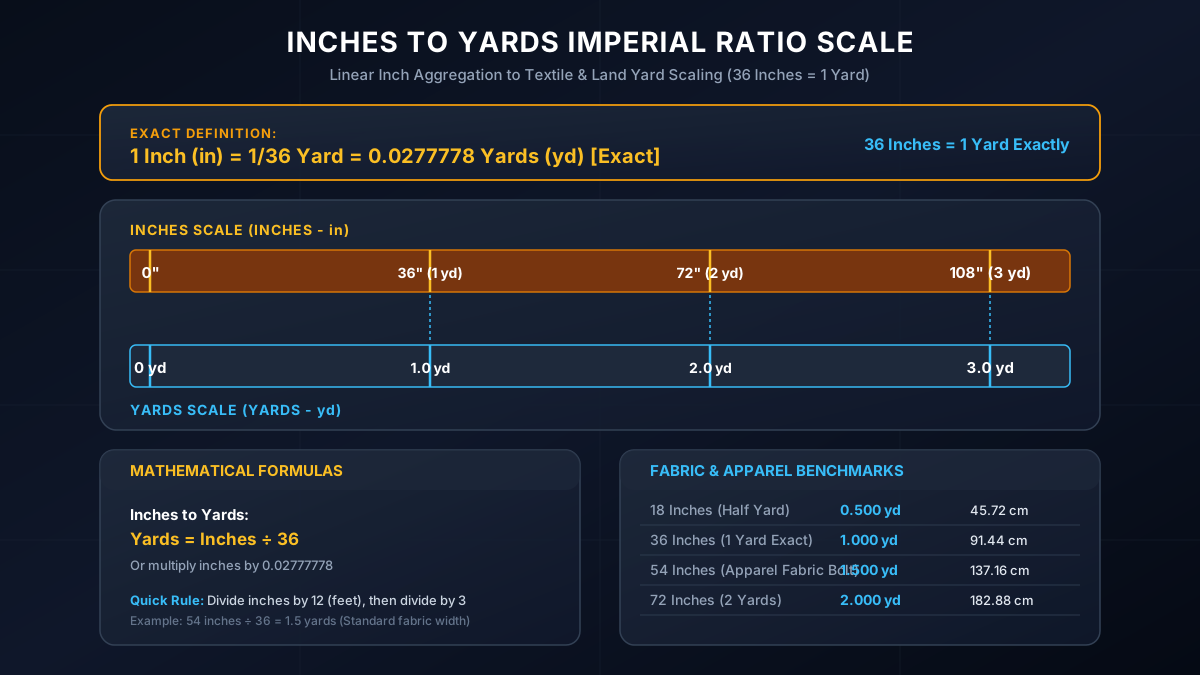
Under the 1959 International Yard and Pound Agreement, 1 Yard is defined as containing exactly 36 Inches (or 3 feet, or ). Therefore, converting inches to yards requires dividing the number of inches by 36:
The Inches to Yards Converter delivers instant, bidirectional calculations across linear inches, imperial yards, feet, meters, and centimeters. This comprehensive guide covers fabric bolt widths (44-inch and 54-inch standard bolts), carpet roll cuts, landscaping mulch barriers, and fast mental division techniques.
2. Core Definitions & Analogy
To understand ratio scaling between linear inches and imperial yards, let us review their core definitions:
- Simple Definition: An inch is a small imperial unit (about the length of the top joint of an adult thumb), while a yard is a larger unit equal to 36 inches (about 3 feet). To find how many yards are in a given number of inches, you divide by 36.
- Technical Definition: The International Inch ():* Codified since 1959 as exactly ().The International Yard ():* Exactly ().
- The Yardstick Analogy: Imagine holding a standard 36-inch wooden yardstick. Every single inch marked on the wood represents exactly of that yardstick. If you have 72 inches, you have exactly 2 full yardsticks (2 yards).
3. The Mathematical Formulas
Converting inches to yards involves exact integer division by 36:
Exact Mathematical Formulas:
Quick Mental Arithmetic (Divide by 12, then by 3):
- First convert inches to feet by dividing by 12, then divide the feet by 3:Example (36 inches): (Exact!)*.Example (54 inches): (Standard fabric bolt width!)*.Example (72 inches): (Exact!)*.Example (108 inches): (Curtain drapery drop!)*.
4. Comprehensive Inches to Yards Lookup Table
| Inches () | Yards () | Feet () | Centimeters () | Meters () | Real-World Context |
|---|---|---|---|---|---|
| 9 in | 0.250 yd | 0.75 ft | 22.86 cm | 0.2286 m | 1/4 yard fabric fat quarter width |
| 18 in | 0.500 yd | 1.50 ft | 45.72 cm | 0.4572 m | Half-yard fabric cut |
| 27 in | 0.750 yd | 2.25 ft | 68.58 cm | 0.6858 m | 3/4 yard cut |
| 36 in | 1.000 yd | 3.00 ft | 91.44 cm | 0.9144 m | 1 Standard Yardstick |
| 44 in | 1.222 yd | 3.67 ft | 111.76 cm | 1.1176 m | Standard quilting cotton bolt width |
| 54 in | 1.500 yd | 4.50 ft | 137.16 cm | 1.3716 m | Standard apparel & upholstery fabric width |
| 60 in | 1.667 yd | 5.00 ft | 152.40 cm | 1.5240 m | Wide apparel fabric bolt |
| 72 in | 2.000 yd | 6.00 ft | 182.88 cm | 1.8288 m | 6-foot fence section |
| 90 in | 2.500 yd | 7.50 ft | 228.60 cm | 2.2860 m | Standard full-length curtain drop |
| 108 in | 3.000 yd | 9.00 ft | 274.32 cm | 2.7432 m | Seamless quilt backing width |
| 144 in | 4.000 yd | 12.00 ft | 365.76 cm | 3.6576 m | Standard broadloom carpet roll width |
| 360 in | 10.000 yd | 30.00 ft | 914.40 cm | 9.1440 m | NFL First Down distance |
| 3,600 in | 100.000 yd | 300.00 ft | 9,144.00 cm | 91.4400 m | American football playing field |
5. Step-by-Step Practical Calculation Examples
Example 1: Fabric Purchasing for Sewing Drapery
- Scenario: A seamstress measures a window panel requiring 126 inches of linen fabric. How many yards of fabric should be ordered at the textile shop?
- Calculation:
Example 2: Residential Carpet Runner Sizing
- Scenario: A homeowner measures a staircase runner spanning 288 inches from top to bottom. Carpet is sold by the linear yard. How many yards are needed?
- Calculation:
6. Major Real-World Applications
flowchart LR
    I2Y["Inches to Yards Conversion"] --> TEXTILE["Textiles & Quilting: Converting garment pattern inches to retail fabric yards"]
    I2Y --> CARPET["Flooring: Staircase & hallway runner cuts (inches to linear yards)"]
    I2Y --> DRAPERY["Interior Design: Curtain drop measurements (inches) to bolt yardage"]
I2Y --> FENCE["Landscaping: Garden border edging and wire fencing lengths"]- Textile Retail: Fabric is sold strictly by the yard in North America, while sewing patterns list garment piece dimensions in inches.
- Quilting Fat Quarters: Quilters purchase cuts based on fractional yard divisions ().
- Broadloom Carpet Rolls: Standard 12-foot carpet rolls () are priced and cut by the linear yard ().
7. Frequently Asked Questions (FAQ)
- How many yards is 72 inches?(exactly 6 feet).
- How many yards is 54 inches?(a yard and a half).
- What is the formula to convert inches to yards?Divide inches by 36 ().
8. Expert Summary & Best Practices
- Divide by 36: Always divide inches by for exact yard conversions.
- Two-Step Mental Trick: Divide inches by 12 to get feet, then divide by 3 to get yards.
- Fabric Buying Rule: When buying fabric, always round up to the nearest yard () to account for fabric shrinkage and pattern alignment seams.
Additional Technical Guidelines & Measurement Standards
When conducting calculations for Inches to Yards Converter, maintaining quantitative precision and verifying input parameter boundaries is essential for reliable scenario evaluation. Always verify that raw numerical inputs are measured using standardized instrumentation, and double-check unit conversions prior to applying outputs in commercial, industrial, or academic projects.
For quantitative unit conversions and scientific calculations, always maintain at least four decimal places of precision during intermediate arithmetic stages before rounding final results. When preparing technical reports, laboratory documentation, or financial forecasts, cross-verify all output variables against established international measurement standards (such as SI, NIST, and ISO metric benchmarks) to guarantee consistent analytical rigor across all computational workflows.
MathsLover.com delivers this interactive solver 100% free of charge to foster global mathematical literacy, educational accessibility, and data-driven problem solving across scientific, technical, and academic communities worldwide.