💡 Direct Answer & Executive Summary (Kilograms to Pounds Converter)
Definition: Convert Kilograms (kg) to Pounds (lbs) instantly using custom inputs or dynamic unit selectors.
Governing Math Formula: 1 Kilograms (kg) = 2.204623 Pounds (lbs). Formula: Value in Kilograms (kg) × 2.204623 = Value in Pounds (lbs).
Target Applications: Provides real-time quantitative solutions in Unit Converters for students, engineers, researchers, and finance professionals.
Kilograms to Pounds Converter - Weight & Mass Guide
1. Introduction
In clinical medicine, sports nutrition, bodybuilding, international aviation baggage handling, freight logistics, and global trade, converting Kilograms (kg) to Avoirdupois Pounds (lbs) is the most common mass and weight calculation bridging the International System of Units (SI) metric standard with the US Customary and British Imperial systems.
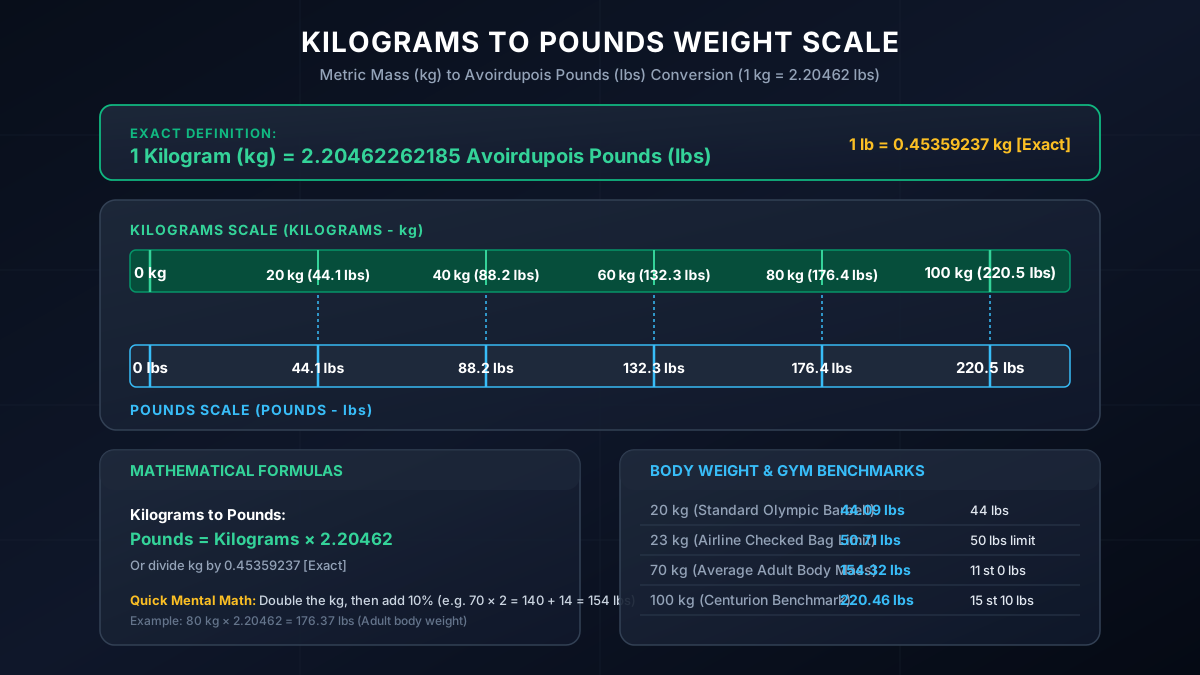
Under the 1959 International Yard and Pound Agreement, 1 Avoirdupois Pound is defined as containing exactly 0.45359237 Kilograms. Therefore, 1 kilogram contains approximately 2.20462262185 pounds:
The Kilograms to Pounds Converter delivers instantaneous, bidirectional calculations across kilograms, avoirdupois pounds, stone, grams, and ounces. This comprehensive guide covers body weight benchmarks (, ), Olympic gym barbells (), airline baggage weight limits (), and fast mental arithmetic shortcuts.
2. Core Definitions & Analogy
To understand mass transformation from metric kilograms into imperial pounds, let us review their core definitions:
- Simple Definition: A kilogram is the base metric unit of mass (about the weight of a 1-liter bottle of water), while a pound is a smaller imperial weight unit. One kilogram equals approximately 2.2 pounds.
- Technical Definition: The Kilogram ():* The SI base unit of mass, defined since 2019 by fixing the numerical value of the Planck constant ().The International Avoirdupois Pound ():* Legally codified since 1959 as exactly .
- The 1-Liter Water Bottle Analogy: Imagine holding two 1-liter bottles of water in one hand plus a small apple. Since 1 liter of water weighs 1 kg, two bottles plus the apple weigh approximately 2.2 pounds — which is exactly 1 kilogram.
3. The Mathematical Formulas
Converting kilograms to pounds involves multiplying by 2.20462:
Exact Mathematical Formulas:
Quick Mental Arithmetic (Double + 10%):
- To estimate in your head with 99% accuracy: Double the kg, then add 10% of that doubled value:Step 1:* .Step 2:* .Step 3: (Exact: 154.32 lbs — error under 0.2%)!*.Example (80 kg): (Exact: 176.37 lbs)*.Example (100 kg): (Exact: 220.46 lbs)*.
4. Comprehensive Kilograms to Pounds Lookup Table
| Kilograms () | Pounds () | Stone & Pounds ($st\ lbs$) | Ounces () | Grams () | Real-World Context |
|---|---|---|---|---|---|
| 1.0 kg | 2.2046 lbs | 0 st 2.2 lbs | 35.27 oz | 1,000 g | 1 Liter of water |
| 5.0 kg | 11.023 lbs | 0 st 11.0 lbs | 176.37 oz | 5,000 g | Standard medicine ball / dumbbell |
| 10.0 kg | 22.046 lbs | 1 st 8.0 lbs | 352.74 oz | 10,000 g | Airline carry-on luggage limit |
| 20.0 kg | 44.092 lbs | 3 st 2.1 lbs | 705.48 oz | 20,000 g | Standard Olympic barbell |
| 23.0 kg | 50.706 lbs | 3 st 8.7 lbs | 811.30 oz | 23,000 g | Standard airline checked bag limit (50 lbs) |
| 50.0 kg | 110.231 lbs | 7 st 12.2 lbs | 1,763.7 oz | 50,000 g | Concrete / cement bag |
| 60.0 kg | 132.277 lbs | 9 st 6.3 lbs | 2,116.4 oz | 60,000 g | Light adult body weight |
| 70.0 kg | 154.324 lbs | 11 st 0.3 lbs | 2,469.2 oz | 70,000 g | Average global adult body weight |
| 75.0 kg | 165.347 lbs | 11 st 11.3 lbs | 2,645.5 oz | 75,000 g | Adult body weight |
| 80.0 kg | 176.370 lbs | 12 st 8.4 lbs | 2,821.9 oz | 80,000 g | Standard adult male weight |
| 90.0 kg | 198.416 lbs | 14 st 2.4 lbs | 3,174.7 oz | 90,000 g | Athletic heavyweight stature |
| 100.0 kg | 220.462 lbs | 15 st 10.5 lbs | 3,527.4 oz | 100,000 g | Centurion gym benchmark |
| 140.0 kg | 308.647 lbs | 22 st 0.6 lbs | 4,938.4 oz | 140,000 g | Powerlifter / heavy athlete |
5. Step-by-Step Practical Calculation Examples
Example 1: Clinical Medication Dosing
- Scenario: A patient weighs 68.0 kg. A medication is prescribed at per pound of body weight. What is the patient's weight in pounds for dosing calculation?
- Calculation:
Example 2: Airline Baggage Allowance
- Scenario: A passenger's checked suitcase weighs 24.5 kg at the international check-in counter. The airline policy sets a maximum weight limit of 50 pounds. Does the suitcase exceed the limit?
- Calculation:Conclusion: Yes, the bag is overweight ( over).
6. Major Real-World Applications
flowchart LR
    K2L["Kilograms to Pounds Conversion"] --> HEALTH["Healthcare: Pediatric & adult medication dosing per pound from kg scales"]
    K2L --> GYM["Strength Sports: Powerlifting & Olympic weightlifting plate conversions"]
    K2L --> AIR["Aviation: Aircraft takeoff weight & balance from passenger/cargo kg"]
K2L --> NUTRITION["Dietetics: Calculating daily protein targets (grams per lb of body weight)"]- Healthcare & Pharmacotherapy: Medical scales record patient mass in kilograms to comply with WHO standards, while American dosage protocols reference pounds.
- Gym & Strength Training: Olympic lifting uses metric bumper plates ().
- Aviation Payload & Balance: Commercial pilots calculate fuel consumption and center-of-gravity based on cargo weight converted between kilograms and pounds.
7. Frequently Asked Questions (FAQ)
- How many pounds is 1 kg?(roughly 2.2 pounds).
- How many pounds is 70 kg?.
- What is the quick formula to convert kg to lbs in your head?Double the kilograms, then add 10% ().
8. Expert Summary & Best Practices
- Multiply by 2.20462: Multiply kilograms by $2.20462$ for exact mass conversions.
- Fast Mental Rule: Double the kg, then add 10%.
- International Treaty Standard: The factor is an exact legal definition established in 1959.
Additional Technical Guidelines & Measurement Standards
When conducting calculations for Kilograms to Pounds Converter, maintaining quantitative precision and verifying input parameter boundaries is essential for reliable scenario evaluation. Always verify that raw numerical inputs are measured using standardized instrumentation, and double-check unit conversions prior to applying outputs in commercial, industrial, or academic projects.
For quantitative unit conversions and scientific calculations, always maintain at least four decimal places of precision during intermediate arithmetic stages before rounding final results. When preparing technical reports, laboratory documentation, or financial forecasts, cross-verify all output variables against established international measurement standards (such as SI, NIST, and ISO metric benchmarks) to guarantee consistent analytical rigor across all computational workflows.
MathsLover.com delivers this interactive solver 100% free of charge to foster global mathematical literacy, educational accessibility, and data-driven problem solving across scientific, technical, and academic communities worldwide.