💡 Direct Answer & Executive Summary (Kilograms to Milligrams Converter)
Definition: Convert Kilograms (kg) to Milligrams (mg) instantly using custom inputs or dynamic unit selectors.
Governing Math Formula: 1 Kilograms (kg) = 1000000.000000 Milligrams (mg). Formula: Value in Kilograms (kg) × 1000000.000000 = Value in Milligrams (mg).
Target Applications: Provides real-time quantitative solutions in Unit Converters for students, engineers, researchers, and finance professionals.
Kilograms to Milligrams Converter - Precision Mass Guide
1. Introduction
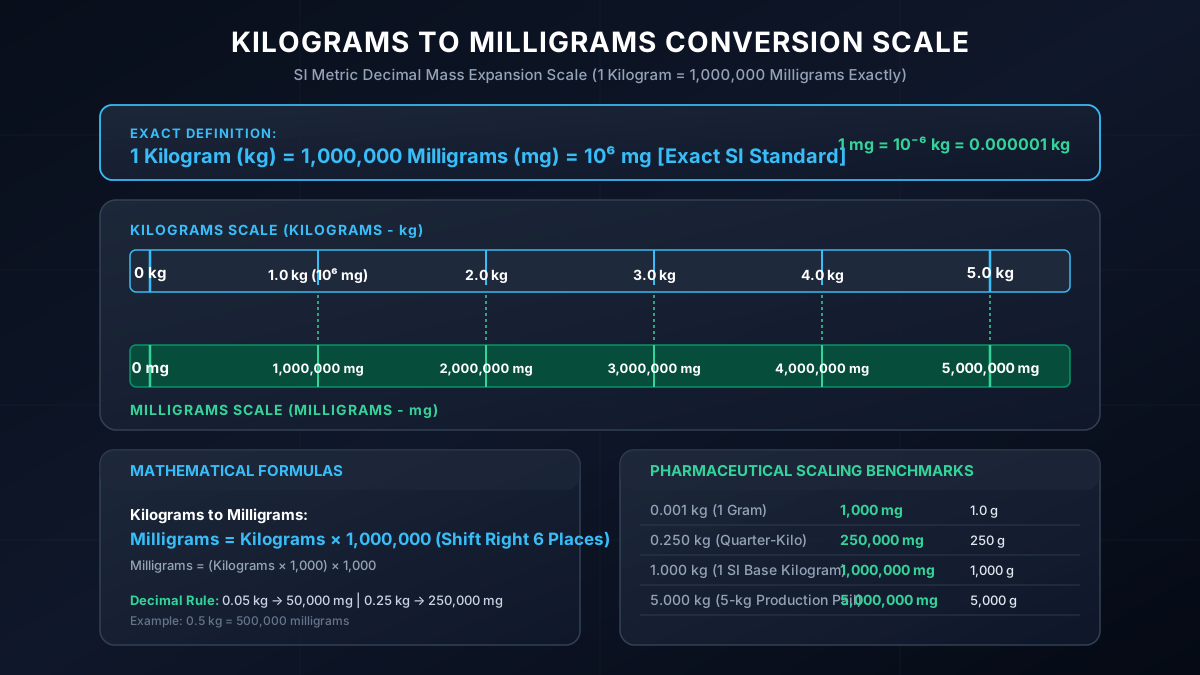
In pharmacology, clinical nursing, analytical chemistry, biochemistry, toxicology, and food fortification, converting Metric Kilograms (kg) to Metric Milligrams (mg) is the primary SI decimal mass expansion calculation used to scale macroscopic raw materials into microscopic unit doses spanning six orders of magnitude ().
Under the SI decimal prefix system established by the International Bureau of Weights and Measures (BIPM), the prefix kilo- represents ($1,000$), while milli- represents ($1/1,000$). Therefore, 1 kilogram equals exactly 1,000,000 Milligrams ():
The Kilograms to Milligrams Converter delivers instantaneous, bidirectional precision calculations across kilograms, milligrams, grams, micrograms (mcg), pounds (lbs), and ounces. This comprehensive guide covers pharmaceutical capsule fills, laboratory reagent compounding, vitamin premixes, and the "Shift Right 6 Places" decimal rule.
2. Core Definitions & Analogy
To understand mass expansion from kilograms into milligrams, let us review their core definitions:
- Simple Definition: A kilogram is the base unit of mass (about the weight of a 1-liter bottle of water), while a milligram is 1,000,000 times smaller (about the weight of a single grain of sand). To convert kilograms to milligrams, you multiply by 1,000,000 (shift the decimal point 6 places to the right).
- Technical Definition: The Kilogram ():* The SI base unit of mass, defined by the Planck constant ().The Milligram ():* Defined as .
- The 1-Liter Water Bottle and Sand Analogy: Imagine taking a 1-liter bottle of pure water (1.0 kg). If you could subdivide that bottle into tiny droplets each weighing exactly 1 milligram (1 mg), you would have exactly 1,000,000 droplets.
3. The Mathematical Formulas
Converting kilograms to milligrams involves multiplying by 1,000,000:
Exact Mathematical Formulas:
The "Shift Right 6 Places" Decimal Rule:
- Because 1,000,000 is , simply move the decimal point 6 positions to the right (or multiply by 1,000 twice):Example (0.05 kg): (50 grams!)*.Example (0.25 kg): (Quarter-kilo!)*.Example (0.50 kg): (Half-kilo!)*.Example (1.25 kg): (1.25 kg!)*.
4. Comprehensive Kilograms to Milligrams Lookup Table
| Kilograms () | Milligrams () | Grams () | Pounds () | Real-World Context |
|---|---|---|---|---|
| 0.001 kg | 1,000 mg | 1.000 g | 0.0022 lbs | 1 Gram Vitamin C tablet |
| 0.005 kg | 5,000 mg | 5.000 g | 0.0110 lbs | 5g Creatine scoop |
| 0.010 kg | 10,000 mg | 10.000 g | 0.0220 lbs | Oral electrolyte sachet |
| 0.050 kg | 50,000 mg | 50.000 g | 0.1102 lbs | Analytical laboratory reagent vial |
| 0.100 kg | 100,000 mg | 100.000 g | 0.2205 lbs | 1 Hectogram bulk chemical container |
| 0.250 kg | 250,000 mg | 250.000 g | 0.5512 lbs | Quarter-kilogram stock container |
| 0.500 kg | 500,000 mg | 500.000 g | 1.1023 lbs | European half-kilo pack |
| 1.000 kg | 1,000,000 mg | 1,000.000 g | 2.2046 lbs | 1 SI Base Kilogram / 1 L Water |
| 2.500 kg | 2,500,000 mg | 2,500.000 g | 5.5116 lbs | Standard consumer flour bag |
| 5.000 kg | 5,000,000 mg | 5,000.000 g | 11.0231 lbs | 5-kg Production pail |
| 10.000 kg | 10,000,000 mg | 10,000.000 g | 22.0462 lbs | Master batch manufacturing drum |
5. Step-by-Step Practical Calculation Examples
Example 1: Pharmaceutical Unit-Dose Capsule Fills
- Scenario: A pharmaceutical facility loads 2.5 kg of pure active ibuprofen powder into an automated encapsulation line. If each capsule contains 200 mg of ibuprofen, how many capsules can be manufactured?
- Step 1 (Convert kg to total milligrams):
- Step 2 (Divide by 200 mg per capsule):
Example 2: Laboratory Buffer Preparation
- Scenario: A biochemist dissolves 0.075 kg of an analytical reagent into a master solution. What is the mass in milligrams?
- Calculation:
6. Major Real-World Applications
flowchart LR
    KG2MG["Kilograms to Milligrams Conversion"] --> RX["Pharmaceutical Tableting: Calculating capsule yields from raw bulk ingredient kg"]
    KG2MG --> LAB["Biochemistry: Preparing milligram enzyme buffers from bulk kg stock jars"]
    KG2MG --> NUTRITION["Food Fortification: Scaling bulk vitamin premix kg to milligram label declarations"]
KG2MG --> QC["Quality Control: Verifying milligram active ingredient tolerances across batch kg"]- Pharmaceutical Manufacturing: Production lines measure bulk active ingredients in kilograms and scale down to milligrams per unit tablet ().
- Nutritional Premix Formulation: Food fortification plants scale bulk vitamin shipments (kg) into milligram micronutrient additions per serving.
- Analytical Chemistry & Buffer Compounding: Chemists dissolve kilogram quantities of buffer salts and calculate active ions in milligrams per milliliter (mg/mL).
7. Frequently Asked Questions (FAQ)
- How many milligrams are in 1 kilogram?There are exactly 1,000,000 milligrams in 1 kilogram ().
- How many milligrams is 0.5 kg?(500 grams).
- What is the formula to convert kg to mg?Multiply kilograms by 1,000,000 ().
8. Expert Summary & Best Practices
- Multiply by 1,000,000: Always multiply kilograms by .
- Shift Decimal 6 Places Right: Move the decimal point 6 positions right ().
- Exact Decimal Standard: Because kilo- and milli- are exact SI powers of ten, calculations between kilograms and milligrams are completely exact.
Additional Technical Guidelines & Measurement Standards
When conducting calculations for Kilograms to Milligrams Converter, maintaining quantitative precision and verifying input parameter boundaries is essential for reliable scenario evaluation. Always verify that raw numerical inputs are measured using standardized instrumentation, and double-check unit conversions prior to applying outputs in commercial, industrial, or academic projects.
For quantitative unit conversions and scientific calculations, always maintain at least four decimal places of precision during intermediate arithmetic stages before rounding final results. When preparing technical reports, laboratory documentation, or financial forecasts, cross-verify all output variables against established international measurement standards (such as SI, NIST, and ISO metric benchmarks) to guarantee consistent analytical rigor across all computational workflows.
MathsLover.com delivers this interactive solver 100% free of charge to foster global mathematical literacy, educational accessibility, and data-driven problem solving across scientific, technical, and academic communities worldwide.