💡 Direct Answer & Executive Summary (Kilograms to Metric Tons Converter)
Definition: Convert Kilograms (kg) to Metric Tons (t) instantly using custom inputs or dynamic unit selectors.
Governing Math Formula: 1 Kilograms (kg) = 0.001000 Metric Tons (t). Formula: Value in Kilograms (kg) × 0.001000 = Value in Metric Tons (t).
Target Applications: Provides real-time quantitative solutions in Unit Converters for students, engineers, researchers, and finance professionals.
Kilograms to Metric Tons Converter - Heavy Mass Guide
1. Introduction
In freight shipping, civil construction, mining geology, industrial metallurgy, waste management, and heavy automotive manufacturing, converting Metric Kilograms (kg) to Metric Tons (t / Tonnes) is the premier reduction calculation used to aggregate bulk materials into standardized commercial freight units.
Under the International System of Units (SI) framework defined by the International Bureau of Weights and Measures (BIPM), the Metric Ton (symbol: t) represents exactly 1,000 Kilograms ( or ). Therefore, 1 kilogram equals exactly 0.001 Metric Tons (1/1,000 t):
The Kilograms to Metric Tons Converter provides instantaneous, bidirectional calculations across kilograms, metric tonnes, US short tons (), British long tons (), and pounds. This comprehensive guide covers vehicle curb masses (), highway weigh scales, ocean cargo manifests, and the "Shift Left 3 Places" decimal rule.
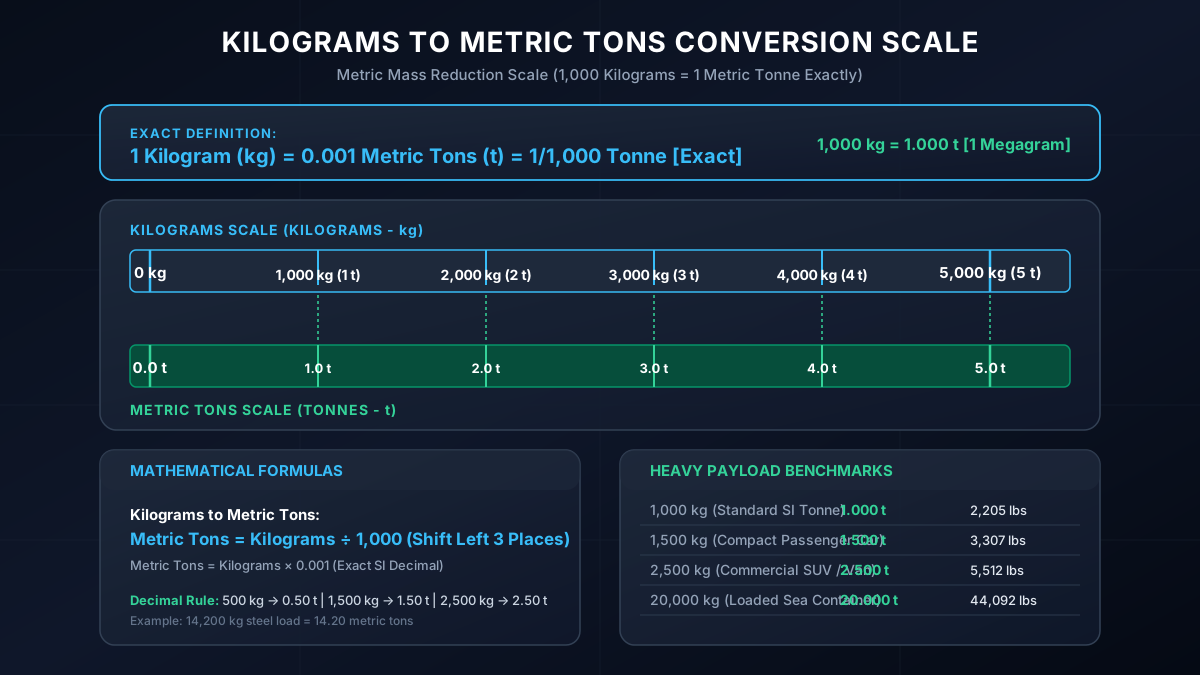
2. Core Definitions & Analogy
To understand mass reduction from kilograms into metric tonnes, let us review their core definitions:
- Simple Definition: A kilogram is the base metric unit of mass (about the weight of a 1-liter water bottle), while a metric ton (tonne) is 1,000 times larger. To convert kilograms to metric tons, you divide by 1,000 (shift the decimal point 3 places to the left).
- Technical Definition: The Kilogram ():* The SI base unit of mass.The Metric Ton (, tonne):* Exactly .
- The Sedan Car Analogy: A standard modern compact passenger car weighs roughly 1,500 kilograms. If you express this mass in metric tons, it is simply 1.50 tonnes (1.5 t).
3. The Mathematical Formulas
Converting kilograms to metric tons involves dividing by 1,000:
Exact Mathematical Formulas:
The "Shift Left 3 Places" Decimal Rule:
- Because 1,000 is , simply move the decimal point 3 positions to the left:Example (500 kg): (Half a tonne!)*.Example (1,500 kg): (Passenger sedan!)*.Example (2,500 kg): (Large SUV!)*.Example (20,000 kg): (Loaded 20-ft container!)*.
4. Comprehensive Kilograms to Metric Tons Lookup Table
| Kilograms () | Metric Tons () | Pounds () | US Short Tons | Real-World Heavy Payload Context |
|---|---|---|---|---|
| 100 kg | 0.100 t | 220.5 lbs | 0.110 tons | Standard industrial pallet of goods |
| 250 kg | 0.250 t | 551.2 lbs | 0.276 tons | Quarter-tonne industrial drum |
| 500 kg | 0.500 t | 1,102.3 lbs | 0.551 tons | Half-tonne bulk aggregate sack |
| 1,000 kg | 1.000 t | 2,204.6 lbs | 1.102 tons | 1 Cubic Meter of Pure Water |
| 1,500 kg | 1.500 t | 3,306.9 lbs | 1.653 tons | Compact passenger car curb weight |
| 2,000 kg | 2.000 t | 4,409.2 lbs | 2.205 tons | Mid-size commercial pickup truck |
| 2,500 kg | 2.500 t | 5,511.6 lbs | 2.756 tons | Full-size electric luxury SUV |
| 5,000 kg | 5.000 t | 11,023.1 lbs | 5.512 tons | Medium flatbed delivery truck |
| 10,000 kg | 10.000 t | 22,046.2 lbs | 11.023 tons | Construction dump truck payload |
| 20,000 kg | 20.000 t | 44,092.5 lbs | 22.046 tons | Loaded 20-ft ISO shipping container |
| 36,287 kg | 36.287 t | 80,000.0 lbs | 40.000 tons | Max legal US interstate semi-truck gross |
5. Step-by-Step Practical Calculation Examples
Example 1: Freight Weigh-Bridge Gross Measurement
- Scenario: A commercial tractor-trailer drives onto a highway dynamic weigh scale, reading a gross mass of 28,450 kg. What is this recorded mass in metric tons for the carrier's international shipping manifest?
- Calculation:
Example 2: Structural Steel Load Sizing
- Scenario: A construction project receives an order of structural I-beams weighing 14,200 kg. How many metric tonnes does this represent toward a 50-tonne crane permit?
- Calculation:
6. Major Real-World Applications
flowchart LR
    KG2T["Kilograms to Metric Tons Conversion"] --> WEIGH["Highway Scales: Converting vehicle platform kg to legal axle tonnes"]
    KG2T --> SHIPPING["Container Shipping: Aggregating individual cargo kg into gross sea tonnes"]
    KG2T --> RECYCLE["Metal Recycling: Translating scrap scale kg into industrial furnace tonnes"]
KG2T --> PERMITS["Heavy Transport: Sizing oversized vehicle gross kg for highway route permits"]- Highway Weigh-Stations & Axle Compliance: Road safety transport authorities convert dynamic wheel scale kilogram readings into metric tons to enforce bridge weight limits.
- Maritime Cargo Manifesting: Port stevedoring systems sum pallet kilogram weights to calculate ship ballast trim and container stack tonnages.
- Scrap Metal & Waste Management: Recycling facilities weigh scrap steel intake in kilograms and process sales in bulk commercial metric tons.
7. Frequently Asked Questions (FAQ)
- How many metric tons is 1,000 kg?(exactly 1 tonne).
- How many metric tons is 10,000 kg?.
- What is the formula to convert kg to metric tons?Divide kilograms by 1,000 ().
8. Expert Summary & Best Practices
- Divide by 1,000: Always divide kilograms by $1,000$ (or multiply by $0.001$).
- Shift Decimal 3 Places Left: For instantaneous conversion, shift the decimal 3 places left ().
- Exact SI Standard: Because the tonne is an exact SI power of ten (), calculations between kilograms and metric tons are completely exact.
Additional Technical Guidelines & Measurement Standards
When conducting calculations for Kilograms to Metric Tons Converter, maintaining quantitative precision and verifying input parameter boundaries is essential for reliable scenario evaluation. Always verify that raw numerical inputs are measured using standardized instrumentation, and double-check unit conversions prior to applying outputs in commercial, industrial, or academic projects.
For quantitative unit conversions and scientific calculations, always maintain at least four decimal places of precision during intermediate arithmetic stages before rounding final results. When preparing technical reports, laboratory documentation, or financial forecasts, cross-verify all output variables against established international measurement standards (such as SI, NIST, and ISO metric benchmarks) to guarantee consistent analytical rigor across all computational workflows.
MathsLover.com delivers this interactive solver 100% free of charge to foster global mathematical literacy, educational accessibility, and data-driven problem solving across scientific, technical, and academic communities worldwide.