💡 Direct Answer & Executive Summary (Kilometers to Nautical Miles Converter)
Definition: Convert Kilometers (km) to Nautical Miles (nmi) instantly using custom inputs or dynamic unit selectors.
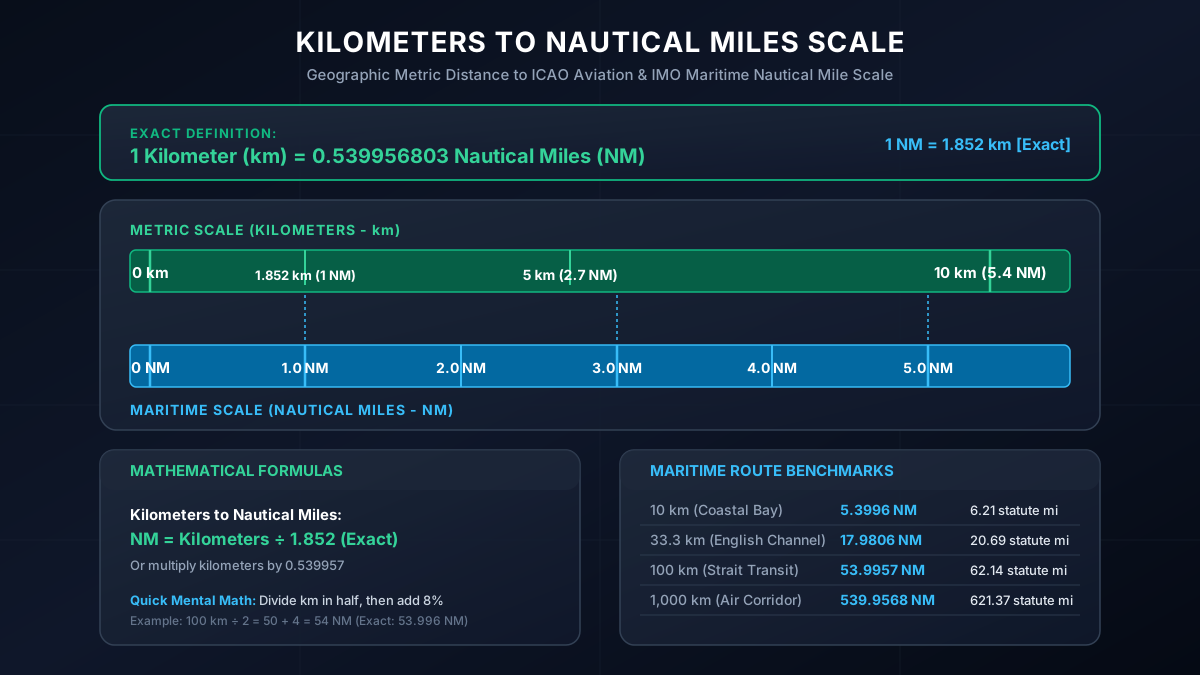
Governing Math Formula: 1 Kilometers (km) = 0.539957 Nautical Miles (nmi). Formula: Value in Kilometers (km) × 0.539957 = Value in Nautical Miles (nmi).
Target Applications: Provides real-time quantitative solutions in Unit Converters for students, engineers, researchers, and finance professionals.
Kilometers to Nautical Miles Converter - Global Navigation Guide
1. Introduction
When interpreting international geographic maps, planning cross-country flight itineraries, charting oceanic routes, or evaluating radar range telemetry, converting Kilometers (km) to Nautical Miles (NM / nmi) is essential for translating metric overland distances into international maritime and aviation standards.
While the metric system is the dominant standard across 95% of civilian ground transportation worldwide, Nautical Miles (NM) and Knots (kt) remain the universal legal language of global air traffic control (ICAO), naval hydrographic offices, and maritime shipping fleets (IMO).
Under international agreement:
The Kilometers to Nautical Miles Converter provides instant, bidirectional speed and distance calculations across metric kilometers, nautical miles, statute miles, knots, and meters. This comprehensive guide covers great-circle navigational distances, aviation flight plan filings, marine radar display rings, mental calculation shortcuts, and maritime reference tables.
2. Core Definitions & Analogy
To understand length transformation between metric kilometers and nautical miles, let us review their core definitions:
- Simple Definition: A kilometer is a standard metric distance unit equal to 1,000 meters, while a nautical mile is a maritime navigation unit based on the Earth's curvature (equal to 1,852 meters). One kilometer equals roughly 0.54 nautical miles (just over half a nautical mile).
- Technical Definition: The Kilometer ():* A decimal multiple of the SI base unit meter ().The International Nautical Mile ( or ):* Exactly , defined as of latitude along a meridian.
- The Half-Portion Analogy: Think of 1 nautical mile as nearly double the length of a kilometer (). If you travel 100 kilometers, you have traveled just under 54 nautical miles across the ocean or in the air.
3. The Mathematical Formulas
Converting kilometers to nautical miles is direct and linear:
Exact Mathematical Formulas:
Quick Mental Arithmetic Shortcut (Divide by 2, add 8%):
- Take the number of kilometers, cut it in half, and then add 8% of the halved value:Example (100 km): (Exact: )*.Example (50 km): (Exact: )*.Example (500 km/h airspeed): (Exact: )*.
4. Comprehensive Kilometers to Nautical Miles Lookup Table
| Kilometers () | Nautical Miles () | Statute Miles () | Meters () | Real-World Context |
|---|---|---|---|---|
| 1 km | 0.5400 NM | 0.6214 mi | 1,000 m | ~10-minute walk |
| 5 km | 2.6998 NM | 3.1069 mi | 5,000 m | 5K road race |
| 10 km | 5.3996 NM | 6.2137 mi | 10,000 m | Coastal bay crossing |
| 18.52 km | 10.0000 NM | 11.508 mi | 18,520 m | Airport radar approach ring |
| 22.224 km | 12.0000 NM | 13.809 mi | 22,224 m | UNCLOS Territorial Sea Limit |
| 33.3 km | 17.9806 NM | 20.692 mi | 33,300 m | English Channel width at Dover |
| 50 km | 26.9978 NM | 31.069 mi | 50,000 m | Marine ferry transit |
| 100 km | 53.9957 NM | 62.137 mi | 100,000 m | Regional flight leg |
| 200 km | 107.9914 NM | 124.274 mi | 200,000 m | Offshore helicopter route |
| 370.4 km | 200.0000 NM | 230.156 mi | 370,400 m | UNCLOS Exclusive Economic Zone (EEZ) |
| 500 km | 269.9784 NM | 310.686 mi | 500,000 m | Short-haul commercial flight corridor |
| 1,000 km | 539.9568 NM | 621.371 mi | 1,000,000 m | Major international airway segment |
| 5,556 km | 3,000.0000 NM | 3,452.338 mi | 5,556,000 m | Transatlantic ocean shipping lane |
5. Step-by-Step Practical Calculation Examples
Example 1: Filing an ICAO Flight Plan Route
- Scenario: A pilot flying from Munich to Rome measures a direct geodesic airway distance of 680 kilometers. How many nautical miles should be entered on the ICAO flight plan?
- Calculation:
Example 2: Marine Radar Range Ring Translation
- Scenario: A coastal radar station tracks a cargo ship at a distance of 45 kilometers offshore. What range ring on a standard nautical radar display corresponds to this contact?
- Calculation:
6. Major Navigational Applications
flowchart LR
    KMNM["Kilometers to Nautical Miles Conversion"] --> FMS["Flight Management Systems: Translating ground GPS track to airway nautical miles"]
    KMNM --> RADAR["Maritime Radar: Interpreting range rings (3, 6, 12, 24 NM) in kilometers"]
    KMNM --> NAVY["Naval Operations: Tactical maneuvering boards & surface missile envelopes"]
KMNM --> GEO["Geodesy: Converting great-circle arc lengths into angular minutes of latitude"]- Marine Radar Range Rings: Marine radar displays present concentric range rings calibrated in 1.5, 3, 6, 12, and 24 nautical miles, requiring metric ship operators to convert distance over ground to NM.
- Flight Management System (FMS) Waypoints: Modern glass cockpits compute remaining route distances in nautical miles while receiving ground station distances in metric telemetry across European and Asian airspace.
- Naval Surface Warfare Envelopes: Anti-ship missile defense systems and naval gunnery calculate engagement perimeters in nautical miles ().
7. Frequently Asked Questions (FAQ)
- How many nautical miles is 100 kilometers?(or approximately 54 NM).
- How do you convert km/h to knots?Divide the speed in km/h by 1.852. For example, .
- Why does international aviation still use nautical miles?Because nautical miles correspond directly to degrees and minutes of latitude on Earth's geographic coordinate system, simplifying navigational math across latitude meridians.
8. Expert Summary & Best Practices
- Divide by 1.852: Divide kilometers by $1.852$ for exact nautical distance conversion.
- Use the 0.54 Multiplier on the Fly: Multiplying kilometers by $0.54$ yields instant mental approximations within 0.008% accuracy.
- Cross-Check Units on ECDIS: When operating Electronic Chart Display and Information Systems (ECDIS), verify whether distance readouts are configured for kilometers (), nautical miles (), or statute miles ().
Additional Technical Guidelines & Measurement Standards
When conducting calculations for Kilometers to Nautical Miles Converter, maintaining quantitative precision and verifying input parameter boundaries is essential for reliable scenario evaluation. Always verify that raw numerical inputs are measured using standardized instrumentation, and double-check unit conversions prior to applying outputs in commercial, industrial, or academic projects.
For quantitative unit conversions and scientific calculations, always maintain at least four decimal places of precision during intermediate arithmetic stages before rounding final results. When preparing technical reports, laboratory documentation, or financial forecasts, cross-verify all output variables against established international measurement standards (such as SI, NIST, and ISO metric benchmarks) to guarantee consistent analytical rigor across all computational workflows.
MathsLover.com delivers this interactive solver 100% free of charge to foster global mathematical literacy, educational accessibility, and data-driven problem solving across scientific, technical, and academic communities worldwide.