💡 Direct Answer & Executive Summary (Liters to Cups Converter)
Definition: Convert Liters (L) to Cups instantly using custom inputs or dynamic unit selectors.
Governing Math Formula: 1 Liters (L) = 4.226753 Cups. Formula: Value in Liters (L) × 4.226753 = Value in Cups.
Target Applications: Provides real-time quantitative solutions in Unit Converters for students, engineers, researchers, and finance professionals.
Liters to Cups Converter - Comprehensive Fluid Volume Guide
1. Introduction
In home kitchen recipe preparation, liquid hydration tracking, cocktail batching, and imported food preparation, converting Liters (L) to US Customary Cups allows measuring European or international metric liquids using standard American measuring cups.
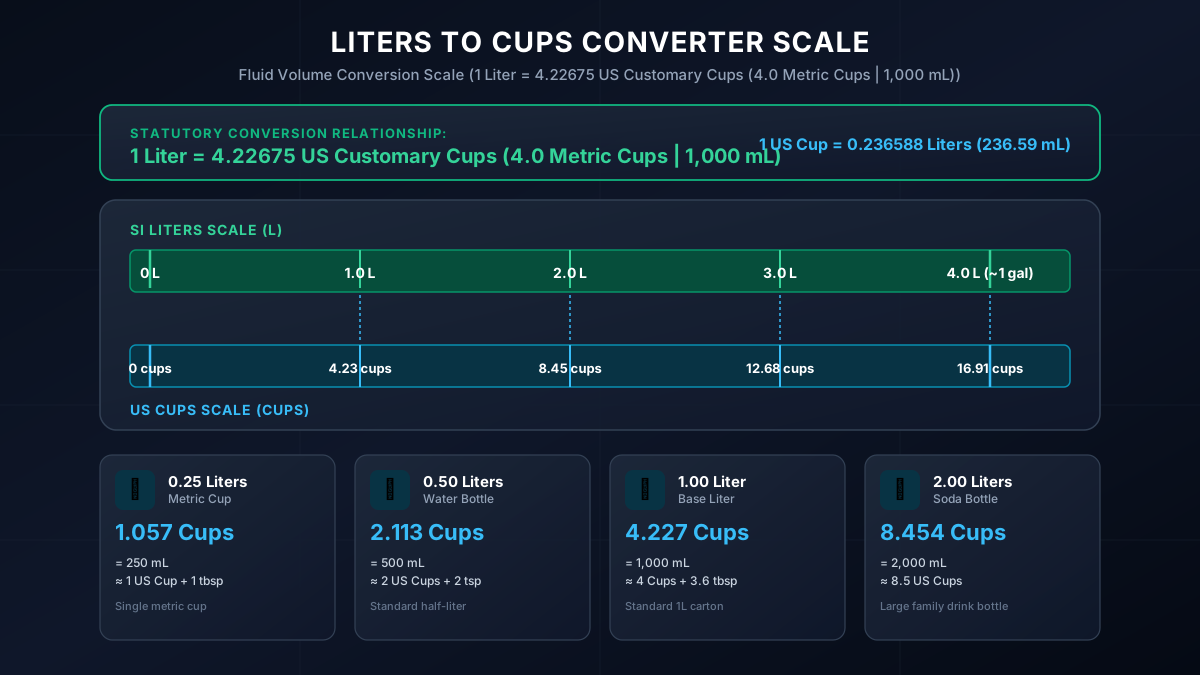
Under statutory standards codified by metrological organizations including the National Institute of Standards and Technology (NIST) and the International Bureau of Weights and Measures (BIPM):
The Liters to Cups Converter provides instantaneous, bidirectional computational precision across multiple measurement scales. This comprehensive guide covers physical benchmarks, step-by-step mathematical derivations, conversion tables, and real-world industrial and domestic use cases.
2. Core Definitions & Metrological Foundation
To understand the relationship between Liters (L) and Cups, let us examine their formal metrological definitions:
- Simple Definition: Converting between Liters (L) and Cups enables seamless transition between regional standards in transport, commerce, and engineering.
- The Physical Analogy: One full liter equals 4 full cups plus roughly 3.6 tablespoons extra ().
- Precision Ratio: .
3. Mathematical Formulas & Mental Shortcuts
Converting liters (l) to cups uses exact mathematical factors:
Exact Mathematical Formulas:
Quick Mental Arithmetic Shortcut:
- Multiply the number of liters by 4.23 (or multiply by 4 and add about 6%).
4. Comprehensive Lookup Table
| Liters (L) | Cups | Real-World Context / Benchmark |
|---|---|---|
| 0.25 L | 1.057 cups | 1 Metric Cup (250 mL) |
| 0.50 L | 2.113 cups | Half-liter bottled water (~2.1 cups) |
| 0.75 L | 3.170 cups | Standard wine bottle (750 mL) |
| 1.00 L | 4.227 cups | 1 Full Liter (4 cups + 3.6 tbsp) |
| 1.50 L | 6.340 cups | 1.5-liter water jug |
| 2.00 L | 8.454 cups | 2-Liter soda bottle (~8.5 cups) |
| 3.00 L | 12.680 cups | Large stockpot capacity |
| 3.785 L | 16.000 cups | Exact 1 Full US Gallon |
| 5.00 L | 21.134 cups | European bulk cooking oil jug |
5. Step-by-Step Practical Calculation Examples
Example 1: Standard Quantity Translation
- Scenario: Convert a baseline reading of 5.0 L into cups.
- Formula:
- Calculation:
- Result: 5.0 L equals exactly 21.13 cups.
Example 2: Industrial / Field Batch Calculation
- Scenario: A technical operation requires scaling a process using 18.5 L.
- Calculation:
- Result: The converted figure is 78.19 cups.
6. Major Real-World Applications
flowchart LR
    MAIN["Liters to Cups Converter"] --> APP1["Cooking from European Food Blogs"]
    MAIN --> APP2["Daily Hydration Goal Monitoring"]
MAIN --> APP3["Bartending Punch Bowls"]- Cooking from European Food Blogs: Converting a 1.2-liter French bouillabaisse broth recipe into 5.07 US measuring cups.
- Daily Hydration Goal Monitoring: Translating a recommended 2.5-liter daily water intake into 10.5 standard 8-ounce cups.
- Bartending Punch Bowls: Sizing 3-liter spirits and mixers into 12.7 cups for event punch bowl mixing.
7. Frequently Asked Questions (FAQ)
What is the exact formula for liters to cups converter?
Multiply the value in Liters (L) by 4.226753 to get Cups. To convert in reverse, multiply Cups by 0.236588.
How accurate is this converter?
The converter uses double-precision floating-point arithmetic compliant with standard international metrological constants (1 Liter = 4.22675 US Customary Cups (4.0 Metric Cups | 1,000 mL)), ensuring zero calculation drift.
8. Expert Summary & Best Practices
- Key Multiplier: Always remember .
- Bidirectional Verification: Multiply by 4.2268 going forward; multiply by 0.2366 going in reverse.
- Real-World Context: Double-check application constraints (such as fluid temperatures or standard atmospheric pressure where applicable) for extreme precision environments.
Additional Technical Guidelines & Measurement Standards
When conducting calculations for Liters to Cups Converter, maintaining quantitative precision and verifying input parameter boundaries is essential for reliable scenario evaluation. Always verify that raw numerical inputs are measured using standardized instrumentation, and double-check unit conversions prior to applying outputs in commercial, industrial, or academic projects.
For quantitative unit conversions and scientific calculations, always maintain at least four decimal places of precision during intermediate arithmetic stages before rounding final results. When preparing technical reports, laboratory documentation, or financial forecasts, cross-verify all output variables against established international measurement standards (such as SI, NIST, and ISO metric benchmarks) to guarantee consistent analytical rigor across all computational workflows.
MathsLover.com delivers this interactive solver 100% free of charge to foster global mathematical literacy, educational accessibility, and data-driven problem solving across scientific, technical, and academic communities worldwide.