💡 Direct Answer & Executive Summary (Liters to Gallons Converter)
Definition: Convert Liters (L) to Gallons (gal) instantly using custom inputs or dynamic unit selectors.
Governing Math Formula: 1 Liters (L) = 0.264172 Gallons (gal). Formula: Value in Liters (L) × 0.264172 = Value in Gallons (gal).
Target Applications: Provides real-time quantitative solutions in Unit Converters for students, engineers, researchers, and finance professionals.
Liters to Gallons Converter - Fluid Volume Guide
1. Introduction
In culinary recipe scaling, automotive fuel capacity modeling, brewery batch formulation, international freight shipping, and domestic beverage packaging, converting Liters (L) to US Liquid Gallons (gal) is the primary inter-system volumetric transition between the International System of Units (SI Metric) and the United States Customary system.
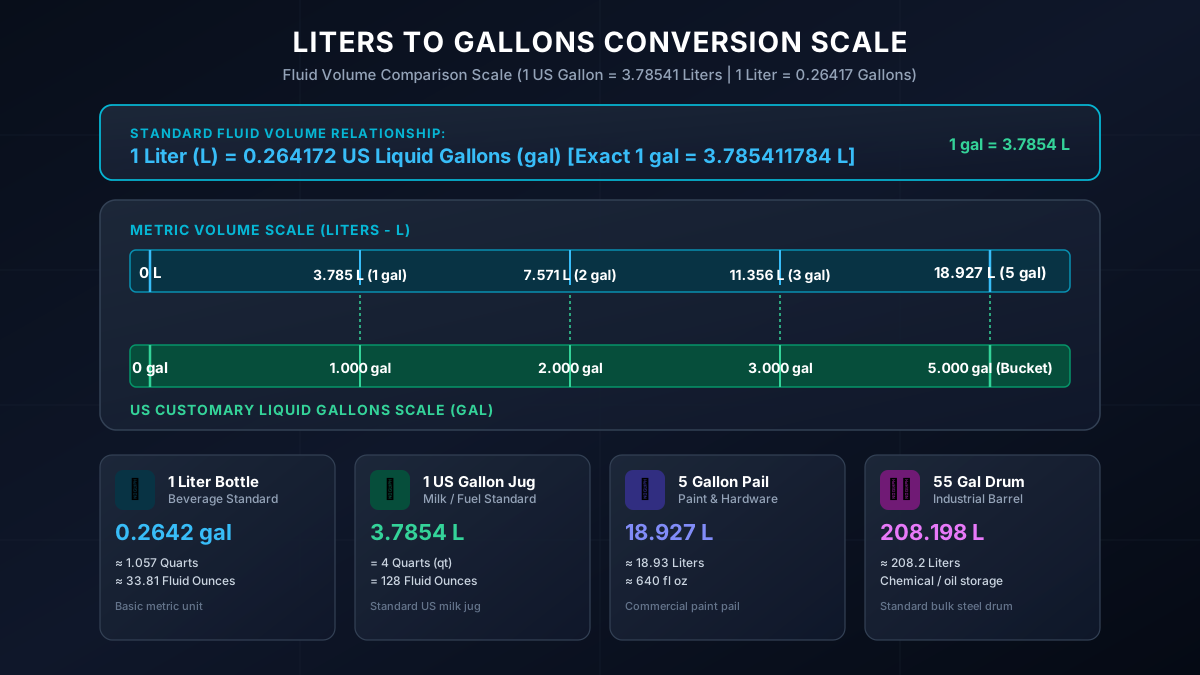
Under statutory standards established by the US National Institute of Standards and Technology (NIST), 1 US Liquid Gallon is defined as exactly 231 cubic inches, which converts to exactly 3.785411784 Liters:
The Liters to Gallons Converter delivers immediate, bidirectional fluid volume calculations across liters, US liquid gallons, UK imperial gallons, milliliters (mL), fluid ounces (fl oz), quarts (qt), pints (pt), and cubic feet (). This comprehensive guide examines real-world volume benchmarks (, , ), tank capacity conversions, and practical mental estimation techniques.
2. Core Definitions & Analogy
To understand fluid capacity conversion between metric liters and customary gallons, let us examine their formal definitions:
- Simple Definition: A liter is a standard metric volume unit (about the size of a standard reusable water bottle or carton of milk), whereas a US gallon is a significantly larger container (equal to the iconic plastic family milk jug or paint container). One US gallon contains roughly 3.79 liters, or conversely, one liter fills slightly more than one-quarter of a gallon.
- Technical Definition:The Liter (, l):* A metric unit of volume equal to 1 cubic decimeter (), , or .The US Liquid Gallon ():* Defined as 231 cubic inches, equivalent to or .The Imperial Gallon (UK):* Defined as exactly (approximately 20% larger than a US gallon).
- The Four-Bottle Milk Jug Analogy: Picture four standard 1-liter reusable water bottles. If you pour three full 1-liter bottles plus about three-quarters of the fourth bottle into an empty US gallon jug, it will fill the gallon jug completely to the brim.
3. The Mathematical Formulas
Converting liters into gallons requires applying the standard NIST reciprocal constant:
Exact Mathematical Formulas:
Quick Mental Arithmetic (Divide by 3.8 or Multiply by 0.264):
- For quick mental calculations without a calculator, divide the liter figure by 4, then add about 5% back to your estimate:Example (10 Liters): (Accurate to within 0.1%!)*.Example (20 Liters): (Standard 5-gal Jerry Can plus extra!)*.Example (50 Liters): (Standard sedan fuel tank!)*.
4. Comprehensive Liters to Gallons Lookup Table
| Liters () | US Gallons () | Imperial Gallons () | Fluid Ounces () | Common Benchmark Context |
|---|---|---|---|---|
| 0.50 L | 0.132 gal | 0.110 UK gal | 16.91 fl oz | Single standard commercial water bottle |
| 1.00 L | 0.264 gal | 0.220 UK gal | 33.81 fl oz | Standard 1-liter beverage bottle |
| 2.00 L | 0.528 gal | 0.440 UK gal | 67.63 fl oz | Classic 2-liter soda bottle |
| 3.785 L | 1.000 gal | 0.833 UK gal | 128.00 fl oz | 1 Full US Standard Milk / Juice Jug |
| 5.00 L | 1.321 gal | 1.100 UK gal | 169.07 fl oz | European bulk cooking oil jug |
| 10.00 L | 2.642 gal | 2.200 UK gal | 338.14 fl oz | Medium household cleaning / mop bucket |
| 18.93 L | 5.000 gal | 4.163 UK gal | 640.00 fl oz | Standard 5-Gallon Paint / Water Cooler Bottle |
| 37.85 L | 10.000 gal | 8.327 UK gal | 1,280.00 fl oz | Aquarium tank / emergency fuel canister |
| 50.00 L | 13.209 gal | 10.998 UK gal | 1,690.70 fl oz | Compact car / crossover fuel tank capacity |
| 75.00 L | 19.813 gal | 16.498 UK gal | 2,536.05 fl oz | Full-size SUV / pickup truck fuel tank |
| 100.00 L | 26.417 gal | 21.997 UK gal | 3,381.40 fl oz | Rainwater collection barrel / brewing vat |
| 208.20 L | 55.000 gal | 45.794 UK gal | 7,040.00 fl oz | Standard 55-Gallon Industrial Steel Drum |
| 1,000.00 L | 264.172 gal | 219.969 UK gal | 33,814.02 fl oz | 1 Cubic Meter () / IBC Bulk Tote Container |
5. Step-by-Step Practical Calculation Examples
Example 1: Sizing an Aquarium in Gallons
- Problem: You purchased a 60-liter rimless glass aquarium from a European manufacturer. You need to calculate its volume in US gallons to calculate water conditioning doses and biological filter flow rates.
- Formula:
- Calculation:
- Result: The aquarium holds approximately 15.85 US Gallons (typically classified as a 16-gallon tank).
Example 2: Fuel Economy Tank Conversion
- Problem: A rental car in North America requires 14.5 gallons of gasoline to fill from empty. How many liters of fuel were dispensed?
- Formula:
- Calculation:
- Result: The fuel pump dispensed 54.89 Liters of gasoline.
6. US Gallons vs. Imperial Gallons (Important Distinction)
A frequent point of confusion in global engineering and recipe translation is the difference between US Customary Gallons and British Imperial Gallons:
- US Liquid Gallon (): Based on the Queen Anne wine gallon of 1707 (231 cubic inches). Divided into 4 quarts, 8 pints, or 128 US fluid ounces ().
- Imperial Gallon (): Established by the British Weights and Measures Act of 1824, defined as the volume of 10 pounds of distilled water at . Divided into 4 quarts, 8 pints, or 160 Imperial fluid ounces ().
- Conversion Ratio:
7. Frequently Asked Questions (FAQ)
Is 1 liter equal to a quart?
A liter is slightly larger than a US liquid quart. Specifically, . In culinary estimates, they are often swapped 1:1, but in chemistry or precision fuel mixing, the 5.67% difference is critical.
How do I convert liters to UK (Imperial) gallons?
Multiply the number of liters by 0.219969, or divide by 4.54609. For example, .
How many bottles of water make 1 US gallon?
A standard plastic bottled water is (). Since 1 US gallon is , it takes exactly 7.57 standard 500 mL water bottles to fill 1 US gallon.
Additional Technical Guidelines & Measurement Standards
When conducting calculations for Liters to Gallons Converter, maintaining quantitative precision and verifying input parameter boundaries is essential for reliable scenario evaluation. Always verify that raw numerical inputs are measured using standardized instrumentation, and double-check unit conversions prior to applying outputs in commercial, industrial, or academic projects.
For quantitative unit conversions and scientific calculations, always maintain at least four decimal places of precision during intermediate arithmetic stages before rounding final results. When preparing technical reports, laboratory documentation, or financial forecasts, cross-verify all output variables against established international measurement standards (such as SI, NIST, and ISO metric benchmarks) to guarantee consistent analytical rigor across all computational workflows.
MathsLover.com delivers this interactive solver 100% free of charge to foster global mathematical literacy, educational accessibility, and data-driven problem solving across scientific, technical, and academic communities worldwide.