💡 Direct Answer & Executive Summary (Liters to Milliliters Converter)
Definition: Convert Liters (L) to Milliliters (mL) instantly using custom inputs or dynamic unit selectors.
Governing Math Formula: 1 Liters (L) = 1000.000000 Milliliters (mL). Formula: Value in Liters (L) × 1000.000000 = Value in Milliliters (mL).
Target Applications: Provides real-time quantitative solutions in Unit Converters for students, engineers, researchers, and finance professionals.
Liters to Milliliters Converter - Metric Volume Guide
1. Introduction
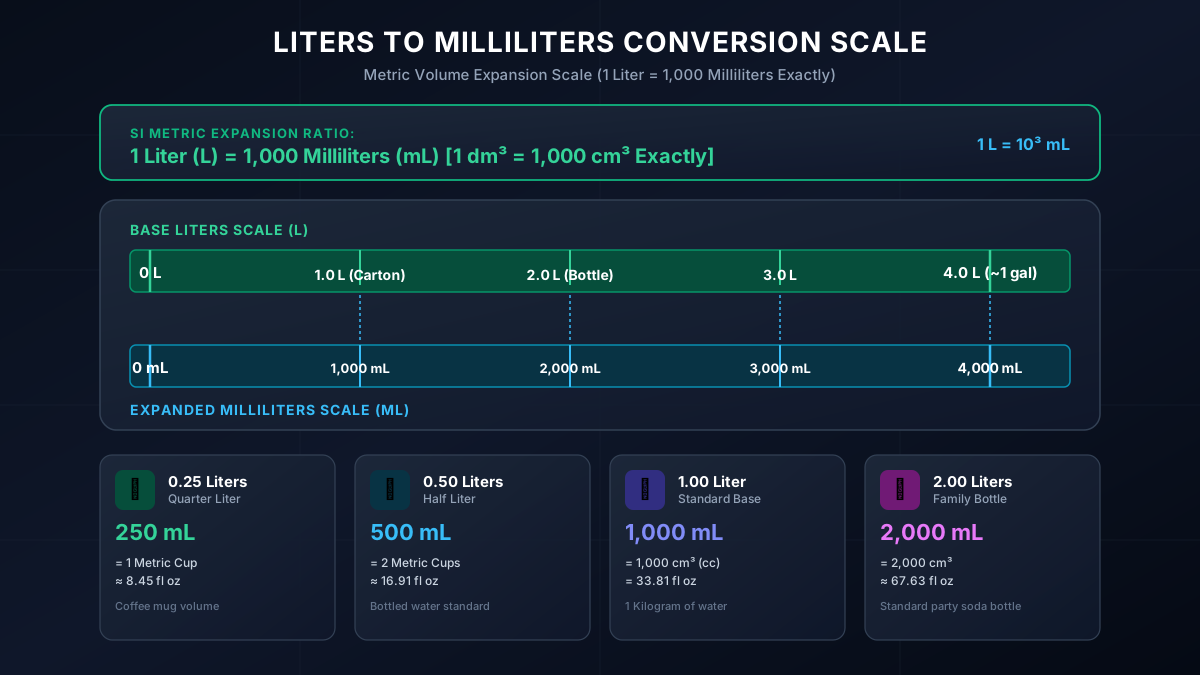
In culinary scaling, pharmaceutical dosage preparation, biochemical laboratory assay design, chemical compounding, and commercial liquid bottling, converting Liters (L) to Milliliters (mL) represents the standard base-to-milli unit expansion within the International System of Units (SI Metric).
Because the SI system utilizes decimal prefix multipliers, 1 Liter contains exactly 1,000 Milliliters (or ), making this calculation mathematically exact:
The Liters to Milliliters Converter provides instant, bidirectional conversions between liters, milliliters, US fluid ounces, cups, tablespoons, teaspoons, and gallons. This guide details practical liquid benchmarks (, , ), recipe scaling rules, and mental multiplication tricks.
2. Core Definitions & Analogy
To understand volumetric expansion from base liters into milliliters:
- Simple Definition: A liter is a standard household liquid volume (like a milk carton or water bottle), while a milliliter is one one-thousandth of that volume (such as a tiny splash or drops in a syringe). One full liter contains exactly 1,000 milliliters.
- Technical Definition:The Liter (, l):* Defined as .The Milliliter ():* Defined as .
- The Medicine Dropper Analogy: If you take a standard medicine dropper holding exactly , you would need to draw and dispense 1,000 full droppers to fill a single 1-liter bottle to the brim.
3. The Mathematical Formulas
Converting liters to milliliters requires multiplying by 1,000 or shifting the decimal point 3 positions to the right:
Exact Mathematical Formulas:
Quick Mental Arithmetic (Shift Decimal 3 Places Right):
- To calculate milliliters instantly in your head, simply move the decimal point 3 spaces to the right:Example (0.25 L): (Standard metric cup)*.Example (0.75 L): (Standard wine bottle)*.Example (1.75 L): (Handle of liquor / large bottle)*.Example (2.5 L): (Large soda / iced tea pitcher)*.
4. Comprehensive Liters to Milliliters Lookup Table
| Liters () | Milliliters () | Fluid Ounces () | US Customary Cups | Common Benchmark Context |
|---|---|---|---|---|
| 0.005 L | 5 mL | 0.169 fl oz | 0.021 cups | 1 Standard Teaspoon (tsp) medicine dose |
| 0.015 L | 15 mL | 0.507 fl oz | 0.063 cups | 1 Standard Tablespoon (tbsp) |
| 0.030 L | 30 mL | 1.014 fl oz | 0.127 cups | 1 Standard Bar shot glass |
| 0.100 L | 100 mL | 3.381 fl oz | 0.423 cups | Maximum carry-on travel bottle size |
| 0.200 L | 200 mL | 6.763 fl oz | 0.845 cups | Small juice pouch / box |
| 0.250 L | 250 mL | 8.454 fl oz | 1.057 cups | 1 Metric Cup / Standard Hot Beverage Mug |
| 0.330 L | 330 mL | 11.159 fl oz | 1.395 cups | Standard European soda / beer can |
| 0.500 L | 500 mL | 16.907 fl oz | 2.113 cups | Standard Half-Liter Water Bottle |
| 0.750 L | 750 mL | 25.361 fl oz | 3.170 cups | Standard 750 mL Wine Bottle |
| 1.000 L | 1,000 mL | 33.814 fl oz | 4.227 cups | 1 Standard Milk / Juice Carton |
| 1.500 L | 1,500 mL | 50.721 fl oz | 6.340 cups | Large mineral water bottle |
| 2.000 L | 2,000 mL | 67.628 fl oz | 8.454 cups | Standard 2-Liter Soda Bottle |
| 3.785 L | 3,785 mL | 128.000 fl oz | 16.000 cups | 1 Full US Liquid Gallon Jug |
| 5.000 L | 5,000 mL | 169.070 fl oz | 21.134 cups | European bulk cooking oil jug |
5. Step-by-Step Practical Calculation Examples
Example 1: Preparing a Laboratory Chemical Reagent
- Problem: A laboratory protocol requires preparing 0.35 liters of a 1M saline solution. The calibrated graduated cylinder measures volume in milliliters.
- Formula:
- Calculation:
- Result: The technician measures exactly 350 mL in the graduated cylinder.
Example 2: Mixing Automotive Coolant Concentrate
- Problem: An automotive cooling system requires 2.8 liters of concentrated antifreeze. How many milliliters of antifreeze should be measured?
- Formula:
- Calculation:
- Result: The mechanic will pour 2,800 mL of coolant concentrate into the reservoir.
6. Frequently Asked Questions (FAQ)
How do I convert liters to milliliters on a syringe or beaker?
Simply multiply liters by 1,000. For instance, (marking on a 5 mL clinical syringe).
Why are 1 liter and 1,000 mL equal to 1 kg of water?
The metric system was purposefully designed so that 1 liter () of pure water at maximum density () weighs exactly 1 Kilogram (1,000 grams). Therefore, of water weighs exactly .
How many milliliters are in a 2-liter soda bottle?
A standard 2-liter bottle contains exactly 2,000 mL (or 2,000 cubic centimeters).
Additional Technical Guidelines & Measurement Standards
When conducting calculations for Liters to Milliliters Converter, maintaining quantitative precision and verifying input parameter boundaries is essential for reliable scenario evaluation. Always verify that raw numerical inputs are measured using standardized instrumentation, and double-check unit conversions prior to applying outputs in commercial, industrial, or academic projects.
For quantitative unit conversions and scientific calculations, always maintain at least four decimal places of precision during intermediate arithmetic stages before rounding final results. When preparing technical reports, laboratory documentation, or financial forecasts, cross-verify all output variables against established international measurement standards (such as SI, NIST, and ISO metric benchmarks) to guarantee consistent analytical rigor across all computational workflows.
MathsLover.com delivers this interactive solver 100% free of charge to foster global mathematical literacy, educational accessibility, and data-driven problem solving across scientific, technical, and academic communities worldwide.