💡 Direct Answer & Executive Summary (Milligrams to Kilograms Converter)
Definition: Convert Milligrams (mg) to Kilograms (kg) instantly using custom inputs or dynamic unit selectors.
Governing Math Formula: 1 Milligrams (mg) = 0.000001 Kilograms (kg). Formula: Value in Milligrams (mg) × 0.000001 = Value in Kilograms (kg).
Target Applications: Provides real-time quantitative solutions in Unit Converters for students, engineers, researchers, and finance professionals.
Milligrams to Kilograms Converter - Precision Mass Guide
1. Introduction
In pharmacology, clinical toxicology, analytical chemistry, biochemical formulations, environmental water testing, and nanotechnology, converting Metric Milligrams (mg) to Metric Kilograms (kg) is the foundational SI decimal mass reduction calculation spanning six powers of ten ().
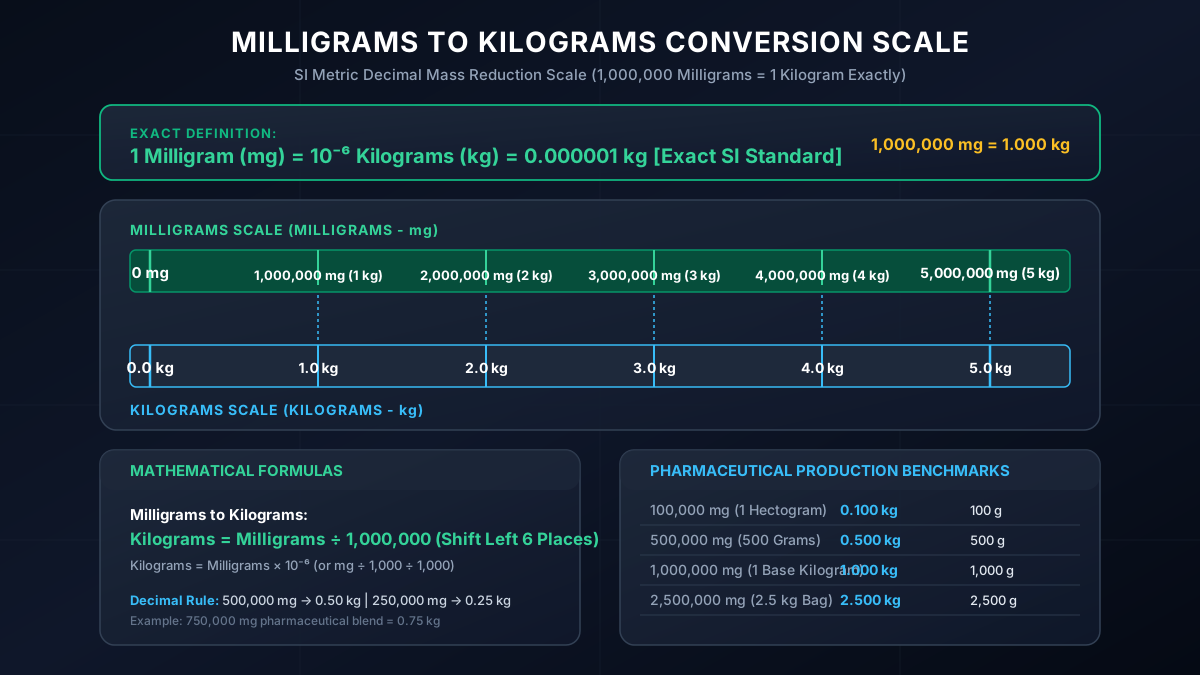
Under the SI decimal prefix framework defined by the International Bureau of Weights and Measures (BIPM), the prefix milli- represents ($1/1,000$), while the base unit Kilogram equals grams (). Therefore, 1 milligram equals exactly 0.000001 Kilograms (), and 1 kilogram contains exactly 1,000,000 Milligrams:
The Milligrams to Kilograms Converter delivers instantaneous, bidirectional calculations across milligrams, kilograms, grams, micrograms (mcg), pounds (lbs), and ounces. This comprehensive guide covers pharmaceutical dosing (, ), active ingredient scaling, toxicology threshold calculations, and the "Shift Left 6 Places" decimal rule.
2. Core Definitions & Analogy
To understand mass reduction from milligrams into kilograms, let us review their core definitions:
- Simple Definition: A milligram is a tiny metric unit (about the weight of a grain of sand), while a kilogram is the base unit of mass (about the weight of a 1-liter bottle of water). To convert milligrams to kilograms, you divide by 1,000,000 (shift the decimal point 6 places to the left).
- Technical Definition: The Milligram ():* Defined as .The Kilogram ():* The SI base unit of mass, defined by fixing the Planck constant ().
- The Grain of Sand Analogy: Think of individual grains of fine table salt or sand, each weighing approximately 1 milligram (1 mg). You would need exactly 1,000,000 individual grains of salt to balance the weight of a 1-liter bottle of water (1.0 kg).
3. The Mathematical Formulas
Converting milligrams to kilograms involves dividing by 1,000,000:
Exact Mathematical Formulas:
The "Shift Left 6 Places" Decimal Rule:
- Because 1,000,000 is , simply move the decimal point 6 positions to the left (or divide by 1,000 twice):Example (50,000 mg): (50 grams!)*.Example (250,000 mg): (Quarter-kilo!)*.Example (500,000 mg): (Half-kilo!)*.Example (1,000,000 mg): (Exact 1 kilogram!)*.
4. Comprehensive Milligrams to Kilograms Lookup Table
| Milligrams () | Kilograms () | Grams () | Pounds () | Clinical & Lab Context |
|---|---|---|---|---|
| 1,000 mg | 0.001000 kg | 1.000 g | 0.0022 lbs | 1 Gram Vitamin C tablet |
| 5,000 mg | 0.005000 kg | 5.000 g | 0.0110 lbs | 5g Creatine workout scoop |
| 10,000 mg | 0.010000 kg | 10.000 g | 0.0220 lbs | Sachet of oral electrolyte rehydration |
| 50,000 mg | 0.050000 kg | 50.000 g | 0.1102 lbs | Laboratory reagent analytical sample |
| 100,000 mg | 0.100000 kg | 100.000 g | 0.2205 lbs | 1 Hectogram bulk chemical container |
| 250,000 mg | 0.250000 kg | 250.000 g | 0.5512 lbs | Quarter-kilogram stock jar |
| 500,000 mg | 0.500000 kg | 500.000 g | 1.1023 lbs | European half-kilo pack |
| 1,000,000 mg | 1.000000 kg | 1,000.000 g | 2.2046 lbs | 1 SI Base Kilogram / 1 L Water |
| 2,500,000 mg | 2.500000 kg | 2,500.000 g | 5.5116 lbs | Standard consumer flour bag |
| 5,000,000 mg | 5.000000 kg | 5,000.000 g | 11.0231 lbs | 5-kg Production pail |
| 10,000,000 mg | 10.000000 kg | 10,000.000 g | 22.0462 lbs | Industrial master batch barrel |
5. Step-by-Step Practical Calculation Examples
Example 1: Pharmaceutical Formulation Scaling
- Scenario: A drug formulation lab compounds 750,000 mg of an active pharmaceutical ingredient (API). The master batch production management system requires mass entries in kilograms. What is the recorded mass?
- Calculation:
Example 2: Environmental Water Contaminant Total
- Scenario: A municipal water utility tests a reservoir containing an estimated 4,800,000 mg of dissolved mineral solids. How many kilograms of minerals does this represent?
- Calculation:
6. Major Real-World Applications
flowchart LR
    MG2KG["Milligrams to Kilograms Conversion"] --> PHARMA["Pharma Compounding: Scaling unit mg doses to bulk manufacturing kg"]
    MG2KG --> LAB["Analytical Chemistry: Weighing microbalance mg samples for kg solutions"]
    MG2KG --> TOXIC["Toxicology: Calculating total industrial toxicant exposures in kg from mg/kg samples"]
MG2KG --> NUTRITION["Dietary Manufacturing: Aggregating million-mg vitamin premixes to final kg barrels"]- Pharmaceutical Manufacturing: Production lines convert billions of individual tablet doses () into commercial bulk raw material orders in kilograms.
- Clinical Toxicology & Environmental Science: Toxicologists measure water contaminants in milligrams per liter and integrate total lake reservoirs into metric kilograms.
- Dietary Supplement Compounding: Micronutrient formulas calculated in milligrams are aggregated into multi-kilogram production batches.
7. Frequently Asked Questions (FAQ)
- How many kilograms is 1,000,000 mg?(exactly 1,000 grams).
- How many milligrams are in 1 kilogram?There are exactly 1,000,000 milligrams in 1 kilogram.
- What is the formula to convert mg to kg?Divide milligrams by 1,000,000 ().
8. Expert Summary & Best Practices
- Divide by 1,000,000: Always divide milligrams by (or multiply by ).
- Shift Decimal 6 Places Left: Move the decimal point 6 positions left ().
- Zero Rounding Error: Because milli- and kilo- are exact SI powers of ten, calculations between milligrams and kilograms are completely exact.
Additional Technical Guidelines & Measurement Standards
When conducting calculations for Milligrams to Kilograms Converter, maintaining quantitative precision and verifying input parameter boundaries is essential for reliable scenario evaluation. Always verify that raw numerical inputs are measured using standardized instrumentation, and double-check unit conversions prior to applying outputs in commercial, industrial, or academic projects.
For quantitative unit conversions and scientific calculations, always maintain at least four decimal places of precision during intermediate arithmetic stages before rounding final results. When preparing technical reports, laboratory documentation, or financial forecasts, cross-verify all output variables against established international measurement standards (such as SI, NIST, and ISO metric benchmarks) to guarantee consistent analytical rigor across all computational workflows.
MathsLover.com delivers this interactive solver 100% free of charge to foster global mathematical literacy, educational accessibility, and data-driven problem solving across scientific, technical, and academic communities worldwide.