💡 Direct Answer & Executive Summary (Miles to Kilometers Converter)
Definition: Convert Miles (mi) to Kilometers (km) instantly using custom inputs or dynamic unit selectors.
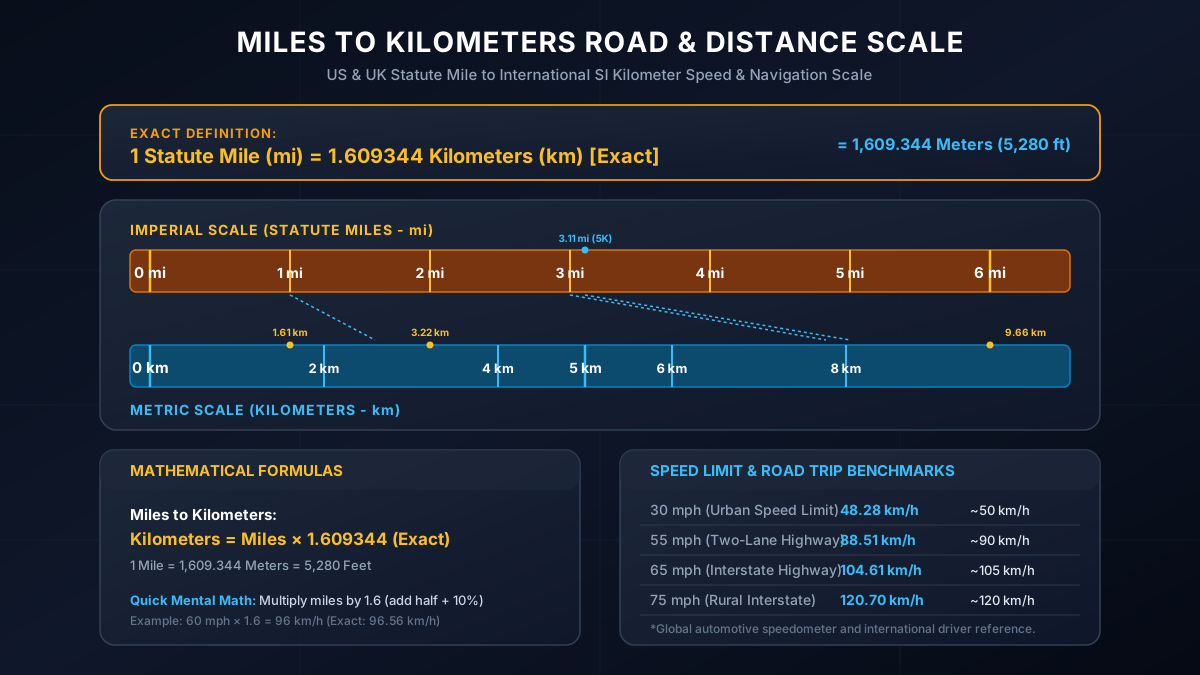
Governing Math Formula: 1 Miles (mi) = 1.609344 Kilometers (km). Formula: Value in Miles (mi) × 1.609344 = Value in Kilometers (km).
Target Applications: Provides real-time quantitative solutions in Unit Converters for students, engineers, researchers, and finance professionals.
Miles to Kilometers Converter - The Complete Highway & Navigation Guide
1. Introduction
From driving along the interstate highway system in the United States to planning international cross-country road trips in Canada, Europe, Australia, or Latin America, converting Statute Miles (mi) to Kilometers (km) is a fundamental calculation in automotive engineering, civil transportation, logistics, and endurance sports.
The Statute Mile is the official legal unit of highway speed, road distance, and vehicle odometry in the United States and the United Kingdom. However, as soon as a traveler crosses into Canada, Mexico, or continental Europe, all speed limit signs, highway markers, and GPS distances immediately switch to Kilometers (km) and Kilometers per Hour (km/h).
Converting miles to kilometers requires applying an exact, legally codified international conversion constant:
The Miles to Kilometers Converter provides instant, bidirectionally synchronized speed and distance calculations with decimal precision down to the tenth decimal place. This comprehensive guide covers the legal history of the statute mile, speed limit conversions, running race benchmarks (1 mile, 5 miles, 10 miles, 26.2 miles), automotive speedometer reading, and fast mental math methods.
2. Core Definitions & Analogy
To understand distance conversions between imperial statute miles and metric kilometers, let us review the fundamental definitions:
- Simple Definition: A statute mile is an imperial unit of distance equal to 5,280 feet (about 1.6 kilometers), while a kilometer is a metric unit of distance equal to 1,000 meters (about 0.62 miles). One mile is approximately 1.61 kilometers (roughly one and six-tenths of a kilometer).
- Technical Definition: The International Statute Mile ():* Codified under the 1959 International Yard and Pound Agreement as exactly (or ).The Kilometer ():* A decimal multiple of the SI base unit meter (), defined by the universal speed of light in a vacuum.
- The Running Track Analogy: Imagine running on a standard 400-meter outdoor athletic track. Running 4 full laps covers 1,600 meters, which is just 9.34 meters shy of 1 full mile (1,609.34 m). In contrast, running 1 kilometer requires only 2.5 laps (1,000 m). Therefore, 1 mile is equivalent to roughly 1.6 kilometer distances.
3. History of the Statute Mile and Metric Adoption
The transition from Roman military marching distances to international metric standards spans over two millennia:
flowchart TD
    A["Roman Empire: Mille Passus = 1,000 paces (5,000 Roman feet)"] --> B["1593: English Parliament under Queen Elizabeth I standardizes 1 Mile = 5,280 Feet (8 furlongs)"]
    B --> C["1893: US Mendenhall Order defines Customary Mile in terms of the SI Meter"]
    C --> D["1959: International Agreement establishes 1 Mile = 1.609344 km Exactly"]
    D --> E["1970s: Global metric conversion of highway systems across Canada, Australia & UK transition"]
In 1593, Queen Elizabeth I of England signed a statute redefining the English mile from 5,000 Roman feet to 5,280 feet (8 furlongs of 660 feet) so that it would match agricultural land surveying chains. In 1959, the United States, United Kingdom, Canada, Australia, and New Zealand formally fixed the international mile at 1,609.344 meters exactly, unifying scientific, civil, and automotive standards globally.
4. The Mathematical Formulas
Converting statute miles to kilometers involves an exact multiplication or division:
Exact Mathematical Formula:
Quick Mental Arithmetic Approximation:
- Multiply by 1.6 (Fast 99.4% Estimate):To multiply by 1.6 in your head, take the number of miles, add half of the value, and then add 10% of the original value:
km ≈ Miles + (Miles / 2) + (Miles / 10)Example (60 mph): 60 + 30 + 6 = 96 km/h (Exact: 96.56 km/h)*.Example (40 miles): 40 + 20 + 4 = 64 km (Exact: 64.37 km)*.Example (70 mph): 70 + 35 + 7 = 112 km/h (Exact: 112.65 km/h)*.
5. Comprehensive Miles to Kilometers Lookup Table
The reference table below outlines common automotive speeds, road trip distances, and athletic running benchmarks:
| Miles () | Kilometers () | Meters () | Yards () | Common Real-World Example |
|---|---|---|---|---|
| 0.5 mi | 0.8047 km | 804.7 m | 880 yd | Half-mile run (800m track event) |
| 1.0 mi | 1.6093 km | 1,609.3 m | 1,760 yd | The Classic 1-Mile Footrace / 5,280 ft |
| 2.0 mi | 3.2187 km | 3,218.7 m | 3,520 yd | Military physical fitness 2-mile run |
| 3.1069 mi | 5.0000 km | 5,000.0 m | 5,468.1 yd | Official 5K Road Race / Parkrun |
| 5.0 mi | 8.0467 km | 8,046.7 m | 8,800 yd | 5-mile recreational training run |
| 6.2137 mi | 10.0000 km | 10,000.0 m | 10,936.1 yd | Official 10K Road Race |
| 10.0 mi | 16.0934 km | 16,093.4 m | 17,600 yd | 10-Mile road race (Broad Street Run) |
| 13.1094 mi | 21.0975 km | 21,097.5 m | 23,072.5 yd | Official Half Marathon |
| 20.0 mi | 32.1869 km | 32,186.9 m | 35,200 yd | Long training run before marathon |
| 26.2188 mi | 42.1950 km | 42,195.0 m | 46,145.0 yd | Official Full Marathon |
| 30.0 mi | 48.2803 km | 48,280.3 m | 52,800 yd | 30 mph city speed limit (~50 km/h) |
| 50.0 mi | 80.4672 km | 80,467.2 m | 88,000 yd | ~50-mile road trip / 50K ultra |
| 55.0 mi | 88.5139 km | 88,513.9 m | 96,800 yd | 55 mph highway speed limit (~90 km/h) |
| 65.0 mi | 104.6074 km | 104,607.4 m | 114,400 yd | 65 mph interstate speed limit (~105 km/h) |
| 75.0 mi | 120.7008 km | 120,700.8 m | 132,000 yd | 75 mph highway limit (~120 km/h) |
| 100.0 mi | 160.9344 km | 160,934.4 m | 176,000 yd | 100-Mile Century cycling ride / Ultra |
6. Step-by-Step Practical Calculation Examples
Example 1: Highway Speed Limit Conversion
- Scenario: An American driver crosses the border from New York into Ontario, Canada. The car's analog speedometer displays 65 mph. The posted Canadian highway sign reads 100 km/h. Is the driver exceeding the speed limit?
- Calculation:
- Insight: Driving 65 mph equals roughly 105 km/h, which slightly exceeds the 100 km/h limit. The driver should decelerate to 62 mph () to match the posted limit.
Example 2: Electric Vehicle Range Calculation
- Scenario: A US-spec electric vehicle has an EPA-estimated range of 300 miles. What is the equivalent range in kilometers for European international marketing?
- Calculation:
7. Major Automotive & Logistics Applications
flowchart LR
    MIK["Miles to Kilometers Conversion"] --> AUTO["Automotive: Dual-dial speedometers (MPH & km/h) & Odometer telemetry"]
    MIK --> LOG["Freight & Logistics: Cross-border US-Mexico-Canada (USMCA) shipping routes"]
    MIK --> RACE["Endurance Sports: Converting marathon mile pacing (e.g. 6:00/mi) to km pacing (3:44/km)"]
MIK --> AERO["Aviation & Space: Converting nautical miles and statute miles to SI metrics"]- Dual-Dial Speedometers: Modern motor vehicles manufactured for the US and UK markets feature dual speedometer displays—a primary outer dial calibrated in Miles per Hour (mph) and a secondary inner dial calibrated in Kilometers per Hour (km/h).
- Cross-Border Freight Logistics: Under the United States-Mexico-Canada Agreement (USMCA), commercial transport fleet dispatchers convert dispatch route mileages into kilometers when scheduling Canadian and Mexican transit corridors.
- Endurance Running Splits: Elite marathon runners utilize the $1.609344$ factor to convert target mile splits (e.g., sub-5:00 minute miles) into international 1-kilometer track and road splits ().
8. Frequently Asked Questions (FAQ)
- How do you convert miles per hour (mph) to kilometers per hour (km/h)?Multiply the speed in mph by 1.609344. For example, (or roughly 90 km/h).
- How many kilometers are in 1 mile?There are exactly (or ) in 1 statute mile.
- What is the difference between 1 mile and 1 kilometer?1 mile is approximately 60.9% longer than 1 kilometer (). A kilometer is , while a mile is .
9. Expert Summary & Best Practices
- Use 1.609344 for Legal & Engineering Precision: Always apply the full international constant in logistics, fuel economy, and engineering calculations.
- Use the
Miles + Half + 10%Shortcut in the Car: When driving abroad, calculate speeds instantly by taking the speed, adding half, and adding 10% ().
- Check Road Sign Units: Remember that in the US and UK, highway signs denote miles, while in Canada, Australia, and continental Europe, all numbers denote kilometers.
Additional Technical Guidelines & Measurement Standards
When conducting calculations for Miles to Kilometers Converter, maintaining quantitative precision and verifying input parameter boundaries is essential for reliable scenario evaluation. Always verify that raw numerical inputs are measured using standardized instrumentation, and double-check unit conversions prior to applying outputs in commercial, industrial, or academic projects.
For quantitative unit conversions and scientific calculations, always maintain at least four decimal places of precision during intermediate arithmetic stages before rounding final results. When preparing technical reports, laboratory documentation, or financial forecasts, cross-verify all output variables against established international measurement standards (such as SI, NIST, and ISO metric benchmarks) to guarantee consistent analytical rigor across all computational workflows.
MathsLover.com delivers this interactive solver 100% free of charge to foster global mathematical literacy, educational accessibility, and data-driven problem solving across scientific, technical, and academic communities worldwide.