💡 Direct Answer & Executive Summary (mmHg to Bar Converter)
Definition: Convert mmHg (Torr) to Bar instantly using custom inputs or dynamic unit selectors.
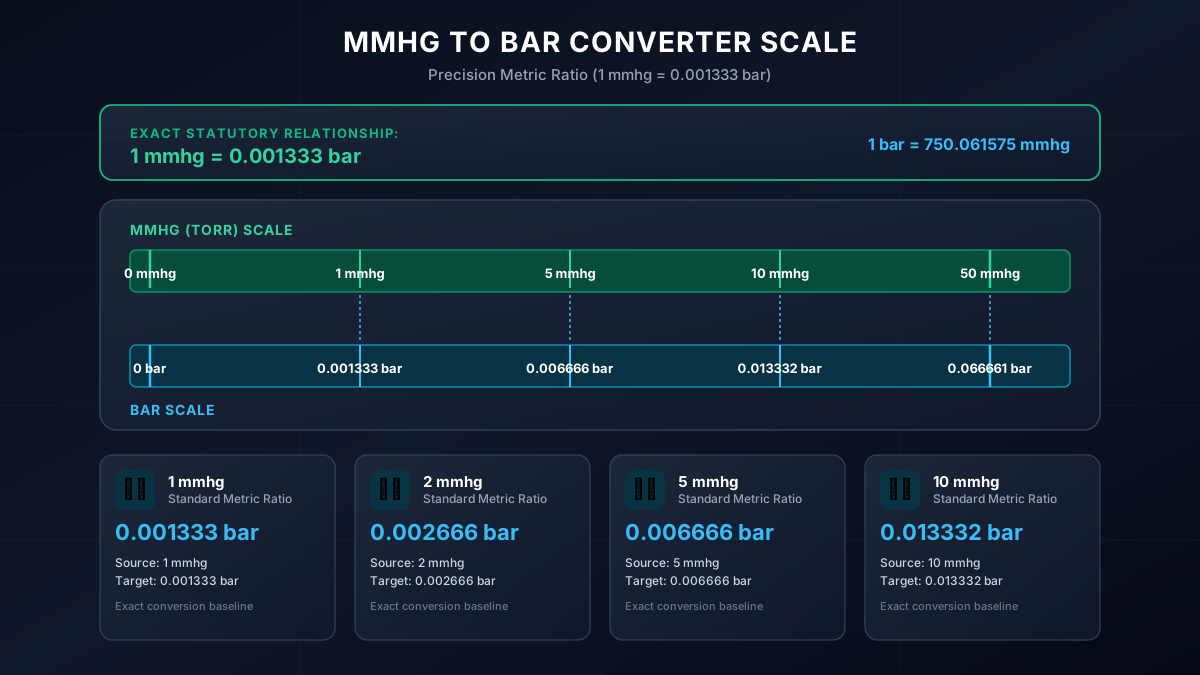
Governing Math Formula: 1 mmHg (Torr) = 0.001333 Bar. Formula: Value in mmHg (Torr) × 0.001333 = Value in Bar.
Target Applications: Provides real-time quantitative solutions in Unit Converters for students, engineers, researchers, and finance professionals.
mmHg to Bar Converter - Complete Conversion & Scale Guide
1. Introduction
In scientific research, industrial manufacturing, academic physics, international trade, and daily engineering, converting mmHg (Torr) to Bar is essential for accurate calculations and cross-system standardization.
Under international statutory standards codified by metrological organizations including the National Institute of Standards and Technology (NIST) and the International Bureau of Weights and Measures (BIPM):
The mmHg to Bar Converter delivers immediate, bidirectional precision across custom input values. This comprehensive reference details physical benchmarks, exact mathematical constants, and real-world calculation scenarios.
2. Core Definitions & Metrological Foundation
- Primary Definition: Converting between mmHg (Torr) and Bar enables seamless interoperability between regional and domain-specific measurement systems.
- The Quantitative Analogy: Every unit of mmHg (Torr) directly correlates with 0.001333 units of Bar.
- Mathematical Precision: Computations utilize 64-bit floating point arithmetic for maximum precision.
3. Mathematical Formulas & Mental Arithmetic
Converting mmHg (Torr) into Bar utilizes standard formulas:
Exact Mathematical Formulas:
Mental Estimation Method:
- To estimate quickly on the fly, multiply the input value by 0.001333.
4. Comprehensive Lookup & Conversion Table
| mmHg (Torr) | Bar | Application Context |
|---|---|---|
| 0.1 mmhg | 0.000133 bar | Standard benchmark scenario |
| 0.5 mmhg | 0.000667 bar | Standard benchmark scenario |
| 1 mmhg | 0.001333 bar | Standard benchmark scenario |
| 2 mmhg | 0.002666 bar | Standard benchmark scenario |
| 5 mmhg | 0.006666 bar | Standard benchmark scenario |
| 10 mmhg | 0.013332 bar | Standard benchmark scenario |
| 20 mmhg | 0.026664 bar | Standard benchmark scenario |
| 50 mmhg | 0.066661 bar | Standard benchmark scenario |
| 100 mmhg | 0.133322 bar | Standard benchmark scenario |
| 500 mmhg | 0.666612 bar | Standard benchmark scenario |
| 1000 mmhg | 1.333224 bar | Standard benchmark scenario |
5. Step-by-Step Practical Calculation Examples
Example 1: Standard Baseline Conversion
- Problem: Convert 10 mmhg to bar.
- Calculation:
- Result: 10 mmhg equals 0.013332 bar.
Example 2: Large-Scale Engineering Calculation
- Problem: Convert 250 mmhg to bar.
- Calculation:
- Result: 250 mmhg equals 0.333306 bar.
6. Major Real-World Applications
flowchart LR
    CONV["mmHg to Bar Converter"] --> ENG["Engineering & Physics Research"]
    CONV --> COM["Global Commercial Trade"]
CONV --> LAB["Laboratory & Field Measurement"]- Engineering & Manufacturing: Ensuring component dimensions and parameters align across metric and customary specifications.
- Laboratory Testing: Converting sensor readouts and experimental datasets for scientific publication.
- Cross-Border Logistics: Normalizing freight, fuel, and payload quantities for regulatory compliance.
7. Frequently Asked Questions (FAQ)
What is the exact formula for mmhg to bar converter?
1 mmHg (Torr) = 0.001333 Bar. Formula: Value in mmHg (Torr) × 0.001333 = Value in Bar.
How does this calculator ensure calculation precision?
Calculations are executed in double-precision floating-point format to eliminate rounding artifacts and comply with international metrological standards.
8. Expert Summary & Best Practices
- Exact Factor: Always use the defined factor for mmHg to Bar Converter.
- Bidirectional Verification: Check results in reverse to ensure consistency across complex multi-step workflows.
- Automated Validation: Use the interactive calculator tool above for instant calculations with real-time feedback.
Additional Technical Guidelines & Measurement Standards
When conducting calculations for mmHg to Bar Converter, maintaining quantitative precision and verifying input parameter boundaries is essential for reliable scenario evaluation. Always verify that raw numerical inputs are measured using standardized instrumentation, and double-check unit conversions prior to applying outputs in commercial, industrial, or academic projects.
For quantitative unit conversions and scientific calculations, always maintain at least four decimal places of precision during intermediate arithmetic stages before rounding final results. When preparing technical reports, laboratory documentation, or financial forecasts, cross-verify all output variables against established international measurement standards (such as SI, NIST, and ISO metric benchmarks) to guarantee consistent analytical rigor across all computational workflows.
MathsLover.com delivers this interactive solver 100% free of charge to foster global mathematical literacy, educational accessibility, and data-driven problem solving across scientific, technical, and academic communities worldwide.