💡 Direct Answer & Executive Summary (Nautical Miles to Kilometers Converter)
Definition: Convert Nautical Miles (nmi) to Kilometers (km) instantly using custom inputs or dynamic unit selectors.
Governing Math Formula: 1 Nautical Miles (nmi) = 1.852000 Kilometers (km). Formula: Value in Nautical Miles (nmi) × 1.852000 = Value in Kilometers (km).
Target Applications: Provides real-time quantitative solutions in Unit Converters for students, engineers, researchers, and finance professionals.
Nautical Miles to Kilometers Converter - Maritime & Aviation Navigation Guide
1. Introduction
In commercial maritime shipping, global aviation flight planning, naval warfare, search-and-rescue operations, and oceanic meteorology, converting Nautical Miles (NM / nmi) to Kilometers (km) is a critical geospatial calculation performed daily by ship captains, pilots, and ocean navigators.
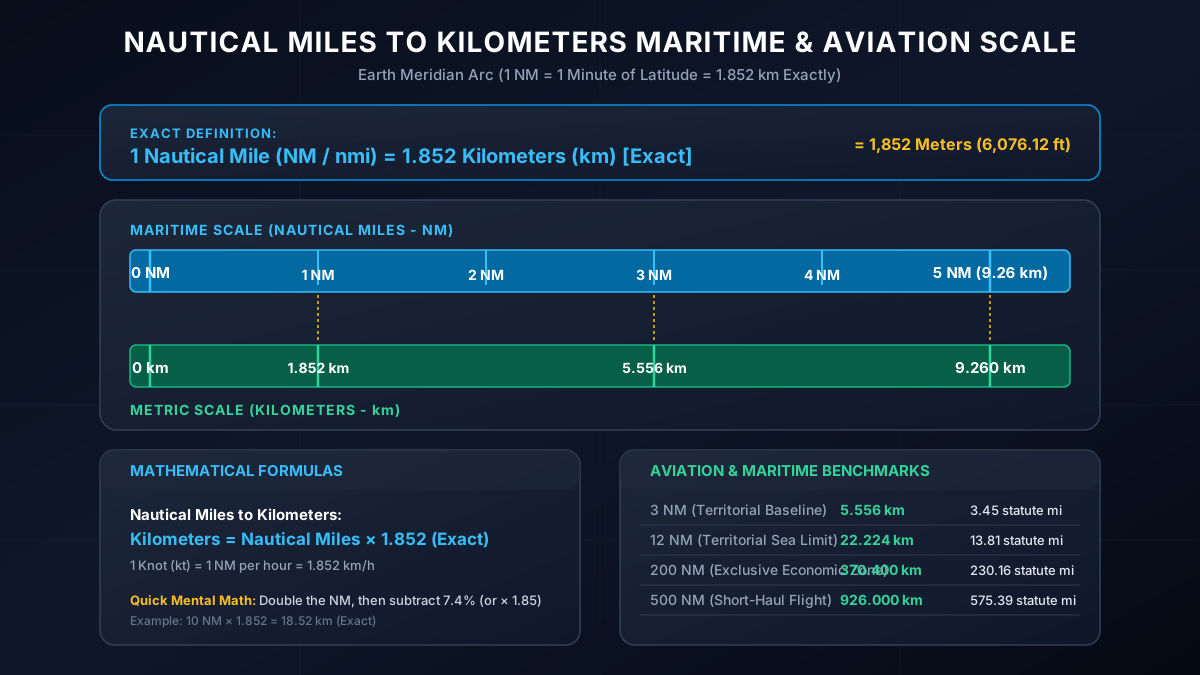
Unlike land-based statute miles (which originated from agrarian surveyor chains), the Nautical Mile is based directly on the spherical geometry of the Earth. One nautical mile corresponds to one minute ($1'$) of latitude along any meridian of the Earth.
Under international treaty established by the First International Extraordinary Hydrographic Conference in Monaco (1929) and officially ratified by the United States and the United Kingdom in 1954/1970:
The Nautical Miles to Kilometers Converter delivers instant, bidirectional calculations across nautical miles, knots (NM/hour), statute miles, kilometers, and meters. This comprehensive guide details the mathematical derivation of the meridian minute, knot speed conversion, international maritime boundaries (UNCLOS territorial waters, EEZ), and aviation airway waypoints.
2. Core Definitions & Analogy
To develop an intuitive physical grasp of maritime and aviation navigational units, let us review their core definitions:
- Simple Definition: A nautical mile is a distance unit used at sea and in the air based on the Earth's curvature (about 1.15 regular land miles). One nautical mile equals exactly 1.852 kilometers (or 1,852 meters).
- Technical Definition: The International Nautical Mile ( or ):* Exactly , corresponding to of a degree () of geographic latitude along a meridian.The Knot ( or ):* A unit of speed equal to one nautical mile per hour ().
- The Globe and Minute Hand Analogy: Imagine Earth as a sphere sliced like an orange into 360 degrees of latitude from pole to pole. Each degree is divided into 60 minutes of arc. Traveling north or south by exactly 1 minute of latitude means covering 1 nautical mile (1.852 km) on the ocean surface.
3. History and Derivation of the Nautical Mile
The nautical mile connects navigational charts directly to astronomy:
flowchart TD
    A["1637: Mathematician Richard Norwood measures 1 minute of meridian arc at 6,120 feet"] --> B["1929: Monaco International Hydrographic Bureau establishes 1 NM = 1,852 m Exactly"]
    B --> C["1954: US Department of Defense & NIST adopt 1,852 m International Nautical Mile"]
    C --> D["1970: UK Admiralty and Royal Navy formally adopt 1,852 m Standard"]
    D --> E["Present Day: Universal ICAO & IMO standard for all flight management systems (FMS) & radar"]
Because mariners measure their position using sextants and GPS coordinates in degrees and minutes (), using nautical miles allows a navigator to measure distances on a nautical paper chart directly using a set of dividers placed against the latitude scale on the map margin ().
4. The Mathematical Formulas
Converting nautical miles to kilometers is exact and linear:
Exact Mathematical Formulas:
Quick Mental Arithmetic Shortcut:
- Double the NM, then subtract 7.4% (or multiply by 1.85):Example (10 NM): (Exact!)*.Example (100 NM): (Exact!)*.Example (20 Knots): (Cruising container ship speed)*.
5. Comprehensive Nautical Miles to Kilometers Lookup Table
| Nautical Miles () | Kilometers () | Meters () | Statute Miles () | Navigational & Geopolitical Context |
|---|---|---|---|---|
| 1 NM | 1.852 km | 1,852 m | 1.151 mi | 1 minute of latitude on marine chart |
| 3 NM | 5.556 km | 5,556 m | 3.452 mi | Historic cannon-shot coastal boundary |
| 5 NM | 9.260 km | 9,260 m | 5.754 mi | Standard harbor vessel traffic separation zone |
| 10 NM | 18.520 km | 18,520 m | 11.508 mi | Airport terminal radar approach control (TRACON) |
| 12 NM | 22.224 km | 22,224 m | 13.809 mi | UNCLOS Official Territorial Sea Boundary |
| 24 NM | 44.448 km | 44,448 m | 27.619 mi | UNCLOS Contiguous Maritime Zone |
| 50 NM | 92.600 km | 92,600 m | 57.539 mi | Offshore coastal helicopter flight leg |
| 100 NM | 185.200 km | 185,200 m | 115.078 mi | Cross-channel marine ferry route |
| 200 NM | 370.400 km | 370,400 m | 230.156 mi | UNCLOS Exclusive Economic Zone (EEZ) |
| 500 NM | 926.000 km | 926,000 m | 575.390 mi | Short-haul commercial regional jet flight |
| 1,000 NM | 1,852.000 km | 1,852,000 m | 1,150.779 mi | Medium-range passenger flight corridor |
| 3,000 NM | 5,556.000 km | 5,556,000 m | 3,452.338 mi | Transatlantic crossing (New York to London) |
6. Step-by-Step Practical Calculation Examples
Example 1: Calculating Exclusive Economic Zone (EEZ) Extent
- Scenario: Under the United Nations Convention on the Law of the Sea (UNCLOS), a nation's Exclusive Economic Zone (EEZ) extends 200 nautical miles from its coastal baseline. What is this boundary distance in metric kilometers?
- Calculation:
Example 2: Transatlantic Airline Flight Range
- Scenario: A commercial Airbus A321XLR has a maximum passenger flight range of 4,700 nautical miles. What is this range in kilometers for an international airline brochure?
- Calculation:
7. Major Aviation & Maritime Applications
flowchart LR
    NMKM["Nautical Miles to Kilometers Conversion"] --> UNCLOS["International Law: UNCLOS 12 NM territorial sea & 200 NM EEZ boundaries"]
    NMKM --> ICAO["Aviation: ICAO flight routes, airspeed in knots & flight planning"]
    NMKM --> SAR["Search & Rescue: Coast Guard search grid patterns & drift velocity"]
NMKM --> MET["Meteorology: Tropical cyclone wind radii & hurricane storm tracks"]- Global Aviation Standards (ICAO): All international civilian and military aircraft navigate using nautical miles and knots for horizontal flight planning, airspeed indicators (KIAS/KTAS), and wind speed reports.
- Maritime Territorial Law (UNCLOS):* Territorial Waters: 12 NM () sovereign ocean zone.* Contiguous Zone: 24 NM () customs enforcement zone.* Exclusive Economic Zone (EEZ): 200 NM () exclusive fisheries and mineral rights.
- Hurricane Storm Track Radii: National Hurricane Center (NHC) advisories forecast hurricane-force and tropical-storm-force wind fields in nautical miles from the storm center ().
8. Frequently Asked Questions (FAQ)
- Why is a nautical mile longer than a statute mile?A Statute Mile is an arbitrary agrarian surveyor distance equal to (). A Nautical Mile is based on Earth's circumference (), making it roughly 15.08% longer.
- What is 1 knot in kilometers per hour?(or ).
- How do you convert nautical miles to kilometers in your head?Multiply by 2, then subtract 15% (or multiply by 1.85). For example, (exact: ).
9. Expert Summary & Best Practices
- Apply 1.852 as an Exact Legal Constant: In ECDIS marine chart plotters and flight management software (FMS), is an exact algebraic integer ratio.
- Remember Chart Scale Utility: On any standard Mercator navigational chart, 1 nautical mile equals 1 minute of latitude on the side border.
- Never Mix Knots and MPH: 100 knots is (). Confusing the two units leads to significant fuel exhaustion errors on long flights or ocean crossings.
Additional Technical Guidelines & Measurement Standards
When conducting calculations for Nautical Miles to Kilometers Converter, maintaining quantitative precision and verifying input parameter boundaries is essential for reliable scenario evaluation. Always verify that raw numerical inputs are measured using standardized instrumentation, and double-check unit conversions prior to applying outputs in commercial, industrial, or academic projects.
For quantitative unit conversions and scientific calculations, always maintain at least four decimal places of precision during intermediate arithmetic stages before rounding final results. When preparing technical reports, laboratory documentation, or financial forecasts, cross-verify all output variables against established international measurement standards (such as SI, NIST, and ISO metric benchmarks) to guarantee consistent analytical rigor across all computational workflows.
MathsLover.com delivers this interactive solver 100% free of charge to foster global mathematical literacy, educational accessibility, and data-driven problem solving across scientific, technical, and academic communities worldwide.