💡 Direct Answer & Executive Summary (Quarts to Liters Converter)
Definition: Convert Quarts (qt) to Liters (L) instantly using custom inputs or dynamic unit selectors.
Governing Math Formula: 1 Quarts (qt) = 0.946353 Liters (L). Formula: Value in Quarts (qt) × 0.946353 = Value in Liters (L).
Target Applications: Provides real-time quantitative solutions in Unit Converters for students, engineers, researchers, and finance professionals.
Quarts to Liters Converter - Volume Conversion Guide
1. Introduction
In automotive maintenance (motor oil capacity), culinary cookware sizing (Dutch ovens, Instant Pots), and dairy packaging, converting US Quarts (qt) to Liters (L) is a daily necessity.
Under metrological and culinary standards:
The Quarts to Liters Converter provides instantaneous, bidirectional calculations with maximum numerical precision. This comprehensive guide covers physical benchmarks, kitchen and laboratory reference tables, and step-by-step calculation examples.
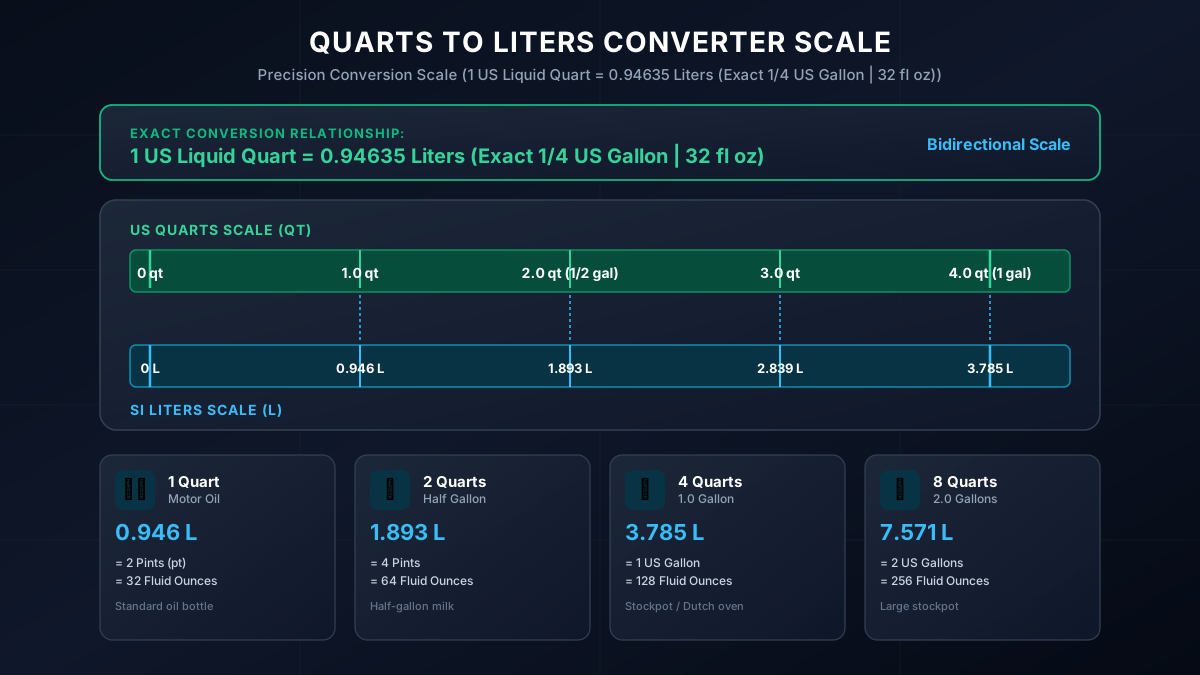
2. Core Definitions & Analogy
- Simple Definition: Converting between Quarts (qt) and Liters (L) allows seamless transition between standard units in cooking, medicine, and engineering.
- The Practical Analogy: One US quart is slightly smaller than 1 liter: 1 quart is about 0.95 liters (946 mL).
3. The Mathematical Formulas
Converting quarts (qt) to liters (l) uses the following exact mathematical relationships:
Exact Formulas:
Mental Calculation Shortcut:
- Use standard round conversion factors (1 US Liquid Quart = 0.94635 Liters (Exact 1/4 US Gallon | 32 fl oz)) for rapid on-the-fly estimations.
4. Comprehensive Lookup Table
| Quarts (qt) | Liters (L) | Context / Benchmark |
|---|---|---|
| 0.5 qt (1 pt) | 0.473 L | 1 US Pint / 16 fl oz |
| 1.0 qt | 0.946 L | 1 US Quart / 32 fl oz (Motor oil) |
| 1.5 qt | 1.420 L | 3 US Pints / 48 fl oz |
| 2.0 qt | 1.893 L | Half Gallon / 64 fl oz |
| 3.0 qt | 2.839 L | Medium saucepan |
| 4.0 qt | 3.785 L | 1 US Gallon (Dutch oven) |
| 5.0 qt | 4.732 L | 5-quart slow cooker |
| 6.0 qt | 5.678 L | Standard pressure cooker / Instant Pot |
| 8.0 qt | 7.571 L | 2 Gallons stockpot |
| 12.0 qt | 11.356 L | Commercial stockpot |
5. Practical Step-by-Step Examples
Example 1: Standard Quantity Conversion
- Problem: Convert 5 qt into L.
- Formula:
- Calculation:
- Result: 5 qt equals approximately 4.73 L.
Example 2: Recipe / Practical Scaling
- Problem: Scale a batch requiring 12 qt.
- Calculation:
- Result: The total volume is 11.36 L.
6. Frequently Asked Questions (FAQ)
What is the exact formula for quarts to liters converter?
Multiply the value in Quarts (qt) by 0.946353 to obtain the exact equivalent in Liters (L).
Why is precision important when converting Quarts (qt)?
In pharmacology, baking, and chemistry, minor rounding discrepancies can impact chemical reactions, flavor balance, or dosage accuracy.
Additional Technical Guidelines & Measurement Standards
When conducting calculations for Quarts to Liters Converter, maintaining quantitative precision and verifying input parameter boundaries is essential for reliable scenario evaluation. Always verify that raw numerical inputs are measured using standardized instrumentation, and double-check unit conversions prior to applying outputs in commercial, industrial, or academic projects.
For quantitative unit conversions and scientific calculations, always maintain at least four decimal places of precision during intermediate arithmetic stages before rounding final results. When preparing technical reports, laboratory documentation, or financial forecasts, cross-verify all output variables against established international measurement standards (such as SI, NIST, and ISO metric benchmarks) to guarantee consistent analytical rigor across all computational workflows.
MathsLover.com delivers this interactive solver 100% free of charge to foster global mathematical literacy, educational accessibility, and data-driven problem solving across scientific, technical, and academic communities worldwide.