💡 Direct Answer & Executive Summary (Metric Tons to Kilograms Converter)
Definition: Convert Metric Tons (t) to Kilograms (kg) instantly using custom inputs or dynamic unit selectors.
Governing Math Formula: 1 Metric Tons (t) = 1000.000000 Kilograms (kg). Formula: Value in Metric Tons (t) × 1000.000000 = Value in Kilograms (kg).
Target Applications: Provides real-time quantitative solutions in Unit Converters for students, engineers, researchers, and finance professionals.
Metric Tons to Kilograms Converter - Heavy Mass Guide
1. Introduction
In maritime shipping, civil engineering, mineral mining, heavy freight logistics, agricultural grain trading, and metallurgy, converting Metric Tons (t / Tonnes) to Metric Kilograms (kg) is the premier macro-to-base mass scaling calculation in the International System of Units (SI).
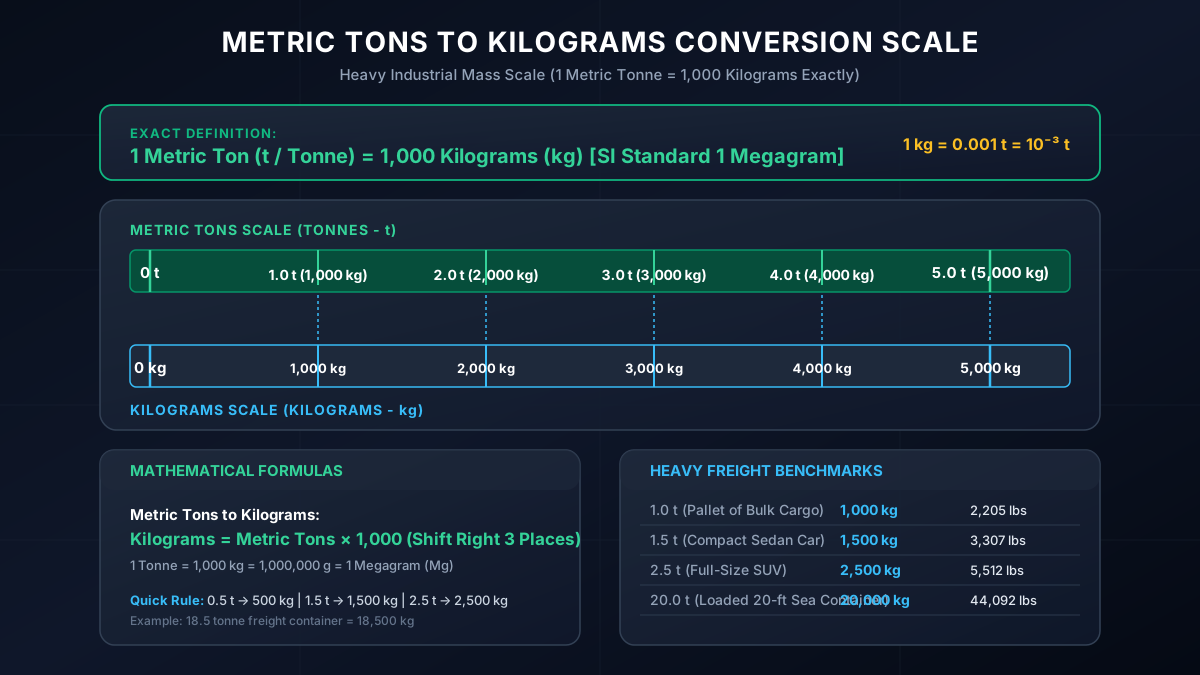
Under BIPM SI definitions, the Metric Ton (symbol: t, also called the tonne) is officially recognized for use alongside SI units and represents exactly 1,000 Kilograms ( or ). Therefore, 1 metric ton equals exactly 1,000 kilograms, and 1 kilogram equals exactly 0.001 metric tons:
The Metric Tons to Kilograms Converter delivers instantaneous, bidirectional precision calculations across metric tonnes, kilograms, US short tons (), British long tons (), and pounds. This comprehensive guide covers commercial cargo containers (), vehicle curb masses (), crane rigging capacities, and the "Shift Right 3 Places" decimal rule.
2. Core Definitions & Analogy
To understand mass expansion from metric tonnes into kilograms, let us review their core definitions:
- Simple Definition: A metric ton (tonne) is a massive unit of weight equal to exactly 1,000 kilograms (about the weight of a small car or 1 cubic meter of water). To convert tonnes to kilograms, you multiply by 1,000 (shift the decimal point 3 places to the right).
- Technical Definition: The Metric Ton (, tonne):* Exactly .The Kilogram ():* The SI base unit of mass.
- The 1-Cubic-Meter Water Tank Analogy: Imagine an industrial water cube container measuring exactly (). When filled with pure water, the total mass is exactly 1.0 metric ton (1,000 kilograms).
3. The Mathematical Formulas
Converting metric tons to kilograms involves multiplying by 1,000:
Exact Mathematical Formulas:
The "Shift Right 3 Places" Decimal Rule:
- Because 1,000 is , simply move the decimal point 3 positions to the right:Example (1.0 t): (Exact 1 tonne!)*.Example (1.5 t): (Compact sedan car!)*.Example (2.5 t): (Commercial SUV!)*.Example (20.0 t): (Loaded 20-ft sea container!)*.
4. Comprehensive Metric Tons to Kilograms Lookup Table
| Metric Tons () | Kilograms () | Pounds () | US Short Tons | Real-World Context |
|---|---|---|---|---|
| 0.10 t | 100 kg | 220.5 lbs | 0.110 tons | Standard industrial pallet of goods |
| 0.50 t | 500 kg | 1,102.3 lbs | 0.551 tons | Half-tonne bulk aggregate bag |
| 1.00 t | 1,000 kg | 2,204.6 lbs | 1.102 tons | 1 Cubic Meter of Pure Water |
| 1.50 t | 1,500 kg | 3,306.9 lbs | 1.653 tons | Compact passenger car curb weight |
| 2.00 t | 2,000 kg | 4,409.2 lbs | 2.205 tons | Mid-size commercial pickup truck |
| 2.50 t | 2,500 kg | 5,511.6 lbs | 2.756 tons | Full-size electric SUV |
| 5.00 t | 5,000 kg | 11,023.1 lbs | 5.512 tons | Medium construction flatbed truck |
| 10.00 t | 10,000 kg | 22,046.2 lbs | 11.023 tons | Heavy-duty city dump truck |
| 20.00 t | 20,000 kg | 44,092.5 lbs | 22.046 tons | Loaded 20-ft ISO shipping container |
| 36.29 t | 36,287 kg | 80,000.0 lbs | 40.000 tons | Max legal US interstate semi-truck gross |
| 50.00 t | 50,000 kg | 110,231.1 lbs | 55.116 tons | Heavy mining haul truck payload |
5. Step-by-Step Practical Calculation Examples
Example 1: Construction Crane Rigging Limit
- Scenario: A mobile construction crane has a safe working load (SWL) rating of 12.5 metric tons. The site manager needs the capacity expressed in kilograms for rigging slings.
- Calculation:
Example 2: Grain Elevator Silo Inventory
- Scenario: An agricultural export silo receives a shipment of 340 metric tons of wheat. How many kilograms are added to inventory records?
- Calculation:
6. Major Real-World Applications
flowchart LR
    T2KG["Metric Tons to Kilograms Conversion"] --> FREIGHT["Intermodal Freight: Converting ship manifest tonnes into truck axle kg"]
    T2KG --> CRANE["Construction Rigging: Verifying crane ton ratings against sling kg tags"]
    T2KG --> MINING["Mining Extraction: Scaling bulk ore haul tonnes into refinery kg assays"]
T2KG --> AGRI["Agricultural Trade: Measuring bulk harvest grain tonnes in farm weigh kg"]- Intermodal Freight & Port Logistics: Ocean container ships declare cargo manifests in metric tons, while road transport scales verify individual axle loads in kilograms.
- Structural Engineering & Crane Safety: Rigging engineers verify lifting sling capacities labeled in kilograms against total crane hoist tonnages.
- Bulk Agricultural Commodities: Grain elevator weigh-bridges calculate net harvest tonnage by subtracting gross and tare truck weights in kilograms.
7. Frequently Asked Questions (FAQ)
- How many kilograms are in 1 metric ton?There are exactly 1,000 kilograms in 1 metric ton (tonne).
- How many kilograms is 5 metric tons?.
- What is the difference between a metric ton and a US ton?A metric ton is 1,000 kg (), while a US short ton is 2,000 lbs (). A metric ton is about 10.23% heavier.
8. Expert Summary & Best Practices
- Multiply by 1,000: Always multiply metric tons by $1,000$.
- Shift Decimal 3 Places Right: Move the decimal point 3 positions to the right ().
- Exact Decimal Standard: Because the tonne is an exact SI power of ten (), conversions between tonnes and kilograms are completely exact.
Additional Technical Guidelines & Measurement Standards
When conducting calculations for Metric Tons to Kilograms Converter, maintaining quantitative precision and verifying input parameter boundaries is essential for reliable scenario evaluation. Always verify that raw numerical inputs are measured using standardized instrumentation, and double-check unit conversions prior to applying outputs in commercial, industrial, or academic projects.
For quantitative unit conversions and scientific calculations, always maintain at least four decimal places of precision during intermediate arithmetic stages before rounding final results. When preparing technical reports, laboratory documentation, or financial forecasts, cross-verify all output variables against established international measurement standards (such as SI, NIST, and ISO metric benchmarks) to guarantee consistent analytical rigor across all computational workflows.
MathsLover.com delivers this interactive solver 100% free of charge to foster global mathematical literacy, educational accessibility, and data-driven problem solving across scientific, technical, and academic communities worldwide.