💡 Direct Answer & Executive Summary (Metric Tons to Ounces Converter)
Definition: Convert Metric Tons (t) to Ounces (oz) instantly using custom inputs or dynamic unit selectors.
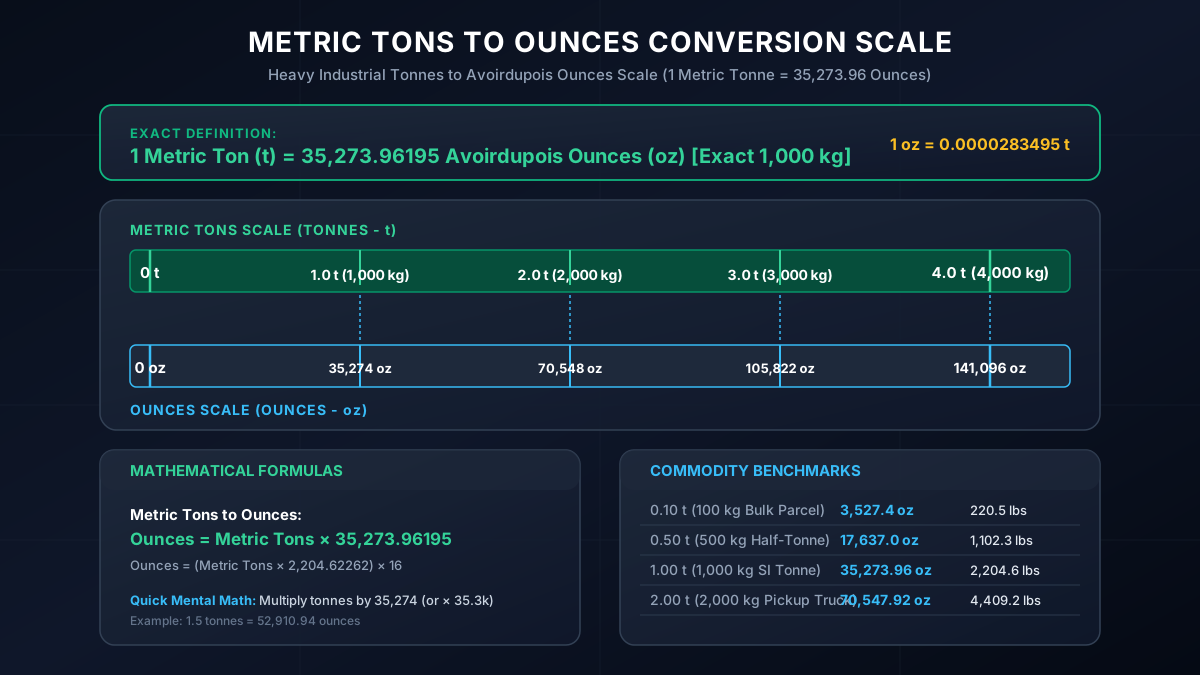
Governing Math Formula: 1 Metric Tons (t) = 35273.961900 Ounces (oz). Formula: Value in Metric Tons (t) × 35273.961900 = Value in Ounces (oz).
Target Applications: Provides real-time quantitative solutions in Unit Converters for students, engineers, researchers, and finance professionals.
Metric Tons to Ounces Converter - Precision Mass Guide
1. Introduction
In international maritime shipping, precious metal bulk bullion trading, agro-commodity futures, heavy industrial processing, and export tariff documentation, converting Metric Tons (t / Tonnes) to Avoirdupois Ounces (oz) bridges macro-scale cargo freight metrics with precision imperial weight units.
Under the 1959 International Yard and Pound Agreement, 1 Avoirdupois Pound contains exactly 16 ounces (). Because 1 Metric Ton is legally defined as exactly 1,000 Kilograms (1,000,000 g), 1 metric ton equals approximately 35,273.96195 Avoirdupois Ounces:
The Metric Tons to Ounces Converter provides instantaneous, bidirectional calculations across metric tonnes, avoirdupois ounces, pounds (lbs), kilograms (kg), and grams. This comprehensive guide covers bulk commodity benchmarks (, ), port logistics, and mental arithmetic methods.
2. Core Definitions & Analogy
To understand mass expansion from metric tonnes into ounces, let us review their core definitions:
- Simple Definition: A metric ton is a massive unit of weight equal to 1,000 kilograms (about the weight of a small car), while an ounce is a small unit (about the weight of a slice of bread). One metric ton contains approximately 35,274 ounces.
- Technical Definition: The Metric Ton (, tonne):* Exactly .The Avoirdupois Ounce ():* Exactly .
- The Bread Loaf Slice Analogy: If you imagine a standard 1-ounce slice of sandwich bread, stacking 35,274 individual bread slices into a single giant pile would equal the exact weight of 1.0 metric ton (1,000 kg).
3. The Mathematical Formulas
Converting metric tons to ounces involves exact decimal multiplication:
Exact Mathematical Formulas:
Quick Mental Arithmetic (Multiply by 35,000 or 35.3k):
- To estimate quickly in your head, multiply tonnes by 35,274 (or multiply by 2,200 to get lbs, then multiply by 16):Example (0.1 t): (100 kg bulk box!)*.Example (0.5 t): (Half-tonne pallet!)*.Example (1.0 t): (Exact 1 tonne!)*.Example (2.0 t): (Standard commercial pickup!)*.
4. Comprehensive Metric Tons to Ounces Lookup Table
| Metric Tons () | Ounces () | Pounds () | Kilograms () | Real-World Commodity Context |
|---|---|---|---|---|
| 0.01 t | 352.74 oz | 22.05 lbs | 10.0 kg | Small specialty spice shipment |
| 0.05 t | 1,763.70 oz | 110.23 lbs | 50.0 kg | Commercial sack of raw cocoa beans |
| 0.10 t | 3,527.40 oz | 220.46 lbs | 100.0 kg | 1 Hectokilogram bulk container |
| 0.25 t | 8,818.49 oz | 551.16 lbs | 250.0 kg | Industrial chemical processing drum |
| 0.50 t | 17,636.98 oz | 1,102.31 lbs | 500.0 kg | Half-tonne aggregate super-sack |
| 1.00 t | 35,273.96 oz | 2,204.62 lbs | 1,000.0 kg | 1 SI Base Tonne / 1 m³ Water |
| 1.50 t | 52,910.94 oz | 3,306.93 lbs | 1,500.0 kg | Compact sedan curb mass |
| 2.00 t | 70,547.92 oz | 4,409.25 lbs | 2,000.0 kg | Full-size commercial pickup truck |
| 5.00 t | 176,369.81 oz | 11,023.11 lbs | 5,000.0 kg | Medium flatbed construction truck |
| 10.00 t | 352,739.62 oz | 22,046.23 lbs | 10,000.0 kg | Heavy municipal dump truck |
| 20.00 t | 705,479.24 oz | 44,092.45 lbs | 20,000.0 kg | Loaded 20-ft ISO ocean container |
5. Step-by-Step Practical Calculation Examples
Example 1: Bulk Coffee Bean Import Batch
- Scenario: A green coffee importer unloads 2.5 metric tons of premium Arabica beans at the port of Seattle. For US retail packaging in 12-oz bags, how many total ounces are available?
- Calculation:
- Bag Yield:
Example 2: Industrial Precious Catalyst Extraction
- Scenario: A chemical refinery extracts 0.15 metric tons of spent catalyst material containing silver. How many ounces does this represent?
- Calculation:
6. Major Real-World Applications
flowchart LR
    T2OZ["Metric Tons to Ounces Conversion"] --> COFFEE["Commodities: Sizing multi-tonne coffee & tea imports into retail package ounces"]
    T2OZ --> METALS["Precious Metals: Translating bulk refinery ore tonnes into commercial ounces"]
    T2OZ --> AGRI["Crop Processing: Sizing grain silo tonnes into consumer grocery ounces"]
T2OZ --> LOGISTICS["Air Cargo: Calculating freight cargo manifests across imperial tariff oz"]- Agro-Commodity Packaging: Bulk import shipments of cocoa, tea, and vanilla beans measured in tonnes are converted into fractional consumer package ounces.
- Metallurgical Smelting & Refining: Precious metal yields from multi-ton industrial smelter batches are accounted for in commercial ounces.
- Chemical & Cosmetic Compounding: Bulk ingredients purchased by the metric tonne are batched in unit ounces for consumer bottled products.
7. Frequently Asked Questions (FAQ)
- How many ounces are in 1 metric ton?There are approximately 35,273.96195 avoirdupois ounces in 1 metric ton.
- How many ounces is 0.5 metric tons?.
- What is the formula to convert metric tons to ounces?Multiply metric tons by 35,273.96195 ().
8. Expert Summary & Best Practices
- Multiply by 35,273.96: Multiply metric tons by $35,273.96195$ for exact conversion.
- Two-Step Mental Math: Multiply tonnes by 2,204.62 to get pounds, then multiply by 16 to get ounces.
- Exact Legal Standard: Derived directly from the international pound () and SI tonne ().
Additional Technical Guidelines & Measurement Standards
When conducting calculations for Metric Tons to Ounces Converter, maintaining quantitative precision and verifying input parameter boundaries is essential for reliable scenario evaluation. Always verify that raw numerical inputs are measured using standardized instrumentation, and double-check unit conversions prior to applying outputs in commercial, industrial, or academic projects.
For quantitative unit conversions and scientific calculations, always maintain at least four decimal places of precision during intermediate arithmetic stages before rounding final results. When preparing technical reports, laboratory documentation, or financial forecasts, cross-verify all output variables against established international measurement standards (such as SI, NIST, and ISO metric benchmarks) to guarantee consistent analytical rigor across all computational workflows.
MathsLover.com delivers this interactive solver 100% free of charge to foster global mathematical literacy, educational accessibility, and data-driven problem solving across scientific, technical, and academic communities worldwide.