💡 Direct Answer & Executive Summary (Yards to Meters Converter)
Definition: Convert Yards (yd) to Meters (m) instantly using custom inputs or dynamic unit selectors.
Governing Math Formula: 1 Yards (yd) = 0.914400 Meters (m). Formula: Value in Yards (yd) × 0.914400 = Value in Meters (m).
Target Applications: Provides real-time quantitative solutions in Unit Converters for students, engineers, researchers, and finance professionals.
Yards to Meters Converter - Complete Dimension & Sports Field Guide
1. Introduction
From measuring fabric bolts in textiles and ordering sod for landscaping to marking first-down yardage on American football fields and surveying Olympic track lengths, converting Yards (yd) to Meters (m) is a vital calculation across athletics, civil engineering, manufacturing, and commerce.
The Yard is an imperial and US customary unit of length equal to 3 feet or 36 inches. The Meter is the foundational International System of Units (SI) metric base standard of length. While the two units are physically close in magnitude (a yard is about 91% of a meter), precise conversion is crucial in engineering blueprints and international athletics.
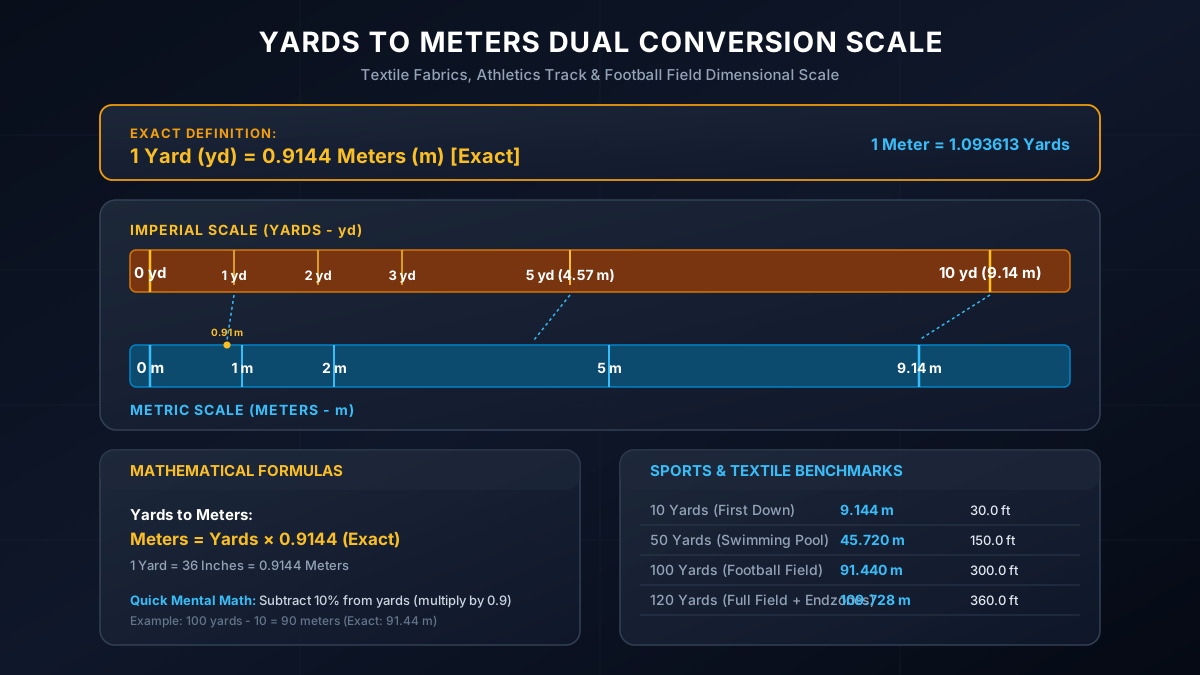
Under the 1959 International Yard and Pound Agreement, the yard is legally defined with exact mathematical precision:
The Yards to Meters Converter provides instant, bidirectional dimensional calculation with high decimal precision. This guide details the historical origin of the king's yard, sports pitch dimensions (NFL vs FIFA Soccer), textile bolt calculations, mental math tricks, and engineering lookup matrices.
2. Core Definitions & Analogy
To develop an intuitive physical grasp of both units, let us review their core definitions:
- Simple Definition: A yard is an imperial unit of length equal to 3 feet or 36 inches (about the distance from the tip of the nose to the end of an outstretched arm), while a meter is the metric base unit of length (roughly 39.37 inches). One yard equals exactly 0.9144 meters (or 91.44 cm).
- Technical Definition: The International Yard ():* Defined since July 1, 1959, as exactly .The Meter ():* The SI fundamental unit of length, defined as the distance traveled by light in a vacuum in $1 / 299,792,458$ seconds.
- The Arm Span Analogy: If you hold a 1-yard ruler from your sternum to your outstretched fingertips, you are spanning 91.44 centimeters. If you extend that distance by roughly 3.37 inches (about the width of a palm), you will reach a full 1-meter length.
3. History of the Yard and the 1959 Agreement
The yard evolved from royal decrees into an international scientific standard:
flowchart TD
    A["1100s: King Henry I of England defines Yard as distance from his nose to his outstretched thumb"] --> B["1305: Edward I establishes 1 Yard = 3 Feet = 36 Inches"]
    B --> C["1878: UK Weights and Measures Act casts physical Imperial Standard Bronze Yard"]
    C --> D["1959: International Agreement permanently defines 1 Yard = 0.9144 m Exactly"]
    D --> E["Present Day: Global standard in NFL fields, golf courses & textile manufacturing"]
Before 1959, the United States defined the yard as , while the United Kingdom used a physical bronze yard bar. The 1959 International Yard and Pound Agreement eliminated all fractional variances by establishing 0.9144 meters as the universal legal standard.
4. The Mathematical Formulas
Converting yards to meters is direct and exact:
Exact Mathematical Formulas:
Quick Mental Arithmetic Shortcut:
- Subtract 10% from yards, then add 1.5%:Example (100 yards): ; (Exact!)*.Example (50 yards): ; (Exact!)*.
5. Comprehensive Yards to Meters Lookup Table
| Yards () | Feet () | Inches () | Meters () | Centimeters () | Common Real-World Example |
|---|---|---|---|---|---|
| 1 yd | 3 ft | 36 in | 0.9144 m | 91.44 cm | 1 standard wooden yardstick |
| 2 yd | 6 ft | 72 in | 1.8288 m | 182.88 cm | Fabric bolt length for trousers |
| 5 yd | 15 ft | 180 in | 4.5720 m | 457.20 cm | Landscaping sod strip |
| 10 yd | 30 ft | 360 in | 9.1440 m | 914.40 cm | NFL First Down distance |
| 25 yd | 75 ft | 900 in | 22.8600 m | 2,286.00 cm | Short course swimming pool (SCY) |
| 50 yd | 150 ft | 1,800 in | 45.7200 m | 4,572.00 cm | Olympic archery target distance |
| 100 yd | 300 ft | 3,600 in | 91.4400 m | 9,144.00 cm | American football field goal line to goal line |
| 120 yd | 360 ft | 4,320 in | 109.7280 m | 10,972.80 cm | Full football field including end zones |
| 150 yd | 450 ft | 5,400 in | 137.1600 m | 13,716.00 cm | Golf driving range fairway marker |
| 500 yd | 1,500 ft | 18,000 in | 457.2000 m | 45,720.00 cm | Golf Par-5 hole fairway distance |
| 1,760 yd | 5,280 ft | 63,360 in | 1,609.3440 m | 160,934.40 cm | 1 Statute Mile |
6. Step-by-Step Practical Calculation Examples
Example 1: American Football Field Conversion
- Scenario: An American football field measures 100 yards between goal lines. A European stadium planner needs to verify if a FIFA soccer pitch fits in the same stadium bowl.
- Calculation:
- Analysis: A standard FIFA soccer field length is 105 meters (114.8 yards). Therefore, a regulation soccer pitch requires 13.56 meters more field length than an NFL gridiron.
Example 2: Textile Fabric Bolt Sizing
- Scenario: An interior designer in New York orders 45 yards of drapery fabric for a hotel project in Paris. How many meters of fabric will be delivered?
- Calculation:
7. Major Real-World Applications
flowchart LR
    YTM["Yards to Meters Conversion"] --> SPORT["Sports: NFL football gridirons, golf hole yardages & short course yards swimming"]
    YTM --> TEXT["Textiles: Fabric bolts, drapery yardage & industrial carpeting"]
    YTM --> LAND["Civil & Landscaping: Topsoil, gravel cubic yards (yd³) to cubic meters (m³)"]
YTM --> HUNT["Ballistics & Archery: Rangefinder distances & target lane calibration"]- Golf Course Yardages: Golf courses in the United States and United Kingdom measure fairway distances and club carry in yards, whereas golf courses in Europe, Japan, and Australia measure in meters ().
- Swimming Competitions: US high school and NCAA collegiate swimming operates on 25-Yard Short Course (SCY) pools, while Olympic and international FINA competitions race in 50-Meter Long Course (LCM) or 25-Meter Short Course (SCM) pools.
- Carpet & Flooring Installation: Roll goods in North America are priced and sold by the square yard (), requiring metric conversion for international architectural specifications.
8. Frequently Asked Questions (FAQ)
- Is a yard shorter than a meter?Yes. 1 yard () is approximately 8.56% shorter than 1 meter (). 1 meter is roughly 3.37 inches longer than 1 yard.
- How do you convert square yards to square meters?Multiply square yards by . For example, .
- How many yards are in a 100-meter sprint?(or 328 feet 1 inch).
9. Expert Summary & Best Practices
- Remember the 0.9144 Factor: In programming and CAD scripts, apply 0.9144 as an exact constant.
- Sporting Rule of Thumb: When watching American football, 10 yards is approximately 9.14 meters.
- Order Extra in Textiles: When converting European metric sewing patterns to US yard goods, round up to the nearest or yard to account for fabric grain alignment.
Additional Technical Guidelines & Measurement Standards
When conducting calculations for Yards to Meters Converter, maintaining quantitative precision and verifying input parameter boundaries is essential for reliable scenario evaluation. Always verify that raw numerical inputs are measured using standardized instrumentation, and double-check unit conversions prior to applying outputs in commercial, industrial, or academic projects.
For quantitative unit conversions and scientific calculations, always maintain at least four decimal places of precision during intermediate arithmetic stages before rounding final results. When preparing technical reports, laboratory documentation, or financial forecasts, cross-verify all output variables against established international measurement standards (such as SI, NIST, and ISO metric benchmarks) to guarantee consistent analytical rigor across all computational workflows.
MathsLover.com delivers this interactive solver 100% free of charge to foster global mathematical literacy, educational accessibility, and data-driven problem solving across scientific, technical, and academic communities worldwide.