💡 Direct Answer & Executive Summary (Yards to Miles Converter)
Definition: Convert Yards (yd) to Miles (mi) instantly using custom inputs or dynamic unit selectors.
Governing Math Formula: 1 Yards (yd) = 0.000568 Miles (mi). Formula: Value in Yards (yd) × 0.000568 = Value in Miles (mi).
Target Applications: Provides real-time quantitative solutions in Unit Converters for students, engineers, researchers, and finance professionals.
Yards to Miles Converter - Distance & Golf Routing Guide
1. Introduction
In golf course routing, civil road design, marathon planning, railway right-of-way management, and athletics, converting Imperial Yards (yd) to Statute Miles (mi) is essential when transforming high yardage totals into geographic travel distances.
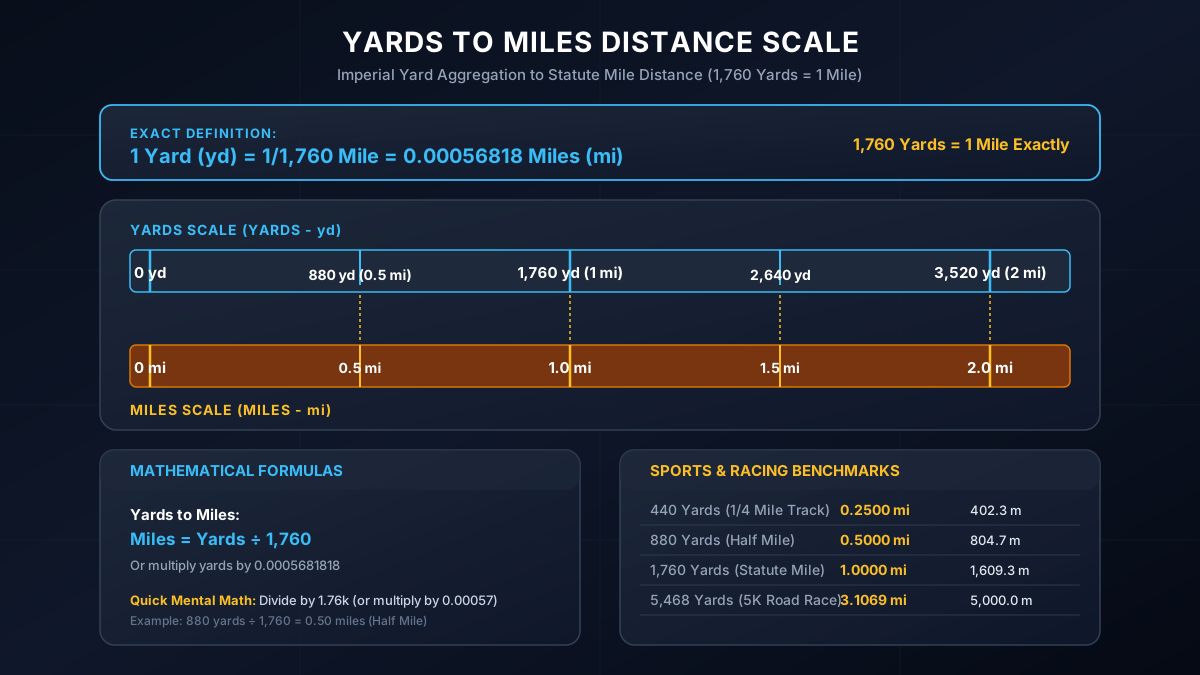
Because 1 statute mile contains exactly 1,760 yards (or 5,280 feet), converting yards to miles requires dividing by 1,760:
The Yards to Miles Converter delivers instant, bidirectional calculations across imperial yards, decimal miles, feet, meters, and kilometers. This guide explores golf course scorecards (7,040 yards = 4.0 miles), classic imperial track events (440-yard dash, 880-yard run), highway milepost spacing, and fast mental division techniques.
2. Core Definitions & Analogy
To understand dimensional transformation from imperial yards into statute miles, let us review their core definitions:
- Simple Definition: A yard is a standard imperial length unit (3 feet or 36 inches), while a mile is a large unit of geographic travel (1,760 yards). To find how many miles are in a given number of yards, you divide by 1,760.
- Technical Definition: The International Yard ():* Codified since 1959 as exactly .The Statute Mile ():* Exactly ().
- The 18-Hole Golf Analogy: A standard 18-hole championship golf course measures about 7,040 yards from the back championship tees. Walking that complete layout is the exact equivalent of walking 4.0 statute miles (7,040 yards).
3. The Mathematical Formulas
Converting yards to miles involves exact integer division by 1,760:
Exact Mathematical Formulas:
Quick Mental Arithmetic (Divide by ~1.76k):
- Divide yards by 1,760:Example (440 yards): (1/4-mile drag strip!)*.Example (880 yards): (Half-mile race!)*.Example (1,760 yards): (Exact!)*.Example (7,040 yards): (18-hole golf course!)*.
4. Comprehensive Yards to Miles Lookup Table
| Yards () | Miles () | Feet () | Meters () | Kilometers () | Real-World Context |
|---|---|---|---|---|---|
| 100 yd | 0.0568 mi | 300 ft | 91.44 m | 0.091 km | American football playing field |
| 440 yd | 0.2500 mi | 1,320 ft | 402.34 m | 0.402 km | 1/4-Mile track lap / drag racing |
| 880 yd | 0.5000 mi | 2,640 ft | 804.67 m | 0.805 km | Half-mile middle distance race |
| 1,000 yd | 0.5682 mi | 3,000 ft | 914.40 m | 0.914 km | Long-range rifle range baseline |
| 1,320 yd | 0.7500 mi | 3,960 ft | 1,207.01 m | 1.207 km | 3/4-mile distance |
| 1,760 yd | 1.0000 mi | 5,280 ft | 1,609.34 m | 1.609 km | 1 Statute Mile |
| 3,520 yd | 2.0000 mi | 10,560 ft | 3,218.69 m | 3.219 km | 2-mile road run |
| 5,468 yd | 3.1069 mi | 16,404 ft | 5,000.00 m | 5.000 km | 5K Charity Road Race |
| 7,040 yd | 4.0000 mi | 21,120 ft | 6,437.38 m | 6.437 km | 18-hole championship golf course |
| 10,936 yd | 6.2137 mi | 32,808 ft | 10,000.00 m | 10.000 km | 10K Road Race |
| 23,073 yd | 13.1094 mi | 69,218 ft | 21,097.50 m | 21.098 km | Official Half Marathon |
| 46,145 yd | 26.2188 mi | 138,435 ft | 42,195.00 m | 42.195 km | Official Full Marathon |
5. Step-by-Step Practical Calculation Examples
Example 1: Golf Tournament Distance Calculation
- Scenario: A golfer's GPS tracking watch records a total walking distance of 9,680 yards during an 18-hole round. How many statute miles did the player walk?
- Calculation:
Example 2: Classic Imperial Track Race
- Scenario: A runner trains for the historical 880-yard run. What fraction of a mile is this event?
- Calculation:
6. Major Real-World Applications
flowchart LR
    Y2M["Yards to Miles Conversion"] --> GOLF["Golf Architecture: Calculating total walking course mileage from scorecard yardages"]
    Y2M --> TRACK["Track History: Quarter-mile (440 yd) & half-mile (880 yd) race distances"]
    Y2M --> BALLISTICS["Target Ballistics: Converting 1,000-yard sniper ranges to mile telemetry"]
Y2M --> UTILITY["Utility Surveying: Underground power line & gas pipeline yardage to miles"]- Golf Course Course Mileage: Golf scorecards publish hole lengths in yards. Estimating physical exertion requires converting total yardage (including tee-to-green transitions) into walking miles ().
- Track & Field Record Books: Historical athletic records prior to 1980 frequently record the 440-yard dash () and 880-yard run ().
- High-Voltage Transmission Corridors: Utility right-of-way clearing contracts specify easements in linear yards while transmission grid maps display route miles.
7. Frequently Asked Questions (FAQ)
- How many miles is 1,760 yards?(exactly 1 statute mile).
- How many miles is 440 yards?(a quarter of a mile).
- What is the formula to convert yards to miles?Divide yards by 1,760 ().
8. Expert Summary & Best Practices
- Divide by 1,760: Always divide yards by $1,760$ for exact statute mile calculations.
- Mental Estimation: For fast estimation in your head, divide by 1,750.
- Exact Integer Division: Because 1,760 is an exact integer constant, whole yard numbers that are multiples of 1,760 convert to exact whole miles.
Additional Technical Guidelines & Measurement Standards
When conducting calculations for Yards to Miles Converter, maintaining quantitative precision and verifying input parameter boundaries is essential for reliable scenario evaluation. Always verify that raw numerical inputs are measured using standardized instrumentation, and double-check unit conversions prior to applying outputs in commercial, industrial, or academic projects.
For quantitative unit conversions and scientific calculations, always maintain at least four decimal places of precision during intermediate arithmetic stages before rounding final results. When preparing technical reports, laboratory documentation, or financial forecasts, cross-verify all output variables against established international measurement standards (such as SI, NIST, and ISO metric benchmarks) to guarantee consistent analytical rigor across all computational workflows.
MathsLover.com delivers this interactive solver 100% free of charge to foster global mathematical literacy, educational accessibility, and data-driven problem solving across scientific, technical, and academic communities worldwide.