💡 Direct Answer & Executive Summary (Composting Carbon-to-Nitrogen Ratio Solver)
Definition: Environmental footprint computation: Composting Carbon-to-Nitrogen Ratio Solver.
Governing Math Formula: C:N_mix = (W_browns × C_browns + W_greens × C_greens) / (W_browns + W_greens)
Target Applications: Provides real-time quantitative solutions in Ecology for students, engineers, researchers, and finance professionals.
Composting Carbon-to-Nitrogen Ratio Solver: The Complete Guide to Aerobic Soil Decomposition
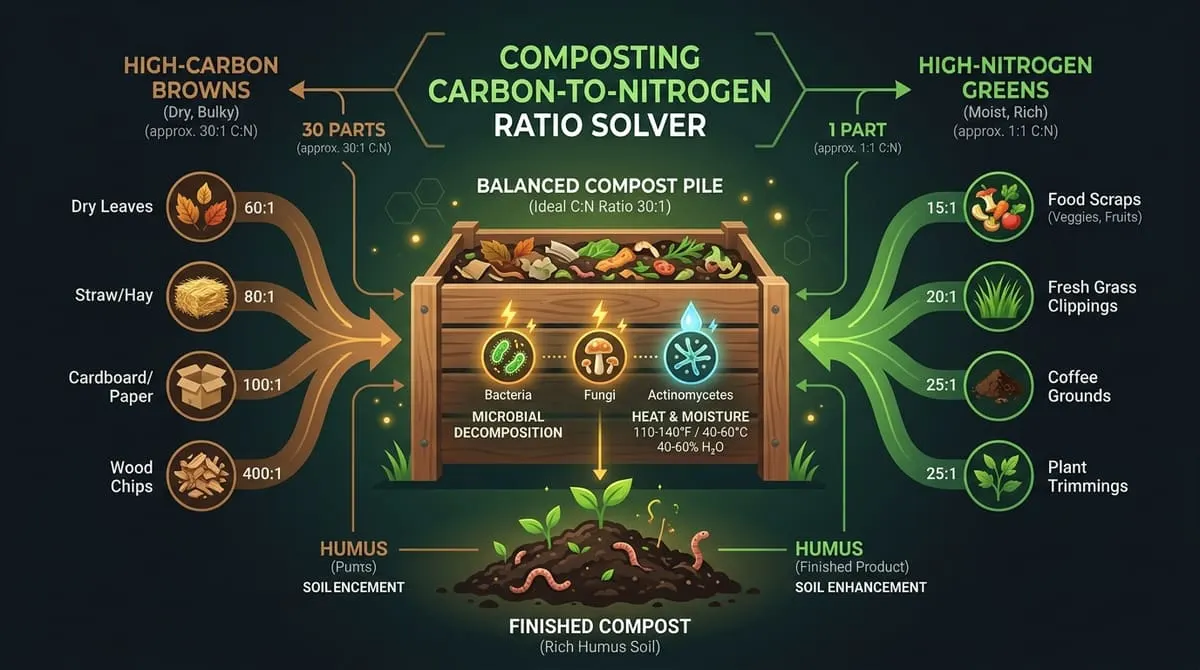
1. Introduction
Composting is nature's ultimate recycling process, transforming organic food waste, fallen leaves, and agricultural residues into nutrient-rich humus soil amendment. At the biological heart of rapid, odor-free composting lies the stoichiometric balance between two key chemical elements: Carbon (C) and Nitrogen (N).
Microorganisms—primarily aerobic bacteria, actinomycetes, and fungi—require carbon as an energy source for cellular respiration and nitrogen for building amino acids, proteins, and cellular enzymes. The Composting Carbon-to-Nitrogen Ratio Solver calculates the exact weighted average C:N ratio of your organic mix and tells you precisely how much carbon-rich "browns" or nitrogen-rich "greens" to add to achieve the ideal 30:1 C:N ratio.
graph TD
    A[Organic Feedstocks] --> B[Carbon-Rich Browns C:N ~ 60:1 to 400:1]
    A --> C[Nitrogen-Rich Greens C:N ~ 12:1 to 25:1]
    B & C --> D[Compost Mixture C:N Ratio Solver]
    D --> E{Target Range 25:1 to 30:1?}
    E -- Yes --> F[Optimal Aerobic Microbial Decomposition]
    E -- Below 20:1 --> G[Anaerobic Odor & Ammonia Gas Escape]
    E -- Above 40:1 --> H[Sluggish Decomposition & Cold Pile]
2. Core Definitions & Analogy
Simple Definition
The C:N Ratio is the proportion of carbon weight compared to nitrogen weight in a compost pile. The ideal mix is roughly 30 parts carbon to 1 part nitrogen by weight.
Technical Definition
Technically, the stoichiometric C:N ratio () of a multi-component organic feedstock blend is the ratio of total organic carbon mass () to total Kjeldahl nitrogen mass (). Maintaining a target C:N ratio between $25:1$ and $30:1$ optimizes microbial metabolic kinetics, sustaining pile temperatures between and () required for pathogen reduction.
3. History & Milestones
timeline
    title History of Composting Science
    1905 : Sir Albert Howard develops the "Indore Process" combining green & brown materials in India.
    1950s : Dr. Clarence Golueke conducts foundational engineering studies on aerobic composting at UC Berkeley.
    1970s : Municipal windrow composting scales up for yard waste management.
    2010s : Thermophilic bio-digestion and stoichiometric Carbon-to-Nitrogen modeling become industry standard.
4. Core Concepts & Feedstock C:N Values
Organic inputs are categorized into Browns (High Carbon) and Greens (High Nitrogen):
| Feedstock Material | Category | Average C:N Ratio | Moisture % | Role in Compost Pile |
|---|---|---|---|---|
| Dry Autumn Leaves | Brown | $60:1$ | High carbon energy, structural aeration. | |
| Clean Wheat Straw | Brown | $80:1$ | 10% | Carbon structure, prevents compaction. |
| Shredded Cardboard | Brown | $100:1$ | 8% | Absorbs excess moisture, high cellulose. |
| Wood Chips / Sawdust | Brown | $400:1$ | 15% | Very high lignin, slow carbon release. |
| Fruit & Vegetable Scraps | Green | $15:1$ | High moisture, fast nitrogen source. | |
| Fresh Grass Clippings | Green | $20:1$ | 70% | Rapid nitrogen release, heats pile quickly. |
| Used Coffee Grounds | Green | $20:1$ | 60% | Surprisingly rich in nitrogen, excellent texture. |
| Cow / Horse Manure | Green | $25:1$ | 65% | Rich microbial inoculum & balanced C:N. |
5. The Mathematical Model & Formulas
The composite C:N ratio () for combined feedstocks is:
Where:
- = Dry weight of feedstock (lbs or kg)
- = Carbon content percentage of feedstock
- = Nitrogen content percentage of feedstock
For a simplified two-material system of Browns (, C:N ) and Greens (, C:N ):
6. Step-by-Step Computational Procedure
Consider mixing 15 lbs of Shredded Cardboard (C:N $100:1$) with 5 lbs of Food Scraps (C:N $15:1$):
- Calculate Carbon-Weighted Value: .
- Calculate Total Weight Basis: .
- Compute Composite Ratio: .
- Diagnostic Result: A ratio of $78.75:1$ is too high in carbon (). The pile will decompose very slowly.
- Corrective Adjustment: Add of high-nitrogen Fresh Grass Clippings ($20:1$) to lower the overall mixture ratio into the optimal $30:1$ zone.
7. Visual Explanations
Microbial Decomposition Dynamics
pie title Ideal Compost Pile Composition (By Volume)
    "High-Carbon Browns (Dry Material)" : 60
    "High-Nitrogen Greens (Moist Material)" : 20
    "Air Pockets (Aerobic Oxygen)" : 10
    "Water Moisture (40-60% Content)" : 10
8. Parameter Comparison Matrix
| Browns Weight (lbs) | Greens Weight (lbs) | Resulting C:N Ratio | Pile State | Corrective Action |
|---|---|---|---|---|
| 5 lbs (Leaves) | 15 lbs (Food) | 18:1 | Wet, smelly, anaerobic (Ammonia odor) | Add 10 lbs dry leaves/straw. |
| 15 lbs (Cardboard) | 5 lbs (Food) | 78.8:1 | Dry, cold, stagnant decomposition | Add 10 lbs fresh grass clippings. |
| 12 lbs (Straw/Leaves) | 6 lbs (Food/Grass) | 28.5:1 | Optimal Thermophilic Composting | No action needed! Keep moist. |
9. Real-World Applications & Case Studies
- Municipal Yard Waste Facilities: Balancing green grass clippings with wood chip mulch to produce commercial-grade compost.
- Organic Farming: Formulating manure-straw compost to enrich topsoil microbial diversity.
- Case Study: A community garden eliminated foul odors from their food scrap collection bin by establishing a mandatory 3-to-1 bucket rule (3 buckets of sawdust for every 1 bucket of food waste), stabilizing the C:N ratio at $29:1$.
10. Advantages & Limitations
Advantages
- Eliminates unpleasant foul odors (ammonia/hydrogen sulfide).
- Accelerates decomposition speed from 12 months down to 4-6 weeks.
- Destroys weed seeds through thermophilic heating ().
Limitations
- Requires monitoring moisture levels (40% - 60%) alongside C:N ratios.
11. Common Pitfalls
Pitfall 1: Assuming All Green Items are Green in Color
Used coffee grounds are dark brown, but chemically they are a high-nitrogen "Green" with a C:N ratio of $20:1$.
12. Frequently Asked Questions (FAQ)
Q: What is the ideal C:N ratio for composting?
A: The ideal starting C:N ratio is between 25:1 and 30:1.
Q: What happens if C:N ratio is too high (>40:1)?
A: The pile will be cold, dry, and decompose very slowly due to nitrogen starvation.
Q: What happens if C:N ratio is too low (<20:1)?
A: Excess nitrogen is lost as smelly ammonia gas, creating an anaerobic sludge.
Q: Are coffee grounds a Brown or a Green?
A: Coffee grounds are a Green with a rich C:N ratio of approximately $20:1$.
Q: How much moisture should a compost pile have?
A: Ideally 40% - 60% moisture—it should feel like a wrung-out damp sponge.
Q: How often should I turn my compost pile?
A: Turning every 3 to 7 days introduces oxygen, speeding up aerobic decomposition.
Q: Can I compost meat or dairy?
A: Backyard piles should avoid meat and dairy to prevent pests, though industrial hot composters handle them easily.
Q: What is the C:N ratio of wood chips?
A: Wood chips have a very high carbon ratio of roughly $400:1$.
Q: How do I know when compost is finished?
A: Finished compost is dark, crumbly, smells like fresh forest soil, and has cooled to ambient temperature.
Q: Why does my compost pile smell like rotten eggs?
A: The pile is too wet and nitrogen-heavy (anaerobic). Turn the pile and mix in dry carbon "browns".
Q: Does shredding material help?
A: Yes! Shredding increases surface area, allowing microbes to decompose material up to 3 times faster.
Q: Is this calculator free?
A: Yes, it is 100% free for gardeners and farmers.
13. Expert Tips & Summary
- Tip: Keep a bag of dry shredded cardboard or leaves next to your compost bin to cover fresh food scraps immediately.
Additional Technical Guidelines & Measurement Standards
When conducting calculations for Composting Carbon-to-Nitrogen Ratio Solver, maintaining quantitative precision and verifying input parameter boundaries is essential for reliable scenario evaluation. Always verify that raw numerical inputs are measured using standardized instrumentation, and double-check unit conversions prior to applying outputs in commercial, industrial, or academic projects.
For quantitative unit conversions and scientific calculations, always maintain at least four decimal places of precision during intermediate arithmetic stages before rounding final results. When preparing technical reports, laboratory documentation, or financial forecasts, cross-verify all output variables against established international measurement standards (such as SI, NIST, and ISO metric benchmarks) to guarantee consistent analytical rigor across all computational workflows.
MathsLover.com delivers this interactive solver 100% free of charge to foster global mathematical literacy, educational accessibility, and data-driven problem solving across scientific, technical, and academic communities worldwide.