💡 Direct Answer & Executive Summary (Rainwater Collection Harvesting Volume Solver)
Definition: Environmental footprint computation: Rainwater Collection Harvesting Volume Solver.
Governing Math Formula: V_harvested = Roof_Area (sq ft) × Annual_Rainfall (in) × 0.6233 × Runoff_Efficiency
Target Applications: Provides real-time quantitative solutions in Ecology for students, engineers, researchers, and finance professionals.
Rainwater Collection Harvesting Volume Solver: The Complete Catchment Engineering Guide
1. Introduction
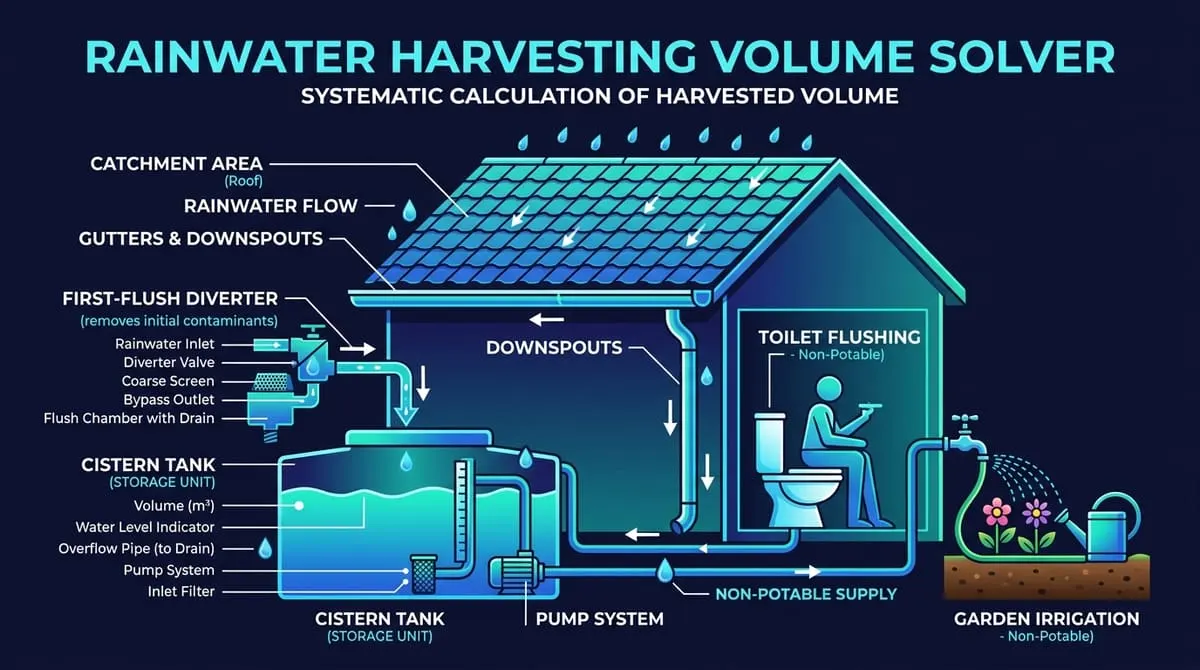
Rainwater harvesting is one of the world's oldest and most efficient decentralized water conservation techniques. Capturing precipitation directly from building rooftops reduces municipal tap draw, mitigates urban stormwater flooding, and provides a sustainable water supply for landscaping, garden irrigation, livestock, and non-potable household uses.
The Rainwater Collection Harvesting Volume Solver calculates the theoretical and practical yield of collectible rainwater based on roof footprint area (sq ft or ), annual local precipitation (inches or mm), and catchment surface runoff efficiency coefficients.
graph TD
    A[Precipitation / Rainfall Event] --> B[Roof Catchment Surface Area]
    B --> C[Gutters & Downspout Conveyance]
    C --> D[First-Flush Diverter & Coarse Mesh Screen]
    D --> E[Storage Cistern / Rain Barrel Tank]
    E --> F[Non-Potable Irrigation & Toilet Reuse]
2. Core Definitions & Analogy
Simple Definition
A Rainwater Harvesting Volume Solver calculates how many gallons of rainwater you can collect from your roof in a typical year based on your local rainfall.
Technical Definition
Technically, annual harvested rainwater volume (, in gallons or Liters) is calculated as the product of horizontal catchment projection area (), annual precipitation depth (), unit volumetric conversion constant (), runoff efficiency coefficient (, ), and first-flush diversion efficiency ().
3. History & Milestones
timeline
    title History of Rainwater Harvesting
    2000 BCE : Ancient Minoans build underground rainwater cisterns in Crete.
    1st Century CE : Roman villas design impluvium basins for rainwater collection.
    1980s : Modern commercial rainwater harvesting systems emerge in Australia & Germany.
    2020s : Municipal green infrastructure tax incentives promote urban rainwater harvesting.
4. Core Concepts & Runoff Coefficients
Roof material surface texture dictates how much water is lost to absorption and evaporation:
| Catchment Surface Material | Runoff Coefficient () | Description & Characteristics |
|---|---|---|
| Metal Roofing (Standing Seam) | 0.90 - 0.95 | Smooth, non-absorbent, highest harvesting efficiency. |
| Asphalt Composite Shingles | 0.75 - 0.85 | Granular surface absorbs initial water; minor loss. |
| Concrete / Clay Tiles | 0.80 - 0.85 | Slightly porous; moderate evaporation loss. |
| Flat Membrane (EPDM/TPO) | 0.80 - 0.90 | Highly smooth, flat roof drainage systems. |
| Green Roof (Vegetated) | 0.10 - 0.30 | High retention for plants; minimal collectible runoff. |
5. The Mathematical Model & Formulas
The standard Imperial formula for annual rainwater collection volume (, in gallons) is:
Where:
- = Roof catchment horizontal footprint area ()
- = Annual precipitation depth ()
- $0.623$ = Conversion constant ()
- = Roof surface runoff efficiency factor (default $0.85$)
6. Step-by-Step Computational Procedure
Consider a 2,000 sq ft roof footprint in a city receiving 35 inches of rain annually with an asphalt shingle roof ():
graph LR
    Step1[1. Raw Volume: 70,000 sq ft-in] --> Step2[2. Convert to Gallons: 43,610 gal]
    Step2 --> Step3[3. Apply Runoff Factor: 37,068 gal]
    Step3 --> Step4[4. Subtract First-Flush: ~35,215 gal]
Step4 --> Step5[5. Monthly Average: ~2,934 gal/mo]- Calculate Raw Footprint-Rainfall Yield: .
- Convert to Gallons: .
- Apply Roof Efficiency (85%): .
- Subtract First-Flush Diverter Loss (5%): .
7. Visual Explanations & Parameter Comparison Matrix
| Roof Footprint (sq ft) | Annual Rainfall (inches) | Roof Type | Net Annual Harvested Volume | Storage Cistern Size Rec. |
|---|---|---|---|---|
| 1,000 sq ft | 20 in | Asphalt Shingle | 10,596 Gallons | 500 - 1,000 gal tank |
| 2,000 sq ft | 35 in | Metal Roof | 39,268 Gallons | 2,500 - 5,000 gal cistern |
| 4,000 sq ft | 50 in | Metal Roof | 112,194 Gallons | 10,000+ gal tank system |
9. Real-World Applications & Case Studies
- Landscaping & Organic Gardening: Free chlorine-free water ideal for sensitive plants.
- Fire Suppression Reserve: Rural homes storing 10,000+ gallons of dedicated emergency firefighting water.
- Case Study: A suburban home in Seattle installed a 1,500-gallon cistern connected to a 1,800 sq ft metal roof, harvesting 36,000 gallons per year and reducing summer municipal irrigation bills by 80%.
10. Advantages & Limitations
Advantages
- Zero municipal water utility costs for harvested water.
- Free from chlorine, fluoride, and hard mineral salts.
- Reduces urban stormwater runoff erosion.
Limitations
- Requires first-flush filtration to prevent leaf debris clogging.
- Requires freezing protection in winter climates.
11. Common Pitfalls
Pitfall 1: Forgetting First-Flush Diversion
Skipping a first-flush diverter allows roof bird droppings and dust into storage tanks, leading to foul odor and bacterial contamination.
12. Frequently Asked Questions (FAQ)
Q: How much rainwater can I collect from 1 inch of rain on a 1,000 sq ft roof?
A: Approximately 600 gallons of water per inch of rain.
Q: Is harvested rainwater safe to drink?
A: Without advanced filtration (UV sterilization and sub-micron filtration), harvested rainwater should only be used for irrigation, washing, and flushing toilets.
Q: What is a first-flush diverter?
A: A mechanism that routes the first 1-2 gallons of rainfall (containing roof dust and debris) away from the main storage tank.
Q: What size rain barrel should I start with?
A: Standard residential starter barrels hold 50 to 100 gallons, suitable for small garden beds.
Q: Will rainwater freeze and crack my tank in winter?
A: Yes, above-ground tanks in freezing climates must be drained before winter unless insulated or buried below frost line.
Q: How long can I store rainwater?
A: Darkened, screened cisterns keep water fresh for several months without algae growth.
Q: Do I need a pump for rainwater irrigation?
A: Gravity feed works for low pressure drip lines; a small 1/2 HP submersible pump provides standard hose pressure.
Q: Is rainwater harvesting legal everywhere?
A: In over 95% of regions yes; some western US states have specific storage volume limits.
Q: How do I prevent mosquitoes in rain barrels?
A: Install fine stainless steel mesh over inlets or use organic Mosquito Dunks (BTI).
Q: Does roof pitch affect harvested volume?
A: No, only the flat horizontal footprint projection area determines rainfall capture.
Q: What is the lifespan of a polyethylene storage cistern?
A: UV-stabilized poly cisterns last 20 to 30+ years.
Q: Is this calculator free?
A: Yes, 100% free and client-side private.
13. Expert Tips & Summary
- Tip: Clean gutter screens every autumn to maintain maximum flow into downspouts.
Additional Technical Guidelines & Measurement Standards
When conducting calculations for Rainwater Collection Harvesting Volume Solver, maintaining quantitative precision and verifying input parameter boundaries is essential for reliable scenario evaluation. Always verify that raw numerical inputs are measured using standardized instrumentation, and double-check unit conversions prior to applying outputs in commercial, industrial, or academic projects.
For quantitative unit conversions and scientific calculations, always maintain at least four decimal places of precision during intermediate arithmetic stages before rounding final results. When preparing technical reports, laboratory documentation, or financial forecasts, cross-verify all output variables against established international measurement standards (such as SI, NIST, and ISO metric benchmarks) to guarantee consistent analytical rigor across all computational workflows.
MathsLover.com delivers this interactive solver 100% free of charge to foster global mathematical literacy, educational accessibility, and data-driven problem solving across scientific, technical, and academic communities worldwide.