💡 Direct Answer & Executive Summary (Tree CO2 Sequestration Offset Calculator)
Definition: Environmental footprint computation: Tree CO2 Sequestration Offset Calculator.
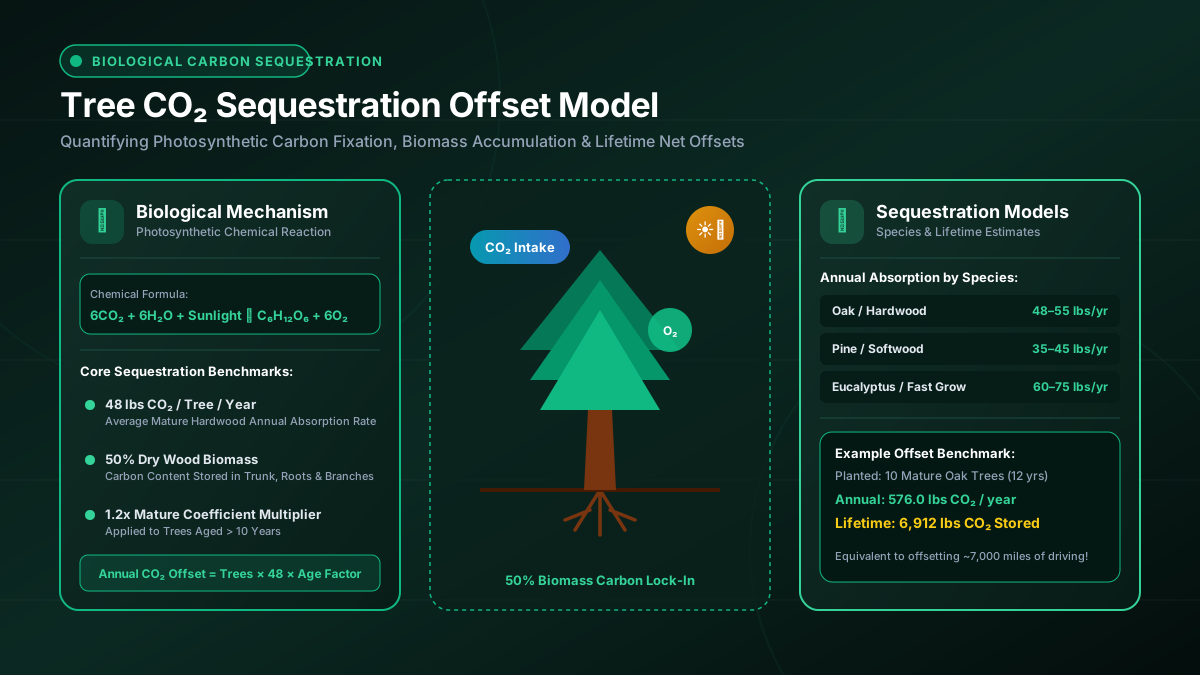
Governing Math Formula: CO2 Offset = Trees Planted × Sequestration rate (48 lbs CO2/tree/year).
Target Applications: Provides real-time quantitative solutions in Ecology for students, engineers, researchers, and finance professionals.
Tree CO2 Sequestration Offset Calculator: Complete Biological Carbon Accounting Guide
1. Introduction
As global greenhouse gas emissions continue to alter atmospheric dynamics, biological carbon sequestration through afforestation, reforestation, and urban forestry represents one of nature’s most effective mechanisms for removing carbon dioxide () from the atmosphere. Trees function as natural carbon sinks, absorbing during photosynthesis, locking carbon into wood biomass (trunks, branches, foliage, and roots), and releasing oxygen () back into the troposphere.
However, calculating the exact carbon sequestration capacity of trees requires an understanding of forest ecology, tree age dynamics, species density, and biomass carbon ratios. Planting a seedling does not immediately offset thousands of pounds of carbon; rather, sequestration rates accelerate as trees mature and enter their peak growth phases.
flowchart TD
    INPUT["🌲 1. Input Forest & Tree Metrics
Trees Planted Count, Average Tree Age (Years) & Species Coefficient"]

    INPUT --> PHOTO["🍃 2. Photosynthetic Carbon Fixation
6CO₂ + 6H₂O + Solar Energy ➔ C₆H₁₂O₆ + 6O₂"]

    PHOTO --> GROWTH["📈 3. Age & Maturation Multiplier Adjustment
Trees ≤ 10 Years: Standard Rate (1.0x)
Trees > 10 Years: Accelerated Mature Rate (1.2x)"]

    GROWTH --> ANNUAL["📊 4. Calculate Annual CO₂ Sequestration
Annual Offset (lbs/yr) = Trees × 48 lbs/yr × Maturation Factor"]

    ANNUAL --> LIFETIME["🌳 5. Compute Cumulative Lifetime Storage
Lifetime CO₂ Stored (lbs) = Annual Offset × Average Tree Age"]

    LIFETIME --> IMPACT["🎯 6. Environmental Offset Contextualization
Compare against Vehicle Mileage, Household Energy & Carbon Budgets"]
Mastering the mathematical modeling of tree carbon sequestration enables foresters, urban planners, land developers, sustainability managers, and eco-conscious individuals to:
- Quantify annual carbon dioxide absorption in both Pounds () and Metric Tons ().
- Model cumulative lifetime carbon storage embedded in forest biomass over 10, 25, 50, or 100-year growth horizons.
- Factor in tree maturity thresholds and species growth rates (hardwoods vs. softwoods).
- Determine the number of trees required to offset specific activities (e.g., airline flights, passenger vehicle commutes, or household energy consumption).
- Design high-yield carbon offset plantings for corporate ESG initiatives or personal net-zero goals.
2. Definition & Core Concepts
2.1 The Simple Definition
Tree carbon sequestration is nature’s process of inhaling carbon dioxide and turning it into solid wood. As a tree grows, it pulls gas out of the air and converts it into roots, trunks, branches, and leaves. Roughly .
2.2 Technical Definition
Under the USDA Forest Service, IPCC Guidelines for National Greenhouse Gas Inventories, and ISO 14064-2 forestry protocols, carbon sequestration rate is determined by estimating total Above-Ground Biomass (AGB) and Below-Ground Biomass (BGB) using allometric growth equations:
Where:
- is stem volume ().
- is basic wood density ().
- is the Biomass Expansion Factor accounting for branches and foliage.
- The molecular ratio converts elemental carbon mass (, atomic weight 12) into carbon dioxide mass (, molecular weight 44).
3. Historical Development of Forestry Carbon Accounting
flowchart TD
    H1["📜 1970s: Allometric Growth Equations
Forestry researchers establish structural equations relating tree trunk diameter (DBH) to total biomass"]

    H1 --> H2["🌍 1990: IPCC First Assessment Report
Recognizes global forests as critical terrestrial carbon sinks in atmospheric climate modeling"]

    H2 --> H3["🌱 1997: Kyoto Protocol Article 3.3
Formally includes Afforestation, Reforestation & Deforestation (ARD) in carbon credit frameworks"]

    H3 --> H4["💻 2006: USDA Forest Service i-Tree Suite
Launch of peer-reviewed software modeling urban tree canopy environmental and carbon benefits"]

    H4 --> M5["📊 Modern Era: Satellite LiDAR & Carbon Credit Verification
High-resolution remote sensing, satellite canopy biomass mapping & verified forest carbon offsets"]- Early Allometric Research (1970s): Foresters developed empirical mathematical formulas linking tree Diameter at Breast Height () and total tree height to wood volume and weight.
- IPCC Recognition (1990): The Intergovernmental Panel on Climate Change identified global forests as absorbing approximately annually.
- Kyoto Protocol Credit Mechanisms (1997): Established biological carbon sequestration as a tradable commodity within compliance and voluntary carbon markets.
- i-Tree & Urban Forestry Tools (2006–Present): Developed by the USDA Forest Service to enable precision calculation of urban canopy carbon offsets, storm water reduction, and energy savings.
4. Tree Sequestration Benchmarks & Species Variations
| Tree Classification | Average Growth Rate | Annual Absorption | Wood Density & Biomass | Typical Species Examples |
|---|---|---|---|---|
| Mature Hardwood | Moderate () | High () | Oak, Maple, Beech, Hickory | |
| Fast-Growing Hardwood | Rapid () | Medium () | Hybrid Poplar, Eucalyptus, Willow | |
| Coniferous Softwood | Moderate to Fast | Low to Medium () | White Pine, Douglas Fir, Spruce | |
| Urban Canopy Tree | Variable | Medium | London Plane, Linden, Elm | |
| Young Seedling () | Slow volumetric growth | Low total mass | Nursery stock plantings |
5. Mathematical Formulations & Governing Equations
flowchart TD
    S1["1. Base Annual Sequestration Rate:
R_base = 48.0 lbs CO₂ / tree / year"]

    S1 --> S2["2. Apply Age & Maturation Multiplier:
If Tree Age > 10 Years: Factor = 1.20
If Tree Age ≤ 10 Years: Factor = 1.00"]

    S2 --> S3["3. Compute Annual Carbon Offset:
Annual CO₂ (lbs/yr) = Trees × R_base × Age Factor"]

    S3 --> S4["4. Compute Lifetime Accumulated Carbon:
Lifetime CO₂ (lbs) = Annual CO₂ × Tree Age"]

    S4 --> S5["5. Unit Conversion to Metric Tons:
Metric Tons CO₂ = Lifetime lbs × 0.00045359237"]
Formula 1: Annual Carbon Dioxide Offset ()
Where:
- = Count of trees planted.
- $48.0$ = Industry-standard baseline annual carbon sequestration rate for a mature tree ().
- = Maturation factor (; ).
Formula 2: Lifetime Cumulative Carbon Storage ()
Where:
- = Average age of trees in years.
Formula 3: Metric Tons Conversion ()
6. Step-by-Step Practical Calculation Examples
Example 1: Community Tree Planting Initiative (25 Mature Trees)
- Inputs:- Trees Planted:- Average Tree Age:
- Step-by-Step Mathematics:1. Determine Maturation Multiplier: Because Age () , .2. Calculate Annual CO₂ Sequestration:3. Calculate Lifetime Cumulative Storage:4. Convert to Metric Tons:
Example 2: Suburban Yard Reforestation (5 Young Trees)
- Inputs:- Trees Planted:- Average Tree Age:
- Calculations:1. Maturation Multiplier: Because Age () , .2. Annual CO₂ Offset: .3. Lifetime Storage: .
7. What Can Tree Sequestration Offset?
| Activity to Offset | Carbon Emissions | Trees Required to Offset (Annual Basis) |
|---|---|---|
| 1 Passenger Vehicle (12,000 miles/yr) | ||
| Roundtrip Flight (NY to London) | ||
| Average US Home Electricity (10,000 kWh/yr) | ||
| 1 Gallon of Gasoline Burned | ||
| Average American Annual Total Footprint |
8. Common Misconceptions in Tree Carbon Accounting
- Assuming Young Seedlings Offset Full Rates Immediately: A newly planted sapling absorbs less than per year. Full sequestration capacity () is achieved as the canopy expands.
- Ignoring Tree Mortality & Fire Risks: If a tree dies, decays, or burns in a wildfire, the stored carbon is oxidized back into atmospheric . Sustainable offset projects must include permanence buffers and replanting management.
- Equating Cutting Old Growth with Planting New Trees: Mature old-growth forests store massive carbon pools in soil organic matter and large trunks that take centuries to replicate.
9. Frequently Asked Questions (FAQ)
How much CO2 does one tree absorb per year on average?
An average mature hardwood tree absorbs approximately ().
Which tree species absorbs the most carbon?
Fast-growing species with high wood density—such as Oak, Yellow Poplar, Eucalyptus, and Redwood—absorb the highest rates of carbon over their growth cycle.
How does tree carbon sequestration relate to dry wood mass?
Approximately . Multiplying dry biomass by ($3.67$) converts elemental carbon weight into total absorbed.
10. Summary Checklist for Forest Carbon Planning
- ✔ Select Native Species: Choose long-lived hardwood or evergreen species adapted to local soil and climate.
- ✔ Track Tree Age: Factor in young vs. mature growth multipliers ().
- ✔ Ensure Long-Term Stewardship: Protect trees from fire, disease, and premature harvesting to guarantee permanent carbon lock-in.
- ✔ Combine Offset Strategies: Combine tree planting with direct emissions reduction (solar, EV, heat pumps) for maximum impact.
Additional Technical Guidelines & Measurement Standards
When conducting calculations for Tree CO2 Sequestration Offset Calculator, maintaining quantitative precision and verifying input parameter boundaries is essential for reliable scenario evaluation. Always verify that raw numerical inputs are measured using standardized instrumentation, and double-check unit conversions prior to applying outputs in commercial, industrial, or academic projects.
For quantitative unit conversions and scientific calculations, always maintain at least four decimal places of precision during intermediate arithmetic stages before rounding final results. When preparing technical reports, laboratory documentation, or financial forecasts, cross-verify all output variables against established international measurement standards (such as SI, NIST, and ISO metric benchmarks) to guarantee consistent analytical rigor across all computational workflows.
MathsLover.com delivers this interactive solver 100% free of charge to foster global mathematical literacy, educational accessibility, and data-driven problem solving across scientific, technical, and academic communities worldwide.