💡 Direct Answer & Executive Summary (Wind Turbine Power Output Potential Solver)
Definition: Environmental footprint computation: Wind Turbine Power Output Potential Solver.
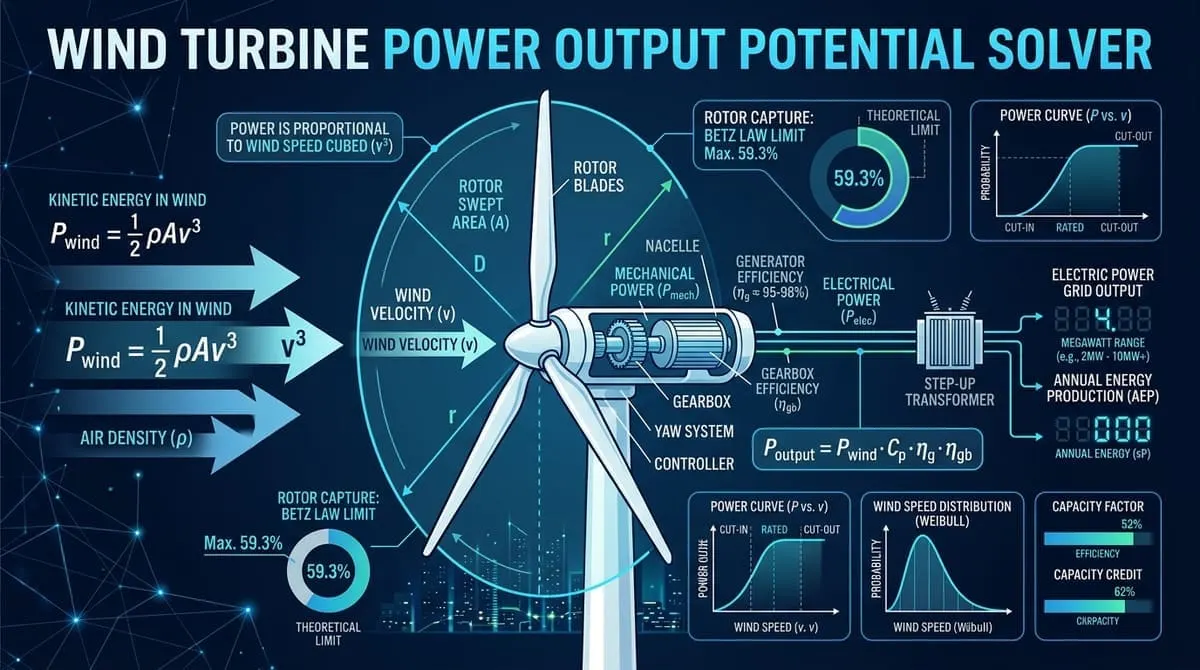
Governing Math Formula: P_power (kW) = [0.5 × ρ (1.225) × (π × r²) × v³ × Cp (0.40) × η_g (0.90)] / 1000
Target Applications: Provides real-time quantitative solutions in Ecology for students, engineers, researchers, and finance professionals.
Wind Turbine Power Output Potential Solver: Sizing Aerodynamic Kinetic Energy Yields
1. Introduction
Wind energy is one of the fastest-growing clean renewable electricity sources globally. As solar radiation unevenly heats the Earth's atmosphere, pressure gradients accelerate atmospheric air masses, creating kinetic wind energy. Wind turbines harvest this kinetic energy using aerodynamic rotor blades, driving an internal generator to produce clean electric power.
The Wind Turbine Power Output Potential Solver models the aerodynamic power output (in Watts, kW, or MW) and annual energy generation (AEP in kWh) based on rotor blade length (, meters), wind speed (, m/s), air density ($\rho$), and aerodynamic capacity coefficients ().
graph TD
    A[Kinetic Energy in Moving Wind v³] --> B[Rotor Swept Area A = π r²]
    B --> C[Aerodynamic Capture Cp Betz Limit 59.3%]
    C --> D[Mechanical Gearbox & Shaft Power]
    D --> E[Electrical Generator Efficiency η]
    E --> F[Electric Grid Output Power kW / MW]
2. Core Definitions & Analogy
Simple Definition
A Wind Turbine Power Output Calculator computes how much electricity a wind turbine can generate based on the length of its blades and how fast the wind is blowing.
Technical Definition
Technically, instantaneous wind power (, in Watts) is proportional to air density (), rotor swept area (), and the cube of wind velocity (). According to Betz's Law, no turbine can capture more than 59.3% () of the kinetic energy in wind.
3. History & Milestones
timeline
    title History of Wind Power Engineering
    1888 : Charles F. Brush builds first automatically operated wind turbine in Ohio.
    1919 : Albert Betz derives Betz's Law (59.3% theoretical limit).
    1990s : Commercial offshore wind farms developed in Europe.
    2026 : Modern 15MW+ offshore turbines feature rotor diameters exceeding 230 meters.
4. Core Concepts & Parameters
| Parameter | Symbol | Unit | Baseline Value | Description |
|---|---|---|---|---|
| Rotor Blade Length | meters (m) | Radius of the rotor swept area (). | ||
| Average Wind Speed | m/s | Average wind velocity at turbine hub height. | ||
| Air Density | $\rho$ | Standard sea-level air density at . | ||
| Power Coefficient | ratio | $0.40$ (40%) | Practical aerodynamic efficiency of the rotor blades. | |
| Generator Efficiency | ratio | $0.90$ (90%) | Electrical conversion efficiency of the nacelle generator. |
5. The Mathematical Model & Formulas
The total kinetic power contained in the wind stream () is:
The net electrical power output (, in Watts) after applying Betz coefficient () and generator efficiency () is:
Convert Watts to Kilowatts ():
The Power-of-Three Rule (): Because power scales with the cube of wind speed, doubling the wind speed increases power output by 8 times ().
6. Step-by-Step Computational Procedure
Consider a turbine with 40 m blades operating at 12 m/s wind speed with and :
- Calculate Swept Area: .
- Calculate Wind Velocity Cubed: .
- Calculate Raw Wind Power: .
- Apply Efficiencies (): .
- Convert to kW: ( instantaneous output).
7. Visual Explanations & Parameter Comparison Matrix
| Blade Length (r) | Wind Speed (v) | Swept Area () | Electrical Power Output | Annual Yield (35% Cap Factor) |
|---|---|---|---|---|
| 5 meters (Residential) | 6 m/s | 1.8 kW | 5,518 kWh/year | |
| 20 meters (Commercial) | 10 m/s | 277.1 kW | 849,630 kWh/year | |
| 40 meters (Utility Scale) | 12 m/s | 1,916.8 kW (1.9 MW) | 5,877,900 kWh/year |
9. Real-World Applications & Case Studies
- Utility Wind Farms: Offshore and onshore multi-megawatt wind developments.
- Micro-Wind Rural Off-Grid: 1 kW to 10 kW rooftop/mast turbines for remote homesteads.
- Case Study: A 2.0 MW wind turbine installed on a Midwest farm produced 6,100,000 kWh per year at a 35% capacity factor, supplying power for 550 homes.
10. Advantages & Limitations
Advantages
- Zero fuel cost and zero operational carbon emissions.
- High land efficiency (farming and cattle grazing continue below turbines).
Limitations
- Intermittent generation dependent on local wind patterns.
- Requires minimum "cut-in" wind speed ().
11. Common Pitfalls
Pitfall 1: Underestimating the Power of Wind Velocity ()
A small decrease in wind speed drastically lowers output. Dropping from to reduces power output by 87.5% ().
12. Frequently Asked Questions (FAQ)
Q: What is Betz's Law?
A: Betz's Law proves that no wind turbine can extract more than 59.3% of the kinetic energy in wind.
Q: Why do wind turbine blades need to be so long?
A: Swept area increases with the square of blade radius (), meaning doubling blade length quadruples swept area.
Q: What is a Capacity Factor in wind power?
A: Capacity factor is the actual annual energy produced divided by theoretical maximum output if running at 100% capacity continuously (typically 30% - 50%).
Q: What is a Cut-In Wind Speed?
A: The minimum wind speed () required for the blades to start turning and generating power.
Q: What is a Cut-Out Wind Speed?
A: The safety shut-down wind speed ( / ) where brakes stop the rotor to prevent structural damage in storms.
Q: How much noise do modern wind turbines make?
A: At 300 meters distance, a modern wind turbine operates at , quiet as a domestic refrigerator.
Q: How does air density affect wind power?
A: Cold, dense air at sea level generates more power than warm air at high mountain altitudes.
Q: What is the lifespan of a wind turbine?
A: Modern wind turbines are designed for a 20 to 25+ year operational lifespan.
Q: What is Nacelle?
A: The housing box at the top of the tower containing the gearbox, generator, and control electronics.
Q: Can small wind turbines power a house?
A: A small wind turbine with blades can power an average home in windy rural areas.
Q: What is the ROI payback period for wind energy?
A: Utility wind turbines achieve financial payback in 3 to 6 years.
Q: Is this calculator free?
A: Yes, 100% free for students and engineers.
13. Expert Tips & Summary
- Tip: Mount wind turbines as high as possible; wind speed increases significantly with elevation above ground friction obstacles.
Additional Technical Guidelines & Measurement Standards
When conducting calculations for Wind Turbine Power Output Potential Solver, maintaining quantitative precision and verifying input parameter boundaries is essential for reliable scenario evaluation. Always verify that raw numerical inputs are measured using standardized instrumentation, and double-check unit conversions prior to applying outputs in commercial, industrial, or academic projects.
For quantitative unit conversions and scientific calculations, always maintain at least four decimal places of precision during intermediate arithmetic stages before rounding final results. When preparing technical reports, laboratory documentation, or financial forecasts, cross-verify all output variables against established international measurement standards (such as SI, NIST, and ISO metric benchmarks) to guarantee consistent analytical rigor across all computational workflows.
MathsLover.com delivers this interactive solver 100% free of charge to foster global mathematical literacy, educational accessibility, and data-driven problem solving across scientific, technical, and academic communities worldwide.