💡 Direct Answer & Executive Summary (Exact Age Calculator)
Definition: Calculate your exact age in years, months, days, hours, and minutes based on birth date.
Governing Math Formula: Exact age is computed as the exact calendar duration between Birth Date and Current Date.
Target Applications: Provides real-time quantitative solutions in Everyday Tools for students, engineers, researchers, and finance professionals.
Exact Age Calculator (Years, Months, Days & Lifetime Metrics)
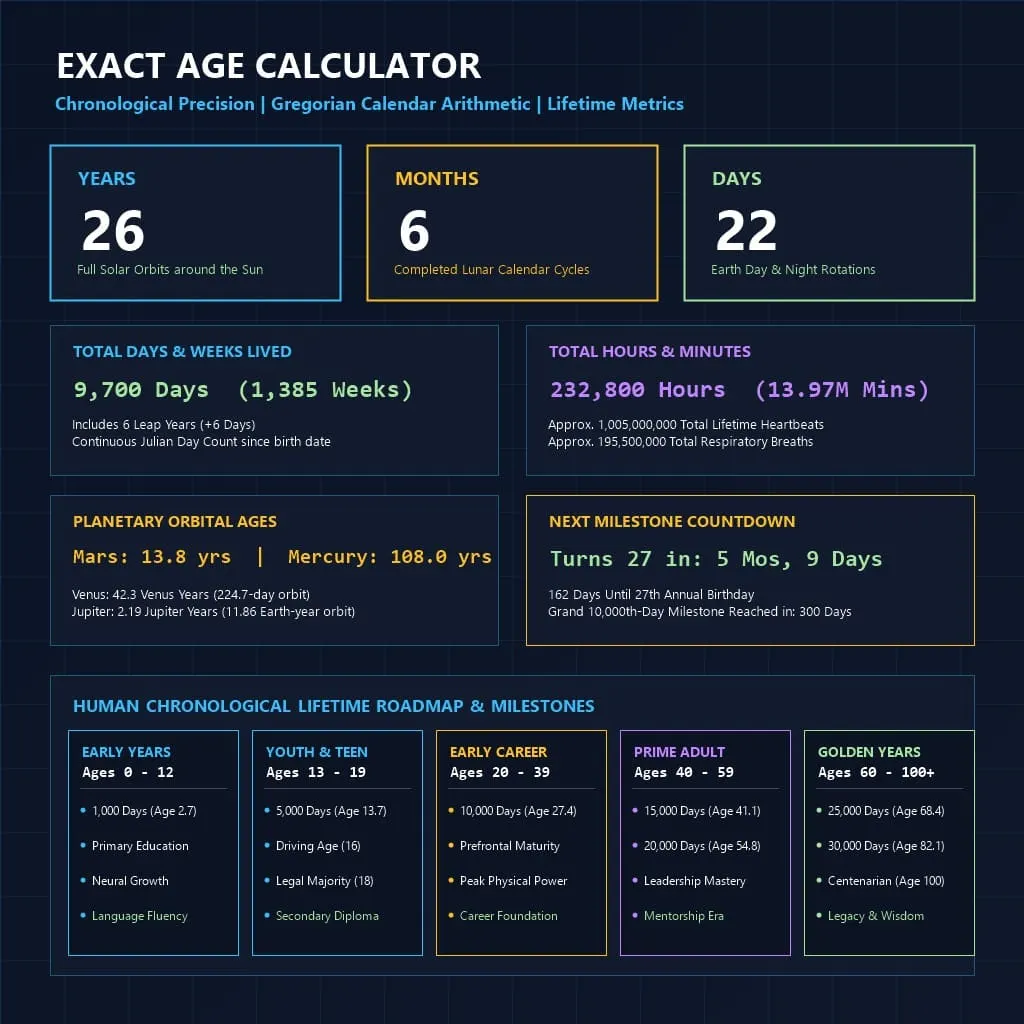
1. Introduction
How old are you right now, down to the exact year, month, day, hour, and minute? While saying "I am 26 years old" is sufficient for casual conversation, calculating your exact chronological age requires navigating the intricate astronomical and mathematical anomalies of the Gregorian Calendar: leap years containing (with February having 29 days), irregular month lengths alternating between 28, 30, and 31 days, and planetary orbital periods.
Whether you are determining legal age verification thresholds (voting, driver's licenses, legal majority), calculating exact retirement pension eligibility dates, processing pediatric medical dosages based on weeks and months of life, or celebrating rare day-count milestones (such as living your 10,000th day on Earth), calculating exact chronological duration is essential across legal, clinical, and financial disciplines.
graph LR
    BD["🎂 Birth Date (YYYY-MM-DD)
Exact Day, Month & Year of Birth"] --> SUB["📅 Calendar Subtraction Engine
Borrowing Algorithms (28, 29, 30, 31 Days)"]
    CD["⏱️ Current Date / Target Date
Gregorian Calendar Timestamp"] --> SUB
    SUB --> YEARS["🗓️ Years, Months & Days
e.g., 26 Years, 6 Months, 22 Days"]
    SUB --> METRICS["📊 Full Lifetime Summary
Total Days, Weeks, Hours & Minutes"]
    SUB --> MILE["🎉 Milestone Countdowns
Next Birthday & 10,000-Day Milestone"]
Mastering calendar age arithmetic and duration computation enables actuaries, demographers, HR specialists, and software engineers to:
- Determine statutory retirement benefit qualification ages and social security disbursement timelines.
- Calculate exact pediatric developmental stages and vaccination administration windows in months and days.
- Ensure legal compliance for contract enforceability, age of consent, and civil majority laws across jurisdictions.
- Verify insurance underwriting risk brackets, life expectancy annuity calculations, and mortality actuarial tables.
- Compute astronomical age equivalents (how many solar revolutions you have lived on Mars, Jupiter, or Venus).
2. Definitions & Analogies
2.1 The Simple Definition
In simple everyday terms:
- Your Age in Years is "how many times Earth has completed a full orbit around the Sun since you were born."
- Your Exact Age tells you the complete breakdown: "How many full years + full months + remaining single days you have lived."
- Total Days Lived is the raw number of sunrise-to-sunset rotations you have experienced on Earth (e.g., a 27-year-old has lived approximately ).
2.2 The Formal Technical Definition
Gregorian Calendar Subtraction Algorithm
Calculating exact chronological age between a Birth Date () and a Target Date () involves sequential column-by-column subtraction with calendar borrowing:
flowchart TD
    D_CHECK{"Is D_age < 0?"} -->|Yes| BORROW_M["Borrow 1 Month from M_now
(M_age = M_age - 1)
Add number of days in the previous month to D_age"]
    D_CHECK -->|No| M_CHECK
    BORROW_M --> M_CHECK{"Is M_age < 0?"}
    M_CHECK -->|Yes| BORROW_Y["Borrow 1 Year from Y_now
(Y_age = Y_age - 1)
M_age = M_age + 12"]
    M_CHECK -->|No| FINISH["Final Output:
Y_age Years, M_age Months, D_age Days"]
    BORROW_Y --> FINISH
Leap Year Rules in the Gregorian Calendar
A year () contains (a leap year with February 29) if and only if: 1. is evenly divisible by (), AND 2. If is divisible by , it must also be divisible by ().
- Example: The year was a leap year (), whereas was not a leap year ( but ). The year was a leap year, while and are standard common years.
Total Raw Day-Count Formula
The total elapsed solar days () between two timestamps is computed via the Julian Day Number () or Unix epoch milliseconds:
- Total Weeks:
- Total Hours:
- Total Minutes:
- Total Seconds:
2.3 The Odometer and Clock Analogy
To visualize calendar age calculation, imagine an automobile digital trip odometer:
graph TD
    subgraph Odometer_Analogy ["🚗 The Trip Odometer Analogy"]
        YearsWheel["⚙️ Outer Dial: Full Revolutions (Years)
Ticks forward once every full 365.2422 days"]
        MonthsWheel["⚙️ Middle Dial: Calendar Partitions (Months)
Ticks forward once every 28 to 31 days"]
        DaysWheel["⚙️ Inner Dial: Daily Ticks (Days)
Ticks forward once every 24-hour midnight rollover"]
        YearsWheel & MonthsWheel & DaysWheel --> EXACT["Exact Reading: 26 Yrs, 6 Mos, 22 Days"]
    end
3. History & Milestones in Calendar & Chronology Systems
graph LR
    JC["🏛️ 46 BC: Julian Calendar
Julius Caesar institutes 365.25-day leap rule"] --> AD["📜 525 AD: Anno Domini
Dionysius Exiguus standardizes AD/CE era"]
    AD --> GC["⛪ 1582: Gregorian Reform
Pope Gregory XIII fixes 10-day equinox drift"]
    GC --> UNIX["💻 1970: Unix Epoch
Digital midnight UTC 1970 timestamping"]
    UNIX --> UTC["⏱️ 1972: Atomic UTC
BIPM introduces International Leap Seconds"]- The Julian Calendar Reform (46 BC): Julius Caesar and Alexandrian astronomer Sosigenes introduced a 365-day year with an extra leap day every four years (). However, because Earth's actual tropical solar year is approximately , the Julian calendar accumulated an error of 1 full day every 128 years.
- The Gregorian Calendar Correction (1582): By 1582, the spring equinox had drifted by 10 full days. Pope Gregory XIII instituted the Gregorian calendar by skipping 10 days (October 4 was immediately followed by October 15, 1582) and refining the centennial leap year rule, bringing the calendar year to (accurate to within 1 day every 3,236 years).
- Unix Epoch Time (1970): In modern computer science, all age and date calculations rely on the Unix Epoch—the integer count of seconds elapsed since midnight UTC on January 1, 1970.
4. Master Age Units & Conversions Matrix
A human life can be expressed across multiple chronological units:
| Life Chronological Unit | Conversion Mathematical Formula | Benchmark for Age 26 (e.g., Born Jan 15, 2000 to Aug 6, 2026) | Primary Professional Usage |
|---|---|---|---|
| Exact Calendar Age | Years, Months, and Days | Legal ID, government records, resumes | |
| Decimal Years | Actuarial life tables, demographic charts | ||
| Total Solar Days | Health research, milestone celebrations | ||
| Total Full Weeks | Pregnancy gestation, pediatric medicine | ||
| Total Hours Lived | Productivity logs, industrial labor cycles | ||
| Total Minutes Lived | Biometric cardiovascular tracking | ||
| Total Heartbeats | () | Cardiology, biological aging research | |
| Breaths Inhaled | Pulmonology & respiratory physiology |
5. Planetary Orbital Ages: How Old Are You on Other Planets?
Because a "year" is physically defined as one complete orbit around the Sun, your age changes dramatically on other planets based on Kepler's Third Law of Planetary Motion ():
graph TD
    EARTH_AGE["🌍 Earth Age: 26.0 Solar Years (9,700 Days)"] --> MERCURY["☿️ Mercury (Orbital Period = 87.97 Days)
Age = 110.3 Mercury Years (Rapid Solar Revolutions!)"]
    EARTH_AGE --> VENUS["♀️ Venus (Orbital Period = 224.70 Days)
Age = 43.2 Venus Years"]
    EARTH_AGE --> MARS["♂️ Mars (Orbital Period = 686.98 Days)
Age = 14.1 Mars Years"]
    EARTH_AGE --> JUPITER["♃ Jupiter (Orbital Period = 4,332.59 Days)
Age = 2.24 Jupiter Years"]
    EARTH_AGE --> SATURN["♄ Saturn (Orbital Period = 10,759.22 Days)
Age = 0.90 Saturn Years (Not yet 1 Saturn year old!)"]| Celestial Planet | Orbital Period (Earth Days) | Orbital Period (Earth Years) | Age Formula Relative to Earth Age () | Age if 26 on Earth |
|---|---|---|---|---|
| Mercury | ||||
| Venus | ||||
| Earth | ||||
| Mars | ||||
| Jupiter | ||||
| Saturn | ||||
| Uranus | ||||
| Neptune | ||||
| Pluto (Dwarf) |
6. Major Human Day-Count Milestones Roadmap
While annual birthdays occur every 365 days, celebrating decimal day milestones offers a unique chronological perspective:
graph LR
    M1["🎈 1,000 Days
Age 2.74 Years
Early Childhood"] --> M2["🎓 5,000 Days
Age 13.69 Years
Entering Adolescence"]
    M2 --> M3["🌟 10,000 Days
Age 27.38 Years
Prime Adulthood"]
    M3 --> M4["🏆 20,000 Days
Age 54.76 Years
Mastery & Leadership"]
    M4 --> M5["👑 30,000 Days
Age 82.14 Years
Golden Wisdom"]| Lifetime Day Milestone | Equivalent Exact Age | Significant Biological / Life Event |
|---|---|---|
| 1,000 Days | First 1,000 days of life: Critical neural synaptic development | |
| 2,500 Days | Primary school education, permanent teeth eruption | |
| 5,000 Days | Becoming a teenager, secondary school entry | |
| 7,500 Days | University graduation, entering the professional workforce | |
| 10,000 Days | The Grand 10,000-Day Milestone (Peak physical conditioning) | |
| 15,000 Days | Middle adulthood, career leadership, family stability | |
| 20,000 Days | The Grand 20,000-Day Milestone (Senior leadership & wisdom) | |
| 25,000 Days | Traditional retirement age, mentorship, leisure | |
| 30,000 Days | The Grand 30,000-Day Milestone (Octogenarian golden era) | |
| 36,525 Days | Centenarian milestone (A full century of living!) |
7. Practical Step-by-Step Calculation Walkthroughs
Example 1: Standard Birthday Date Subtraction (No Borrowing Needed)
- Birth Date: June 10, 1995 ()
- Current Date: November 25, 2026 ()
- Step 1 (Days):
- Step 2 (Months):
- Step 3 (Years):
- Result: .
Example 2: Date Subtraction Requiring Month & Year Borrowing
- Birth Date: September 28, 1998 ()
- Current Date: March 15, 2026 ()
- Step 1 (Days with Borrowing):- Because , borrow 1 month from March ( becomes , February).- The preceding month (February 2026) has (non-leap year).- Add 28 to days: .- .
- Step 2 (Months with Borrowing):- Current month is now (February). Because , borrow 1 year from ( becomes ).- Add 12 months: .- .
- Step 3 (Years):- .
- Final Exact Age: .
Example 3: Leap Year Baby Born on February 29
- Birth Date: February 29, 2004 ( was a leap year)
- Target Date: March 1, 2026
- Calculation in Common Years:- By legal convention in the UK and US, a person born on Feb 29 officially turns a year older on March 1 in common years (or February 28 in select European civil codes).- On March 1, 2026: The individual has celebrated ($2008, 2012, 2016, 2020, 2024$), but their true chronological age is exactly ().
8. Real-World Case Studies
Case Study 1: Statutory Pension & Social Security Retirement Windows
- Actuarial Dilemma: The US Social Security Administration (SSA) mandates that individuals born between 1943 and 1954 reach Full Retirement Age (FRA) at exactly , while those born in 1960 or later reach FRA at .
- The "Day Before Birthday" Legal Doctrine: Under federal law (20 CFR § 404.102), a person attains a given age on the first moment of the day before their annual birthday.
- Impact: An individual born on January 1, 1960 attains age 67 on December 31, 2026, making them eligible for full retirement benefits starting in December 2026 rather than January 2027—preventing benefit check delays.
Case Study 2: Pediatric Drug Dosing by Exact Weeks & Months of Life
- Clinical Pharmacology Context: In neonatology and pediatrics, infant liver metabolism and renal clearance rates change drastically week-by-week. Administering medication (such as paracetamol or ampicillin) based solely on "1 year old" can lead to dangerous toxicity or therapeutic underdosing.
- Protocol: Pediatricians calculate exact gestational age () plus post-natal age in exact weeks and days:- Infant born 6 weeks premature () currently has a Corrected Chronological Age of only , dictating lower dosage weights.
9. Common Mistakes & How to Avoid Them
Mistake 1: Assuming All Months Have 30 Days
Dividing total days by or assuming every month is . This produces inaccurate fractional month offsets. Always use calendar-specific borrowing based on the actual preceding month ().
Mistake 2: Forgetting Century Leap Year Rules
Assuming every year ending in is a leap year. Years divisible by are NOT leap years unless also divisible by 400. The year 2000 was a leap year, but 1900 was not, and 2100 will not be a leap year.
Mistake 3: Timezone Boundary Discrepancies
Calculating age across international date lines without normalizing to midnight UTC. A person born in Tokyo on May 1 at 2:00 AM was born on April 30 at 17:00 UTC in London.
10. Frequently Asked Questions (FAQ)
Q1: How is exact age calculated if born on a Leap Day (February 29)?
A: In common years (365 days), most legal jurisdictions (such as US Social Security and UK law) consider a Leap Day baby to reach their next age on March 1. In leap years, they celebrate on February 29.
Q2: What is the difference between Chronological Age and Biological Age?
A: - Chronological Age: The exact calendar time elapsed since birth (measured in years, months, and days).
- Biological Age: The physiological state of your body's cells, DNA methylation biomarkers (epigenetic clocks like the Horvath Clock), telomere length, and cardiovascular health.
Q3: When do I celebrate my 10,000th Day on Earth?
A: A person reaches their 10,000th day of life at approximately of age (accounting for roughly 6 to 7 leap years).
Q4: How many days are in a standard astronomical year?
A: - Standard Gregorian Calendar Year: on average.
- Astronomical Tropical Solar Year: ().
- Sidereal Year: .
Q5: Why do some cultures calculate age differently (e.g., East Asian Age Reckoning)?
A: In traditional East Asian age reckoning (such as traditional Korean or Chinese age), a newborn is considered 1 year old at birth, and everyone turns a year older simultaneously on New Year's Day (or Lunar New Year), rather than on their biological birthday. Modern legal documents across East Asia now officially use international Gregorian chronological age.
Q6: How many hours has an average 30-year-old lived?
A: A 30-year-old has lived approximately ().
Q7: How many total weeks are in 50 years?
A: 50 years equals approximately , which is .
Q8: What is the Julian Day Number ()?
A: The Julian Day Number is a continuous count of days elapsed since the beginning of the Julian Period (January 1, 4713 BC). Astronomers and computer scientists use to compute exact time differences between distant historical dates without dealing with complex calendar month variations.
11. Expert Tips & Best Practices
- Use the Preceding Month Length for Day Borrowing: When subtracting days (), always add the exact number of days contained in the month immediately preceding the target date.
- Track Decimal Milestones: Celebrate 10,000 days () and 20,000 days () as meaningful life milestones alongside traditional annual birthdays.
- Normalize to UTC Midnight for Digital Records: When storing birth timestamps in software databases, always store as UTC
YYYY-MM-DDto avoid automatic 1-day shifts when users view profiles in different time zones.
12. Summary & Key Takeaways
- Exact Calendar Duration: Computed as full years, full months, and remaining days via sequential borrowing.
- Gregorian Leap Year Precision: Accounts for February 29 every 4 years (except non-400 divisible century years).
- Rich Lifetime Metrics: A typical 26-year-old has lived , , and experienced over 1 billion heartbeats.
- Interplanetary Planetary Perspective: Your orbital age varies across the solar system—from 108 years old on Mercury to just 2.2 years old on Jupiter!
Additional Technical Guidelines & Measurement Standards
When conducting calculations for Exact Age Calculator, maintaining quantitative precision and verifying input parameter boundaries is essential for reliable scenario evaluation. Always verify that raw numerical inputs are measured using standardized instrumentation, and double-check unit conversions prior to applying outputs in commercial, industrial, or academic projects.
For quantitative unit conversions and scientific calculations, always maintain at least four decimal places of precision during intermediate arithmetic stages before rounding final results. When preparing technical reports, laboratory documentation, or financial forecasts, cross-verify all output variables against established international measurement standards (such as SI, NIST, and ISO metric benchmarks) to guarantee consistent analytical rigor across all computational workflows.
MathsLover.com delivers this interactive solver 100% free of charge to foster global mathematical literacy, educational accessibility, and data-driven problem solving across scientific, technical, and academic communities worldwide.