💡 Direct Answer & Executive Summary (Text Case Case Converter)
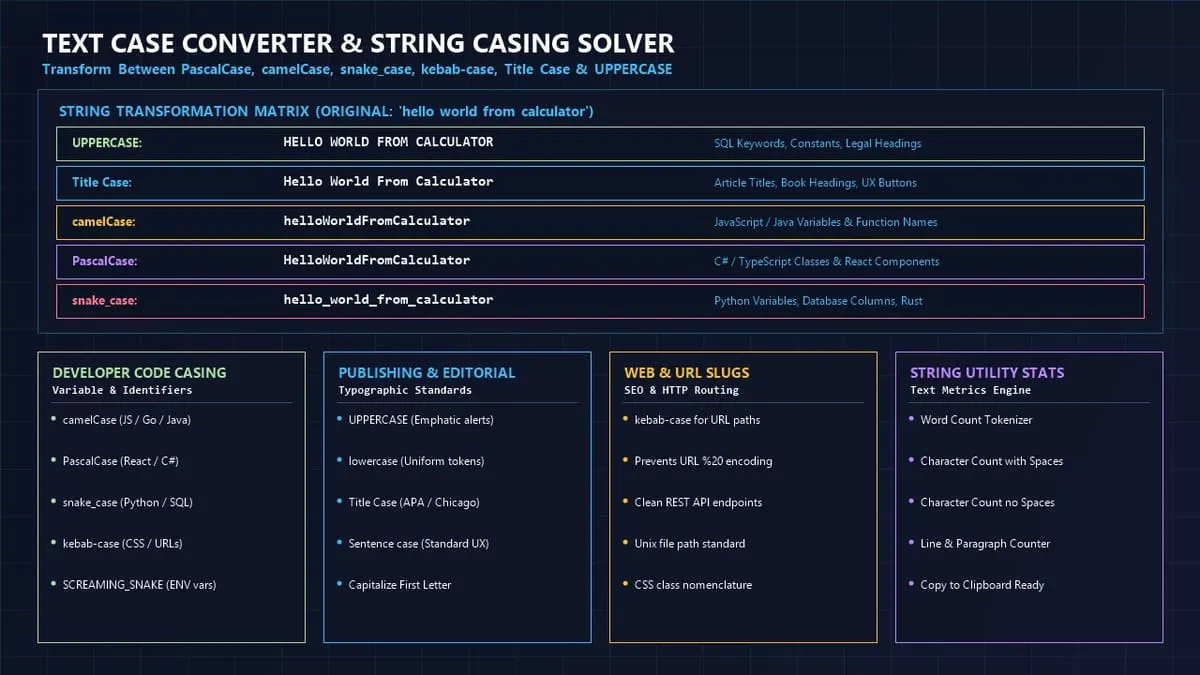
Definition: Transform input text into camelCase, UPPERCASE, lowercase, Title Case, PascalCase, snake_case, or kebab-case based on your selected target casing format.
Governing Math Formula: String tokenization splits input by whitespace and punctuation delimiters, applying specific capitalization rules and join delimiters.
Target Applications: Provides real-time quantitative solutions in Everyday Tools for students, engineers, researchers, and finance professionals.
Text Case Converter: Programming Nomenclature & Typographic Casing Standards Guide
1. Introduction
Why does JavaScript use camelCase for variables while Python insists on snake_case? Why do URL slugs use kebab-case instead of spaces? How should article headlines be formatted under Chicago vs. APA Title Case guidelines?
In computer programming, database administration, web development, and digital publishing, string casing conventions are fundamental structural rules. Because computer operating systems, compilers, and URL parsers treat whitespace and capitalization with strict semantic meaning, converting raw human sentences into standardized identifiers is a daily requirement for developers, content editors, and database architects.
The Text Case Converter instantly parses any raw text string and generates 8 standardized casing transformations across software development paradigms and editorial styles.
graph LR
    RAW["🔤 Raw Input String
e.g. 'hello world from calculator'"] --> TOKEN["🔍 Regex Delimiter Tokenizer
Detects spaces, hyphens, underscores & camel boundaries"]
    TOKEN --> CODE_CASE["💻 Code Identifiers
camelCase | PascalCase | snake_case | kebab-case | CONSTANT_CASE"]
    TOKEN --> EDIT_CASE["📰 Publishing Styles
Title Case | UPPERCASE | lowercase | Sentence case"]
    CODE_CASE --> OUT["📋 One-Click Copy Output Matrix"]
    EDIT_CASE --> OUT
Mastering text casing and naming conventions enables professionals to:
- Adhere strictly to language-specific style guides (PEP 8 for Python, standard Go/Java conventions, React component naming).
- Transform blog and article titles into clean, URL-safe kebab-case slugs (avoiding messy
%20URL encodings).
- Format SQL database tables and column names uniformly in
snake_case.
- Define environment configuration variables in
CONSTANT_CASE(SCREAMING_SNAKE_CASE).
- Automate text normalization for Natural Language Processing (NLP) and search indexing pipelines.
2. Definitions & Mathematical Formulations
2.1 The Simple Definition
- Case Sensitivity: Whether a computer system treats
Variable,variable, andVARIABLEas distinct entities.
- camelCase: Words concatenated without spaces; initial letter is lowercase, subsequent words capitalized (
userProfileData).
- PascalCase (UpperCamelCase): Every word begins with an uppercase letter (
UserProfileData).
- snake_case: Words are all lowercase, separated by underscores (
user_profile_data).
- kebab-case (lisp-case): Words are all lowercase, separated by hyphens (
user-profile-data).
- Title Case: Headline capitalization where major words are capitalized and minor grammatical articles remain lowercase.
2.2 Formal String Tokenization & Transformation Algorithms
flowchart TD
    START["Input Raw Text String S"] --> CLEAN["Normalize Whitespace & Split on Camel Boundaries"]
    CLEAN --> ARRAY["Token Array: [W_1, W_2, ..., W_n]"]
    ARRAY --> FOR_UPPER["UPPERCASE: Join all with spaces, apply toUpperCase()"]
    ARRAY --> FOR_TITLE["Title Case: Capitalize W_i[0] + lowercase remainder"]
    ARRAY --> FOR_CAMEL["camelCase: W_0 lowercase + W_i[1..n] Capitalized"]
    ARRAY --> FOR_PASCAL["PascalCase: All W_i Capitalized"]
    ARRAY --> FOR_SNAKE["snake_case: All lowercase joined with '_'"]
    ARRAY --> FOR_KEBAB["kebab-case: All lowercase joined with '-'"]
    ARRAY --> FOR_CONST["CONSTANT_CASE: All uppercase joined with '_'"]
    FOR_UPPER --> COMPILE["Aggregate Output Array"]
    FOR_TITLE --> COMPILE
    FOR_CAMEL --> COMPILE
    FOR_PASCAL --> COMPILE
    FOR_SNAKE --> COMPILE
    FOR_KEBAB --> COMPILE
    FOR_CONST --> COMPILE
    COMPILE --> DISPLAY["Display Transformation Matrix"]
1. camelCase Transformation
2. PascalCase Transformation
3. snake_case Transformation
4. kebab-case Transformation
3. Master Programming Casing Standards Matrix
| Case Style | Visual Pattern | Primary Technology Stack | Canonical Use Case |
|---|---|---|---|
| camelCase | calculateGrossPay | JavaScript, TypeScript, Java, Swift, Go | Local variables, function & method names |
| PascalCase | CalculatorController | C#, .NET, TypeScript, React, Java | Classes, Interfaces, React Components |
| snake_case | user_account_balance | Python (PEP 8), PostgreSQL, MySQL, Rust | Variable names, database table columns |
| SCREAMING_SNAKE | MAX_BUFFER_CAPACITY | C/C++, Java, Linux Shell, Docker | Global constants, Environment Variables |
| kebab-case | everyday-tools-menu | HTML/CSS, Web URLs, Kubernetes, Lisp | CSS class names, URL slugs, REST paths |
| Title Case | The Comprehensive Guide | Publishing, Journalism, UI Copy | Article headlines, modal dialog titles |
| UPPERCASE | WARNING SYSTEM HALTED | Legal Disclaimers, SQL Commands | SELECT, WHERE, JOIN SQL syntax |
4. History & Evolution of Text Casing in Computing
timeline
    title Evolution of Text Casing & Code Nomenclature
    1950s : Early teleprinters (TTY) and punch cards only support monocase UPPERCASE Baudot code
    1963 : ASCII standard formalized, introducing 7-bit character sets with full lowercase support
    1970s : C language and UNIX introduce concise snake_case for system calls (printf, malloc)
    1980s : Xerox PARC Smalltalk pioneers 'CamelCase' for object-oriented identifiers
    1995 : Java codifies camelCase methods and PascalCase classes as universal OOP standard
2000s : Web 2.0 and SEO make kebab-case mandatory for clean URL permalinks- Monocase Punch Cards (1950s): Early computers (like the IBM 704) had no concept of lowercase letters; all instructions, comments, and data were punched in monocase uppercase.
- The Birth of
snake_casein UNIX (1970s): Dennis Ritchie and Ken Thompson wrote the C standard library with underscores (get_time()) because spaces were illegal in identifiers.
- Smalltalk & The Rise of
CamelHump(1980s): Xerox PARC researchers developed graphical user interfaces in Smalltalk, popularizing embedded capital letters to save screen space and eliminate punctuation.
- The URL Revolution &
kebab-case(2000s): As search engines evolved, Google confirmed that hyphens (kebab-case) are interpreted as word separators in URLs, whereas underscores (snake_case) were historically indexed as single concatenated words.
5. Step-by-Step Practical Walkthrough
Problem: Converting a Headline into Software Artifacts
- Raw Input String:
"Customer payment gateway transaction solver"
Transformations:
- JavaScript Function Name (camelCase):-
"customerPaymentGatewayTransactionSolver" - React / C# Component Class (PascalCase):-
"CustomerPaymentGatewayTransactionSolver" - PostgreSQL Database Column (snake_case):-
"customer_payment_gateway_transaction_solver" - Web URL SEO Slug (kebab-case):-
"customer-payment-gateway-transaction-solver"- Resulting URL:https://example.com/blog/customer-payment-gateway-transaction-solver - Environment Configuration Constant (CONSTANT_CASE):-
"CUSTOMER_PAYMENT_GATEWAY_TRANSACTION_SOLVER" - Blog Article Headline (Title Case):-
"Customer Payment Gateway Transaction Solver"
6. Real-World Applications
graph TD
    CASE_APP["🔤 Text Case Applications"] --> WEB_SEO["🌐 SEO & Web Routing
Generating hyphenated kebab-case URL slugs"]
    CASE_APP --> CODE_REFACTOR["💻 Code Refactoring & IDEs
Converting snake_case JSON payloads to camelCase frontend models"]
    CASE_APP --> SQL_DB["🗄️ Database Architecture
Standardizing table schema identifiers and migration scripts"]
    CASE_APP --> NLP_AI["🤖 AI & Natural Language Processing
Text normalization and token lemmatization"]
1. Frontend-Backend API Normalization
Python backends (Django, FastAPI) commonly output JSON with snake_case keys (first_name, email_address). Frontend JavaScript frameworks (React, Angular) convert these keys into camelCase (firstName, emailAddress) to maintain language idiomaticity.
2. Search Engine Optimization (SEO) URL Slugs
Replacing spaces with hyphens prevents URLs from becoming corrupted with ugly escape sequences like https://example.com/my%20new%20article.
3. Database Migration Scripting
Consistent naming prevents case-sensitivity bugs across database engines (e.g., PostgreSQL folds unquoted identifiers to lowercase, while Oracle folds them to uppercase).
7. Common Text Casing Mistakes
Watch out for these four common naming convention pitfalls:
- Mixing Underscores and Hyphens in Code: In languages like JavaScript and C#, hyphens are treated as the minus subtraction operator (
user-nameis evaluated asuser minus name), causing compile-time syntax errors. - Using Spaces in File Names for Linux / Cloud Servers: Spaces in scripts break shell commands (
rm my file.txttries to delete two separate files,myandfile.txt). Always usekebab-caseorsnake_case. - Inconsistent Title Case Capitalization: Forgetting that short prepositions and coordinating conjunctions (like in, of, on, and, the) should remain lowercase in titles unless they start the sentence.
- Over-Relying on Case in Database Keys: Storing email addresses or usernames in mixed case without converting them to lowercase causes duplicate user account collisions (
User@Email.comvs.user@email.com).
8. Frequently Asked Questions (FAQ)
What is camelCase?
camelCase is a naming convention where words are joined without spaces, the first letter is lowercase, and each subsequent word starts with a capital letter (e.g. firstName).
What is the difference between camelCase and PascalCase?
In camelCase, the very first letter is lowercase (myVariableName). In PascalCase (UpperCamelCase), the very first letter is uppercase (MyClassName).
Why do URLs use kebab-case instead of snake_case?
Search engine algorithms (like Google) explicitly treat hyphens (-) as word separators, whereas underscores (_) were historically treated as letter connectors joining two words into one single token.
What is SCREAMING_SNAKE_CASE?
SCREAMING_SNAKE_CASE (or CONSTANT_CASE) is a convention where all letters are uppercase and words are separated by underscores (e.g. DATABASE_PORT). It is universally used for constants and environment variables.
How does Title Case differ between Chicago and APA style?
In Chicago style, all prepositions are lowercased regardless of length. In APA style, prepositions of 4 or more letters (like With, From, Between) are capitalized in titles.
Can numbers be included in camelCase or snake_case?
Yes. Numbers are appended directly (e.g. item2Count in camelCase, item_2_count in snake_case).
What is sentence case?
Sentence case capitalizes only the first letter of the first word and proper nouns, exactly like a standard sentence in English prose.
How do I convert text to snake_case in JavaScript?
const toSnakeCase = (str) =>
  str
    .replace(/([a-z])([A-Z])/g, '$1 $2')
    .replace(/[^a-zA-Z0-9]+/g, '_')
    .toLowerCase();
What is StudlyCaps?
StudlyCaps (or spongy case) is an informal, alternating casing format (sTuDlYcApS) popularized in internet meme culture to denote mockery or sarcasm.
Why do CSS class names use kebab-case?
CSS syntax is case-insensitive in HTML documents and naturally supports hyphenated identifiers (e.g. btn-primary-large), making kebab-case the universal standard.
9. Summary Checklist
- ✔ Enter Source Text: Input raw sentence, headline, or identifier string.
- ✔ Select Developer Target: Use
camelCasefor JS,PascalCasefor React/C#,snake_casefor Python.
- ✔ Select Web Target: Use
kebab-casefor URL slugs and CSS class selectors.
- ✔ Select Editorial Target: Use Title Case for headlines and UPPERCASE for constants.
- ✔ Verify Output: Ensure all special symbols and spaces are cleanly handled.
Additional Technical Guidelines & Measurement Standards
When conducting calculations for Text Case Case Converter, maintaining quantitative precision and verifying input parameter boundaries is essential for reliable scenario evaluation. Always verify that raw numerical inputs are measured using standardized instrumentation, and double-check unit conversions prior to applying outputs in commercial, industrial, or academic projects.
For quantitative unit conversions and scientific calculations, always maintain at least four decimal places of precision during intermediate arithmetic stages before rounding final results. When preparing technical reports, laboratory documentation, or financial forecasts, cross-verify all output variables against established international measurement standards (such as SI, NIST, and ISO metric benchmarks) to guarantee consistent analytical rigor across all computational workflows.
MathsLover.com delivers this interactive solver 100% free of charge to foster global mathematical literacy, educational accessibility, and data-driven problem solving across scientific, technical, and academic communities worldwide.