💡 Direct Answer & Executive Summary (Concrete Volume Bag Calculator)
Definition: Calculate total cubic yards, cubic feet, cubic meters, and pre-mixed concrete bag counts (80lb, 60lb, 50lb) for slabs, footings, and patios.
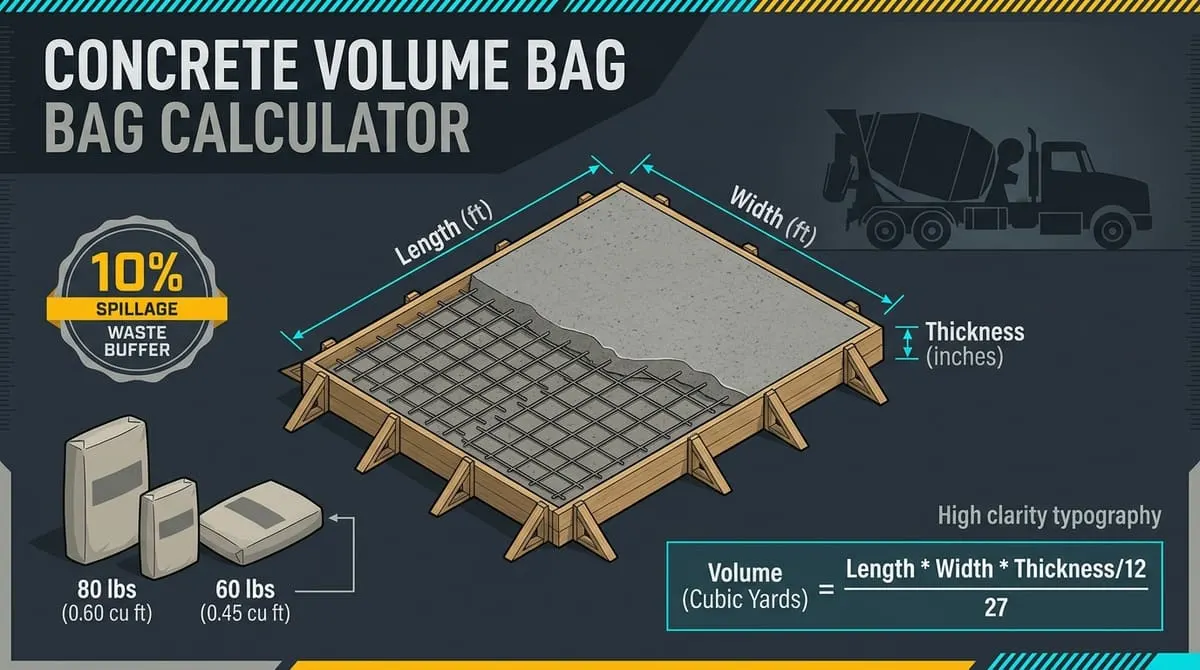
Governing Math Formula: Volume (cu ft) = Length × Width × (Thickness / 12). Cubic Yards = Volume / 27 × (1 + Waste % / 100). 80lb Bags = Gross Cu Ft / 0.60.
Target Applications: Provides real-time quantitative solutions in Everyday Tools for students, engineers, researchers, and finance professionals.
Concrete Volume & Bag Calculator: Comprehensive Slab, Footing & Pre-Mix Estimating Guide
1. Introduction
Concrete is the literal foundation of modern civilization. From interstate highway bridges and airport runways to residential backyard patios, garage slabs, foundation footings, and fence post anchors, concrete is the world's most widely consumed synthetic material.
However, pouring concrete is an irreversible, time-critical chemical process. Once water hydrates Portland cement, the resulting exothermic reaction begins a finite 90-minute curing window during which the concrete must be placed, consolidated, screeded, bull-floated, and troweled. Running out of concrete with of bare wire mesh exposed creates a catastrophic structural defect known as a cold joint (a weak plane where fresh concrete meets hardened concrete, allowing water penetration and eventual freeze-thaw cracking).
graph LR
    DIM["📐 Formwork Dimensions
Length (ft) × Width (ft) × Thickness (in)"] --> VOL_CF["📦 Net Volume in Cubic Feet
Cu Ft = L × W × (Thickness / 12)"]
    SUBGRADE["🚜 Subgrade & Spillage Buffer
10% Standard Waste Allowance"] --> GROSS_CF["🧱 Gross Volume in Cubic Feet
Gross Cu Ft = Net Cu Ft × 1.10"]
    VOL_CF --> GROSS_CF
    GROSS_CF --> YARD_DIV["➗ Divided by 27 cu ft/yd³
Volume in Cubic Yards (yd³)"]
    YARD_DIV --> TRUCK["🚚 Ready-Mix Truck Order
Cubic Yards (for jobs > 1-2 yd³)"]
    GROSS_CF --> BAGS["🛒 Pre-Mix Bag Calculation
80lb (0.60 cu ft) | 60lb (0.45 cu ft)"]
Mastering concrete volumetric mathematics enables homeowners, general contractors, masons, and civil engineers to:
- Accurately project cubic yardage and cubic footage for rectangular slabs, circular column footings, retaining walls, and post holes.
- Calculate exact pre-mixed bag quantities across standard retail bag sizes (80-lb, 60-lb, and 50-lb bags).
- Determine the economic and logistical break-even threshold between hand-mixing bagged concrete vs. scheduling a ready-mix transit mixer truck delivery.
- Incorporate a realistic 10% spillage and subgrade settlement buffer.
- Understand structural reinforcement design (rebar grids, welded wire mesh, and expansion joint spacing).
2. Definitions & Mathematical Formulations
2.1 The Simple Definition
- Cubic Foot (): A unit of volume measuring ().
- Cubic Yard ( / "Yard"): The standard commercial concrete delivery unit, equivalent to ().
- Bag Yield: The volume of wet, compacted concrete produced by a single dry pre-mixed bag (an yields ; a yields ).
- Cold Joint: A structurally compromised boundary formed when fresh concrete is poured against concrete that has already begun its initial set.
2.2 Formal Mathematical Formulations
1. Rectangular Slab Volume ()
For a rectangular pour with Length () and Width () in feet, and Thickness () in inches:
2. Conversion to Cubic Yards ()
Since , :
3. Gross Volume Factoring Spillage & Subgrade Allowance ()
Adding the percentage waste allowance ( standardly 10%):
4. Pre-Mixed Bag Calculation Formulations
- 80-lb Bags (Yield: per bag | ):
- 60-lb Bags (Yield: per bag | ):
- 50-lb Bags (Yield: per bag | ):
5. Cylindrical Column / Post Hole Footing Volume ()
For circular footings or Sonotube sonotubes with Radius (in feet) and Depth (in feet):
flowchart TD
    START["Measure Slab Dimensions: Length (ft), Width (ft), Thickness (in)"] --> VOL_CALC["Calculate Net Volume: Cu Ft = L × W × (T / 12)"]
    VOL_CALC --> APPLY_WASTE["Add 10% Spillage & Subgrade Deflection Buffer"]
    APPLY_WASTE --> YARD_CONV["Convert to Cubic Yards: Gross Cu Ft / 27"]
    YARD_CONV --> DECISION{"Total Volume > 1.5 - 2.0 Cubic Yards?"}
    DECISION -->|Yes| READYMIX["🚚 Order Ready-Mix Concrete Truck Delivery"]
    DECISION -->|No| BAG_SELECT["🛒 Purchase Pre-Mix Bags: 80lb Bags = Gross Cu Ft / 0.60"]
    READYMIX --> ORDER["Coordinate Pour Crew & Chute Access"]
    BAG_SELECT --> ORDER
3. Historical Timeline of Concrete Engineering
timeline
    title Milestones in Concrete Chemistry & Hydraulic Cement
    6500 BCE : Nabataean bedouins invent waterproof hydraulic lime mortar in desert cisterns
    c. 125 CE : Roman builders complete Pantheon rotunda using unreinforced volcanic pozzolana
    1824 : Joseph Aspdin patents modern Portland cement in Leeds, England
    1867 : Joseph Monier invents steel rebar reinforced concrete for structural slabs
    1930s : Construction of Hoover Dam pioneers internal refrigeration cooling pipes for mass concrete
Modern : Ultra-High-Performance Concrete (UHPC) achieving >20,000 PSI compressive strength- Roman Pozzolanic Concrete (125 CE): Roman engineers combined slaked lime with volcanic ash (pozzolana) from Mount Vesuvius to construct the majestic dome of the Pantheon ( span), which remains the world's largest unreinforced concrete dome standing intact after 1,900 years.
- Joseph Aspdin & Portland Cement (1824): English stonemason Joseph Aspdin patented Portland Cement by firing finely ground limestone and clay in a high-temperature kiln, creating a standardized hydraulic binder named after Portland building stone.
- Reinforced Concrete (1867): French gardener Joseph Monier embedded iron mesh into concrete planter boxes and railway ties, resolving concrete's fundamental limitation: its high compressive strength but weak tensile strength.
- Modern Ready-Mix Transit (1930s–Present): Rotating drum mixer trucks, computerized batch plants, and water-reducing plasticizer admixtures enabled precise, large-scale structural pours worldwide.
4. Master Pre-Mix Concrete Bag Comparison Matrix
| Pre-Mix Bag Size | Dry Weight | Wet Mixed Yield | Bags Needed per Cubic Yard () | Water Required per Bag | Best Project Applications |
|---|---|---|---|---|---|
| 80-lb Bag (Standard) | Patios, driveways, walkway slabs, heavy machinery pads | ||||
| 60-lb Bag (Handy) | Post hole setting, sidewalk repairs, solo DIY lifting | ||||
| 50-lb Bag (Fast-Setting) | Fence posts, mailbox anchors (sets in ) | ||||
| Bulk Ready-Mix Truck | Sold by the | Pre-blended in drum | Pours () |
5. Step-by-Step Calculation Walkthrough
Let us calculate the concrete materials required to pour a 10 ft × 12 ft outdoor patio slab with a standard residential 4-inch thickness.
graph TD
    subgraph "Patio Slab Project Dimensions"
        S_DIM["📐 Slab: 12 ft Length × 10 ft Width × 4 in Thickness"]
        S_NET["📦 Net Volume: 12 × 10 × (4/12) = 40.0 cu ft"]
        S_DIM --> S_NET
        S_WASTE["🛡️ 10% Waste Buffer: 40.0 × 1.10 = 44.0 cu ft Gross"]
        S_NET --> S_WASTE
        S_YARD["🚚 Cubic Yards: 44.0 / 27 = 1.63 Cubic Yards"]
        S_WASTE --> S_YARD
        S_BAGS["🛒 80lb Bags: 44.0 / 0.60 = 73.3 → Buy 74 Bags (5,920 lbs)"]
        S_WASTE --> S_BAGS
    end
Step 1: Calculate Net Slab Volume in Cubic Feet
- Convert 4 inches of thickness to feet: .
Step 2: Apply 10% Spillage & Subgrade Settlement Buffer
Step 3: Convert to Cubic Yards
Step 4: Determine Pre-Mix Bag Counts
- Using 80-lb Bags ():(Total dry weight to transport: )
- Using 60-lb Bags ():
6. The Economic Decision: Bagged Concrete vs. Ready-Mix Truck Delivery
graph TD
    VOL_CHECK{"Project Volume"} --> SMALL["< 1.0 Cubic Yard (< 45 Bags)
e.g., Post holes, sidewalk pad"]
    VOL_CHECK --> MID["1.0 - 2.0 Cubic Yards (45 - 90 Bags)
e.g., Small patio, shed slab"]
    VOL_CHECK --> LARGE["> 2.0 Cubic Yards (> 90 Bags)
e.g., Garage slab, driveway"]
    SMALL --> DO_BAGS["🛒 Buy Bagged Pre-Mix (Rent portable drum mixer)"]
    MID --> EVAL["⚖️ Evaluate: Ready-mix short-load fee ($100-$150) vs 3 tons of heavy manual lifting"]
LARGE --> DO_TRUCK["🚚 Order Ready-Mix Transit Truck Delivery"]| Decision Factor | Pre-Mix Bags () | Ready-Mix Transit Truck |
|---|---|---|
| Material Cost (for 2.0 Yards) | $\sim 90\text{ bags} \times \$6.00 = \mathbf{\$540.00}$ | $2.0\text{ yards} \times \$140/\text{yd} = \mathbf{\$280.00}$ |
| Delivery / Short Load Surcharge | $0 (if hauling in pickup) or $80 flat flatbed | $\$100\text{–}\$175$ (under-minimum short-load fee for $<4\text{ yds}$) |
| Total Out-of-Pocket Expense | $540 - $620 | $380 - $455 |
| Physical Labor Required | Extremely Exhausting (Shoveling 7,200 lbs) | Minimal (Chute pours directly into forms in 15 mins) |
| Risk of Cold Joints | High (Slow manual batch-mixing in wheelbarrow) | Zero (Monolithic single pour) |
7. Real-World Case Studies in Concrete Slab Construction
Case Study 1: The "Wheelbarrow Fatigue" Cold Joint Disaster
- Scenario: Tom decided to pour an shed slab () solo using a single wheelbarrow and garden hoe.
- Disaster: Mixing each 2-bag batch took 12 minutes. By bag #40, Tom was exhausted, and 4 hours had elapsed. The first half of the slab had completely cured, while the second half was still wet, resulting in a fractured cold joint that cracked during the first winter freeze.
- Takeaway: For pours exceeding 30 bags, always rent an electric drum mixer and assemble a minimum crew of 3 people (one mixing, one hauling/dumping, one screeding).
8. Crucial Advantages of Accurate Concrete Estimating
- Prevents Structural Cold Joints: Pouring continuously ensures a single monolithic concrete crystal matrix with uniform tensile and compressive strength.
- Protects Subgrade Settlement: Excavated soil is rarely laser-flat; budgeting a 10% waste factor prevents running short due to subgrade undulations.
- Optimizes Short-Load Delivery Costs: Ready-mix companies charge hefty penalty fees if a driver must return with a "cleanup load" of .
- Calculates Hauling Payload Limits: Knowing that 74 bags weigh prevents overloading standard 1/2-ton pickup trucks (), avoiding dangerous axle and suspension damage.
9. Frequently Asked Questions (FAQ)
How many 80-lb bags of concrete are in a cubic yard?
There are 45 bags of 80-lb concrete in one cubic yard ().
How many 60-lb bags of concrete make a cubic yard?
There are 60 bags of 60-lb concrete in one cubic yard.
What is the formula for calculating concrete slab volume?
How thick should a concrete patio or driveway be?
- Patios & Walkways: Standard thickness is 4 inches ().
- Driveways & Heavy RV Pads: Standard thickness is 5 to 6 inches () with rebar reinforcement.
Why do I need to add 10% extra for concrete?
Excavated soil is never perfectly level. Formwork bows slightly under wet concrete hydrostatic pressure, and spillage occurs during placement. A 10% buffer prevents running out before the slab is full.
How much water should I add per 80-lb bag?
Add 2.5 to 3.0 quarts () of clean water per 80-lb bag. Avoid adding excessive water; runny concrete loses up to 50% of its compressive strength and is prone to surface dusting and cracking.
How long does concrete take to cure?
Concrete reaches approximately 70% of its design strength in 7 days and achieves its full rated strength (e.g., ) in 28 days.
Can I drive on a new concrete driveway after 24 hours?
No. You can walk on new concrete after 24–48 hours, but you must wait at least 7 days before driving passenger vehicles on it.
What is the difference between cement and concrete?
Cement (Portland cement) is a fine gray powder binder. Concrete is the finished structural building material made by mixing cement, sand, gravel (aggregate), and water.
How do I calculate concrete for fence post holes?
Use the cylinder formula: . For an 8-inch diameter hole () that is deep, the volume is , which requires 1.5 bags of 80-lb concrete per post.
10. Summary Checklist
- ✔ Measure Length, Width, and Form Thickness: Convert thickness to feet ($T/12$).
- ✔ Compute Net Cubic Feet: .
- ✔ Add 10% Waste Factor: Account for subgrade irregularities and spillage.
- ✔ Convert to Cubic Yards: Divide gross cubic feet by .
- ✔ Calculate Bags: Multiply cubic yards by (for 80-lb bags) or (for 60-lb bags).
- ✔ Evaluate Ready-Mix vs. Bag Mixing: Choose truck delivery for pours .
Additional Technical Guidelines & Measurement Standards
When conducting calculations for Concrete Volume Bag Calculator, maintaining quantitative precision and verifying input parameter boundaries is essential for reliable scenario evaluation. Always verify that raw numerical inputs are measured using standardized instrumentation, and double-check unit conversions prior to applying outputs in commercial, industrial, or academic projects.
For quantitative unit conversions and scientific calculations, always maintain at least four decimal places of precision during intermediate arithmetic stages before rounding final results. When preparing technical reports, laboratory documentation, or financial forecasts, cross-verify all output variables against established international measurement standards (such as SI, NIST, and ISO metric benchmarks) to guarantee consistent analytical rigor across all computational workflows.
MathsLover.com delivers this interactive solver 100% free of charge to foster global mathematical literacy, educational accessibility, and data-driven problem solving across scientific, technical, and academic communities worldwide.