💡 Direct Answer & Executive Summary (Stopwatch & Timer Duration Solver)
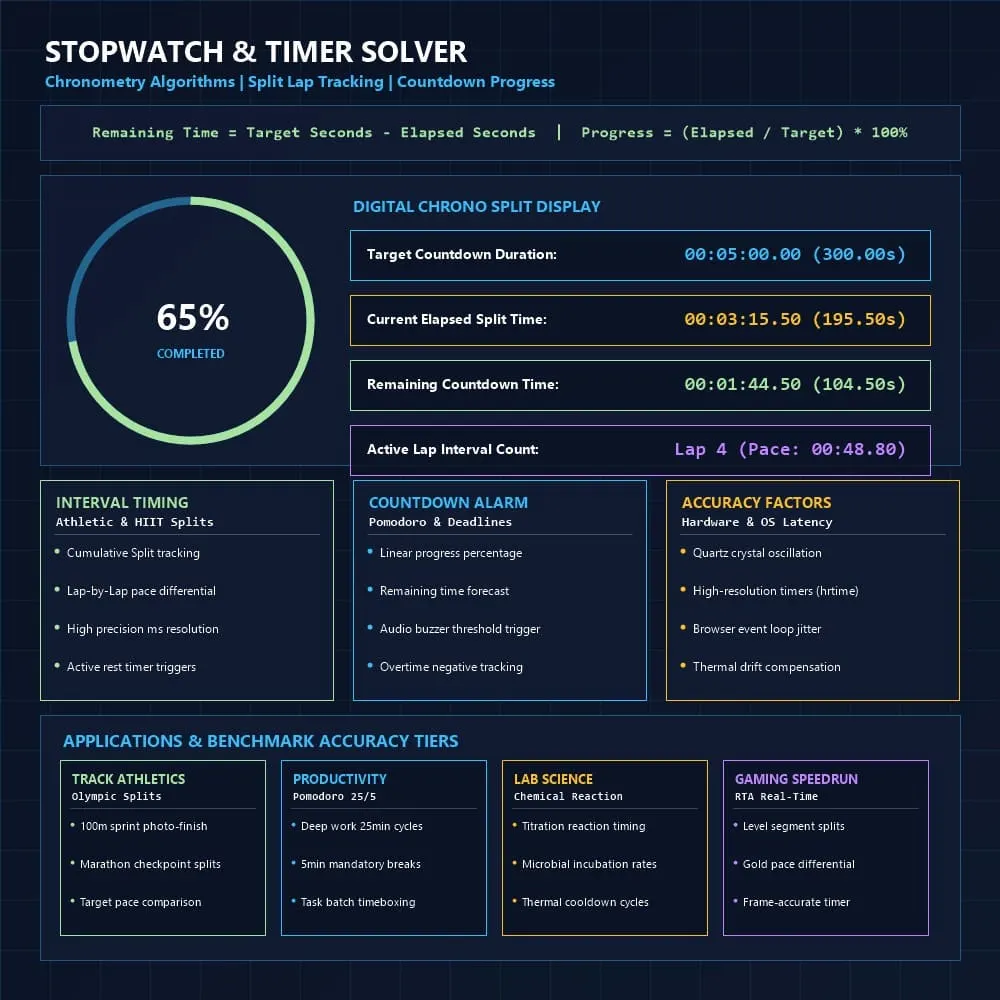
Definition: Calculate high-precision stopwatch split intervals, countdown progress percentages, remaining time to target, and average lap paces for athletics and productivity.
Governing Math Formula: Remaining Seconds = Target Seconds - Elapsed Seconds. Progress Rate (%) = (Elapsed Seconds / Target Seconds) × 100%. Lap Average Pace = Elapsed Seconds / Lap Count.
Target Applications: Provides real-time quantitative solutions in Everyday Tools for students, engineers, researchers, and finance professionals.
Stopwatch & Timer Duration Solver: High-Precision Chronometry, Splits & Intervals Guide
1. Introduction
From Olympic sprinters crossing the 100-meter finish line separated by hundredths of a second to software developers tracking deep-work sprints using the Pomodoro Technique, time tracking is one of humanity’s most vital applications of chronometry. A Stopwatch counts elapsed time upward from zero with millisecond precision, while a Timer executes a countdown downward toward a predetermined goal or deadline.
The Stopwatch & Timer Duration Solver bridges the gap between raw hardware clock ticks and actionable human performance metrics. By analyzing target durations, elapsed split times, and lap intervals, this tool calculates exact percentage completion rates, remaining countdown times, overtime tolerances, and pace differentials across track athletics, laboratory chemical reactions, study sessions, and industrial manufacturing cycles.
graph LR
    TARGET["🎯 Target Duration (T)
Target Minutes + Seconds"] --> SOLVER["⏱️ Chronometry Engine
Remaining = Target - Elapsed
Progress = (Elapsed / Target) × 100%"]
    ELAPSED["⏳ Elapsed Split (E)
Elapsed Minutes + Seconds"] --> SOLVER
    LAPS["🏃 Completed Lap Count (L)
Pace = Elapsed / L"] --> SOLVER
    SOLVER --> REM["⌛ Remaining Canonical Time (HH:MM:SS)"]
    SOLVER --> RATE["📊 Progress Completion Rate (%)"]
    SOLVER --> PACE["⚡ Average Lap Pace Differential"]
    SOLVER --> STAT["🔔 Status Diagnosis (Overtime / On Pace / Complete)"]
Mastering chronometric calculations enables athletes, coaches, engineers, scientists, and productivity enthusiasts to:
- Quantify exact progress across single-session workouts and Pomodoro productivity timeboxes.
- Measure average lap paces and split intervals to forecast race finishing times.
- Understand the hardware physics of quartz crystal oscillations, high-resolution timers (
performance.now()), and software event-loop drift.
- Prevent timekeeping errors in clinical medical trials, kitchen baking, and laboratory titration reactions.
- Track overtime intervals to analyze burnout risks or project delivery overruns.
2. Definitions & Mathematical Formulations
2.1 The Simple Definition
- Stopwatch: An instrument designed to measure elapsed time from activation to deactivation.
- Split Time (Cumulative): Total elapsed time from the race start to a specific checkpoint.
- Lap Time (Interval): Time taken to complete an individual segment or loop.
- Countdown Timer: An instrument configured to count backward from a specified duration toward zero.
- Progress Rate (): The percentage of the target duration that has elapsed.
2.2 Formal Mathematical Formulations
1. Total Seconds Conversion
2. Remaining Duration Formula
If , the timer is in Overtime by .
3. Linear Progress Percentage Formula
4. Average Lap Pace Formula
For completed laps:
Decomposed into canonical minutes and seconds:
flowchart TD
    START["Input Target Time (M, S) & Elapsed Time (M, S) & Lap Count"] --> SEC_CALC["Compute Total Target Seconds & Total Elapsed Seconds"]
    SEC_CALC --> REM_CALC["Calculate Remaining Seconds = Target - Elapsed"]
    REM_CALC --> PROG_CALC["Compute Progress % = (Elapsed / Target) × 100"]
    PROG_CALC --> PACE_CALC["Compute Lap Average Pace = Elapsed / Laps"]
    PACE_CALC --> STATUS_EVAL{"Is Elapsed > Target?"}
    STATUS_EVAL -->|"Yes (Overtime)"| OVER["🚨 Overtime Alert: Goal Exceeded by Remaining Difference"]
    STATUS_EVAL -->|"No (In Progress)"| ON_TRACK["✅ On Track: Display Remaining Time & % Complete"]
    OVER --> DISPLAY["Render Formatted Metrics & Diagnosis"]
    ON_TRACK --> DISPLAY
3. History & Milestones of Precision Timekeeping
timeline
    title Evolution of Stopwatches & Precision Timers
    1776 : Jean-Moyse Pouzait invents first independent seconds-hand stopwatch movement
    1821 : Nicolas Mathieu Rieussec patents first commercial inking chronograph for horse racing
    1927 : Warren Marrison develops first quartz crystal clock at Bell Labs
    1968 : Heuer introduces first digital electronic stopwatch at Olympic trials
    1980s : Casio & Timex popularize digital wrist stopwatches with lap memory
Modern : High-resolution Web API performance.now() achieves microsecond execution accuracy- Pouzait's Independent Seconds (1776): Swiss horologist Jean-Moyse Pouzait introduced the first watch mechanism with a secondary gear train that allowed the seconds hand to be started and stopped without stopping the primary movement.
- Rieussec's Inking Chronograph (1821): French watchmaker Nicolas Rieussec coined the term chronograph (literally "time writer") by inventing a device that deposited a tiny drop of ink onto a rotating enamel dial whenever a horse crossed the finish line at the Champ de Mars.
- Quartz Crystal Oscillators (1927): Discovering that quartz crystals vibrate at a hyper-stable piezoelectric frequency (), Bell Labs engineers unlocked chronometry precision within milliseconds per year.
- Modern High-Resolution Digital Timers: Operating systems and web browsers utilize high-precision monotonic clock registers (
CLOCK_MONOTONIC_RAW) delivering sub-millisecond resolution ().
4. Master Comparison: Timing Modes & Applications
| Timing Mode | Direction | Primary Output | Typical Domains | Key Metric |
|---|---|---|---|---|
| Elapsed Stopwatch | Upward () | Total elapsed seconds & splits | Track, Swimming, Motorsport | Lowest Lap Time |
| Countdown Timer | Downward () | Remaining seconds & progress % | Pomodoro, Cooking, Exam tests | Time Remaining |
| HIIT Interval Timer | Alternating cycles | Active vs. Rest phase blocks | CrossFit, Tabata, Boxing | Work-to-Rest Ratio |
| Speedrun RTA Split | Upward + Deltas | Gold pace delta comparison | Video game speedrunning | Real-Time Attack Delta |
5. Step-by-Step Practical Walkthrough
Problem: 5-Kilometer Race Pacing
- Runner's Target Goal: Finish in ().
- Current Checkpoint: At the marker (Lap 3), the stopwatch reads ().
Step-by-Step Calculations:
- Target Seconds:
- Elapsed Seconds:
- Remaining Race Time:
- Race Completion Percentage:
- Average Kilometer Pace:
- Required Remaining Pace:
- Verdict: The runner is currently running ahead of their required pace and is well on track to beat their 25-minute goal!
6. Real-World Applications
graph TD
TIMER_APP["⏱️ Real-World Chronometry Applications"] --> SPORTS["🏃 Track Athletics & Swimming
Photo-finish splits and lap cadence analysis"]
TIMER_APP --> WORK["💼 Deep-Work Productivity
Pomodoro 25min focus + 5min active recovery"]
TIMER_APP --> MED["🧪 Pharmaceutical Titration
Reaction incubation and centrifugal spinning"]
TIMER_APP --> CULINARY["👨🍳 Precision Culinary Arts
Sous-vide temperature and sourdough fermentation"]1. Productivity & Pomodoro Timeboxing
Working in focused 25-minute intervals followed by 5-minute rest breaks prevents cognitive fatigue, enhances executive focus, and creates positive psychological momentum.
2. Olympic Athletics Photo-Finish
Modern Olympic timing systems integrate electronic starting pistols with laser finish line sensors and high-speed slit-scan cameras capturing to separate competitors by thousandths of a second.
3. Laboratory Chemical Reactions
Kinetic rate experiments require precise stopwatch timings to calculate activation energies and reaction rate constants ().
7. Common Timing Pitfalls
Watch out for these four common precision timing errors:
- JavaScript
setTimeoutDrift: Relying on basic timers in browser tabs causes time drift when tabs are backgrounded. Robust apps must calculate delta timestamps usingperformance.now(). - Confusing Cumulative Splits with Lap Times: A split measures total time from the start line; a lap measures the isolated duration of that single lap loop.
- Human Reaction Time Latency: Manual finger activation of a mechanical stopwatch introduces an average human reaction delay of .
- Quartz Thermal Drift: Extreme temperature swings cause standard quartz crystals to oscillate slightly faster or slower, causing uncompensated wristwatches to gain or lose seconds over time.
8. Frequently Asked Questions (FAQ)
What is the difference between a stopwatch and a timer?
A stopwatch counts upward from zero to measure how long an event took. A timer counts downward from a set duration to zero to alert you when time has elapsed.
What is a "Split" vs. a "Lap"?
- Split: Total cumulative time elapsed from the initial start line to the current checkpoint.
- Lap: The isolated time duration taken to complete only the most recent loop or segment.
How accurate are smartphone and browser stopwatches?
Digital software stopwatches measuring system clock registers are accurate within milliseconds (). However, manual human tapping introduces a reaction delay.
What is the Pomodoro Technique?
A time-management method where work is broken into 25-minute focused intervals ("Pomodoros") separated by 5-minute short breaks, with a longer 15–30 minute break every 4 cycles.
How do I calculate percentage progress on a countdown timer?
What does "Overtime" mean in a timer?
Overtime occurs when elapsed time surpasses the target countdown duration. The timer continues counting into negative territory to indicate how long you have exceeded the goal.
Why do quartz watches use a 32,768 Hz frequency?
Because . A simple 15-stage binary frequency divider circuit can halve the signal 15 times to produce an exact 1-second pulse ().
What is a monotonic clock?
A monotonic clock is a hardware clock source that only moves forward at a constant rate, unaffected by system time adjustments or Daylight Saving Time shifts.
What is Tabata training?
An intense HIIT workout protocol consisting of 8 rounds of 20 seconds of maximum effort exercise followed by 10 seconds of rest (total ).
How is average lap pace calculated?
Divide the total elapsed time by the number of completed laps: .
9. Summary Checklist
- ✔ Set Target Duration: Specify target minutes and seconds ().
- ✔ Log Elapsed Time: Enter elapsed split minutes and seconds.
- ✔ Input Lap Count: Provide completed loops to calculate average pace.
- ✔ Evaluate Progress: Review remaining canonical time and percentage progress.
- ✔ Check Diagnosis: Monitor overtime alerts and pace trends.
Additional Technical Guidelines & Measurement Standards
When conducting calculations for Stopwatch & Timer Duration Solver, maintaining quantitative precision and verifying input parameter boundaries is essential for reliable scenario evaluation. Always verify that raw numerical inputs are measured using standardized instrumentation, and double-check unit conversions prior to applying outputs in commercial, industrial, or academic projects.
For quantitative unit conversions and scientific calculations, always maintain at least four decimal places of precision during intermediate arithmetic stages before rounding final results. When preparing technical reports, laboratory documentation, or financial forecasts, cross-verify all output variables against established international measurement standards (such as SI, NIST, and ISO metric benchmarks) to guarantee consistent analytical rigor across all computational workflows.
MathsLover.com delivers this interactive solver 100% free of charge to foster global mathematical literacy, educational accessibility, and data-driven problem solving across scientific, technical, and academic communities worldwide.