💡 Direct Answer & Executive Summary (Calendar Day of Week Finder)
Definition: Determine the exact day of the week for any past, present, or future calendar date using Christian Zeller's mathematical congruence algorithm.
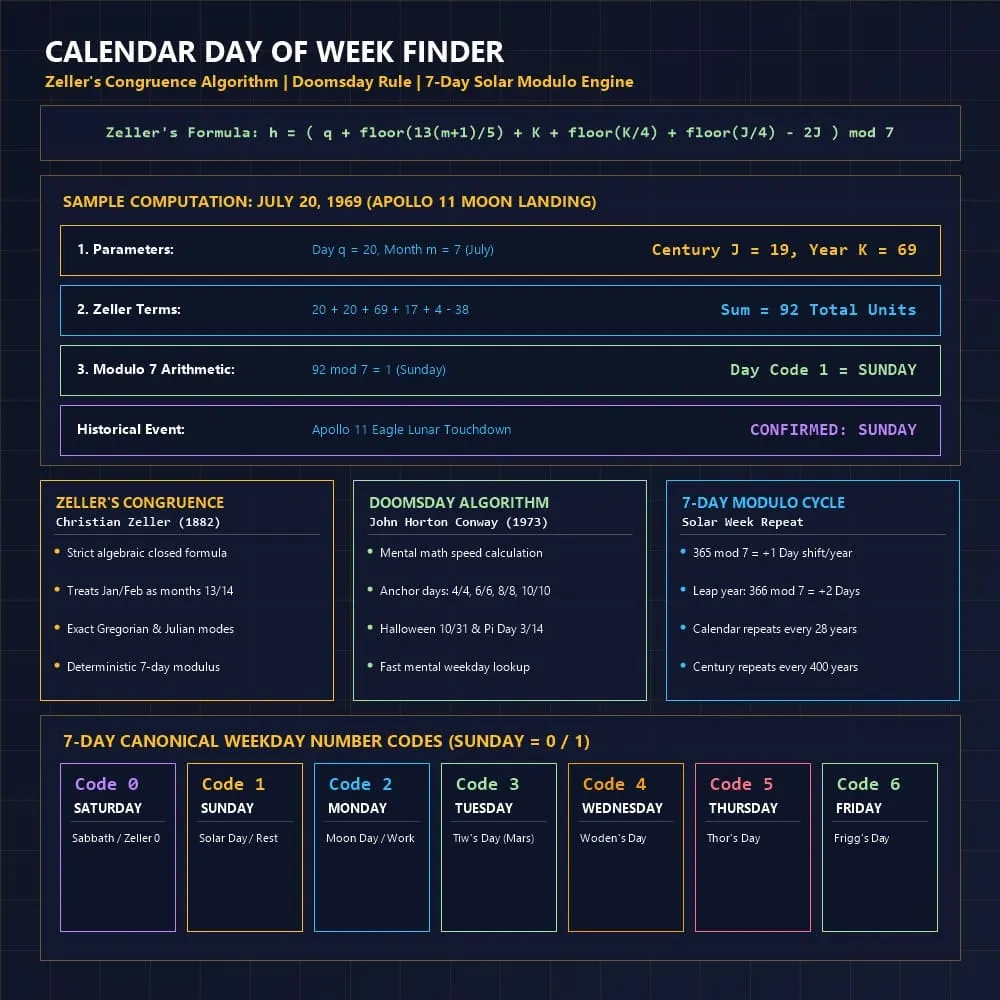
Governing Math Formula: Zeller's Congruence: h = (q + floor(13(m+1)/5) + K + floor(K/4) + floor(J/4) - 2J) mod 7. Day codes: 0=Saturday, 1=Sunday, 2=Monday, 3=Tuesday, 4=Wednesday, 5=Thursday, 6=Friday.
Target Applications: Provides real-time quantitative solutions in Everyday Tools for students, engineers, researchers, and finance professionals.
Calendar Day of Week Finder: Comprehensive Zeller's Congruence & Doomsday Guide
1. Introduction
What day of the week was July 20, 1969 when Apollo 11 touched down on the Moon? On what day of the week were you born? On what day will December 25 fall five years from now?
Determining the exact weekday for any calendar date across thousands of years of human history might seem to require leafing through endless paper archives. In reality, calendar days follow strict cyclical modular arithmetic. Because standard common years contain (, ) and leap years contain (), dates shift systematically across the 7-day week.
In 1882, German mathematician Christian Zeller formulated Zeller’s Congruence, a brilliant algebraic equation that directly computes the day of the week for any Gregorian or Julian date. Later in 1973, Cambridge mathematician John Horton Conway developed the famous Doomsday Rule, allowing mental calculation prodigies to calculate the day of the week for any historical date in just seconds.
graph LR
    DATE_IN["📅 Input Date (Year, Month, Day)
e.g. July 20, 1969"] --> ZELLER["🧮 Zeller's Congruence Engine
h = (q + floor(13(m+1)/5) + K + K/4 + J/4 - 2J) mod 7"]
    ZELLER --> CODE["🔢 Weekday Code Index (0 to 6)
0=Sat, 1=Sun, 2=Mon, 3=Tue, 4=Wed, 5=Thu, 6=Fri"]
    CODE --> CANON["🗓️ Canonical Day Name (e.g. SUNDAY)"]
    CODE --> META["📊 Calendar Metadata
Day of Year (1-366) | ISO Week | Weekend Status"]
Mastering weekday calendar arithmetic enables historians, genealogists, software developers, legal investigators, and astronomy enthusiasts to:
- Instantly verify the day of the week for historical events, genealogical birth records, and legal document executions.
- Implement closed-form date calculation algorithms in software without heavy third-party datetime libraries.
- Apply the Doomsday Algorithm for mental math speed calculations.
- Analyze 28-year solar calendar repetition cycles and 400-year Gregorian perpetual loops.
- Calculate ISO 8601 week numbers and annual Julian day-of-year indices.
2. Definitions & Mathematical Formulations
2.1 The Simple Definition
- Day of the Week: One of the seven standard cyclical days (Sunday through Saturday).
- Zeller’s Congruence: An algebraic formula devised by Christian Zeller to calculate the weekday of any Gregorian or Julian date.
- Doomsday: In Conway’s algorithm, an anchor weekday that shared dates (like 4/4, 6/6, 8/8, 10/10, 12/12) always fall on in a given year.
- Solar Cycle (28 Years): The period after which the days of the week repeat on the exact same calendar dates (7 days 4-year leap cycle).
2.2 Formal Mathematical Formulations
1. Zeller’s Congruence Formula (Gregorian Calendar)
For any calendar date with Day , Month , and Year :
Where:
- is the Day of the Month ().
- is the Shifted Month Number:- March = , April = , ..., December = .- Crucial Rule: January and February are counted as months and of the previous year ($Y - 1$).
- is the Year of the Century: .
- is the Zero-Based Century: .
- $\lfloor \dots \rfloor$ is the integer floor function.
- is the Day of the Week Code:- .
2. Equivalent Positive Modulo Formulation
In programming languages where the % modulo operator can return negative values for negative operands, the $-2J$ term is replaced by $+5J$ ():
flowchart TD
    START["Input Year Y, Month M, Day Q"] --> JAN_FEB{"Is Month January (1) or February (2)?"}
    JAN_FEB -->|"Yes"| SHIFT["Shift Month: m = M + 12
Shift Year: Y = Y - 1"]
    JAN_FEB -->|"No"| NO_SHIFT["Keep Month: m = M
Keep Year: Y = Y"]
    SHIFT --> SPLIT_CENT["Extract Century J = floor(Y/100) and Year K = Y % 100"]
    NO_SHIFT --> SPLIT_CENT
    SPLIT_CENT --> RUN_ZELLER["Compute Zeller Sum:
S = Q + floor(13(m+1)/5) + K + floor(K/4) + floor(J/4) + 5J"]
    RUN_ZELLER --> MOD7["Compute h = S % 7"]
    MOD7 --> MAP_DAY["Map Code: 0=Sat, 1=Sun, 2=Mon, 3=Tue, 4=Wed, 5=Thu, 6=Fri"]
    MAP_DAY --> DISPLAY["Render Final Weekday & Calendar Metadata"]
3. History & Milestones of Calendar Weekday Calculation
timeline
    title Milestones in Weekday Chronometry & Algorithms
    c. 1st Century CE : Roman Empire standardizes 7-day planetary week (Sun, Moon, Mars, Mercury, Jupiter, Venus, Saturn)
    1582 : Pope Gregory XIII introduces Gregorian calendar reform
    1882 : Christian Zeller publishes Acta Mathematica paper establishing Zeller's Congruence
    1973 : John Horton Conway invents the mental math Doomsday Algorithm
    1988 : ISO 8601 international standard establishes Monday as Day 1 of calendar week
Modern : JavaScript Date.prototype.getDay() & POSIX time_t implement standardized epoch offsets- The 7-Day Planetary Week (1st Century CE): Ancient Hellenistic and Roman astrologers named the seven days after the classical planetary deities: Sun (Sunday), Moon (Monday), Mars/Tiw (Tuesday), Mercury/Woden (Wednesday), Jupiter/Thor (Thursday), Venus/Frigg (Friday), and Saturn (Saturday).
- Christian Zeller’s Breakthrough (1882): German mathematician and minister Christian Zeller published his formula in Acta Mathematica, simplifying centuries of complex table lookups into a single elegant polynomial.
- Conway’s Doomsday Rule (1973): British mathematician John Conway devised the "Doomsday Rule" by identifying memorable annual anchor dates:- Even months: 4/4, 6/6, 8/8, 10/10, 12/12.- Mnemonic dates: "9-to-5 at the 7-Eleven" ($5/9, 9/5, 7/11, 11/7$), Pi Day (), and Halloween ().- In any given year, all of these dates fall on the exact same day of the week (the year’s "Doomsday").
4. Master 7-Day Weekday Mapping Matrix
| Day Code () | Standard Weekday Name | Celestial Origin | ISO 8601 Number | Business Classification |
|---|---|---|---|---|
| Saturday | Saturn (Saturni dies) | Weekend (Rest) | ||
| Sunday | The Sun (Solis dies) | Weekend (Rest) | ||
| Monday | The Moon (Lunae dies) | Weekday (Start of Business Week) | ||
| Tuesday | Tiw / Mars (Martis dies) | Weekday | ||
| Wednesday | Woden / Mercury (Mercurii dies) | Weekday ("Hump Day") | ||
| Thursday | Thor / Jupiter (Iovis dies) | Weekday | ||
| Friday | Frigg / Venus (Veneris dies) | Weekday (End of Business Week) |
5. Step-by-Step Practical Walkthroughs
Example 1: July 20, 1969 (Apollo 11 Moon Landing)
- Target Date: , Month = July (), Year = .
- Decomposition:- (March–December, no shift needed).- Century .- Year of Century .
Step-by-Step Execution:
- Month Term:
- Year Terms:
- Century Terms:
- Sum All Terms:
- Modulo 7:
- Result: Day Code corresponds to SUNDAY. Neil Armstrong stepped onto the lunar surface on a Sunday!
Example 2: January 1, 2000 (New Millennium Day)
- Target Date: , Month = January (), Year = .
- January Shift Rule:- .- .- .- .1. Month Term: .2. Year Terms: , .3. Century Terms: , .4. Sum: .5. Modulo 7: .
- Result: Day Code corresponds to SATURDAY. The year 2000 began on a Saturday!
6. Real-World Applications
graph TD
    DAY_APP["🗓️ Weekday Calculation Applications"] --> HIST["📜 Historical & Genealogical Research
Verifying birth records, marriage certificates, ship manifests"]
    DAY_APP --> LEGAL["⚖️ Legal & Forensic Evidence
Validating alibi testimony and statute of limitations filings"]
    DAY_APP --> LOGISTICS["🚚 Supply Chain & Retail Delivery
Determining freight business day transit schedules"]
    DAY_APP --> FINANCE["💹 Financial Market Settlement
T+1 and T+2 stock market trading day clearance"]
1. Historical & Genealogical Verification
Genealogists examining 18th-century church parish registries use weekday algorithms to verify authentic baptismal and wedding records against known parish service schedules.
2. Supply Chain Logistics & Business Days
Global shipping carriers calculate package delivery dates by skipping weekends (), ensuring realistic arrival windows for industrial supply chains.
3. Financial Market Settlements
Securities markets operate strictly on business days. If a trade executes on a Friday (), a $T+1$ settlement cycle settles on the following Monday (), skipping the weekend.
7. Common Pitfalls in Weekday Calculation
Watch out for these three common date calculation errors:
- Forgetting to Shift January and February: In Zeller's Congruence, January and February must be treated as months 13 and 14 of the preceding year. Failing to decrement the year causes a 1-day or 2-day calculation error.
- Negative Modulo Operator in Code: In languages like C, Java, and JavaScript,
-5 % 7evaluates to-5, not+2. Always use the positive formulation $+5J$ or write((h % 7) + 7) % 7. - Applying Gregorian Rules to Pre-1582 Dates: Dates prior to October 15, 1582 followed the Julian calendar, which uses a different century term ($+5 - J$ instead of $+ \lfloor J/4 \rfloor - 2J$).
8. Frequently Asked Questions (FAQ)
What is Zeller's Congruence?
Zeller's Congruence is an algebraic algorithm created by Christian Zeller in 1882 to calculate the day of the week for any Gregorian or Julian calendar date.
Why are January and February treated as months 13 and 14?
Because leap days occur at the end of February. Treating January and February as the 13th and 14th months of the previous year places the leap day at the very end of the calculation cycle, preventing leap year arithmetic from complicating earlier months.
What is the Doomsday rule?
The Doomsday Rule is a mental math method invented by John Conway where certain easy-to-remember dates (4/4, 6/6, 8/8, 10/10, 12/12) always share the same day of the week (the Doomsday) in any given year.
How often does a calendar repeat exactly?
A calendar year repeats its exact dates and days of the week every 28 years (), except across century boundaries that skip a leap year.
What day of the week is Day Code 0 in Zeller's formula?
In Zeller's standard formula, Code 0 represents Saturday, Code 1 represents Sunday, and Code 6 represents Friday.
What is an ISO 8601 week number?
ISO 8601 defines weeks as starting on Monday (Day 1). Week 1 of any year is the week containing the first Thursday of that year (or containing January 4).
Can Zeller's congruence calculate days thousands of years in the future?
Yes! As long as humanity continues to use the Gregorian calendar system, Zeller's congruence is accurate for any future year (e.g., year 3000, 5000, etc.).
What day of the week was July 4, 1776 (US Independence)?
July 4, 1776 was a Thursday ().
What is the difference between Julian Day and Day of the Year?
- Day of the Year: A number from 1 to 365 (or 366 in a leap year) representing the day's position in that calendar year.
- Julian Day (Astronomical): A continuous integer count of days since January 1, 4713 BCE used by astronomers.
What is the day of the week formula in JavaScript?
const dayOfWeek = (year, month, day) => {
  const d = new Date(year, month - 1, day);
  return ["Sunday", "Monday", "Tuesday", "Wednesday", "Thursday", "Friday", "Saturday"][d.getDay()];
};
9. Summary Checklist
- ✔ Enter Target Year: Specify the 4-digit calendar year (YYYY).
- ✔ Select Month: Choose from January through December.
- ✔ Enter Day of Month: Input calendar day ().
- ✔ Apply January/February Shift: Use months 13/14 and $Y-1$ if calculating Jan/Feb.
- ✔ Evaluate Output: Review canonical weekday, weekend status, day of year, and ISO week number.
Additional Technical Guidelines & Measurement Standards
When conducting calculations for Calendar Day of Week Finder, maintaining quantitative precision and verifying input parameter boundaries is essential for reliable scenario evaluation. Always verify that raw numerical inputs are measured using standardized instrumentation, and double-check unit conversions prior to applying outputs in commercial, industrial, or academic projects.
For quantitative unit conversions and scientific calculations, always maintain at least four decimal places of precision during intermediate arithmetic stages before rounding final results. When preparing technical reports, laboratory documentation, or financial forecasts, cross-verify all output variables against established international measurement standards (such as SI, NIST, and ISO metric benchmarks) to guarantee consistent analytical rigor across all computational workflows.
MathsLover.com delivers this interactive solver 100% free of charge to foster global mathematical literacy, educational accessibility, and data-driven problem solving across scientific, technical, and academic communities worldwide.